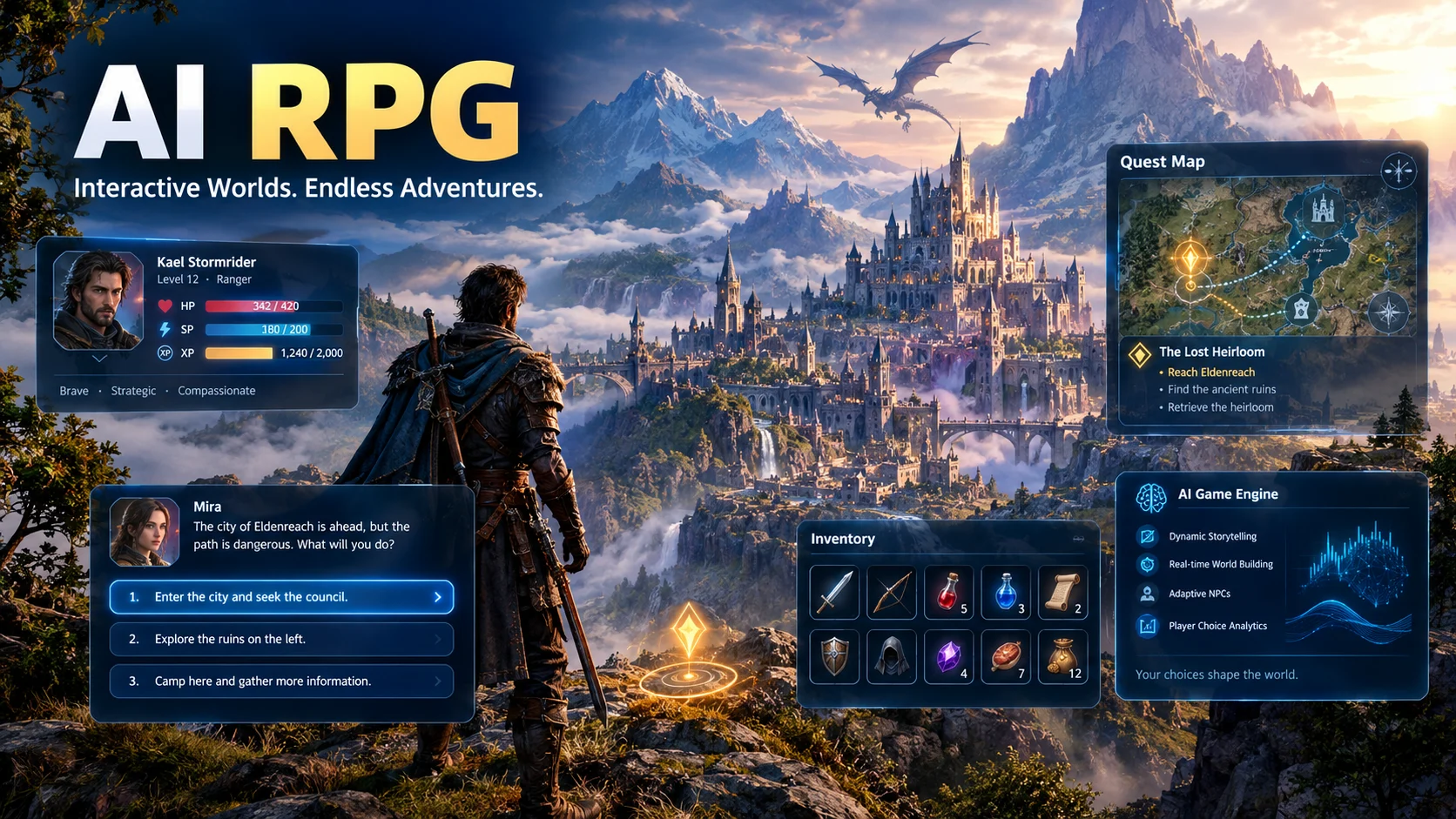
An AI RPG is an artificial intelligence-powered role-playing game that generates interactive stories, characters, quests, or game-world responses based on a player’s choices. Depending on the platform, it may offer freeform storytelling, character roleplay, or structured gameplay with health points, inventory, quests, and progression.
AI RPG at a Glance
Interactive storytelling
Explore stories that adapt to your actions instead of following only fixed dialogue paths.
AI-controlled characters
Meet virtual companions, allies, enemies, merchants, and other non-player characters.
Different gameplay styles
Choose between text adventures, AI game masters, character roleplay, and more structured RPG systems.
AI-generated responses
Language models generate dialogue and narrative, although consistency varies between tools.
Free and paid options
Some games offer free access, while others limit turns, memory, or advanced models.
Important limitations
AI can forget events, invent details, misapply rules, and produce inconsistent outcomes.
What Is an AI RPG?
An AI RPG, short for artificial intelligence role-playing game, combines role-playing with AI-generated content. Players create characters, explore settings, interact with fictional people, and influence the direction of an adventure.
Traditional role-playing games generally rely on developer-written dialogue, planned encounters, and programmed responses. AI RPGs can generate new dialogue and narrative developments in response to actions that developers did not explicitly script.
For example, imagine playing a fantasy adventure as a traveling merchant. Instead of choosing only between fighting a dragon and escaping, you might offer it a business partnership, investigate its treasure, or negotiate safe passage.
An AI narrator can respond to these unexpected ideas. However, whether the game tracks money, consequences, character abilities, and quest progress depends on its underlying systems.
Is an AI RPG the same as an AI chatbot?
No. An AI chatbot primarily responds to messages, while an AI RPG adds a role-playing framework around the interaction.
A simple chatbot can pretend to be a wizard. A more developed AI RPG might also track your character’s health, remember a previous encounter, manage an inventory, and determine whether a spell succeeds.
The distinction matters because convincing storytelling does not automatically create consistent gameplay. A platform’s actual mechanics matter as much as its AI-generated writing.
How Does an AI RPG Work?
Most AI RPGs combine a language model with instructions, player inputs, and some method of maintaining the fictional world.
1. Player action
The player chooses an action or writes a response.
2. AI interpretation
The model interprets the action using the story and available context.
3. Game logic and world state
Where implemented, rules, dice rolls, quests, and character data determine valid outcomes.
4. Narrative response
The game describes the outcome and presents the next opportunity to act.
1. Large language models generate the story
Many AI RPGs use large language models (LLMs) to interpret player input and generate dialogue, descriptions, and narrative developments.
The model predicts text based on its training, instructions, and the information provided during the current interaction. It does not inherently know every event that has occurred in your game.
This is why a character may occasionally forget a promise or contradict an earlier scene.
2. Context and memory help preserve continuity
An AI system needs relevant information to maintain a coherent adventure. That information may include character descriptions, important relationships, previous events, active quests, and world rules.
Some platforms use summaries, memory systems, or structured character records to keep important details available. AI Dungeon, for example, documents features such as Memory and Story Cards to help maintain consistency
However, memory is not necessarily unlimited. The model’s context window determines how much information it can process at once. Older details may be summarized, omitted, or retrieved imperfectly.
3. Game mechanics determine what happens
The most important technical distinction is whether a platform uses a separate rules system.
A language model might narrate a successful sword attack simply because that makes the story flow naturally. A rules-based RPG can instead calculate hit chances, damage, and enemy health before generating the description.
A stronger design separates two responsibilities:
- Narrative generation: Describes the world, characters, dialogue, and consequences.
- Game-state management: Tracks health, inventory, quests, character attributes, and valid actions.
Not every AI RPG implements both. Check for actual mechanics instead of assuming that a platform supports them because its marketing mentions an AI game master.
Key Features to Look for in an AI RPG
The best features depend on whether you prefer open-ended storytelling or a game with clear rules and progression.
| Feature | Why it matters | What to check |
|---|---|---|
| Character creation | Establishes your role and abilities | Custom attributes, backstory, appearance |
| Adaptive storytelling | Responds to creative choices | Can you attempt actions outside preset options? |
| Persistent memory | Supports long campaigns | Does it remember important events across sessions? |
| Quests and progression | Creates meaningful goals | Are objectives, rewards, and levels tracked? |
| Inventory and combat | Adds gameplay structure | Are items and battle outcomes consistently managed? |
| World customization | Enables original settings | Can you define lore, factions, and locations? |
| Save and export options | Protects long-term play | Can you resume, edit, or export adventures? |
| Content controls | Helps tailor the experience | Are there useful filters and age-appropriate settings? |
Dynamic characters and believable dialogue
Non-player characters, commonly called NPCs, can respond to the player’s words rather than selecting only from fixed dialogue options.
A shopkeeper might react differently to a polite request, a threat, or a clever bargain. More advanced implementations may track relationships, motivations, or previous encounters.
Still, realistic dialogue is not proof of genuine long-term memory. Test whether characters remember information several scenes later.
Custom worlds and character building
Many AI role-playing experiences let players choose fantasy, science fiction, horror, mystery, or other settings. Some support custom scenarios, detailed backstories, and user-created worlds.
These options suit players who enjoy world-building as much as gameplay. Before investing time in a large setting, check whether you can save and edit its core information.
Combat, inventory, and progression
Structured mechanics can make an adventure feel more like a traditional RPG. Health points, experience, equipment, skill checks, and quests give players measurable goals.
Look for a visible character sheet or another reliable record of these values. If the AI can freely change your statistics through ordinary conversation, the game may feel less fair over time.
Popular AI RPG Platforms and Alternatives
There is no single platform that suits every type of player. Some emphasize open-ended storytelling, others offer a more structured AI game-master experience, and character-chat services focus primarily on conversational roleplay.
The following comparison uses official product information where available. It is a feature-based overview, not a hands-on performance ranking.
Platform comparison
| Platform | Target user | Main strength | Pricing transparency | Main limitation |
|---|---|---|---|---|
| AI Dungeon | Solo storytellers and creative players | Open-ended adventures, custom scenarios, and player-directed stories | Free tier and paid memberships are documented | Freeform storytelling may not provide the structured mechanics every RPG player wants. |
| AnyVerse | Players seeking persistent, genre-based adventures | AI game master, character creation, worlds, and story progression | Free tier; Basic at $9/month and Pro at $19/month on its published pricing page | Published turn limits apply, and its capabilities should be tested against your preferred play style. |
| Perchance AI RPG | Players looking for browser-based text adventures | Multiple community-created RPG and text-adventure generators | Individual generators may advertise free access; check each experience | Features, continuity, quality, and available controls can differ between generators. |
| Character.AI | Character-focused roleplayers | Interactive fictional characters and conversational storytelling | Check the current official offering for plan details | Character conversation is not equivalent to a complete RPG rules engine. |
These platforms are not interchangeable. AI Dungeon focuses on open-ended text adventures, AnyVerse presents a more game-like AI game-master experience, Perchance offers individual community-created generators, and Character.AI centers on character interaction.
Which should you try first?
- Choose AI Dungeon if you want to create unusual scenarios and control a story through freeform text.
- Explore AnyVerse if you want an AI game master, persistent adventures, and visible character progression.
- Try a Perchance RPG generator if you want to experiment with a lightweight browser-based text adventure.
- Consider Character.AI if your priority is roleplaying with fictional personalities rather than managing combat and inventory.
These are starting points, not a universal ranking. Features, access limits, and product terms can change, so verify the current offering before paying.
How Much Does an AI RPG Cost?
AI RPG pricing ranges from free browser-based experiences to subscription services with higher usage allowances and additional features.
Some platforms charge a monthly fee. Others restrict the number of story turns, access to advanced models, or the amount of context available for long adventures.
For example, AnyVerse’s published pricing lists a free plan with 30 story turns per month, a Basic plan at $9 per month with 300 turns, and a Pro plan at $19 per month with 3,000 turns. Its site states that unused turns reset monthly.
AI Dungeon also offers free access and paid membership tiers. Its published membership information lists Journey at $14.99 per month, Legend at $29.99, Mythic at $49.99, and Ultimate at $99.99, alongside differences in memory capacity, credits, and context length. Check its live pricing page before subscribing.
Hidden costs and limits worth checking
Before choosing a paid AI role-playing game, examine more than the headline subscription price.
- Usage limits: Determine how many player actions you receive daily or monthly.
- Context limits: Find out how much of your previous story the AI can consider.
- Credit systems: Check whether images, premium models, or extended context consume separate credits.
- Unused allowances: Confirm whether turns or credits expire or roll over.
- Model access: Check which models your plan includes and whether you can switch between them.
- Cancellation terms: Review renewal dates, trial conditions, and refund policies.
A cheap subscription may be sufficient for short adventures. Long campaigns with detailed lore and frequent sessions may require a larger allowance.
Benefits of AI Role-Playing Games
AI RPGs offer several advantages, especially for players who enjoy improvisation and personalized stories.
Greater creative freedom
Players can experiment with unusual ideas without waiting for a developer to create a specific dialogue branch. You might investigate a haunted spaceship, negotiate with a dragon, or turn a fantasy adventure into a detective story.
This flexibility is useful when you prefer exploration over following a predetermined plot.
Personalized storytelling
Your choices can influence the next scene, the characters you encounter, and the challenges you face. Some platforms also let you customize the setting, tone, protagonist, and starting scenario.
The result can feel more personal than a fixed narrative, although the quality depends on the model and the game’s design.
Solo play without scheduling a group
An AI game master can provide a role-playing experience when friends are unavailable or nobody wants to manage a campaign.
It can also help beginners practice describing actions, creating characters, and learning role-playing conventions.
Faster world-building
Writers, game designers, and tabletop enthusiasts can use AI to brainstorm NPCs, quests, locations, dialogue, and alternate plot developments.
These outputs work best as starting material. Human review remains important for originality, balance, tone, and continuity.
Limitations of AI RPGs
AI-generated adventures can be entertaining, but they have weaknesses that affect long sessions.
Characters may forget important events
A game might forget an alliance, change a character’s personality, or contradict an established fact. Memory tools can help, but they do not guarantee perfect recall.
For long campaigns, maintain a short summary of essential events, characters, relationships, and unresolved quests.
Game rules may become inconsistent
A narrative model can produce an exciting outcome that violates the game’s established rules. It might change an item’s properties, overlook a character’s injury, or allow an impossible action.
Look for a platform with structured rules and visible character records if fairness and progression matter to you.
Generated content can feel repetitive
AI may reuse familiar fantasy plots, predictable dialogue, or similar descriptions. The story can also become less coherent when prompts contain conflicting instructions.
Specific settings, clear character motivations, and meaningful constraints often improve results.
Content and privacy require attention
AI RPGs can generate unexpected material. Parents and players should check content filters, age requirements, moderation policies, and reporting options.
Privacy deserves equal attention. Some services process prompts on remote servers and store account or adventure data. Read the relevant privacy policy before entering real names, private conversations, personal details, or confidential creative work.
Do not assume that a platform is private simply because it offers a paid plan. Look for explicit information about retention, deletion, training use, and third-party processing.
How to Get Better Results From an AI RPG
The quality of an AI adventure depends partly on how clearly you establish its rules and expectations.
1. Write a specific character profile
Define your character’s role, motivations, abilities, weaknesses, and personality. Give the AI enough detail to guide the story without overwhelming it with unnecessary backstory.
For example:
I am a cautious elven ranger who protects remote villages. I avoid unnecessary violence, distrust royal officials, and carry a map of abandoned forest roads. Keep my skills and possessions consistent throughout the adventure.
2. Establish the world’s rules
Explain how combat, magic, technology, money, and character progression work. If you want a difficult game, tell the AI that failure is possible and actions should have consequences.
For example, ask it to use explicit skill checks for risky actions and keep a record of health and inventory.
Remember that instructions alone cannot guarantee reliable rule enforcement. Prefer built-in mechanics when available.
3. Give the story a clear direction
Open-ended freedom works best when the adventure has a goal. You might need to recover a stolen artifact, uncover a political conspiracy, or survive a journey across an unfamiliar planet.
A clear objective helps the AI produce relevant events without removing your freedom to choose how to proceed.
4. Keep a campaign summary
After a long session, record the essential details:
- Current location and main objective
- Important characters and relationships
- Inventory, abilities, and health
- Decisions that changed the world
- Unresolved mysteries and active quests
Use the platform’s memory or summary features when available. Keep your own copy if exporting or preserving the campaign matters.
5. Correct contradictions early
If the AI changes a character’s name or forgets a critical item, correct it before continuing. Many narrative tools allow users to retry, edit, or redirect an output.
Small corrections early in a session can prevent larger continuity problems later.
Who Should Use an AI RPG?
AI role-playing games suit different audiences for different reasons.
| Audience | Potential benefit | Best feature to prioritize |
|---|---|---|
| Casual players | Quick, personalized adventures | Simple setup and free access |
| Fantasy and sci-fi fans | Exploring original fictional worlds | World customization |
| Solo tabletop players | An alternative to a human game master | Rules, quests, and persistent state |
| Writers | Testing dialogue and story ideas | Editable scenarios and exports |
| Game developers | Prototyping NPC interactions | APIs, integration options, and controllable game logic |
| Roleplay enthusiasts | Developing character relationships | Character consistency and memory |
An AI RPG may not suit players who prefer carefully balanced combat, polished graphics, competitive multiplayer, or a fully authored narrative. Traditional RPGs can provide more predictable pacing and stronger designer control.
AI RPG vs. Traditional RPG: What Is the Difference?
The main difference is how each game produces content and responds to the player.
| Aspect | AI RPG | Traditional RPG |
|---|---|---|
| Dialogue | Can be generated dynamically | Usually written or selected from scripted options |
| Story paths | May adapt to unexpected actions | Usually follow designed branches and systems |
| World consistency | Depends on memory and game logic | Typically controlled by programmed rules and authored content |
| Replayability | Can offer many narrative variations | Depends on the game’s design and available choices |
| Gameplay balance | Varies with implementation | Usually designed and tested by developers |
| Visual presentation | Depends on the platform | Often includes purpose-built art, animation, and sound |
| Predictability | May produce surprising or inconsistent results | Usually offers more controlled outcomes |
Neither approach is automatically superior. Traditional RPGs can offer polished systems and carefully constructed stories. AI RPGs can offer flexible interactions and improvisation.
Some developers combine both approaches, using AI for dialogue or NPC behavior while preserving conventional game mechanics.
What Is the Future of AI RPGs?
AI role-playing games are part of a broader shift toward interactive content generated from natural-language instructions.
Developers are exploring more responsive NPCs, AI-assisted game creation, procedural storytelling, and systems that connect generated dialogue to persistent game states. These approaches could make virtual worlds more reactive without requiring developers to write every possible conversation manually.
The important challenge is coordination. An engaging character needs more than fluent dialogue. It needs believable motivations, consistent memories, appropriate reactions, and a world that respects the consequences of player decisions.
Future improvements may come from better language models, stronger memory systems, structured game engines, and tools that let developers constrain what AI characters can do. These are promising directions, not guarantees that every new AI RPG will deliver a better experience.
For players, the practical question remains simple: does the game remember enough, follow its rules, and give you meaningful choices?
Frequently Asked Questions About AI RPGs
1. What is the best AI RPG to play?
The right AI RPG depends on your priorities. AI Dungeon is worth exploring for open-ended text adventures, while AnyVerse offers an AI game-master format with visible character progression. Compare memory, game mechanics, usage limits, and pricing before choosing.
2. Are there free AI RPG games?
Yes. AI Dungeon offers a free tier, and some Perchance RPG generators advertise free browser-based adventures. Free access can still involve limits on features, model quality, or usage, so check the current terms of the specific platform.
3. Can AI RPGs remember previous sessions?
Some platforms save adventures and use memory features, summaries, or structured character information to maintain continuity. However, memory is not always perfect or unlimited. Check how the platform preserves important events and whether you can edit or export campaign data.
4. Can an AI RPG replace a human Dungeon Master?
An AI game master can narrate scenes, play fictional characters, and support solo adventures. However, it may struggle with complex rules, balanced encounters, group dynamics, and nuanced judgment. It can complement tabletop play, but it may not replace everything an experienced human game master provides.
5. Is an AI RPG different from an AI roleplay chatbot?
Yes. An AI roleplay chatbot primarily focuses on conversational interaction with a character. An AI RPG may add quests, combat, inventory, character progression, and persistent world state. Some products combine both, so check their actual features rather than relying on labels.
Conclusion
An AI RPG combines role-playing with AI-generated storytelling, giving players more freedom to explore fictional worlds and influence their adventures. The experience can range from a simple text generator to a structured game with quests, inventory, and character progression.
The most important factors are consistent memory, meaningful mechanics, transparent pricing, and control over your story. Beginners can start with a free option, while tabletop fans may prefer a platform with clear rules and persistent character data.
Before committing to a long campaign, test a short adventure and see how well the AI handles your choices, remembers key events, and maintains the world’s rules.

Oliver Wilson is an AI researcher and tech writer living at the intersection of human creativity and machine intelligence. At AixOrbit.com, he decodes complex neural networks, generative AI and emerging tech trends into actionable insights making sure humans stay one step ahead of the algorithms.