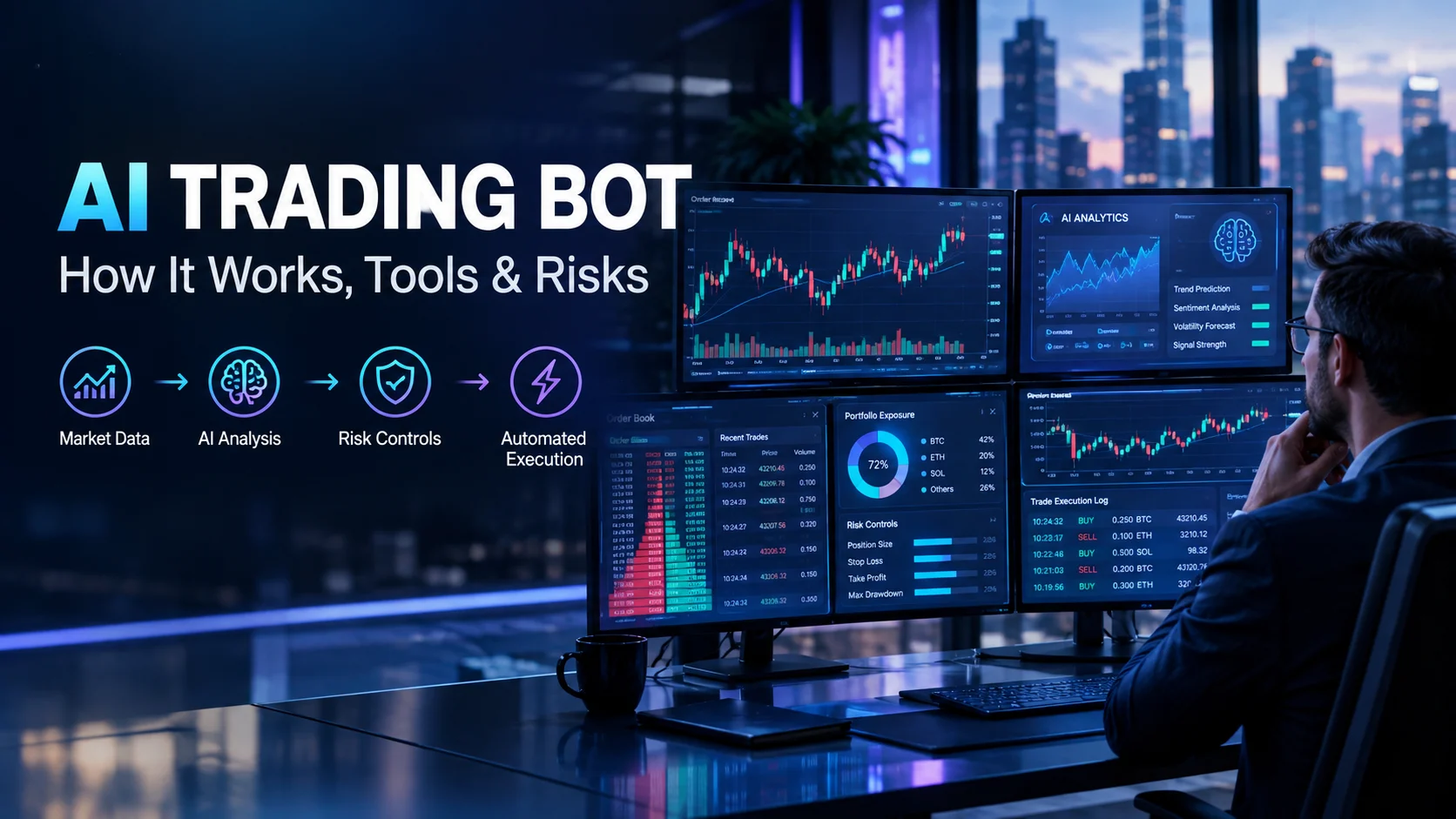
An AI trading bot is software that uses artificial intelligence, machine learning, or automated trading rules to analyze market data and help execute trades. It can improve consistency and speed, but it cannot guarantee profits or eliminate the risk of losing money.
At a Glance
- What it does: Analyzes market information, generates trading signals, and may automatically place orders.
- How it works: Uses algorithms, technical indicators, statistical models, or machine learning to follow a trading strategy.
- Where it’s used: Cryptocurrency markets, stocks, forex, and other financial instruments, depending on the platform.
- Main advantage: Automates repetitive tasks and monitors markets without constant manual intervention.
- Biggest risk: A bot can lose money because of market volatility, flawed strategies, execution costs, or technical failures.
- Before you start: Check fees, exchange compatibility, API permissions, historical testing, security controls, and withdrawal access.
What Is an AI Trading Bot?
An AI trading bot is a software system that uses market data and predefined instructions to help make trading decisions. Depending on its design, it may identify patterns, estimate market probabilities, generate buy or sell signals, manage positions, or execute orders through a connected brokerage or exchange.
The term covers several different technologies. Some products use machine learning to analyze historical prices, while others automate simple rules and market indicators. A product marketed as an AI trading bot may not use advanced AI at all.
The distinction matters because automation and artificial intelligence are not the same thing. A bot that buys an asset when its price crosses a moving average can operate without machine learning. An AI-driven system might use statistical models to evaluate several signals before suggesting an action.
AI trading bot vs. traditional trading bot
| Feature | Traditional trading bot | AI trading bot |
|---|---|---|
| Decision process | Fixed rules and conditions | Rules, learned patterns, or predictive models |
| Adaptability | Usually needs manual strategy changes | May update predictions when appropriately retrained |
| Data analysis | Indicators and predefined inputs | May analyze more varied or complex datasets |
| Transparency | Often easier to explain | Some models are difficult to interpret |
| Main limitation | Can struggle when market conditions change | Can learn misleading patterns or make incorrect predictions |
Neither approach is automatically more profitable. Results depend on the strategy, data quality, execution, costs, and risk controls.
How Does an AI Trading Bot Work?
Most AI trading systems follow a sequence that transforms market data into a trading decision. The exact process depends on the product and the strategy it supports.
1. Collect market data
Prices, trading volume, order-book information, historical candles, and sometimes news or sentiment.
2. Analyze signals
Rules or statistical and machine-learning models evaluate market conditions.
3. Generate a decision
The strategy determines whether to enter, exit, hold, or ignore a potential trade.
4. Apply risk controls
Position limits, stop conditions, exposure caps, and available-balance checks restrict trades.
5. Execute and monitor
The bot may send orders through an API, track fills, record results, and respond to errors.
The role of machine learning
Machine learning allows a system to find statistical relationships in data rather than relying entirely on manually specified conditions. A model might estimate the likelihood of a short-term price movement using historical returns, volatility, and trading volume.
However, a prediction is not a guarantee. Financial markets change, historical relationships can disappear, and unexpected events can overwhelm a model.
Some systems also use natural language processing to classify financial news or analyze text. This can help organize information, but interpreting a headline correctly does not necessarily translate into a profitable trade.
Large language models can assist with research, coding, or summarizing market information. They should not automatically be treated as reliable price-prediction engines or unrestricted order-execution systems.
Backtesting and paper trading
Before using real money, traders should test a strategy in two ways.
- Backtesting: Runs a strategy against historical data to estimate how it might have performed.
- Paper trading: Simulates trades in a live or near-live environment without risking actual trading capital.
A backtest can be misleading if it ignores fees, slippage, liquidity, or information that would not have been available at the time. Testing many strategies and selecting only the best historical result can also produce overfitting, where the model performs well on old data but poorly on new data.
Paper trading helps reveal operational issues, but simulated fills may not match real execution. Neither method proves that a strategy will be profitable in the future.
Common Types of AI Trading Bots
Different bots serve different markets and trading styles. Understanding the strategy is more useful than relying on the word “AI” in a product description.
1. Crypto AI trading bots
Cryptocurrency trading bots connect to supported exchanges and automate strategies for assets such as Bitcoin and Ethereum. Depending on the product, they may support spot trading, grid strategies, dollar-cost averaging, or derivatives.
Crypto markets operate around the clock and can experience sharp price movements. A bot that works during a calm period may perform poorly during a sudden crash or liquidity disruption.
2. Stock trading bots
Stock trading bots can analyze equity prices, market indicators, and portfolio data. Some systems integrate with broker APIs, while others generate signals without placing orders.
Access to market data, order types, short selling, and automated execution depends on the brokerage, account permissions, jurisdiction, and product.
3. Forex trading bots
Forex bots automate currency-trading strategies, including indicator-based systems and rule-driven entries. Some use statistical models to estimate price movements or volatility.
Leverage can magnify both gains and losses. Traders should also consider spreads, overnight financing, execution quality, and broker-specific restrictions.
4. Arbitrage and market-making bots
Arbitrage bots seek price differences between markets or related instruments. Market-making bots attempt to earn the spread between buy and sell prices by providing liquidity.
These strategies can be sensitive to fees, execution speed, available liquidity, and competition. A displayed price difference does not necessarily represent an opportunity that can be captured profitably.
5. AI signal generators
Not every trading bot executes orders. Some tools analyze data and suggest entry points, exit points, or potential market trends.
These products leave the execution decision with the trader, but users still need to verify the signal methodology, historical testing, and limitations.
Popular AI Trading Bot Platforms to Compare
There is no universal AI trading bot for every market or investor. The following platforms illustrate different approaches to trading automation, particularly in cryptocurrency markets.
The descriptions below summarize product positioning and publicly displayed pricing checked on October 20, 2026. Prices and feature availability can change, so review each provider’s current terms before subscribing.
3Commas offers tools for spot and futures automation, including dollar-cost averaging and signal-driven strategies. Its published pricing page lists a Starter plan at $20 monthly or $15 per month on annual billing, with higher tiers for expanded capabilities.
Cryptohopper lists features such as backtesting, paper trading, strategy design, and AI-related tools on higher-tier plans. Its published monthly prices include Explorer at $29, Adventurer at $69, and Hero at $129; annual billing offers lower monthly equivalents.
Pionex is known for integrating trading bots into its cryptocurrency exchange experience. Check its current bot options, trading fees, supported regions, and asset availability before using it. Do not assume that built-in automation means every bot uses machine learning.
These are comparison candidates, not endorsements or independently verified rankings. Availability varies by location, and a feature list does not establish that a strategy is profitable.
Platform comparison at a glance
| Platform | Primary focus | Pricing transparency | Important consideration |
|---|---|---|---|
| 3Commas | External exchange automation | Published subscription tiers | Check supported exchanges, bot limits, and API permissions |
| Cryptohopper | Strategy design and crypto automation | Published subscription tiers | Check which AI and strategy features require paid plans |
| Pionex | Exchange-integrated trading bots | Review current trading-fee schedule | Consider exchange custody, regional availability, and asset risk |
For stock or forex trading, begin with your brokerage’s supported automation tools and API documentation. A crypto-focused service may not support the instruments or protections you need.
Benefits of Using an AI Trading Bot
An AI trading bot can make a trading process more consistent, but its practical value depends on the quality of the strategy and its implementation.
Faster analysis and automated execution
Bots can monitor multiple assets and process market updates more consistently than a person manually checking charts. When connected to a supported trading venue, they can also submit orders according to configured rules.
Faster execution does not automatically mean better execution. Network delays, liquidity shortages, and changing prices can affect the final order.
Reduced emotional decision-making
A properly configured bot follows its programmed strategy rather than reacting emotionally to a sudden price movement. This can help traders avoid impulsive decisions caused by fear or excitement.
However, automation cannot eliminate poor judgment. A trader can still select an unsuitable strategy, set excessive position sizes, or leave a bot running when market conditions change.
Continuous market monitoring
Some bots monitor markets 24 hours a day. This is especially useful in cryptocurrency markets, where prices can change significantly outside conventional business hours.
Continuous operation also requires monitoring for exchange outages, rejected orders, software errors, and unexpected positions.
Strategy testing and portfolio monitoring
Trading platforms may provide backtesting, performance reports, allocation controls, and automated alerts. These features can help users assess a strategy and identify operational problems.
The important distinction is between measuring performance and predicting future returns. A strong historical report is evidence about a particular test, not proof of future profitability.
Risks and Limitations You Should Understand
An AI trading bot introduces technology and operational risks alongside the ordinary risks of investing.
| Risk | Why it matters | How to manage it |
|---|---|---|
| Market volatility | Prices can move against a strategy rapidly | Set position limits and define exit conditions |
| Overfitting | A model may fit historical data but fail on new data | Test on unseen data and different market conditions |
| Trading costs | Fees, spreads, funding, and slippage reduce returns | Calculate net performance after all costs |
| Technical failures | API errors or outages can interrupt execution | Monitor logs, alerts, and failed orders |
| Security exposure | Compromised API credentials may enable unauthorized activity | Use restricted permissions and secure credential storage |
| Platform dependency | A service may change prices, features, or availability | Check portability, export options, and cancellation terms |
| Fraud | Fake bots may display invented profits | Verify the company, broker, and custody arrangements |
The hidden cost of frequent trading
Suppose a strategy generates many small gains but pays substantial trading fees and spreads on every transaction. Those costs can consume much of its apparent performance.
Consider a hypothetical strategy that earns $100 before costs. If trading fees and execution costs total $35, the remaining gain is $65 before taxes and subscription expenses. If a subscription costs $30 over the same measurement period, the gain falls to $35.
This example is illustrative, not a forecast. Actual costs depend on trade size, venue, order type, trading frequency, and market conditions.
Can an AI trading bot lose all your money?
Yes, substantial losses are possible, especially when a strategy uses leverage, concentrates positions, or operates without effective risk limits. Depending on the asset and trading arrangement, losses can approach or exceed the amount initially allocated.
Stop-loss orders are not guaranteed to execute at the specified price. Gaps, thin liquidity, exchange failures, and rapid market moves can produce worse outcomes.
Never assume that a bot will automatically protect your capital simply because its marketing emphasizes risk management.
Is an AI Trading Bot Safe and Legitimate?
The answer depends on the specific provider, trading venue, permissions, and strategy. Legitimate automation software exists, but scammers also use AI-related claims to make fraudulent investment offers appear credible.
The US Commodity Futures Trading Commission warns investors about bots marketed with unrealistic or guaranteed returns. The agency specifically notes that AI cannot predict the future or sudden market changes.
The risk is not merely theoretical. On September 29, 2026, the US Securities and Exchange Commission announced charges involving alleged investment schemes that used supposed AI trading signals and bots to attract investors. The complaints alleged that the platforms displayed fictitious profits and misappropriated funds. These are allegations in enforcement proceedings, not a blanket finding against legitimate trading automation.
Warning signs of an AI trading scam
Be cautious when a provider:
- Promises guaranteed daily, weekly, or monthly profits.
- Claims its AI never loses or has a 100% win rate.
- Refuses to explain how funds are held or how withdrawals work.
- Requires you to transfer cryptocurrency to a personal wallet.
- Pressures you to deposit more money to unlock supposed profits.
- Uses fabricated endorsements, fake regulatory certificates, or impersonated professionals.
- Shows account balances without verifiable transaction records.
- Requires additional advance payments before releasing your withdrawal.
A professional website and a convincing AI-generated video do not establish legitimacy.
What Pakistani investors should check
For readers in Pakistan, the Securities and Exchange Commission of Pakistan (SECP) has warned about unauthorized online trading platforms and exaggerated investment-return claims. It has also highlighted fraudulent applications that misuse licensed brokers’ names and promote supposed AI-based trading systems.
Before depositing money, verify the relevant broker or intermediary through official regulatory resources. Confirm that the specific service and financial product are permitted in your jurisdiction. A foreign company’s registration or a technology provider’s reputation does not automatically authorize every investment activity locally.
How to Choose an AI Trading Bot
The right choice starts with your market and strategy, not the most impressive promotional claims.
Use this checklist before connecting an account or paying for a subscription.
Pre-purchase safety checklist
0 of 8The provider identifies its legal entity and publishes clear terms.The platform supports my intended assets, exchange, and jurisdiction.The strategy can be tested without risking real money.Performance reports account for fees, slippage, and realistic execution.API permissions can be restricted, including disabling withdrawals.Position limits, emergency stops, and monitoring alerts are available.Subscription fees, trading fees, and cancellation terms are clear.I understand where funds are held and how withdrawals work.
Reset checklist
No checklist guarantees safety. It helps identify unanswered questions before you put funds at risk.
Check API permissions and data security
An application programming interface (API) lets a trading bot communicate with an exchange or brokerage account. The access granted to that connection determines what the bot can do.
When supported, use a separate API key with only the permissions required for the strategy. Disable withdrawals and unnecessary account access. Never share account passwords, authentication codes, or unrestricted credentials with a provider.
Other useful safeguards include:
- Multi-factor authentication on the exchange account.
- IP restrictions when supported and practical.
- Secure storage and regular rotation of API credentials.
- Alerts for unexpected trades, withdrawals, and account changes.
- A documented process for stopping automation and revoking access.
A vendor’s security claims should be checked against its actual documentation. A compliance report or security certification does not, by itself, establish that all customer data is never retained or that every integration is risk-free.
How Much Does an AI Trading Bot Cost?
Pricing varies widely. Some exchange-integrated bots are available without a separate software subscription, while third-party platforms charge recurring fees for more advanced controls, integrations, or strategy features.
As examples, the published pricing pages reviewed for this article list:
| Platform | Example advertised price | What to verify |
|---|---|---|
| 3Commas | Starter: $20 monthly, or $15 per month with annual billing | Active bot limits, supported exchanges, and plan restrictions |
| Cryptohopper | Explorer: $29 monthly; higher plans cost more | AI feature access, strategy limits, and annual billing |
| Pionex | Check current official fee schedule | Trading fees, regional availability, and bot-specific costs |
Sources: 3Commas pricing and Cryptohopper pricing.
These are software or trading-platform costs, not the money required to fund trades. Exchange fees, spreads, funding charges, taxes, data subscriptions, and infrastructure expenses may add to the total.
Before choosing a paid plan, calculate whether the features you actually need justify the recurring cost. A more expensive plan does not guarantee stronger trading performance.
A Practical Example: Testing an AI Trading Bot
Imagine a trader wants to test a bot that evaluates Bitcoin price trends and enters positions when several predefined conditions align.
Rather than immediately funding a live account, the trader could follow a controlled process.
- Define the strategy. Specify entry conditions, exit conditions, position sizes, and maximum acceptable exposure.
- Test historical data. Include realistic fees, spreads, and execution assumptions.
- Evaluate unseen data. Check whether the strategy still performs outside the period used to develop it.
- Paper trade. Observe its decisions under current market conditions without committing actual trading capital.
- Review failures. Investigate rejected orders, unexpected trades, drawdowns, and differences between simulated and live prices.
- Consider limited live testing. If the system meets the trader’s requirements, test with an amount they can afford to lose and retain manual oversight.
For example, a bot might appear profitable during a steady upward trend but repeatedly lose money in a sideways market. That result does not necessarily mean the software is broken. It may mean the strategy is unsuitable for those conditions.
This is why robust testing, clear limits, and ongoing review matter more than a single impressive return figure.
Who Should Use an AI Trading Bot?
AI trading bots may suit several groups, provided they understand the underlying risks.
- Experienced traders: Can automate established strategies and monitor execution.
- Quantitative researchers: Can test models and evaluate their performance systematically.
- Developers: Can build custom trading systems using supported APIs and market data.
- Beginners: May use paper trading to learn how automation works, without assuming that AI removes the need for financial knowledge.
A bot is less suitable for someone who expects guaranteed passive income, cannot afford potential losses, or does not understand the products being traded.
Investors with long-term goals should also compare automated trading with simpler approaches, including diversified investing and periodic portfolio rebalancing. More frequent activity does not necessarily improve investment outcomes.
AI Trading Bot Alternatives
An autonomous trading bot is only one way to use technology in financial markets.
| Alternative | How it works | Best use |
|---|---|---|
| Rule-based automation | Executes predefined conditions | Traders who value transparent, repeatable rules |
| AI signal tools | Analyze data and suggest potential trades | People who want to retain manual control |
| Broker-native automation | Uses tools offered by a brokerage | Users prioritizing supported integrations |
| Portfolio rebalancing tools | Restore target asset allocations | Long-term investors managing portfolio weights |
| Manual trading with AI research | Uses AI to summarize information or help write code | Users who want research assistance without automatic execution |
These approaches differ in complexity, control, and operational risk. A simple rule-based system can be easier to audit than a complicated machine-learning model, while a signal tool may reduce the risks associated with unattended execution.
Frequently Asked Questions
1. Can an AI trading bot make money?
An AI trading bot can generate profits under some market conditions, but losses are also possible. Results depend on strategy quality, market conditions, fees, execution, and risk management. Historical or simulated profits do not guarantee future returns.
2. Are free AI trading bots worth using?
Free bots can be useful for learning and testing, but review their trading fees, exchange compatibility, permissions, and limitations. Free access does not establish that a provider is trustworthy or that its strategy is profitable.
3. What is the best AI trading bot for beginners?
There is no universally best bot for beginners. Look for transparent pricing, paper trading, clear documentation, supported assets, restricted API permissions, and understandable risk controls. Start with simulation rather than immediately committing real money.
4. Can I use an AI trading bot for cryptocurrency?
Yes. Some platforms support automated cryptocurrency trading through exchange integrations or built-in bots. Check supported assets, spot or derivatives access, regional availability, fees, and API permissions before using a service.
5. Is an AI trading bot legal?
Legality depends on the jurisdiction, assets traded, service provided, and applicable financial regulations. Using automation does not exempt a trader or provider from relevant laws. Verify the provider and trading venue with the appropriate regulator before investing.
Conclusion
An AI trading bot can help analyze markets, automate strategies, and execute trades consistently. However, its real value depends on the quality of its underlying strategy, realistic testing, transparent costs, secure account access, and effective risk controls.
Before choosing a platform, verify its legitimacy, understand its limitations, and test its behavior without risking real money. Treat claims of guaranteed profits as a warning, not a selling point. AI can support a trading process, but it cannot remove market uncertainty.

Oliver Wilson is an AI researcher and tech writer living at the intersection of human creativity and machine intelligence. At AixOrbit.com, he decodes complex neural networks, generative AI and emerging tech trends into actionable insights making sure humans stay one step ahead of the algorithms.