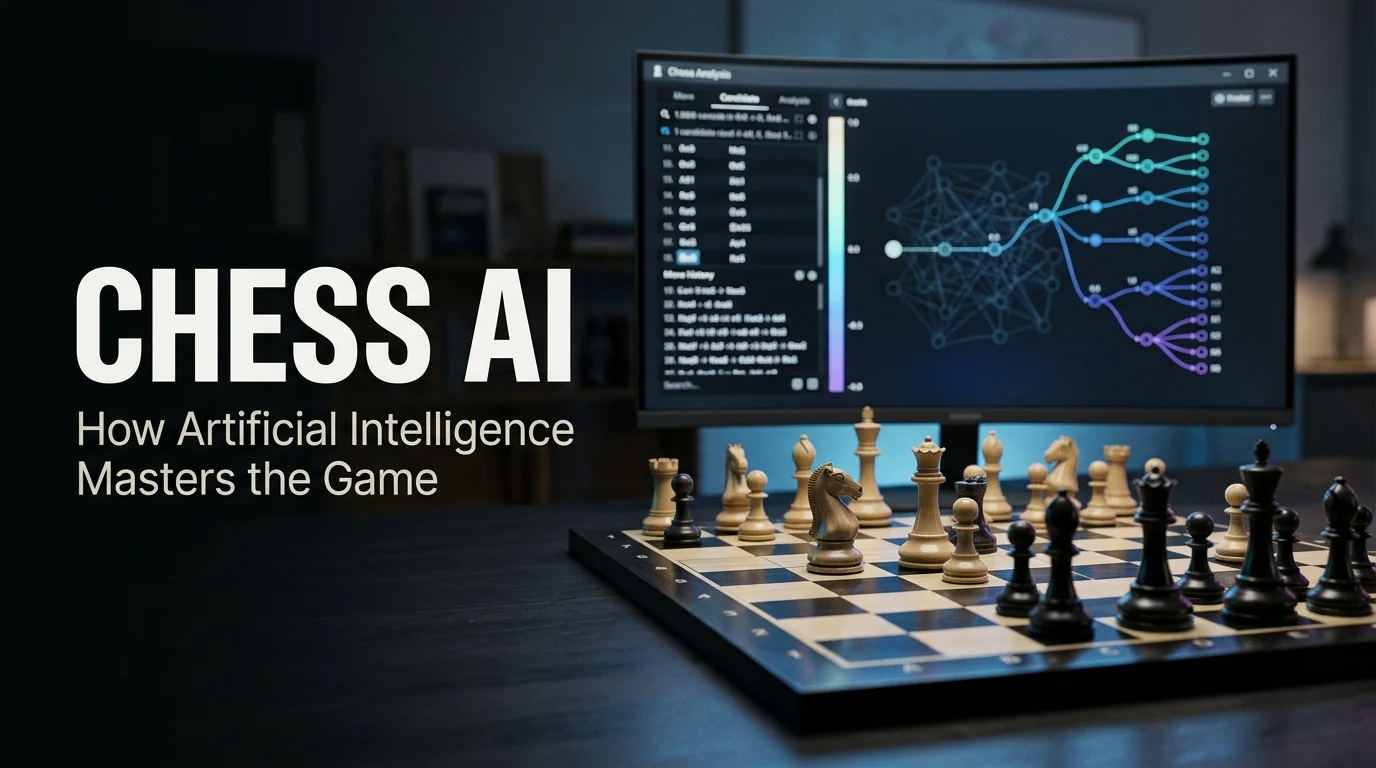
Chess AI uses artificial intelligence and advanced search algorithms to evaluate chess positions, calculate possible moves, and select strong strategies. Tools such as Stockfish, Lichess analysis, and Chess.com help players practice, analyze games, solve puzzles, and understand mistakes.
At a Glance
- What it is: Chess AI is software that plays chess, evaluates positions, or helps people improve.
- How it works: Most modern chess engines combine extensive move searches with sophisticated position evaluation.
- Popular tools: Stockfish, Lichess, Chess.com, and Leela Chess Zero serve different chess needs.
- Best uses: Game analysis, tactical training, opening preparation, endgame study, and playing against computer opponents.
- Cost: Stockfish is free and open source. Other platforms offer different free and paid features.
- Main limitation: Engine recommendations can be difficult to understand without learning the underlying chess ideas.
What Is Chess AI?
Chess AI is a type of artificial intelligence designed to play chess, analyze positions, and identify promising moves. It can calculate tactical combinations, evaluate strategic advantages, and help players explore alternatives they might otherwise overlook.
Chess has played an important role in artificial intelligence research because it combines clear rules with an enormous number of possible positions. Researchers have used chess to investigate search algorithms, machine learning, reinforcement learning, and decision-making.
Today, chess AI serves several purposes. Beginners use computer opponents to practice, club players review their games, coaches prepare training materials, and professional players examine complex positions before tournaments.
However, not every chess AI tool works the same way. Some programs specialize in calculating the strongest moves, while others emphasize natural-looking play, interactive lessons, or understandable feedback.
The right choice depends on whether you want to win against a computer, improve your chess skills, or study the technology behind intelligent game-playing systems.
How Does Chess AI Work?
Most modern chess engines use a combination of search algorithms and position evaluation. They examine candidate moves, explore possible responses, and estimate which resulting positions offer the strongest prospects.
1. Move Generation and Search
A chess engine begins with the current board position and generates legal moves. It then considers how an opponent might respond and continues exploring possible sequences.
Searching every possible continuation is impractical because the number of variations grows rapidly. Engines therefore use techniques such as alpha-beta pruning to avoid examining branches that cannot improve the current decision.
They also use move ordering, transposition tables, and other optimizations to direct computing resources toward promising variations.
2. Position Evaluation
Searching moves is only part of the problem. The engine also needs to estimate the quality of a position.
Traditional evaluation methods consider factors such as:
- Material balance, including pawns and pieces.
- King safety and potential mating threats.
- Piece activity and control of important squares.
- Pawn structure and weaknesses.
- Passed pawns and promotion opportunities.
- Space, mobility, and long-term positional compensation.
Modern engines can incorporate neural-network evaluations to recognize complex positional patterns that are difficult to express through manually designed rules.
3. Neural Networks and NNUE
NNUE stands for Efficiently Updatable Neural Network Evaluation. It is a neural-network approach that allows chess engines to evaluate positions efficiently during search.
Stockfish combines NNUE evaluation with highly optimized search techniques. This differs from systems that rely primarily on traditional handcrafted evaluation functions.
The distinction matters because strong chess AI is not simply a language model predicting the next word. A chess engine must reason about legal moves, calculate variations, and evaluate board positions under strict game rules.
4. Self-Play and Reinforcement Learning
Some chess AI systems learn through repeated games against themselves.
AlphaZero, introduced by DeepMind in 2017, used reinforcement learning and self-play to develop chess-playing ability from the game’s rules. It combined a neural network with a search procedure to select moves. Its unconventional style attracted considerable attention from researchers and chess players.
Leela Chess Zero, also known as Lc0, is another important neural-network chess project. It provides a different approach to engine evaluation and search.
These methods demonstrate that multiple AI architectures can achieve high-level chess performance without following identical training and evaluation strategies.
Best Chess AI Tools to Use in 2026
The chess AI landscape includes standalone engines, browser-based analysis boards, online playing platforms, and research projects. These options overlap, but they are designed for different workflows.
1. Stockfish
Stockfish is a powerful chess engine for calculating moves, analyzing positions, and studying tactical and strategic possibilities. It is available across multiple operating systems and can be integrated with compatible chess interfaces.
Best for: Serious analysis, advanced players, developers, and anyone who wants a standalone engine.
2. Lichess
Lichess combines online chess with analysis, puzzles, studies, and other learning features. Its analysis board makes it practical to investigate positions without setting up a separate desktop application.
Best for: Players who want an accessible chess-learning and analysis environment.
3. Chess.com
Chess.com offers game review, self-analysis, computer opponents, puzzles, and guided feedback. Its documented engine setup includes Stockfish 18 for analysis, while its computer opponents use Komodo. Some analysis capabilities depend on membership level.
Best for: Players who want to play, review games, and access learning features in one platform.
4. Leela Chess Zero
Lc0 is a community-developed chess engine built around neural-network techniques. It provides an alternative approach to position evaluation and is useful for players interested in comparing engine recommendations and playing styles.
Best for: Advanced analysis, experimentation, and studying neural-network chess engines.
Chess AI Tool Comparison
| Tool | Target user | Key strength | Pricing transparency | Main limitation |
|---|---|---|---|---|
| Stockfish | Beginners to experts, developers | Deep move analysis | Free engine; GPLv3 license | Requires a suitable interface for a convenient board experience |
| Lichess | Casual and competitive players | Integrated chess and analysis features | Core platform is free | Some advanced workflows require learning the analysis interface |
| Chess.com | Players seeking guided practice | Game review and learning tools | Free and paid tiers; feature access varies | Some advanced analysis features are membership-restricted |
| Leela Chess Zero | Advanced players and researchers | Neural-network-based evaluation | Open-source project; hardware costs may apply | Setup and hardware requirements can be less convenient |
This comparison describes general capabilities rather than a universal strength ranking. Engine results also depend on hardware, settings, search depth, and the position being analyzed.
Key Features of Chess AI
Chess AI tools differ in their interfaces, but most provide some combination of the following features.
Move Suggestions and Evaluation
An engine can recommend a move and estimate whether a position favors White, Black, or neither side. Many interfaces display this information using an evaluation bar.
A positive evaluation generally favors White, while a negative evaluation favors Black. The exact interpretation depends on the interface and its scoring conventions.
An evaluation is not a guarantee of victory. It is an estimate based on the engine’s search and evaluation methods.
Multiple Principal Variations
A principal variation is a calculated line showing a possible continuation of the game.
Instead of examining only one recommendation, players can compare several candidate moves and their likely responses. This helps reveal why a seemingly attractive move may be inferior to another option.
Game Review
Game review tools examine a completed game and highlight important decisions, missed tactics, inaccuracies, and major mistakes.
Chess.com, for example, distinguishes guided Game Review from Self Analysis, where players can explore engine lines directly.
Computer Opponents
AI opponents let players practice without arranging a game with another person. Depending on the platform, you may be able to select a difficulty level, play from a custom position, or practice particular tactical situations.
Remember that a labeled difficulty level is a product setting, not a guarantee of a specific playing strength.
Opening and Endgame Analysis
Chess engines help investigate opening variations, middlegame plans, and endgame positions.
For endgames with a small number of pieces, tablebases can provide mathematically exact results for covered positions. These differ from ordinary engine evaluations, which may remain uncertain or change with deeper search.
How to Use Chess AI to Improve Your Game
The most productive way to use chess AI is to combine engine analysis with your own reasoning. Simply memorizing recommended moves may help in a particular position, but understanding the underlying idea makes the lesson easier to apply elsewhere.
Step 1: Play a game without assistance
Focus on your own decisions. During a live rated game, follow the platform’s rules and do not consult an engine unless assistance is explicitly permitted.
Step 2: Review the game yourself
Identify the moves where you felt uncertain. Write down what you considered, what you expected your opponent to play, and why you chose your move.
Step 3: Analyze critical positions
Open the game in Stockfish, Lichess, or another analysis tool. Compare your move with the engine’s recommendation and examine the strongest responses.
Step 4: Understand the reason
Ask whether you missed a tactic, weakened your king, overlooked a defensive resource, or misjudged a pawn structure. Follow the variation until the strategic or tactical difference becomes clear.
Step 5: Practice the same pattern
Solve related puzzles or replay the position against a computer. Return to your notes later to see whether you recognize the idea without engine assistance.
A Practical Example
Imagine you move a knight to attack your opponent’s queen. The move looks forcing, but the engine recommends a quiet move that protects your king instead.
Rather than immediately copying the engine, inspect the candidate lines. You might discover that the queen has a safe escape square, while your knight move allows a dangerous counterattack.
The useful lesson is not merely that your move was wrong. It is that forcing moves should be checked against the opponent’s strongest reply, especially when your own king is vulnerable.
Common Mistakes When Using Chess AI
Avoid these habits when reviewing games:
- Trusting the top move without understanding it. Study the continuation and identify the idea behind the recommendation.
- Treating every evaluation change as equally important. A small numerical difference may not matter much in a practical game.
- Ignoring your own analysis. Thinking independently first helps you identify recurring weaknesses.
- Memorizing engine lines without context. Understand the position’s plans, pawn structure, and tactical motifs.
- Assuming one engine answer settles every question. Different engines or search settings may produce different candidate moves, particularly in complicated positions.
- Using AI during prohibited games. Follow the fair-play rules of the relevant platform and competition.
Benefits of Chess AI
Chess AI has changed how players study chess, from casual practice to professional preparation. Its greatest advantage is the ability to examine positions consistently and reveal possibilities that a person might miss.
Faster Error Detection
An engine can identify tactical mistakes, missed opportunities, and defensive resources in a completed game. Players can focus their study on the moments that most affected the result.
More Targeted Training
Instead of solving random puzzles alone, players can use their own games to identify recurring weaknesses. Someone who repeatedly overlooks back-rank tactics can devote more time to that specific pattern.
Better Opening Preparation
Chess AI can compare opening variations, test candidate moves, and uncover tactical problems in prepared lines. Competitive players use engine analysis alongside opening databases, annotated games, and their own preparation.
However, a move that scores well in an engine analysis is not automatically the easiest move to play over the board. Practical considerations, time pressure, and familiarity still matter.
Access to Advanced Analysis
Strong engines make sophisticated chess analysis accessible to people who do not have a professional coach. Free software and online analysis boards can provide useful training resources at little or no direct cost.
New Insights Into Chess Strategy
Neural-network systems have helped researchers investigate how chess-playing programs develop positional concepts. AlphaZero research, for example, examined patterns associated with human chess concepts in a system trained through self-play.
These findings make chess AI valuable beyond playing games. It also serves as a research environment for studying decision-making and machine learning.
Limitations of Chess AI
Despite its strength, chess AI does not automatically make every player better. Its usefulness depends on how the results are interpreted and applied.
Engine Evaluations Need Context
An engine might identify a narrow winning continuation that is difficult for a human to find under tournament conditions. Another position may be objectively equal but much easier for one player to defend than the other.
The engine’s recommendation describes the chess position, not necessarily the practical difficulty of executing a plan.
Strong Moves Can Be Difficult to Understand
Some recommendations involve quiet moves, counterintuitive exchanges, or long tactical sequences. Beginners may struggle to understand why the engine prefers one move over another.
A useful approach is to examine the principal variation, identify the immediate threat, and compare the resulting positions rather than studying evaluation numbers alone.
Computing Resources Affect Analysis
Local engines rely on the device’s available processing power and memory. Stronger hardware and more analysis time can help an engine explore positions more deeply, although the benefit varies by position and engine.
Cloud analysis moves some of this computation to remote servers, but access may depend on the platform and subscription.
Engine Strength Is Not the Same as Teaching Quality
A program can calculate excellent moves without explaining them in beginner-friendly language. Players who want structured lessons may prefer a platform that combines engine analysis with exercises, explanations, and guided feedback.
Chess AI Pricing: What Does It Cost?
Chess AI does not have one standard price because it describes a category of tools rather than a single product.
| Option | Cost considerations | What to check |
|---|---|---|
| Stockfish | The engine is free and open source | Interface, device compatibility, and local computing resources |
| Lichess | Core chess and analysis services are available free | Whether the specific feature meets your needs |
| Chess.com | Free and paid membership tiers | Which analysis, review, and training features require payment |
| Leela Chess Zero | Open-source software | Hardware requirements and setup |
| Desktop chess software | Depends on the application and edition | License terms, bundled engines, and update policies |
Stockfish is distributed under the GNU General Public License version 3. Its engine is separate from the graphical interfaces that make it easier to use.
Chess.com documents membership-dependent access to certain analysis features, including its advanced Cloud Analysis options. Check its current membership page before paying, as feature availability and pricing can change.
For most people beginning chess analysis, it makes sense to test a free option first. Consider paying only if you need a particular coaching feature, workflow, or level of convenience.
Privacy and Security Considerations
Chess AI is generally less complicated from a data-privacy perspective than many generative AI services, but the implementation still matters.
A locally installed engine such as Stockfish can analyze positions on your computer without requiring an online AI service. By contrast, an online platform may process game data on its servers to provide analysis, account features, or cloud computation.
Before uploading private preparation material or using a third-party chess application, consider the following:
- Game visibility: Check whether your games and studies are public, private, or shared by default.
- Cloud processing: Determine whether positions are analyzed locally or sent to remote servers.
- Account permissions: Review what personal information the platform requests.
- Third-party integrations: Check the permissions of connected applications and browser extensions.
- Data retention: Read the provider’s privacy policy if you are uploading confidential material.
Do not assume that every chess website uses the same data practices. Local processing, online analysis, and cloud-based features can have different privacy implications.
Who Should Use Chess AI?
Chess AI can help almost anyone who wants to play or study chess, but the ideal tool depends on the player’s goals.
Beginners
Use computer opponents, basic analysis, and tactical puzzles. Concentrate on hanging pieces, checkmate patterns, and simple threats before studying long engine variations.
Club players
Review completed games, study recurring mistakes, and investigate opening positions. Compare your original thought process with the engine’s recommended line.
Competitive players
Use deeper analysis for preparation, tactical verification, and complex endgames. Combine engine output with opening knowledge and practical tournament experience.
Developers and researchers
Explore engine integration, chess-position formats, search algorithms, neural-network evaluation, and reproducible engine testing.
What Is the Future of Chess AI?
Chess AI development continues to explore the relationship between search, learning, and strategic decision-making.
One important direction is the study of different playing styles. Traditional engines and neural-network-based engines can evaluate positions differently, giving players alternative perspectives on complicated positions.
Another direction is interpretability. A strong engine may identify an excellent move, but explaining that move in language a beginner can understand is a separate challenge. Future chess-learning tools may increasingly combine precise engine analysis with interactive explanations and personalized exercises.
Research also continues into how machine-learning systems represent chess concepts. AlphaZero remains a prominent example of self-play-based learning, while Stockfish demonstrates how optimized search can work alongside neural-network evaluation. These are distinct approaches rather than interchangeable implementations.
For everyday players, the most meaningful development is not necessarily a stronger engine. It is a better way to turn accurate analysis into understandable, practical lessons.
Frequently Asked Questions About Chess AI
1. What is the best free chess AI?
Stockfish is a strong free, open-source chess engine for move analysis and position evaluation. Lichess also provides accessible online chess analysis. The right option depends on whether you need a standalone engine, a browser-based board, or an integrated learning platform.
2. Can chess AI help beginners improve?
Yes. Beginners can use chess AI to review completed games, identify blunders, practice tactics, and explore alternative moves. They should focus on understanding a few important mistakes at a time rather than trying to memorize every engine variation.
3. Is Stockfish better than Chess.com?
They serve different purposes. Stockfish is an open-source chess engine, while Chess.com combines online play, analysis, and learning features. Chess.com also uses Stockfish for documented analysis functions, so the comparison depends on the specific features and workflow you need.
4. Can chess AI predict every winning move?
No engine can guarantee that every recommended move will lead to a win in every position. Evaluations depend on the position, search depth, computing resources, and analysis method. In positions that are not fully solved, deeper analysis may change the engine’s assessment.
5. Is it legal to use chess AI during an online game?
It depends on the game’s rules, but many online platforms prohibit engine assistance during live games. Chess.com, for example, prohibits outside assistance in Live Chess. Use engines for permitted practice and post-game analysis, and follow the applicable competition rules.
Conclusion
Chess AI combines advanced search algorithms, neural-network evaluation, and efficient computing to analyze positions and play chess at a high level. Tools such as Stockfish, Lichess, Chess.com, and Leela Chess Zero offer different ways to practice, study, and explore the game.
For beginners, accessible analysis and tactical training may be enough. Competitive players may benefit from deeper engine analysis, while developers can explore open-source engines and machine-learning techniques.
The key is to choose a tool that matches your goals, understand its limitations, and use engine recommendations to develop your own chess judgment. Accurate analysis becomes most valuable when you can explain why a move works and apply that lesson in your next game.

Oliver Wilson is an AI researcher and tech writer living at the intersection of human creativity and machine intelligence. At AixOrbit.com, he decodes complex neural networks, generative AI and emerging tech trends into actionable insights making sure humans stay one step ahead of the algorithms.