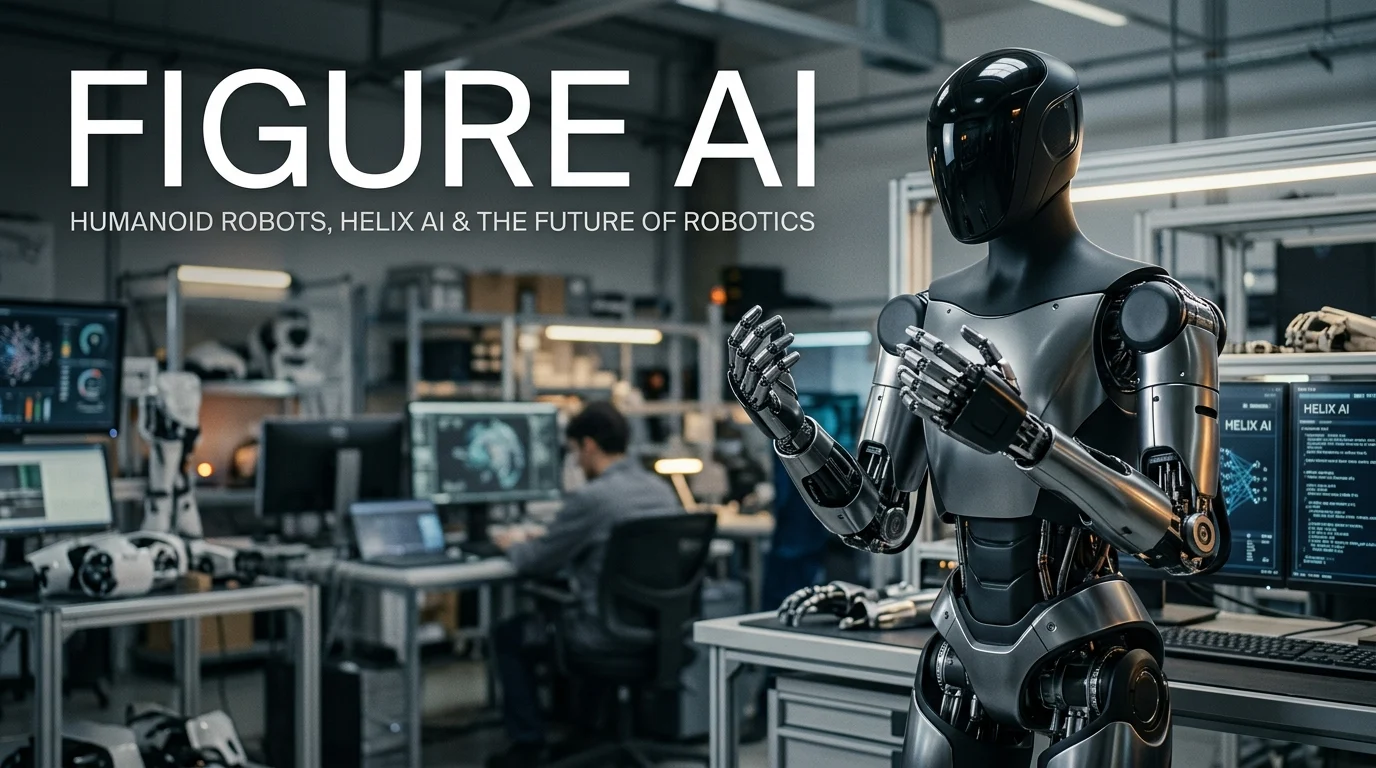
Figure AI is a robotics company developing human-shaped robots that use artificial intelligence to perform physical tasks in homes, factories, and other workplaces. Its Figure 03 robot and Helix AI system combine visual perception, language understanding, and movement to help robots interact with the real world, although broad, reliable autonomy remains an ongoing engineering challenge.
At a Glance
- Company: Figure AI develops general-purpose humanoid robots.
- Main technology: Helix, a vision-language-action AI system designed to connect perception, reasoning, and movement.
- Latest robot generation covered here: Figure 03, designed for work environments and future household applications.
- Real-world progress: Figure 02 supported BMW vehicle production in South Carolina before being superseded by newer hardware.
- Potential applications: Manufacturing, logistics, repetitive material handling, and household chores.
- Main limitation: Demonstrations and selected deployments do not establish that robots can perform every task safely, reliably, or economically.
What Is Figure AI?
Figure AI, commonly called Figure, is a US-based robotics company founded in 2022. It develops humanoid robots intended to perform useful physical work in environments designed for people, including manufacturing facilities, warehouses, and homes.
Unlike a chatbot that generates text on a screen, Figure AI is focused on physical AI. This means building AI systems that perceive their surroundings, make decisions, and control machines that interact with real objects.
A humanoid robot has a body with features such as a torso, arms, hands, and legs. That form can help it navigate spaces and use equipment designed for human workers, although it also introduces challenges involving balance, safety, dexterity, and energy consumption.
Figure’s long-term ambition is to develop a general-purpose robot rather than a machine limited to one narrowly defined task. Its commercial strategy combines robot hardware, proprietary AI, training data, and manufacturing infrastructure.
Why Is Figure AI attracting attention?
The company has moved beyond laboratory demonstrations. Its Figure 02 robot worked in BMW’s South Carolina manufacturing facility, where BMW reported that the robot supported production of more than 30,000 X3 vehicles during the pilot. Figure subsequently introduced Figure 03 and returned to BMW with the newer generation in June 2026.
That progress matters because a factory introduces conditions that controlled demonstrations may not capture: repeated shifts, variable object positions, operational safety requirements, and the need to integrate with existing production systems.
However, a successful deployment of a specific task does not prove that a robot can independently handle every job in a factory or home.
How Does Figure AI Work?
Figure AI combines several technologies to help a robot translate a goal into physical action.
1. Perception
Cameras and other sensors collect information about nearby objects, surfaces, and the robot’s own position. This helps the system estimate what is happening around it.
2. Reasoning and task understanding
AI interprets the goal and relevant scene information. For example, tidying a room involves identifying objects, choosing where to move them, and sequencing actions.
3. Movement and manipulation
Control systems translate the intended action into coordinated movements. The robot must manage balance, joint positions, grip force, and contact with objects.
4. Feedback and correction
The robot observes the results of its actions and adjusts when objects shift or an initial movement does not work as expected.
These stages are not necessarily separate steps executed one at a time. Figure’s stated approach increasingly connects perception, reasoning, and control into integrated neural systems.
Figure AI Robots: Figure 02 vs. Figure 03
Figure has developed multiple humanoid generations. Figure 02 helped demonstrate industrial applications, while Figure 03 represents a newer hardware platform intended to support the company’s broader ambitions.
Earlier industrial generation
Figure 02 demonstrated material handling on BMW’s assembly line. BMW reported more than 90,000 components moved and approximately 1,250 operating hours during the pilot. Figure announced the retirement of this generation in November 2025, and its news page later listed a decommissioning update in September 2026.
Figure 03
Newer robot platform
Figure 03 introduces updated hardware, including tactile sensing and palm cameras described in the company’s Helix 02 research. Figure positions this generation for work applications and eventual household assistance. It arrived at BMW’s Spartanburg plant in June 2026.
The distinction is important: footage of Figure 02 should not automatically be treated as evidence of Figure 03’s performance, and a feature demonstrated in a research setting is not necessarily a commercially available product capability.
What Is Helix AI?
Helix is Figure’s proprietary vision-language-action (VLA) system. A VLA model connects visual information and language-based task instructions to actions performed by a robot.
For example, a conventional software assistant might explain how to load a dishwasher. A robot powered by a VLA system aims to recognize dishes, approach the appliance, grasp objects, and place them in suitable locations.
Figure’s Helix research describes an architecture that combines task-level reasoning with fast movement control. Its Helix 02 announcement in January 2026 presented a system designed to coordinate walking, manipulation, and balance through whole-body control.
Helix 02: Whole-body autonomy
Helix 02 extends the company’s approach beyond upper-body manipulation. Its design addresses locomotion and manipulation together, a robotics challenge often called loco-manipulation.
Consider a robot carrying a bowl across a kitchen. Moving its feet changes its balance, while holding the bowl constrains its arms and posture. The robot must coordinate these movements instead of treating walking and grasping as unrelated actions.
Figure reported a four-minute autonomous dishwasher task and additional demonstrations involving delicate object handling. These are meaningful research results, but they remain demonstrations under particular conditions rather than proof of universal household competence.
Helix 2.5: Generalization to unfamiliar homes
In September 2026, Figure announced Helix 2.5, a system intended to transfer learned behaviors to unfamiliar environments.
According to Figure, the company evaluated tidying living rooms, folding towels, and making beds across 30 previously unseen homes. It reported a 56% success rate for its Index-pretrained model, compared with 9% for a model trained from scratch under the company’s stated comparison.
This is an important distinction: generalization is not the same as guaranteed success. A reported 56% success rate indicates substantial remaining failure in the evaluated trials, even if the evaluation represents progress toward more adaptable robots.
The results also come from the company developing the system. Independent replication, broader testing, and transparent evaluation across different environments would help establish how well the findings translate into everyday use.
What Is Index, Figure AI’s Training Dataset?
Robots need more than language and images. They need experience with physical actions, object interactions, movement, and the consequences of their decisions.
Figure introduced Index in August 2026 as an effort to build a large, diverse dataset of human behavior for humanoid robot training. The company describes it as a foundation for transferring human experience into robotic capabilities.
The basic idea is that a robot may learn useful patterns from broad human demonstrations instead of requiring extensive task-specific training in every new location.
That could reduce the work needed to deploy a robot in a new home or factory. Yet training data alone cannot eliminate the need for safety validation, hardware reliability, and real-world testing.
Figure also announced a partnership with Nscale in September 2026 involving plans for up to 100,000 GPUs using NVIDIA’s Vera Rubin platform, with initial deployment targeted for the second half of 2027. The announcement describes a future compute plan, not a completed installation.
This illustrates the scale of infrastructure that advanced physical AI may require. Model training, simulation, data collection, and hardware manufacturing all influence how quickly a robotics company can improve its products.
Key Features and Capabilities of Figure AI
The following capabilities reflect the company’s stated technology and reported demonstrations. Their availability and maturity vary by robot generation and task.
| Capability | What it means | Practical relevance |
|---|---|---|
| Humanoid movement | Walking and coordinated body motion | Navigating human-designed spaces |
| Object manipulation | Grasping and moving physical items | Material handling and household tasks |
| Vision-language-action AI | Connecting visual observations and instructions to actions | Following flexible task goals |
| Whole-body control | Coordinating arms, hands, torso, and legs | Moving while carrying or manipulating objects |
| Tactile sensing | Detecting contact and applied forces | Handling delicate or irregular items |
| Generalization research | Applying learned behavior in unfamiliar settings | Reducing environment-specific retraining |
Figure’s Helix 02 research describes fingertip tactile sensors and palm cameras as tools for improving manipulation when objects are small, hidden, or difficult to grip. The company has demonstrated tasks involving pills, syringe handling, bottle caps, and objects in clutter.
These examples show the range of problems the company is investigating. They do not establish that Figure robots are certified for medical procedures, approved for unsupervised healthcare work, or ready to handle every fragile object reliably.
Figure AI Use Cases: Where Could These Robots Work?
Figure’s potential applications span several industries, but their readiness differs. The clearest evidence currently comes from selected industrial tasks and company-led demonstrations.
1. Manufacturing
Robots can potentially load parts, move components, and support production-line logistics. Figure’s BMW work provides a concrete example of industrial testing and deployment.
2. Warehousing and logistics
Material movement, item sequencing, and handling containers are promising applications. Businesses must still assess throughput, recovery from errors, equipment downtime, and integration costs.
3. Household assistance
Folding towels, tidying rooms, and making beds are among the behaviors demonstrated in Figure’s Helix 2.5 research. These demonstrations indicate progress, not proof of a widely available home robot.
4. Repetitive physical work
In suitable environments, humanoid robots may eventually take over repetitive or physically demanding activities. Human supervision, emergency procedures, and task-specific safety controls remain important.
Benefits of Figure AI
Figure’s approach could offer several advantages if the technology becomes reliable and affordable at scale.
- Flexible automation: A humanoid platform may handle multiple tasks without requiring a completely different machine for every workflow.
- Human-compatible environments: Its body design could help it use existing workspaces, shelves, carts, and tools.
- Potentially reduced retraining: Better generalization could reduce the data collection and programming needed for new tasks.
- Consistent repetitive work: Robots may perform defined activities across long operating schedules, subject to maintenance and operational constraints.
- Continuous improvement: Better training data, models, sensors, and control systems could expand the range of tasks a robot can perform.
The commercial value depends on measurable outcomes, not impressive demonstrations alone. Companies need to know whether a robot completes work at the required speed, meets quality standards, and costs less than the alternatives over its operating life.
Limitations and Challenges of Figure AI
Humanoid robotics remains difficult because physical environments are unpredictable. A system that performs well in a demonstration may struggle when an object slips, a surface changes, or an unexpected person enters its path.
1. Reliability and task completion
Long tasks contain many opportunities for failure. A robot might pick up an object successfully but fail to place it correctly, lose its balance, or become stuck during the next step.
Figure’s reported Helix 2.5 results illustrate this gap: the company reported 56% success in its defined zero-shot evaluation, not universal success.
2. Safety around people
A full-sized robot can create risks through collisions, dropped objects, unstable movement, or unexpected behavior. Commercial operators need risk assessments, physical safeguards, emergency stops, and procedures for recovering from failures.
Safety must be evaluated for each environment and task. A system suitable for a controlled factory cell may not be suitable for a crowded household.
3. Battery life and maintenance
Walking, lifting, and operating articulated hands require energy. Battery capacity, charging time, heat, actuator wear, and maintenance requirements all influence useful operating time.
Businesses should evaluate real operating data rather than assume a robot can work continuously like a human across an entire shift.
4. Cost and return on investment
A robot’s total cost includes more than the initial purchase. Facilities may need charging infrastructure, integration engineering, training, maintenance, software support, safety equipment, and downtime coverage.
Figure does not publish a standard public purchase price for a generally available consumer robot in the sources reviewed here. Buyers should request a detailed commercial quotation rather than rely on online price speculation.
5. Generalization is still limited
Learning to tidy one room does not automatically mean a robot can clean every house. Different furniture, lighting, clutter, object materials, and layouts can change how a task must be performed.
Even promising zero-shot results should be assessed across more environments and independent tests before buyers assume a system will work reliably in their own facilities.
Figure AI Pricing: How Much Does It Cost?
Figure AI does not list a standard public retail price for Figure 03 in the company sources reviewed for this article. Its robots are being developed and deployed through commercial and research activities, rather than marketed as ordinary consumer electronics with a clearly published checkout price.
For businesses considering humanoid automation, the actual cost may depend on the robot configuration, order volume, software arrangements, integration requirements, support, and deployment conditions. Specific terms should be confirmed directly with Figure.
Before evaluating a proposal, request details covering:
- Hardware and software fees.
- Installation and integration costs.
- Maintenance, replacement parts, and support.
- Required supervision and operator training.
- Expected uptime and task completion rates.
- Warranty, service-level commitments, and contract termination terms.
- Data handling, remote access, and software-update policies.
A useful comparison is total cost per successfully completed task, rather than purchase price alone. A cheaper robot that requires frequent intervention may offer worse value than a more expensive system that completes work consistently.
Figure AI Competitors: How Does It Compare?
Figure operates in a competitive humanoid robotics market. Several companies pursue overlapping goals, but their robot designs, customer targets, and commercial maturity differ.
The following is a qualitative comparison, not a universal ranking. Product availability and deployment status can change quickly.
| Company | Robot or platform | Primary focus | Pricing transparency |
|---|---|---|---|
| Figure AI | Figure 03, Helix | General-purpose humanoids for work and future home use | No standard public Figure 03 price identified |
| Tesla | Optimus | Humanoid automation, including potential factory and home tasks | No established general retail price in the sources reviewed |
| Agility Robotics | Digit | Warehouse and industrial material handling | Commercial terms generally require inquiry |
| Boston Dynamics | Atlas | Advanced humanoid mobility and industrial robotics | Not marketed as a standard consumer robot |
| Unitree Robotics | G1, H1 | Humanoid research, development, and robotics applications | Some models have publicly advertised prices, depending on configuration |
| Apptronik | Apollo | Industrial and logistics automation | Commercial pricing requires confirmation |
Figure AI vs. Tesla Optimus
Both companies are pursuing humanoid robots for physical work. Figure emphasizes its Helix AI system and has reported external factory deployments, while Tesla’s Optimus program is closely connected to its manufacturing ambitions.
A meaningful comparison should consider independently verifiable task performance, safety, operating costs, deployment scale, and maintenance requirements, not promotional videos alone.
Figure AI vs. Agility Robotics
Agility Robotics focuses on Digit, a robot designed for logistics and industrial environments. Its form is more specialized than a conventional human-shaped design, illustrating an important trade-off: a robot optimized for warehouse material movement may be more practical for that job than a general-purpose humanoid.
Figure’s broader ambition is flexibility across different physical tasks. The best option for a company depends on whether it needs a narrow, repeatable workflow or a platform that could eventually handle several jobs.
Figure AI vs. Boston Dynamics
Boston Dynamics has extensive experience in dynamic robotics and advanced mobility. Its Atlas platform competes in the broader humanoid robotics field, while Figure is developing its own integrated hardware and AI stack.
Neither a company’s reputation nor a robot’s movement capabilities alone establish which system will provide the best return for a particular business.
Is Figure AI Publicly Traded?
Figure AI is a privately held company, not a publicly listed stock that ordinary investors can purchase through a conventional stock-market brokerage.
In September 2025, Figure announced that it had exceeded $1 billion in committed Series C financing at a post-money valuation of $39 billion. That figure describes the valuation associated with the announced financing round, not a guaranteed current market value.
Private-company shares may sometimes be offered through secondary markets or private investment arrangements, but access can be restricted and offers may be difficult to verify. Figure also published a July 2026 notice concerning unauthorized attempts to sell its stock. Anyone considering a private-share offer should independently verify the seller, legal rights, fees, and transaction documentation through appropriate professional channels.
Figure’s funding and investor interest demonstrate confidence in the company’s potential. They do not guarantee future revenue, successful commercialization, or investment returns.
Who Should Pay Attention to Figure AI?
Figure AI is particularly relevant to several groups.
- Manufacturing leaders: Those evaluating automation for repetitive material handling or production logistics.
- Robotics engineers and researchers: Those studying embodied intelligence, VLA models, whole-body control, and robot learning.
- Business strategists: Those assessing how humanoid systems might fit into long-term automation plans.
- Technology enthusiasts: Those following advances in physical AI and general-purpose robotics.
- Investors and analysts: Those researching robotics markets, private-company financing, and commercialization risks.
For companies considering deployment, the sensible starting point is a narrowly defined task with measurable success criteria. Evaluate safety, reliability, throughput, and cost before expanding to more complex workflows.
Latest Figure AI Developments in 2026
Several developments help explain the company’s current direction.
- January 2026: Helix 02. Figure announced a system designed to coordinate full-body movement, balance, and manipulation. FigureAI
- June 2026: Figure 03 at BMW. The newer robot arrived at BMW’s Spartanburg facility for a logistics workflow involving part sequencing and coordinated movement. FigureAI
- August 2026: Index. Figure introduced a large-scale human-behavior dataset intended to improve robotic learning and transfer. Figure
- September 2026: Helix 2.5. Figure reported zero-shot generalization experiments across 30 unfamiliar homes, with results that suggest progress but leave reliability challenges. FigureAI
- September 2026: Compute partnership. Figure and Nscale announced plans involving up to 100,000 GPUs, with initial deployment targeted for the second half of 2027. This is a future infrastructure plan, not a completed deployment. FigureAI
Together, these developments show that Figure is working on several connected bottlenecks: robot hardware, physical-world training data, AI control, and the computing resources needed to train more capable systems.
The key question is whether these investments will translate into dependable robots that can perform useful work at a competitive cost.
Frequently Asked Questions About Figure AI
1. What is Figure AI used for?
Figure AI develops humanoid robots for physical tasks such as industrial material handling, logistics, and potential household assistance. Its robots combine sensors, mechanical control, and AI designed to understand tasks and interact with real environments.
2. Is Figure AI available to the public?
Figure AI does not offer Figure 03 as a standard consumer product with a public retail checkout price in the sources reviewed. Commercial availability, eligibility, and deployment arrangements should be confirmed directly with the company.
3. What is the difference between Figure AI and Helix AI?
Figure AI is the robotics company, while Helix is its proprietary vision-language-action AI system. Figure builds the robot hardware and develops AI technology intended to connect perception, reasoning, and physical movement.
4. How much does a Figure AI robot cost?
Figure AI has not published a standard public retail price for Figure 03 in the sources reviewed for this article. Prospective customers should contact the company for commercial pricing and clarify integration, maintenance, support, and operating costs.
5. Can Figure AI robots work independently in homes?
Figure has demonstrated household tasks in unfamiliar homes using Helix 2.5, including tidying rooms, folding towels, and making beds. However, its reported evaluations do not establish that the robots can reliably perform every household task without supervision.
Conclusion
Figure AI is developing humanoid robots that combine physical hardware with AI designed to perform real-world tasks. Its BMW deployments, Helix research, and Index training initiative provide evidence of progress toward more flexible automation.
The most important questions are now practical: Can these robots work safely, complete tasks reliably, adapt to unfamiliar environments, and justify their total operating costs? Businesses should evaluate real deployments and verified performance, while consumers should treat home robotics as an emerging capability rather than a fully mature product category.

Oliver Wilson is an AI researcher and tech writer living at the intersection of human creativity and machine intelligence. At AixOrbit.com, he decodes complex neural networks, generative AI and emerging tech trends into actionable insights making sure humans stay one step ahead of the algorithms.