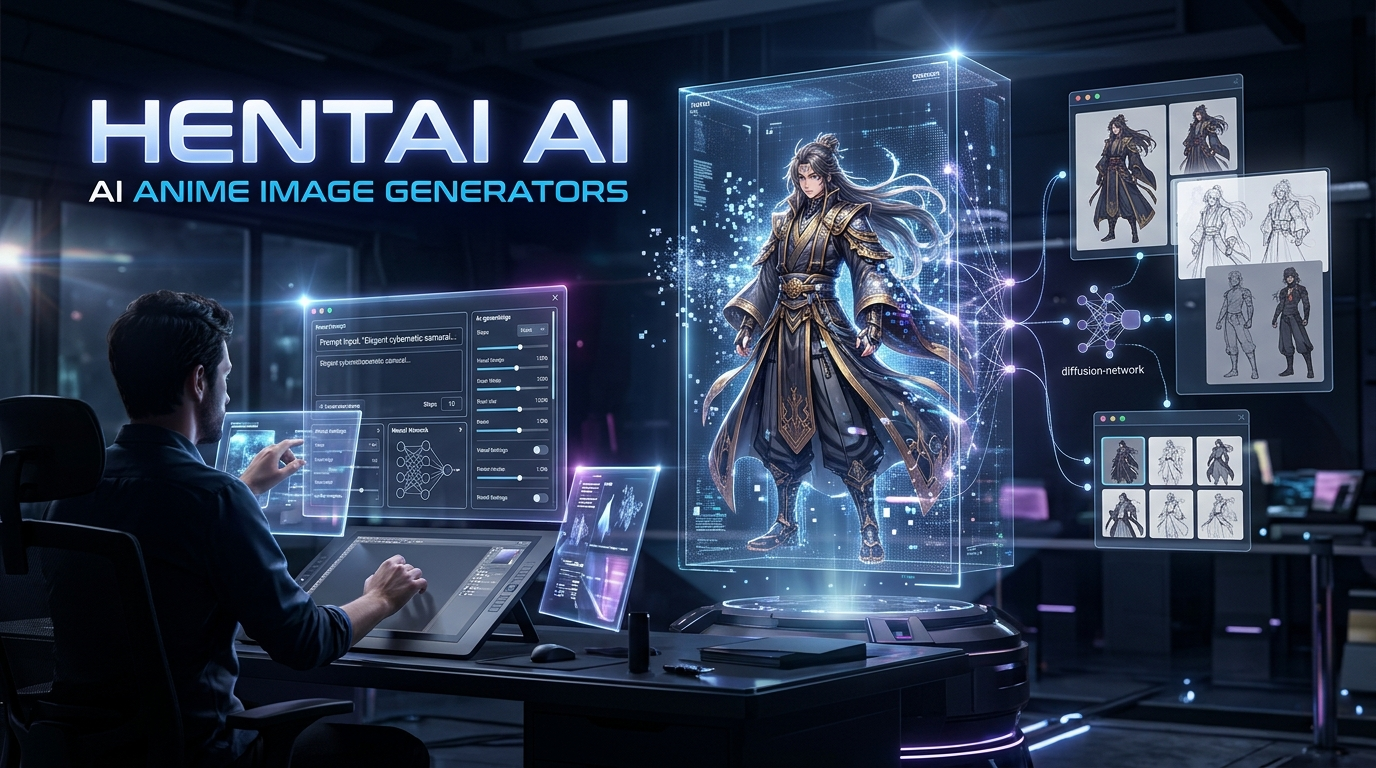
Hentai AI refers to artificial intelligence tools that generate anime-inspired illustrations, characters and adult-oriented fictional artwork from text prompts or reference images. These tools use generative AI models, particularly diffusion technology, to create customized visuals while raising important questions about privacy, copyright, consent and responsible content generation.
At a Glance What You Should Know
- Meaning: Hentai AI describes AI-generated anime-style artwork, including adult-oriented fictional illustrations.
- Technology: Most modern image generators use diffusion models and machine learning.
- Customization: Users can influence character appearance, clothing, backgrounds, colors, poses, and artistic styles.
- Available tools: NovelAI and Civitai are examples of platforms with AI image-generation capabilities.
- Privacy: Data collection, image storage, prompt logging, and sharing policies differ between providers.
- Responsible use: Keep characters clearly adult, avoid non-consensual real-person imagery, and follow applicable laws.
What Is Hentai AI?
Hentai AI is a category of generative artificial intelligence focused on creating anime-inspired illustrations and fictional characters. The term combines traditional anime aesthetics with AI image-generation technology.
Unlike conventional digital illustration, which often requires drawing skills and specialized software, AI generators can produce artwork from written descriptions.
A creator might describe a fictional adult anime character with specific hair colors, clothing, facial features, lighting, and an environment. The AI interprets these instructions and generates an image based on learned visual patterns.
The technology has applications beyond adult-oriented illustrations. It can also support:
- Anime character design.
- Manga-inspired concept art.
- Fictional character development.
- Fantasy illustrations.
- Digital storytelling.
- Background and environment design.
- Non-explicit character portraits.
The important distinction is that AI-generated anime artwork is not automatically adult content. Its classification depends on the actual image, subject, and intended presentation.
Why Is Hentai AI Becoming Popular?
Several developments have made AI anime generation more accessible.
First, image-generation models have improved their ability to interpret detailed text descriptions. Second, browser-based platforms have reduced the technical knowledge required to create illustrations.
Artists can also experiment with different visual concepts without manually recreating every variation.
However, popularity does not mean every generator is suitable for every purpose. Platform restrictions, licensing, privacy, and content moderation remain important considerations.
How Does Hentai AI Work?
Hentai AI generators use machine learning to transform text instructions into visual artwork.
Many modern systems rely on diffusion models, a type of generative AI that gradually transforms random noise into an image.
Step 1: Understanding the Text Prompt
The user describes the intended image using natural language or structured visual tags.
A prompt might specify:
- Character age: clearly adult.
- Hair color and hairstyle.
- Eye color and facial characteristics.
- Clothing and accessories.
- Background environment.
- Artistic style.
- Lighting and composition.
The AI converts the text into numerical representations that help the model understand the requested visual concepts.
Step 2: Processing Visual Patterns
The model uses patterns learned during training to connect descriptions with visual characteristics.
For example, it may associate terms such as anime illustration, cel shading, expressive eyes, and fantasy background with particular visual features.
This process does not mean the AI searches for and simply copies one matching image.
Instead, it generates a new composition based on learned statistical relationships.
Step 3: Image Generation
Diffusion models typically begin with random noise.
The system gradually removes that noise through repeated computational steps, producing an image that reflects the prompt.
NovelAI’s official documentation describes its image-generation process as progressively refining noise into a finished illustration. docs.novelai.net
Step 4: Refinement and Customization
Depending on the platform, users may be able to adjust:
- Image dimensions.
- Generation steps.
- Prompt guidance.
- Visual references.
- Character consistency.
- Image variations.
- Background details.
Some systems also provide image-to-image generation, inpainting, and other editing capabilities.
These features are not universal, so users should check the documentation of their chosen service.
Main Features of Hentai AI Generators
AI anime generators offer several creative features. Their availability depends on the model and platform.
Text-to-Image Generation
Text-to-image generation allows users to describe an image instead of drawing it manually.
It is useful for developing original fictional characters, fantasy environments, and anime-inspired concepts.
Anime Character Customization
Character customization gives creators more control over visual identity.
Common options include:
- Hair style and color.
- Facial expressions.
- Eye appearance.
- Clothing design.
- Accessories.
- Character proportions.
- Artistic presentation.
Multiple Artistic Styles
Different AI models can produce different visual results.
Examples include:
- Traditional Japanese anime.
- Manga-inspired illustrations.
- Modern digital anime.
- Watercolor-inspired artwork.
- Fantasy concept art.
- Semi-realistic anime illustrations.
Image-to-Image Generation
Some generators accept an existing reference image and use it to guide a new composition.
This can help maintain a general visual direction or explore alternative character designs.
However, uploading photographs of real people for sexual manipulation or unauthorized intimate imagery raises serious consent and legal concerns.
Image Enhancement
Certain tools offer additional processing features, such as:
- Image upscaling.
- Resolution enhancement.
- Background refinement.
- Color adjustments.
- Inpainting.
- Visual corrections.
The quality of these features varies between providers.
Popular Hentai AI and Anime Image Generation Platforms
Not every anime AI generator offers the same capabilities or content policies.
The following platforms illustrate different approaches to AI-generated anime artwork.
Is NovelAI’s Image Generator Worth It? An In-Depth Review
Civitai Review: A Hands-On Look at the Model Marketplace for AI Image Creation
NovelAI
NovelAI is an AI storytelling and image-generation service with a strong anime-art focus.
Its official documentation describes custom NovelAI Diffusion models and prompt-based image creation.
Notable characteristics:
- Anime-focused image generation.
- Text-to-image functionality.
- Adjustable generation settings.
- Image-to-image capabilities.
- Creative storytelling tools.
NovelAI also documents its image storage and privacy practices. Its documentation states that image-generation requests and outputs are not logged or stored on its side, subject to the stated service conditions. docs.novelai.net+1
Best suited for: Users interested in anime illustrations and AI-assisted storytelling.
Official website: NovelAI.
Civitai
Civitai is a platform for discovering, sharing, and working with AI models.
It supports a community-driven ecosystem where creators can explore different models and visual styles.
Notable characteristics:
- AI model discovery.
- Community-created resources.
- Image-generation capabilities.
- Model-specific artistic styles.
- Community artwork and inspiration.
Civitai requires users to be at least 18 and prohibits sexualized depictions of minors, real-person likeness misuse, and tools intended to undress real individuals. It also requires generation metadata for certain sexualized content.
Best suited for: Experienced AI art creators interested in exploring different models and configurations.
Official website: Civitai.
Stable Diffusion Ecosystem
Stable Diffusion is a family of image-generation models used in different creative applications.
It has helped expand access to customizable image-generation workflows.
Its ecosystem includes:
- Model checkpoints.
- Community-developed interfaces.
- Fine-tuned models.
- Image-generation extensions.
- Local and hosted workflows.
The experience depends heavily on the particular model, interface, hardware, and applicable usage restrictions.
Best suited for: Technically experienced creators who want greater control over their image-generation environment.
Platform Comparison
| Platform | Main Strength | Target User | Important Consideration |
|---|---|---|---|
| NovelAI | Anime-focused generation | Anime artists and storytellers | Subscription and usage limits |
| Civitai | Model discovery and community | Experienced AI creators | Content rules and model licensing |
| Stable Diffusion ecosystem | Customization and flexibility | Technical creators | Hardware and setup requirements |
Important: Pricing, generation limits, and available features can change. Check the official pricing pages and current terms before subscribing. The table does not imply that every platform permits every category of adult content.
Benefits of Hentai AI Technology
AI-powered anime generation offers several advantages for digital creativity.
Faster Creative Experimentation
Traditional illustration can require hours of drawing, coloring, and refinement.
AI tools can generate initial concepts much faster, allowing creators to explore multiple visual directions.
Reduced Technical Barriers
Beginners do not necessarily need advanced drawing skills to experiment with AI-generated illustrations.
Text prompts provide an accessible starting point.
Character Design Exploration
Creators can explore different fictional characters, visual identities, and artistic approaches.
This can be useful during early concept development.
Creative Inspiration
AI-generated images can provide inspiration for:
- Manga concepts.
- Fantasy storytelling.
- Character sheets.
- Fictional worlds.
- Digital illustration projects.
Flexible Visual Customization
Many generators allow users to adjust several visual characteristics without rebuilding an illustration from scratch.
This can make experimentation more efficient.
9Limitations and Challenges
Despite its advantages, hentai AI technology has several limitations.
Inconsistent Image Quality
Generated images may contain visual errors.
Common problems include:
- Incorrect hands or fingers.
- Distorted facial features.
- Unnatural proportions.
- Inconsistent accessories.
- Unwanted background objects.
- Unclear visual details.
Users may need multiple attempts or manual editing to achieve a satisfactory result.
Limited Character Consistency
Some generators struggle to maintain exactly the same character across multiple images.
Hair, facial features, clothing, and body proportions can change between generations.
This creates challenges for manga creators and visual storytellers.
Copyright and Licensing Questions
AI-generated artwork raises questions about training data, copyrighted characters, artist styles, and commercial rights.
A platform allowing image downloads does not automatically mean every generated image is free of copyright restrictions.
NovelAI explicitly advises users to conduct their own research before using generated images outside its service. docs.novelai.net
Content Restrictions
Platforms may block certain prompts, images, models, or uploads.
Restrictions can change as companies update their moderation systems and terms of service.
Ethical Concerns
AI-generated intimate imagery can be misused to impersonate real individuals.
Even when an image is synthetic, presenting it as a real person’s intimate photograph can cause serious harm.
Responsible creation should respect consent and avoid identifiable real-person sexual imagery.
Privacy and Security
Privacy is particularly important when using AI tools that process personal prompts, reference images, and generated artwork.
Different platforms have different approaches to data collection and storage.
Before uploading anything, review these areas.
Prompt and Image Storage
Find out whether the provider stores:
- Text prompts.
- Uploaded reference images.
- Generated artwork.
- Account information.
- Generation history.
- Device and usage information.
For example, NovelAI documents that its image-generation requests and outputs are not logged or stored on its side. Its terms also describe encrypted storage for certain user content.
These are provider-specific statements, not guarantees that every AI generator offers equivalent privacy.
Data Sharing
Review whether a platform shares information with:
- Hosting providers.
- Analytics services.
- Payment processors.
- Advertising partners.
- Other third-party services.
Read the privacy policy before submitting sensitive material.
Account Security
Use a unique password and enable additional account protection when available.
Avoid sharing account credentials or uploading private photographs without a clear, legitimate reason.
Is Zero Data Retention Important?
Zero Data Retention (ZDR) refers to an arrangement in which specified customer data is not retained after processing, subject to the provider’s documented terms and exceptions.
A company mentioning encryption or secure storage is not automatically offering ZDR.
Users should look for explicit retention periods and deletion procedures rather than relying on general security language.
Legal and Ethical Considerations of Hentai AI
AI-generated adult-oriented illustrations involve legal and ethical questions that users should understand.
The distinction between fictional artwork and imagery involving real people is especially important.
Keep Characters Clearly Adult
Only create adult fictional characters in adult-oriented artwork.
Avoid sexualized depictions of minors, underage characters, or characters presented as children.
Changing a character’s stated age does not necessarily resolve concerns if the visual presentation indicates that the character is underage.
Avoid Non-Consensual Deepfakes
Never use AI to create intimate imagery of someone without their consent.
This includes celebrities, influencers, acquaintances, and private individuals.
In the United States, the TAKE IT DOWN Act, signed on May 19, 2025, addresses the non-consensual publication of intimate visual depictions, including certain AI-generated digital forgeries.
The US Department of Justice also reported arrests in May 2026 involving alleged violations of the law related to AI-generated intimate deepfakes. United States Department of Justice
Understand Local Laws
Legal rules differ between countries and jurisdictions.
For example, UK government guidance updated in September 2026 explains existing restrictions concerning AI-generated child sexual abuse material and additional legislative measures targeting models optimized to create such material. GOV.UK
Users should check the laws that apply where they live and where they distribute content.
Respect Copyright and Artist Rights
Do not assume that an AI-generated image can automatically be used commercially.
Check:
- Model licenses.
- Platform terms.
- Character ownership.
- Trademark restrictions.
- Commercial-use permissions.
- Applicable copyright laws.
Respecting these rules helps reduce disputes and protects creators.
How to Choose a Hentai AI Generator
Choosing an AI anime generator requires more than comparing image quality.
A suitable platform should match the user’s creative needs, technical experience, budget, and privacy expectations.
Consider these factors before choosing.
| Evaluation Factor | What to Look For |
|---|---|
| Image quality | Consistent details and clean compositions |
| Anime specialization | Models trained or designed for anime artwork |
| Customization | Adjustable prompts and generation settings |
| Privacy | Clear image retention and data policies |
| Pricing | Transparent subscriptions and generation limits |
| Licensing | Clear rules for personal and commercial use |
| Moderation | Documented content restrictions |
| Export options | Downloadable images and supported formats |
Free vs. Paid AI Generators
Some platforms provide limited free access, while others use subscriptions or credit-based generation.
Free access can be useful for testing a service.
Paid plans may offer additional generation capacity, higher usage limits, or advanced features.
However, a paid subscription does not automatically provide better privacy, unrestricted usage, or commercial rights.
Before purchasing, check:
- Monthly subscription cost.
- Included generation credits.
- Credit expiration rules.
- Image resolution limits.
- Additional generation charges.
- Cancellation and refund conditions.
Always review the latest pricing information directly from the provider.
Who Should Use AI Anime Generators?
AI anime generators can serve different creative audiences.
Digital Artists
Artists can use AI-generated concepts to explore compositions, color palettes, and character designs.
Manga and Story Creators
Writers and visual storytellers can develop fictional characters and environments for early-stage projects.
Anime Enthusiasts
Adult anime enthusiasts can explore original fictional characters and artistic variations.
Game Developers
Independent developers may use AI-generated concept art during early visual development, subject to licensing and production requirements.
AI Researchers
Researchers can study generative models, prompt interpretation, image quality, and content moderation.
AI-generated artwork should be treated as a creative starting point rather than a guaranteed replacement for professional illustration.
Common Mistakes to Avoid
Beginners often make mistakes when selecting and using AI image generators.
Here are some important issues to avoid.
- Ignoring platform policies: Read the content rules before generating or uploading artwork.
- Assuming all tools are private: Check image storage, prompt logging, and deletion policies.
- Expecting perfect results: AI-generated images can contain errors and inconsistencies.
- Ignoring licensing: Review commercial-use and model-license restrictions.
- Using real people’s photographs improperly: Avoid non-consensual intimate image manipulation.
- Overlooking subscription limits: Check credits, usage caps, and additional charges.
- Trusting misleading advertisements: Verify features through official documentation.
- Ignoring age-related safeguards: Keep adult-oriented fictional characters clearly adult.
A little research before using a platform can prevent unnecessary privacy, financial, and legal problems.
The Future of Hentai AI and Anime Image Generation
AI anime generation continues to develop alongside broader improvements in generative AI.
Several technological developments could influence its future.
Better Image Consistency
Improved image models may help creators maintain character appearance across multiple illustrations.
This could be especially useful for manga, animation, and storytelling projects.
More Precise Creative Controls
Future systems may offer better control over composition, lighting, expressions, and individual visual elements.
Improved Image Editing
Inpainting and image-to-image workflows may become more precise, reducing the need for repeated generations.
Stronger Content Moderation
AI providers are under increasing pressure to prevent harmful and non-consensual imagery.
Civitai, for example, documents prompt screening, input-image checks, model checks, and moderation of generated content.
Greater Transparency
Users may increasingly expect clear information about:
- Training data.
- Model licensing.
- Image retention.
- Generation metadata.
- Content moderation.
- Commercial usage rights.
These developments could make AI anime tools more useful for legitimate creative projects while improving accountability.
Frequently Asked Questions
1. What is hentai AI?
Hentai AI refers to artificial intelligence technology used to generate anime-inspired illustrations, including adult-oriented fictional artwork. These systems generally use text prompts and generative image models to create customized visuals.
2. How does a hentai AI generator work?
A hentai AI generator interprets written descriptions and uses a trained image-generation model to create artwork. Many modern systems use diffusion technology, which gradually transforms random noise into an image.
3. Are there free hentai AI generators?
Some AI image-generation platforms offer limited free access, while others require subscriptions or credits. Availability, content restrictions, and generation limits vary by provider.
4. Is AI-generated hentai artwork legal?
Legality depends on the content, jurisdiction, and intended use. Users should avoid illegal sexual depictions of minors, non-consensual intimate imagery, and copyright violations, and should check applicable local laws.
5. Is hentai AI safe to use?
Safety depends on the platform’s privacy practices, security measures, content policies, and data retention rules. Users should review official terms, avoid uploading sensitive personal images, and use reputable services.
Conclusion
Hentai AI represents a specialized application of generative AI that combines anime-inspired artwork with automated image creation.
Tools such as NovelAI, Civitai and the Stable Diffusion ecosystem demonstrate different approaches to AI-powered visual creativity.
These platforms can help artists, anime enthusiasts, and storytellers explore fictional characters and visual concepts without requiring advanced drawing skills.
However, image quality is only one part of the decision. Privacy, licensing, platform restrictions, consent and legal compliance also matter.
The best approach is to select a platform based on its verified capabilities, transparent policies, and suitability for your creative goals.

Alex Smith is an AI-focused tech writer at Aixorbit.com, sharing simple and actionable insights on artificial intelligence, automation and digital growth.