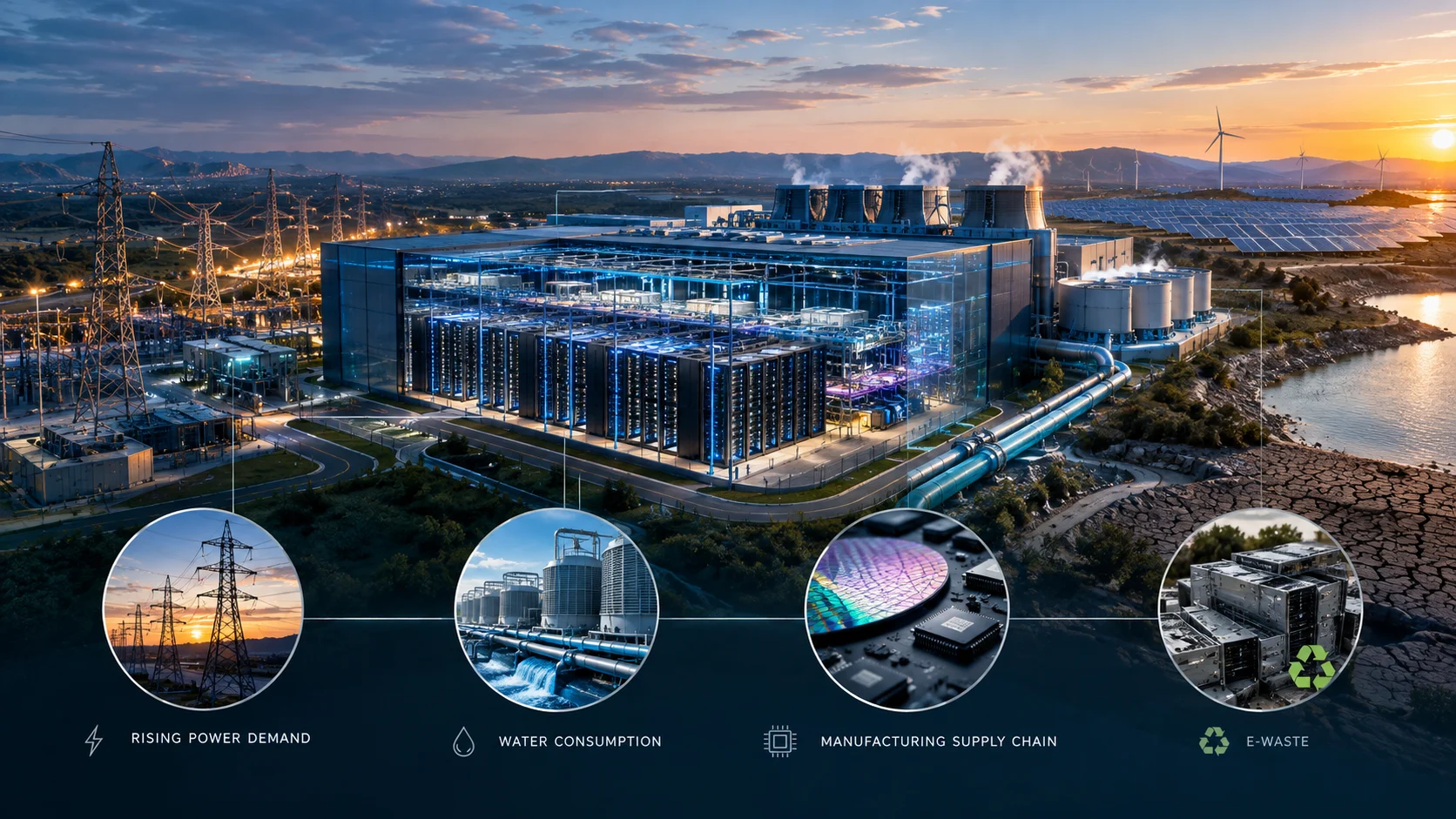
AI can harm the environment because training and running AI models requires electricity, water, physical infrastructure, semiconductor manufacturing, and hardware that eventually becomes waste. The impact varies widely by model, workload, data-center location, electricity source, cooling technology, hardware efficiency, and how extensively AI is used.
At a Glance
- AI is energy-intensive at scale: Data-center electricity consumption is projected to roughly double from 485 TWh in 2025 to 950 TWh by 2030, with AI-focused facilities growing faster.
- AI can increase carbon emissions: Data centers consume electricity generated from a mix of renewable and fossil-fuel sources, so their climate impact depends heavily on the local grid.
- Water is another major concern: Cooling systems and electricity generation can consume water, while semiconductor manufacturing also requires substantial water resources.
- AI hardware has a physical footprint: GPUs, servers, networking equipment and chips require energy, materials, manufacturing capacity and transportation.
- E-waste could grow: A 2024 Nature Computational Science study estimated that generative AI could create 1.2 to 5.0 million tonnes of accumulated e-waste during 2020–2030 under different development scenarios.
- AI is not environmentally harmful in every application: AI can also reduce energy use, improve renewable-energy integration and help detect methane leaks. Its overall environmental effect depends on how the technology is deployed and what activity it replaces.
How Is AI Bad for the Environment?
The simplest answer is that AI turns computation into a physical resource demand.
A chatbot, image generator or AI agent may feel almost weightless to the user. Behind that interface are servers, GPUs, networking equipment, cooling systems, buildings, electricity infrastructure and semiconductor supply chains.
The environmental footprint therefore extends far beyond model training.
It includes training, inference, data-center construction, cooling, electricity generation, chip manufacturing, raw-material extraction, transportation and hardware disposal.
The scale also matters. A single AI request can have a relatively small footprint, while billions of requests and increasingly sophisticated AI workloads can create substantial aggregate demand.
The latest IEA analysis illustrates this distinction. Electricity consumption per AI task has been falling rapidly because of better hardware and software, yet overall demand continues to rise as AI adoption expands and more energy-intensive applications, including video generation, reasoning and AI agents, become common.
1. AI Requires a Lot of Electricity
Electricity is the most visible part of AI’s environmental footprint.
Large AI models run on specialized processors such as GPUs and other accelerators. Training can require large clusters of these processors running continuously, while inference consumes electricity every time a model generates an answer, image, video or action.
The important issue is scale.
According to the IEA’s April 2026 analysis, global data-center electricity consumption grew 17% in 2025, while electricity use from AI-focused data centers increased by 50%. The IEA projects total data-center electricity demand to rise from about 485 TWh in 2025 to approximately 950 TWh in 2030.
That does not mean AI alone consumes 950 TWh. Data centers also run cloud computing, storage, websites, enterprise software and other workloads.
However, the IEA identifies AI as a major driver of the increase.
Why AI workloads are unusually demanding
Modern AI systems can perform billions or trillions of mathematical operations to generate outputs.
Large language models repeatedly process tokens. Image and video models process far more computationally intensive data. Reasoning models and AI agents can perform many additional inference steps before producing a final result.
That creates an important distinction:
AI is becoming more efficient per task, but the tasks themselves are becoming more demanding and much more numerous.
The IEA reports that simple text queries now typically require substantially less electricity than many earlier estimates suggested. At the same time, video generation, reasoning and agentic workloads can require hundreds or thousands of times more energy per query than simple text generation.
This is why quoting one universal “energy cost per AI prompt” is misleading.
2. AI Can Increase Carbon Emissions
Electricity consumption does not automatically equal carbon emissions.
The climate impact depends on how that electricity is generated.
A data center powered largely by low-carbon electricity can have a substantially different operational carbon footprint from one drawing electricity from a fossil-fuel-heavy grid.
The IEA estimates that data centers currently produce around 180 million tonnes of indirect CO₂ emissions from electricity consumption, excluding emissions from backup generation. In its scenarios, data-center electricity emissions increase substantially through the 2030s even as low-carbon power expands.
The situation is especially important because AI data centers are concentrated in particular regions.
A global average can hide local effects. A new data center connected to a constrained, carbon-intensive grid may create different environmental consequences from one built where abundant low-carbon electricity is available.
AI can also increase fossil-fuel demand
Renewables are expected to supply a large share of additional electricity required by data centers.
However, the IEA also expects natural gas and coal to contribute significantly to meeting near-term data-center demand. In some markets, developers are considering on-site natural-gas generation because grid connections cannot be built quickly enough.
That creates a potential feedback loop:
More AI demand → more data-center capacity → more electricity demand → additional generation and grid infrastructure → additional environmental impacts.
The exact outcome depends on energy policy, grid conditions, technology and location.
3. AI Data Centers Can Consume Water
Water is one of the least visible parts of AI’s environmental footprint.
High-performance computing generates substantial heat. Data centers must remove that heat to keep servers operating safely.
Depending on the facility, cooling may involve air cooling, evaporative systems, chilled water, direct liquid cooling or combinations of these technologies.
Some systems consume water directly through evaporation.
There is also an indirect water footprint associated with electricity generation. Power plants can use water for cooling, meaning an AI system can have water impacts even when the data center itself uses relatively little water.
The United Nations University highlighted this broader perspective in its 2026 report on AI’s environmental costs. It describes AI as a physical system dependent on data centers, chips, cooling infrastructure, electricity grids, water resources, land and critical-mineral supply chains.
Why location matters
Water consumption is not equally significant everywhere.
Using water in a water-abundant region is different from consuming the same amount in a drought-prone watershed.
A 2025 Nature Sustainability study projected that AI-server deployment in the United States could generate an annual water footprint of roughly 731 million to 1.125 billion cubic meters between 2024 and 2030, depending on deployment scenarios. The researchers also found substantial variation according to server location, grid conditions and efficiency practices.
These figures are projections, not measurements of every AI system operating today.
That distinction matters because AI’s environmental footprint remains difficult to measure consistently.
4. AI Chip Manufacturing Uses Energy, Water and Raw Materials
It is easy to focus on what happens inside a data center and overlook what happens before the server arrives.
AI depends on advanced semiconductor manufacturing.
Producing modern chips involves complex fabrication processes, highly controlled facilities, chemicals, energy and large quantities of ultrapure water.
A peer-reviewed analysis of 28 semiconductor companies found substantial water withdrawals, energy consumption and greenhouse-gas emissions across the semiconductor industry.
AI hardware also requires materials and components beyond the processor itself.
A high-performance AI server can contain GPUs or other accelerators, memory, CPUs, storage, networking equipment, power supplies and cooling infrastructure.
This creates embodied environmental impacts before an AI model performs its first inference.
A 2025 life-cycle assessment of AI training on NVIDIA A100 GPUs found that the use phase dominated climate impact in the studied scenario, while manufacturing was dominant for several other impact categories, including mineral and metal depletion.
The lesson is straightforward: measuring only electricity used during AI inference does not capture the full environmental cost.
5. AI Creates More Electronic Waste
AI infrastructure evolves quickly.
As newer accelerators, memory systems and servers become available, older equipment can become economically inefficient even when it remains technically functional.
That can shorten hardware replacement cycles.
A Nature Computational Science study published in 2024 modeled the potential e-waste consequences of generative AI. Under its scenarios, accumulated generative-AI-related e-waste could reach 1.2 to 5.0 million tonnes between 2020 and 2030. The study also found that circular-economy strategies could substantially reduce the projected waste.
This is particularly important because electronic waste contains valuable materials but can also contain hazardous substances.
Responsible reuse, refurbishment, component recovery and recycling can reduce the need for virgin materials and prevent unnecessary waste.
6. AI Can Increase Land and Infrastructure Demand
AI needs physical space.
Large data centers require buildings, substations, transmission infrastructure, backup systems, cooling equipment and roads.
New electricity generation may also be required.
The United Nations University emphasizes that AI’s environmental footprint includes land as well as carbon and water. It also notes that environmental burdens can become concentrated in specific communities even when the economic benefits of AI are distributed globally.
This is one reason global averages can be deceptive.
A relatively small global percentage can still create significant local pressure when a very large facility is built in a particular community.
7. AI Agents and Reasoning Models Could Change the Equation
One of the most important developments in AI sustainability is the shift from simple question-and-answer systems toward models that perform longer reasoning and multi-step tasks.
An AI agent might call tools, retrieve information, execute code, inspect results and repeat the process.
Each additional step can require more computation.
Research published in Joule in 2026 estimated that optimized frontier-model inference can consume a fraction of a watt-hour for a typical query under production-scale assumptions, but long reasoning workloads can consume much more. The study estimated that test-time scaling with substantially longer outputs could increase per-query energy by more than an order of magnitude.
This creates a crucial sustainability challenge.
Efficiency improvements do not automatically reduce total resource consumption if usage grows faster than efficiency improves.
Economists and technology researchers often discuss this type of effect as a rebound effect.
8. Why AI Environmental Numbers Often Conflict
Search for AI’s environmental footprint and you will find dramatically different estimates.
That does not necessarily mean one source is wrong.
The problem is that researchers may measure different things.
For example, an estimate might include:
- GPU electricity only
- The entire data center
- Cooling overhead
- Electricity-generation emissions
- Hardware manufacturing
- Water withdrawal
- Water consumption
- A single inference
- An entire model-training run
- Training plus inference over the model’s lifetime
Even the phrase “water use” can be ambiguous.
Water withdrawal means water taken from a source. Water consumption generally refers to water that is not immediately returned to the same system, such as water lost through evaporation.
The ITU has identified fragmented lifecycle coverage, limited transparency, inconsistent measurement and underreported water and e-waste impacts as major challenges in assessing AI’s environmental footprint.
For that reason, credible environmental analysis should provide its system boundary, assumptions, location, workload and measurement method.
What About the Environmental Benefits of AI?
A balanced answer to “how is AI bad for the environment?” also needs to address the other side.
AI can potentially reduce environmental impacts elsewhere.
The IEA identifies applications including renewable-energy forecasting, electricity-grid optimization, predictive maintenance, industrial efficiency, building controls and methane-leak detection.
Its 2026 analysis estimates that well-documented AI applications could save more than 13 exajoules of energy by 2035 if barriers to adoption are overcome.
That does not prove that AI is environmentally beneficial overall.
An AI system that saves energy in one application may simultaneously create additional energy demand elsewhere.
The relevant question is therefore not simply:
“Does AI use energy?”
It obviously does.
A better question is:
“Does the environmental benefit created by this particular AI application outweigh the resources required to build and operate it?”
That requires a life-cycle assessment rather than a headline statistic.
How Can AI’s Environmental Impact Be Reduced?
The largest opportunities are generally at the infrastructure, model and system-design levels.
Use smaller models when they are sufficient
A small model can require considerably less computation than a frontier model.
For routine classification, extraction, summarization or simple automation, using a large reasoning model may be unnecessary.
Model selection is therefore an environmental decision as well as a technical one.
Improve inference efficiency
Developers can reduce energy use through techniques such as:
- Quantization
- Efficient model architectures
- Better batching
- Model routing
- Caching
- Hardware acceleration
- Reduced unnecessary output
- Smaller context windows when appropriate
Research has found strong relationships between inference energy, output length and system configuration.
Choose data-center locations carefully
Location affects electricity emissions, water stress, cooling requirements and grid constraints.
A low-carbon grid is valuable, but low-carbon electricity does not automatically mean low water or land impact. The United Nations University specifically warns that these environmental footprints do not always move together.
Improve cooling systems
Better cooling can reduce water consumption and electricity overhead.
The challenge is that different cooling technologies shift impacts rather than eliminating them. A water-saving design may require more electricity, while a highly efficient cooling system may have different material or infrastructure requirements.
Extend hardware lifetimes
Longer server lifetimes can reduce the environmental burden associated with manufacturing replacement equipment.
Reuse, refurbishment and component recycling can also reduce e-waste.
Measure the complete lifecycle
Companies should report more than annual electricity consumption.
Useful metrics include:
| Metric | What it reveals |
|---|---|
| Energy use | Electricity required for training and inference |
| Carbon intensity | Emissions associated with the electricity used |
| PUE | Data-center overhead relative to IT equipment |
| WUE | Water used relative to IT energy |
| Water stress | Local significance of water consumption |
| Embodied carbon | Manufacturing and supply-chain emissions |
| E-waste | Hardware discarded or recovered |
| Hardware lifetime | How long AI equipment remains in service |
This is increasingly important because the IEA and ITU both point to transparency and better measurement as prerequisites for responsible AI infrastructure planning.
What Should AI Users Do?
Individual users have less influence than model providers, cloud companies and data-center operators, but usage choices still matter at scale.
Practical steps include:
- Use AI when it provides real value.
- Choose smaller or faster models for simple tasks when possible.
- Avoid unnecessary regeneration of long responses.
- Do not use high-compute reasoning or video generation when a simpler method works.
- Prefer providers that publish meaningful environmental data.
- For organizations, measure energy and emissions instead of relying on generic industry averages.
The goal should not be to make every AI interaction guilt-driven.
The more useful approach is to make environmental efficiency another engineering and procurement metric.
FAQs
How is AI bad for the environment?
AI can harm the environment because training and running AI models requires electricity, water, physical infrastructure, semiconductor manufacturing, and hardware that eventually becomes waste.
Does AI use a lot of electricity?
Yes. AI is a major driver of growing data-center electricity demand, although energy use per individual AI task is falling rapidly as hardware, software and model efficiency improve.
Does AI consume water?
Yes. AI can consume water through data-center cooling, electricity generation and semiconductor manufacturing. The amount varies significantly by cooling technology, location, electricity source and hardware.
Is AI always bad for the environment?
No. AI can also reduce energy use and emissions through applications such as grid optimization, renewable-energy forecasting, industrial efficiency and methane-leak detection. Its overall environmental effect depends on how it is deployed and what activities it replaces.
What is the biggest environmental problem with AI?
There is no single universal impact. At today’s scale, rapidly growing electricity demand is a major concern, while water use, carbon emissions, semiconductor manufacturing, land use and e-waste can become particularly important depending on where and how AI infrastructure is built.
The Bottom Line
AI is not environmentally harmful because the software itself “pollutes.” Its environmental footprint comes from the physical systems required to create and operate AI.
Those systems consume electricity, water, land, semiconductor materials and hardware, and they generate emissions and electronic waste.
The scale is growing quickly, but so is efficiency. The IEA’s latest analysis shows that energy use per AI task has fallen dramatically while total AI-focused data-center electricity demand continues to grow because adoption and computationally intensive workloads are expanding.
That is the central sustainability challenge.
AI does not have one fixed environmental footprint. The impact depends on which model is used, what task it performs, how long it runs, where it runs, what powers the data center, how it is cooled, what hardware supports it and what happens to that hardware afterward.
For businesses and developers, the most meaningful questions are therefore practical: Can a smaller model do the job? Can the workload run more efficiently? Is the data center powered by a lower-carbon grid? Is water stress being considered? Are hardware lifetimes long enough? And can the environmental benefits of the application be measured against its full lifecycle cost?
Those questions provide a much more useful framework than simply asking whether AI is “good” or “bad” for the environment.

Oliver Wilson is an AI researcher and tech writer living at the intersection of human creativity and machine intelligence. At AixOrbit.com, he decodes complex neural networks, generative AI and emerging tech trends into actionable insights making sure humans stay one step ahead of the algorithms.