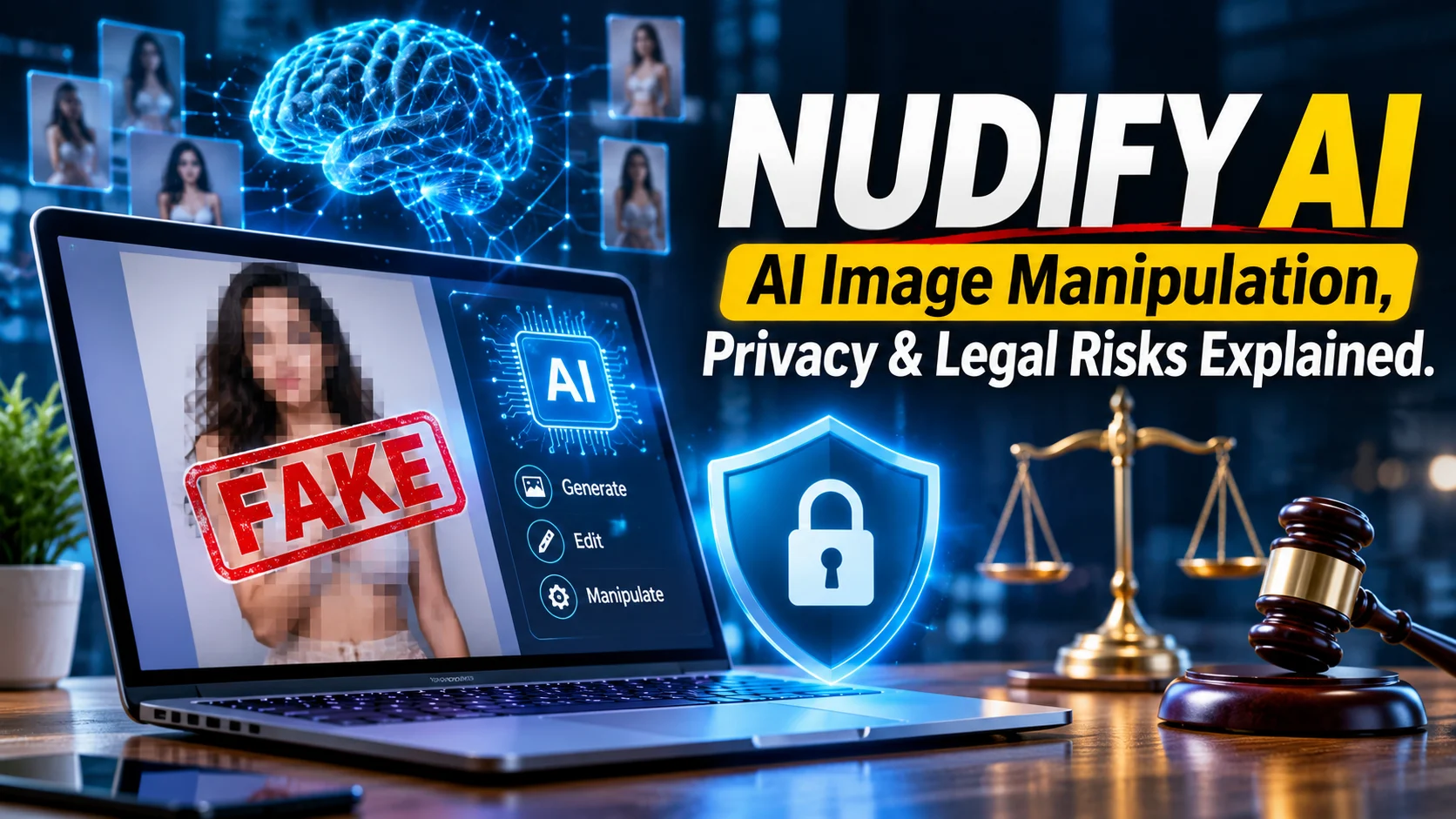
Nudify AI refers to artificial intelligence tools that manipulate photographs to create fake nude or sexually explicit images of people. These applications raise serious concerns about consent privacy image-based abuse cybersecurity and the growing legal consequences of non-consensual intimate imagery.
Nudify AI at a Glance
- Category: AI image manipulation and synthetic intimate imagery.
- Main purpose: Generate artificial nude or sexually suggestive versions of photographs.
- Technology: Generative AI, image synthesis, and deepfake techniques.
- Common concern: Creating or distributing intimate images without permission.
- Privacy risks: Uploaded photographs may expose sensitive personal information.
- Legal considerations: Non-consensual intimate imagery may violate criminal, civil, or privacy laws, depending on jurisdiction.
- Important distinction: An AI-generated intimate image is not proof that the depicted person was ever photographed nude.
What Is Nudify AI?
Nudify AI is a general term for applications that use artificial intelligence to digitally alter photographs of clothed people and produce fabricated nude or sexually explicit imagery.
These applications are also described as AI undressing tools AI clothes removers or synthetic intimate image generators.
Unlike conventional photo-editing software these systems use generative models to create visual content that was not present in the original photograph.
The resulting image may appear realistic but it does not represent an authentic photograph of the person’s body.
The term Nudify AI can refer to individual websites mobile applications bots or image-manipulation services. It is not necessarily the name of one particular AI company or technology.
Why Has Nudify AI Attracted Attention?
Several developments have increased public attention around these applications:
- Improvements in generative image technology.
- Wider availability of consumer AI tools.
- Easier access to automated image manipulation.
- Increased circulation of synthetic intimate images online.
- Growing concern about harassment and digital exploitation.
- New legislation addressing non-consensual sexual imagery.
The central issue is not simply whether AI can manipulate photographs. It is whether people have control over how their likeness is used.
How Does Nudify AI Work?
Nudify AI applications generally use generative image-processing technology to produce synthetic intimate imagery.
The underlying technology overlaps with methods used in image generation and deepfake creation. However the intended application and the potential harm are different.
1. Image Analysis
An AI system analyzes an uploaded photograph to identify visual elements, including:
- Human figures and body positioning.
- Clothing and visible body regions.
- Lighting and shadows.
- Image composition.
- Background details.
This analysis helps the model understand the original photograph.
2. Generative Image Processing
Generative AI models learn patterns from large collections of training data.
Depending on the system, image generation may involve diffusion models, image-to-image transformations, or other neural network architectures.
These technologies can generate new visual details that were not present in the original photograph.
3. Synthetic Image Creation
The application generates an altered image based on its learned visual patterns.
The result is synthetic, even when it resembles a real photograph.
Importantly, the generated anatomy, appearance, and other visual details may be inaccurate or entirely fabricated.
4. Image Quality and Realism
The apparent quality of generated imagery depends on several factors:
- Original photograph quality.
- Model architecture.
- Training data.
- Image resolution.
- Lighting consistency.
- Generative model limitations.
A realistic-looking result does not establish authenticity.
It is also important to understand that AI-generated intimate images can cause harm even when obvious visual errors make them appear artificial.
Technologies Behind Nudify AI
Understanding the underlying technology helps explain why synthetic intimate imagery has become easier to produce.
Generative Artificial Intelligence
Generative AI creates new content based on patterns learned during training.
It can generate text, images, audio, and video.
In image manipulation, generative systems can produce visual details that do not exist in the original photograph.
Diffusion Models
Diffusion models are a major approach to modern image generation.
They learn to create images by progressively transforming noise into structured visual content.
These models can also support image editing and image-to-image generation.
Deepfake Technology
Deepfakes use AI to create or manipulate media that appears to depict real people.
Although deepfakes are often associated with videos, they can also involve still photographs.
Nudification applications represent a particularly harmful category of synthetic image manipulation when used without consent.
Image-to-Image Transformation
Image-to-image systems transform an existing image while attempting to preserve selected visual characteristics.
The output may retain aspects of the original composition while introducing AI-generated elements.
This does not make the resulting image an authentic record of the depicted person.
Why Is Nudify AI Controversial?
The controversy surrounding Nudify AI involves consent, personal autonomy, and the misuse of photographs.
A publicly accessible photograph is not permission to create an intimate image of the person.
Likewise, permission to photograph someone does not automatically provide permission to manipulate that photograph into sexual content.
Non-Consensual Intimate Imagery
Non-consensual intimate imagery commonly abbreviated as NCII refers to intimate or sexually explicit imagery created or distributed without the depicted person’s consent.
This category can include:
- Authentic private photographs shared without permission.
- AI-generated sexual deepfakes.
- Manipulated photographs that falsely depict nudity.
- Synthetic intimate videos.
- Threats involving fabricated sexual imagery.
The distinction between authentic and synthetic imagery matters for evidence and legal analysis. Both can cause serious harm.
Digital Harassment and Reputation Damage
A fabricated intimate image can be distributed through social networks messaging applications websites and online communities.
Victims may experience embarrassment harassment reputational damage workplace difficulties and emotional distress.
The problem can become more serious when someone uses fabricated images to threaten intimidate or blackmail another person.
Risks to Women and Girls
Research has identified AI undressing applications as a growing form of image-based sexual abuse.
A 2026-published study examining 29 undressing applications investigated their technical capabilities marketing revenue models and privacy practices.
Its findings highlight concerns about the normalization of non-consensual intimate imagery and the objectification of women. PubMed
Children face especially serious risks. Creating requesting possessing or distributing sexual imagery involving minors can trigger severe legal consequences even when AI generates the material.
Is Nudify AI Legal?
Legally sensitive technology
The legality of Nudify AI depends on the country the person’s age consent the purpose of creation and whether the image is distributed or used for threats.
There is no single international law covering every situation.
Some jurisdictions criminalize creating non-consensual synthetic intimate images. Others focus primarily on distribution harassment threats or exploitation.
United States: TAKE IT DOWN Act
The United States enacted the TAKE IT DOWN Act on May 19, 2025.
The law addresses the intentional publication of non-consensual intimate visual depictions, including certain digitally fabricated images.
It also requires covered platforms to establish removal procedures.
The Federal Trade Commission began enforcing the platform removal requirements in May 2026. Covered platforms must remove qualifying content within 48 hours after receiving a valid request and address known identical copies under the law. GovInfo+1
This is an important development because it recognizes that fabricated intimate imagery can cause harm even when no authentic nude photograph exists.
United Kingdom: New Deepfake and Nudification Offences
The United Kingdom has introduced specific offences addressing synthetic intimate imagery.
Under sections 66E and 66F of the Sexual Offences Act 2003, creating or requesting the creation of purported intimate images of adults without consent can constitute an offence in England and Wales.
Further legislation introduced section 66I, which targets making, adapting, supplying, or offering to supply tools intended to generate purported intimate images.
These provisions came into force on February 6 and June 29, 2026, respectively. Legislation.
This is particularly significant because the legislation addresses both the creation of non-consensual images and the supply of tools designed to facilitate their creation.
Pakistan: Prevention of Electronic Crimes Act
Pakistan’s Prevention of Electronic Crimes Act (PECA) 2016 includes Section 21, which addresses offences against the modesty of a natural person and a minor.
Its provisions cover specified conduct involving sexually explicit images, including superimposing a person’s face onto sexually explicit imagery, when the statutory requirements concerning public transmission and harmful intent are met.
The section also provides for imprisonment and fines, with additional provisions concerning minors and removal or blocking of offending information.
People affected by synthetic intimate imagery in Pakistan should consider seeking advice from a qualified local lawyer or an appropriate cybercrime reporting authority.
Important: These examples are jurisdiction-specific, not universal legal advice. A person’s location, the location of the perpetrator, and the circumstances of the incident can all affect the applicable law.
Privacy and Security Risks of Nudify AI Websites
Privacy is one of the most overlooked issues surrounding AI image manipulation applications.
Uploading a photograph to an unfamiliar website can create risks beyond the generated image itself.
1. Photograph Storage
Some services process uploaded photographs on remote servers.
Users should investigate whether a platform stores original images, generated results, or associated account information.
A statement that images are deleted after processing should be supported by a clear retention policy.
2. Facial and Biometric Information
Photographs may contain identifiable facial information.
When an image is uploaded, users may expose personal visual data to a service whose ownership, infrastructure, and data practices are unclear.
3. Third-Party Data Sharing
An application may rely on external hosting providers, analytics services, payment processors, or AI infrastructure providers.
Users should check whether its privacy policy explains these relationships.
4. Payment and Subscription Risks
Some questionable services advertise free image processing but introduce payment requirements, recurring subscriptions, or unclear cancellation conditions.
Users should be cautious about providing payment information to unfamiliar websites.
5. Malware and Phishing
Unverified applications and downloads may expose users to:
- Malicious software.
- Credential theft.
- Fake subscription pages.
- Browser redirects.
- Suspicious permissions.
- Fraudulent payment requests.
Avoid installing unknown applications or providing unnecessary personal information.
What Should Users Check Before Trusting an AI Image Service?
| Privacy factor | What to investigate |
|---|---|
| Image retention | How long are uploaded files stored? |
| Deletion policy | Can users request permanent deletion? |
| Data sharing | Are photographs shared with third parties? |
| Encryption | Is information protected during transmission and storage? |
| Ownership | Is the company clearly identified? |
| Payment terms | Are recurring charges and cancellation conditions explained? |
| Age restrictions | Are safeguards against exploitation of minors documented? |
An HTTPS connection does not prove that an application handles photographs responsibly. Similarly, an encryption claim does not automatically establish a strong privacy policy.
What Are the Safer Alternatives to Nudify AI?
The right alternative depends on what someone wants to accomplish with image editing.
There are legitimate reasons to use AI for photography, fashion visualization, portrait editing, and digital design. These tasks do not require creating non-consensual intimate imagery.
Instead of using applications designed to fabricate nude images of real people, consider tools with transparent editing policies and consent-based workflows.
Recommended AI Image Editing Alternatives
10 Best AI Photo Editing Tools (April 2026) – Unite.AI
| Platform | Target user | Key strength | Pricing transparency | Core limitation |
|---|---|---|---|---|
| Adobe Photoshop | Professional designers | Advanced photo editing and compositing | Public subscription plans | Learning curve |
| Adobe Firefly | Creators and designers | Generative image creation and editing | Public plans and credit allowances | Generative results need review |
| Canva | General users and marketers | Accessible AI-assisted visual design | Free and paid plans | Less control over advanced editing |
These are alternatives for legitimate creative editing, not equivalent nudification services.
Adobe Photoshop
Photoshop offers professional image editing, compositing, retouching, and generative editing capabilities.
It is useful for photographers and designers who need control over their visual projects.
Adobe Firefly
Firefly supports AI-assisted image generation and editing.
It can help creators explore visual concepts, produce creative assets, and modify authorized images.
Canva
Canva provides accessible design tools for social media graphics, presentations, marketing materials, and visual content.
Its AI-assisted editing features can help non-designers create polished graphics without advanced editing skills.
How to Protect Yourself From AI-Generated Nude Images
People do not need to upload intimate photographs to experience image-based abuse.
An ordinary public photograph can be manipulated into a fabricated sexual image.
If you discover that someone has created or shared an intimate deepfake of you, take practical steps to protect yourself.
1. Preserve Evidence
Save relevant evidence before requesting removal.
This may include:
- Screenshots of the content.
- Website addresses.
- Usernames and account details.
- Publication dates.
- Messages and threats.
- Relevant email notifications.
Keep original evidence where possible. Avoid forwarding or redistributing explicit material.
If the content involves a minor, do not download, copy, or circulate the material. Contact the appropriate child-protection or law-enforcement authority.
2. Report the Content
Report the image to the platform where it appears.
Select the closest available reporting category, such as non-consensual intimate imagery, sexual exploitation, harassment, or manipulated media.
Google also provides a removal request process for explicit images that falsely depict someone as nude or in a sexual situation. Google Search Help+1
3. Use StopNCII.org
Sextortion advice and guidance for adults
StopNCII.org
Free support tool
Official website: StopNCII.org
StopNCII helps adults prevent the spread of qualifying intimate images through participating platforms.
It creates a digital fingerprint, called a hash, directly on the user’s device. The original image does not need to be uploaded to the service.
Participating platforms can use that fingerprint to identify matching content and enforce their policies.
There are limitations: StopNCII cannot remove content from every website or the entire internet. Stop NCII+1
4. Use Take It Down for Images Involving Minors
The National Center for Missing and Exploited Children operates this service.
It helps people address nude, partially nude, or sexually explicit images taken when they were under 18.
Like StopNCII, it uses digital fingerprinting without requiring the original image to leave the user’s device.
It works with participating platforms, not every website or messaging service. Take It Down
5. Seek Professional Support
Victims may benefit from legal advice, digital safety assistance, and emotional support.
If someone threatens to publish fabricated intimate images, avoid paying demands or negotiating alone.
For immediate threats, blackmail, or risks involving minors, contact the relevant authorities.
Can AI Detect Fake Nude Images?
AI can assist with detecting manipulated imagery, but reliable detection remains challenging.
Some systems analyze visual inconsistencies, image artifacts, facial characteristics, and other signals associated with synthetic media.
However, detection tools have limitations.
Common Detection Methods
Visual artifact analysis: Examines inconsistencies in lighting, textures, edges, and image details.
Metadata analysis: Reviews available information about an image’s origin and editing history.
Digital provenance: Uses available content credentials or signed metadata to help establish how an image was created or modified.
Machine-learning detection: Classifiers estimate whether an image contains signs of synthetic generation or manipulation.
Why Deepfake Detection Is Difficult
AI image generators continue to improve.
Compression, resizing, screenshots, filters, and additional editing can also remove or obscure useful forensic signals.
A detector may incorrectly classify an authentic photograph or fail to identify a manipulated one.
Therefore, detection results should be treated as supporting evidence, not definitive proof.
The absence of a detection warning does not establish that an image is authentic.
Who Should Understand Nudify AI?
Although the technology itself is controversial, understanding it is important for several audiences.
| Audience | Why it matters |
|---|---|
| General users | Understand privacy and consent risks |
| Parents and educators | Recognize AI image-based abuse |
| Cybersecurity professionals | Study threats involving synthetic imagery |
| Journalists | Report accurately on AI manipulation |
| Policymakers | Develop appropriate legal safeguards |
| Technology companies | Improve moderation and misuse prevention |
| Researchers | Study deepfakes and image-based abuse |
For developers and technology companies, the challenge extends beyond image generation.
Responsible systems need safeguards against non-consensual use, protection for minors, effective reporting processes, and mechanisms for preventing repeated abuse.
Responsible AI: What Should Technology Companies Do?
AI companies have an important role in preventing misuse.
Technical safeguards should be considered during product development rather than added only after abuse occurs.
Important measures include:
- Blocking non-consensual intimate image generation.
- Preventing sexual image generation involving minors.
- Restricting abusive prompts and repeated misuse.
- Providing accessible reporting mechanisms.
- Establishing transparent data-retention policies.
- Limiting unnecessary access to uploaded photographs.
- Responding quickly to credible abuse reports.
- Monitoring attempts to bypass safety protections.
Content moderation should also account for synthetic images, not just authentic photographs.
A fabricated image can violate someone’s privacy and dignity even when it does not document a real intimate event.
Common Myths About Nudify AI
| Myth | Reality |
|---|---|
| AI-generated nude images are harmless because they are fake. | Fabricated images can cause serious personal and reputational harm. |
| Public photographs can be used for any purpose. | Public availability does not establish consent for intimate manipulation. |
| AI-generated images are always easy to detect. | Modern synthetic imagery can be difficult to identify reliably. |
| Deleting an uploaded image removes every copy. | Copies may remain on other systems or have been downloaded. |
| Only celebrities are targeted. | Ordinary individuals can also experience image-based abuse. |
| AI-generated images cannot create legal problems. | Several jurisdictions recognize legal protections against synthetic intimate imagery. |
Frequently Asked Questions About Nudify AI
1. What is Nudify AI?
Nudify AI refers to artificial intelligence applications that manipulate photographs to create fabricated nude or sexually explicit images. These applications use generative image technology and raise concerns about consent, privacy, and image-based abuse.
2. How does Nudify AI work?
Nudify AI applications use generative image-processing models to analyze photographs and produce synthetic visual content. Technologies associated with these systems include diffusion models, neural networks, and image-to-image generation.
3. Is Nudify AI legal?
Its legality depends on the jurisdiction and circumstances. Several countries have introduced laws addressing non-consensual intimate deepfakes. The United States, United Kingdom, and Pakistan have legal provisions that may apply to different forms of this conduct.
4. Can AI-generated nude images be detected?
Some detection systems analyze image artifacts, metadata, digital provenance, and machine-learning signals. However, detection is not completely reliable, and results should not be treated as definitive proof of authenticity.
5. What should I do if someone creates a fake nude image of me?
Preserve relevant evidence, report the content to the hosting platform, and seek appropriate legal support. Adults can also explore StopNCII.org, while people affected by images taken when they were under 18 can use NCMEC’s Take It Down service.
Conclusion
Nudify AI represents a controversial application of generative image technology. Although it demonstrates the capabilities of modern AI image manipulation, its misuse raises serious questions about consent, privacy, and digital safety.
The most important consideration is that creating a fabricated intimate image of someone without permission can cause genuine harm. Legal protections are also expanding in several jurisdictions.
For individuals, understanding the risks and available reporting resources is essential. For developers and businesses, responsible AI design, strong safeguards, and transparent privacy practices should remain priorities.
AI innovation should respect personal dignity, consent, and individual rights.

Oliver Wilson is an AI researcher and tech writer living at the intersection of human creativity and machine intelligence. At AixOrbit.com, he decodes complex neural networks, generative AI and emerging tech trends into actionable insights making sure humans stay one step ahead of the algorithms.