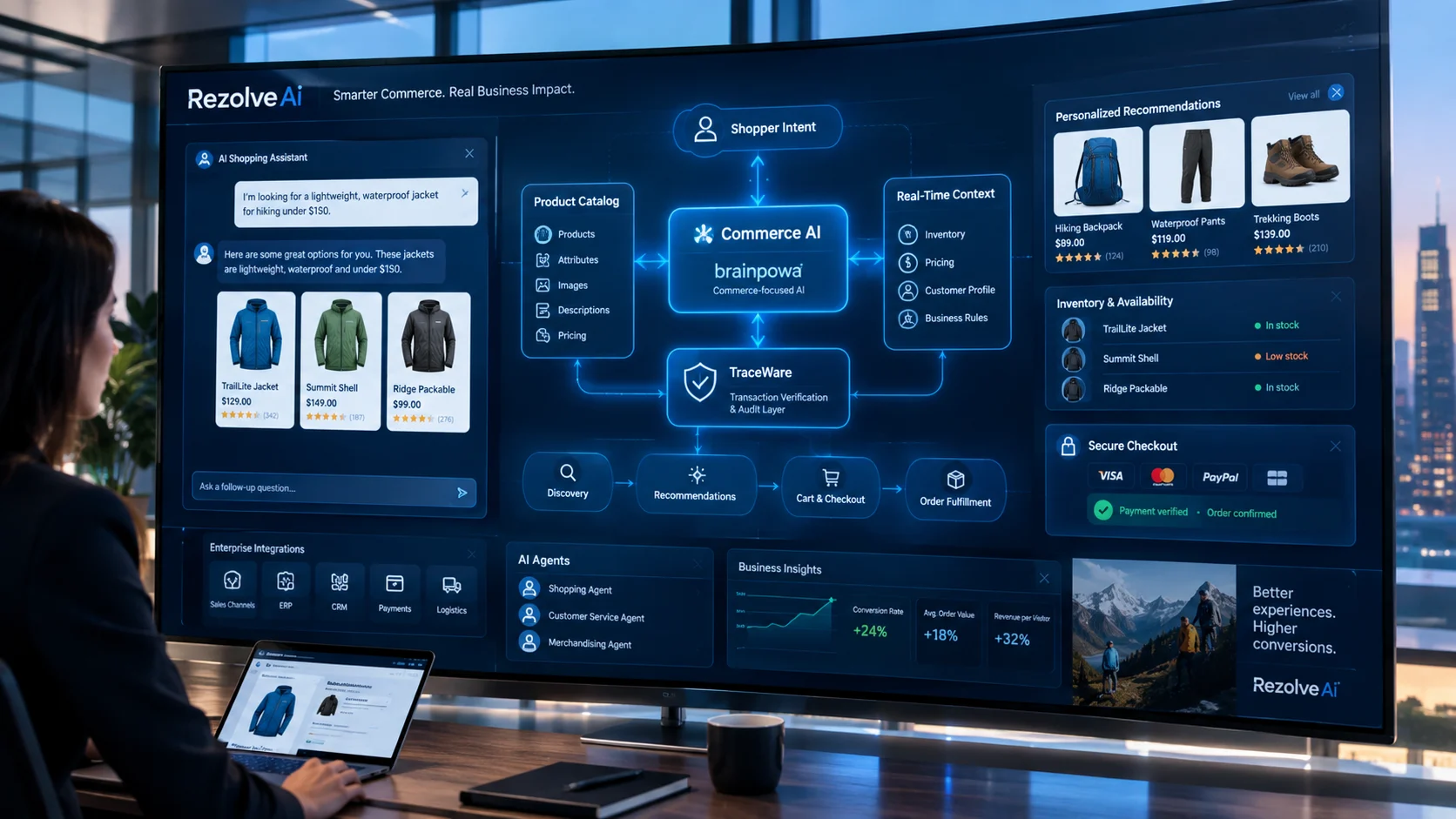
Rezolve Ai is an AI commerce technology company that helps retailers use conversational AI, product discovery, personalization and agentic workflows across the shopping journey. Its platform combines commerce-specific AI models, transaction verification and commerce infrastructure rather than functioning as a general-purpose chatbot.
Rezolve Ai at a glance
- What it is: An AI platform focused on retail, ecommerce and agentic commerce.
- Core platform: The Brain Suite, which covers conversational commerce, discovery, recommendations and transaction-oriented experiences.
- AI model: brainpowa, a commerce-focused AI architecture designed around retail and ecommerce data.
- Verification layer: TraceWare, designed to verify AI actions and transaction states.
- Public company: Rezolve Ai trades on Nasdaq under RZLV.
- Current scale: Rezolve Ai reported $130.8 million in H1 2026 revenue and said its customer base exceeded 1,640 as of September 2026.
What is Rezolve Ai?
Rezolve Ai is a technology company focused on applying artificial intelligence to digital commerce and retail.
Unlike a general-purpose AI assistant, its platform is designed around commercial tasks such as product search, product discovery, recommendations, guided selling, personalization, customer engagement and transactions.
The company’s central proposition is that ecommerce AI needs more than a language model. A shopping agent must understand products, catalogs, inventory, customer intent and commercial rules, then connect those insights to actual business systems.
Rezolve Ai calls this agentic commerce.
In practical terms, that means moving from an experience where AI simply answers, to one where AI can help a shopper discover a product, compare options, receive recommendations and potentially complete a transaction.
The company describes its platform as an AI infrastructure layer for commerce. Its Brain Suite is positioned around the end-to-end digital shopping journey, including conversational commerce, search, recommendations, checkout and customer service.
An important naming distinction
There are two different companies that can appear for “Rezolve AI” searches.
Rezolve Ai, the subject of this article, operates at rezolve.com and trades on Nasdaq as RZLV. Its focus is AI-powered commerce and retail.
Rezolve.ai, at rezolve.ai, is a separate company focused on agentic AI for enterprise IT, HR and finance service desks.
This distinction matters when researching reviews, pricing, competitors or security information. Search results can otherwise combine information from two unrelated products.
How does Rezolve Ai work?
Rezolve Ai’s architecture is built around a commerce-specific AI layer rather than relying solely on a general-purpose LLM.
The company says its brainpowa technology is trained and designed for ecommerce use cases. Its stated purpose is to ground AI interactions in product and retail information, including catalog data and commercial context.
The second important component is TraceWare.
TraceWare is designed to verify what actually happened during an AI-assisted customer journey. This addresses a particularly important problem in agentic commerce: an AI system could theoretically tell a customer that something happened when the underlying transaction system says it did not.
For example, consider an AI shopping assistant that says:
“Your product has been added to the cart.”
A reliable commerce architecture needs to distinguish between generating that sentence and verifying that the cart actually changed.
Rezolve Ai says TraceWare addresses this type of “journey hallucination” by checking AI claims against execution data and transaction states.
The company’s May 2026 announcement described research presented at ACM UMAP 2026 involving user-state verification in conversational commerce. The research was conducted by Rezolve Ai Labs and the University of Sarajevo. The company’s description of the research should still be distinguished from independent validation of the entire commercial platform.
What are the main Rezolve Ai products?
Rezolve Ai’s product strategy is broader than an ecommerce chatbot.
Brain Commerce
Brain Commerce is the company’s core commerce experience platform.
It combines capabilities such as:
- Conversational commerce
- Ecommerce search
- Product recommendations
- Personalization
- Merchandising
- Product and data enrichment
- Analytics
- SEO-related commerce capabilities
The goal is to connect discovery and conversion instead of treating search, recommendations and customer assistance as isolated tools.
brainpowa
brainpowa is Rezolve Ai’s proprietary commerce-focused AI architecture.
The company positions it as a retail-specific alternative to relying entirely on generic foundation models. It is intended to understand commerce terminology, product attributes, shopping intent and retailer-specific information.
In April 2026, Rezolve Ai announced that brainpowa commerce-tuned models became available through Microsoft Foundry, allowing businesses to build commerce-focused AI applications on Azure.
That is strategically significant because it puts Rezolve Ai’s specialized models inside an established enterprise AI distribution ecosystem.
TraceWare
TraceWare is the platform’s verification and audit layer.
Its purpose is different from the LLM itself. Rather than generating a response, it is intended to check whether AI-generated claims and actions correspond to actual execution data.
That distinction is important for commerce because errors can affect transactions, prices, availability, orders and customer trust.
Auditable AI
In July 2026, Rezolve Ai introduced Auditable AI, designed to provide explanations for AI-generated product recommendations.
The company says recommendations can be explained using factors such as customer preferences, product attributes, purchase history and business rules.
For enterprise buyers, this points toward a broader architecture:
AI model → commerce context → action → verification → explanation
That is more complex than simply placing an LLM behind a shopping chatbot.
Rezolve Ai use cases
Rezolve Ai is primarily relevant to organizations with substantial digital commerce operations.
Conversational shopping
Instead of forcing shoppers to formulate precise keyword queries, a conversational interface can interpret natural-language intent.
A shopper might ask for:
“A lightweight black jacket for rainy weather under $150.”
The system needs to understand attributes such as color, weather suitability, weight and price, then connect them to actual catalog data.
Product discovery
AI can help users find products through conversational, semantic or visual interactions.
This matters particularly for retailers with large catalogs where traditional keyword search can struggle with ambiguous queries.
Personalization
Rezolve Ai also targets personalized recommendations based on shopper behavior, product information and business rules.
The commercial objective is not simply relevance. Retailers typically care about metrics such as conversion rate, average order value and revenue per visitor.
Visual search
Rezolve Ai has also been used for visual product discovery. Its published Myntra case study describes image-based search and “View Similar” functionality, with the company reporting a 35% year-over-year increase in image-search traffic.
That figure is a company-reported case-study result, not an independently established performance benchmark for every Rezolve Ai deployment.
Agentic commerce
The larger strategic direction is agentic commerce.
Here, AI does more than recommend products. It can participate in workflows that connect product discovery, decision-making and transaction systems.
That requires reliable APIs, inventory data, payment infrastructure, identity systems and transaction verification.
It also creates a much higher reliability requirement than ordinary content-generation AI.
What are the benefits of Rezolve Ai?
For an enterprise retailer, the main potential benefits are architectural rather than simply conversational.
Commerce specialization: The platform is designed around retail rather than general-purpose knowledge work.
End-to-end coverage: Rezolve Ai aims to connect discovery, recommendations, engagement and transactions.
Model specialization: brainpowa provides a commerce-oriented AI layer.
Verification: TraceWare is designed to validate AI activity against actual transaction states.
Enterprise distribution: Rezolve Ai has announced relationships involving Microsoft, Google Cloud, TCS and Tech Mahindra.
AI-native discovery: The platform addresses the shift from conventional search toward conversational and AI-mediated product discovery.
The important caveat is that these capabilities do not automatically translate into better commercial performance for every retailer. Results depend on catalog quality, integrations, product data, traffic, UX design, business rules and implementation quality.
What are the limitations and risks?
Rezolve Ai should be evaluated as an enterprise commerce platform, not simply as another AI chatbot.
Implementation complexity
Agentic commerce touches systems such as:
- Product information management
- Ecommerce platforms
- Inventory
- Pricing
- Customer identity
- Payments
- Order management
- Analytics
- CRM and customer-service systems
The more systems an AI agent can access, the more important permissions, testing and monitoring become.
Vendor dependency
Using a proprietary commerce platform can create long-term dependency on the vendor’s APIs, architecture and product roadmap.
Enterprise buyers should therefore evaluate data portability, API access, integration ownership and exit requirements before signing a long-term agreement.
AI accuracy remains contextual
Rezolve Ai makes strong claims about reducing hallucinations and improving reliability. Those claims should not be interpreted as meaning that AI is incapable of producing errors.
A production deployment still needs testing, monitoring, fallback paths and human escalation for appropriate cases.
Pricing transparency
Rezolve Ai does not publish a simple self-service price list for its enterprise Brain Commerce platform.
Its commercial model is therefore best treated as sales-led and quote-based. Buyers should request a detailed proposal covering licensing, implementation, integrations, support, usage and renewal terms.
That is especially important because two AI commerce platforms can appear similarly priced while having very different implementation and infrastructure costs.
How much does Rezolve Ai cost?
Public pricing for the enterprise Rezolve Ai commerce platform is not presented as a simple monthly per-user or per-query plan.
The company directs prospective customers toward product demonstrations and commercial discussions.
That means a serious evaluation should request a total-cost-of-ownership breakdown, including:
- Platform or subscription fees
- Implementation costs
- Integration work
- Data preparation
- Support and professional services
- Usage-related charges, if applicable
- Contract minimums
- Renewal terms
- Additional modules
- Exit and data-export provisions
This is more useful than comparing headline prices alone.
Rezolve Ai competitors and alternatives
Rezolve Ai overlaps several technology categories, so there is no single perfect competitor.
| Platform/Tool | Target User | Key Strength | Pricing Transparency | Core Limitation |
|---|---|---|---|---|
| Rezolve Ai | Enterprise retailers | Commerce AI, discovery and agentic commerce | Mostly sales-led | Enterprise implementation complexity |
| Algolia | Developers, ecommerce and digital teams | Search, discovery and APIs | High for self-service tiers | More search-centric than end-to-end commerce infrastructure |
| Constructor | Enterprise ecommerce teams | Search, browse, recommendations and AI shopping agents | Sales-led | Primarily focused on product discovery |
| Yext | Enterprises managing digital experiences | Search, content and knowledge experiences | Varies by product | Broader digital experience scope |
| Salesforce Commerce ecosystem | Existing Salesforce customers | Commerce, CRM and AI integration | Enterprise pricing | Strongest fit when already invested in Salesforce |
Algolia, for example, currently publishes self-service plans with usage limits, while enterprise pricing is available by request. Constructor positions its platform around ecommerce search, browse, recommendations and AI shopping agents.
The choice therefore depends heavily on architecture.
A retailer looking primarily for search infrastructure may evaluate search specialists.
A retailer looking to build a broader AI commerce layer spanning discovery, recommendation, conversation and transactions may evaluate platforms such as Rezolve Ai alongside broader commerce ecosystems.
Rezolve Ai’s 2026 developments
- Rezolve Ai has expanded its positioning significantly during 2026.
- In April, the company announced the availability of brainpowa models in Microsoft Foundry.
- In May, it announced research around TraceWare and verification of AI-generated commerce journeys.
- In July, it introduced Auditable AI, adding an explainability layer to its commerce architecture.
- In August, Rezolve Ai announced a global alliance with Tech Mahindra intended to support enterprise deployments of agentic commerce.
The company’s September 2026 results reported $130.8 million in revenue for the first six months of 2026, compared with $6.3 million in the same period of 2025, and said its customer base exceeded 1,640. The SEC filing confirms the $130.788 million H1 revenue figure.
Rezolve Ai also reaffirmed approximately $360 million in 2026 revenue guidance. That is company guidance, not an independently verified forecast, so it should be treated accordingly.
The broader story is clear: Rezolve Ai is attempting to position itself beyond conversational retail AI and toward the infrastructure required for agentic commerce.
Who should consider Rezolve Ai?
Rezolve Ai is most relevant to large retailers and commerce organizations that need AI across a substantial customer journey.
It may be worth evaluating if you have:
- A large or complex product catalog
- Significant ecommerce traffic
- Existing search and recommendation infrastructure
- A need for conversational shopping
- Multiple customer touchpoints
- Enterprise integration requirements
- A strategy around AI shopping agents
- Sufficient technical resources to manage integrations
It may be less appropriate if you only need a basic chatbot, simple site search or a lightweight recommendation widget.
In those cases, a narrower SaaS product can be easier to deploy and evaluate.
What should enterprises evaluate before buying?
A proof of concept should go beyond a polished AI demo.
Ask the vendor to demonstrate real scenarios using representative data.
Test product accuracy
Give the system ambiguous, long-tail and incomplete queries.
Measure whether the returned products actually satisfy the shopper’s intent.
Test transactional accuracy
Ask the AI to perform actions such as adding an item to a basket or checking order status.
Then independently verify the underlying transaction state.
Test failure handling
Deliberately create cases involving:
- Out-of-stock products
- Conflicting product attributes
- Invalid discounts
- Missing customer information
- API failures
- Ambiguous requests
A reliable agent should fail safely rather than confidently inventing an answer.
Examine integration architecture
Ask which systems are connected directly and which depend on middleware or APIs.
Also clarify who owns the integration code and how it is maintained.
Review commercial terms
Do not evaluate only the license.
Calculate the full five-year cost, including implementation, integrations, support, infrastructure and potential migration costs.
Frequently asked questions
What is Rezolve Ai?
Rezolve Ai is a public technology company focused on AI-powered commerce and retail. Its platform provides conversational commerce, product discovery, recommendations, personalization and infrastructure for agentic commerce.
Is Rezolve Ai the same as Rezolve.ai?
No. Rezolve Ai and Rezolve.ai are separate companies. Rezolve Ai focuses on retail and ecommerce, while Rezolve.ai focuses on agentic service-desk automation for enterprise IT, HR and finance.
What is brainpowa?
brainpowa is Rezolve Ai’s proprietary commerce-focused AI architecture. The company positions it as a retail-specific AI technology designed for product discovery, personalization and conversational commerce.
Does Rezolve Ai publish pricing?
Rezolve Ai does not present a simple public self-service pricing table for its enterprise commerce platform. Prospective customers are directed toward sales and product discussions, so actual costs need to be established through a commercial proposal.
Is Rezolve Ai publicly traded?
Yes. Rezolve Ai plc is publicly traded on Nasdaq under the ticker RZLV. Its investor disclosures and SEC filings provide information about financial results, business developments and company guidance.
Conclusion
Rezolve Ai is best understood as an AI commerce infrastructure company, not merely a chatbot provider.
Its strategy combines commerce-focused AI through brainpowa, verification through TraceWare, explainability through Auditable AI, and broader commerce capabilities spanning search, recommendations, personalization and transactions.
The strongest reason to evaluate it is therefore not a single AI feature. It is the attempt to connect AI intelligence with the operational systems required to make ecommerce actions reliable.
The main questions for buyers are equally practical: how well does it perform on your catalog, how deeply must it integrate with your stack, what does implementation cost, how transparent are its AI decisions, and what contractual or technical dependencies will exist over time?
For enterprise retailers moving toward conversational and agentic shopping, those questions matter more than a generic AI feature checklist.

Oliver Wilson is an AI researcher and tech writer living at the intersection of human creativity and machine intelligence. At AixOrbit.com, he decodes complex neural networks, generative AI and emerging tech trends into actionable insights making sure humans stay one step ahead of the algorithms.