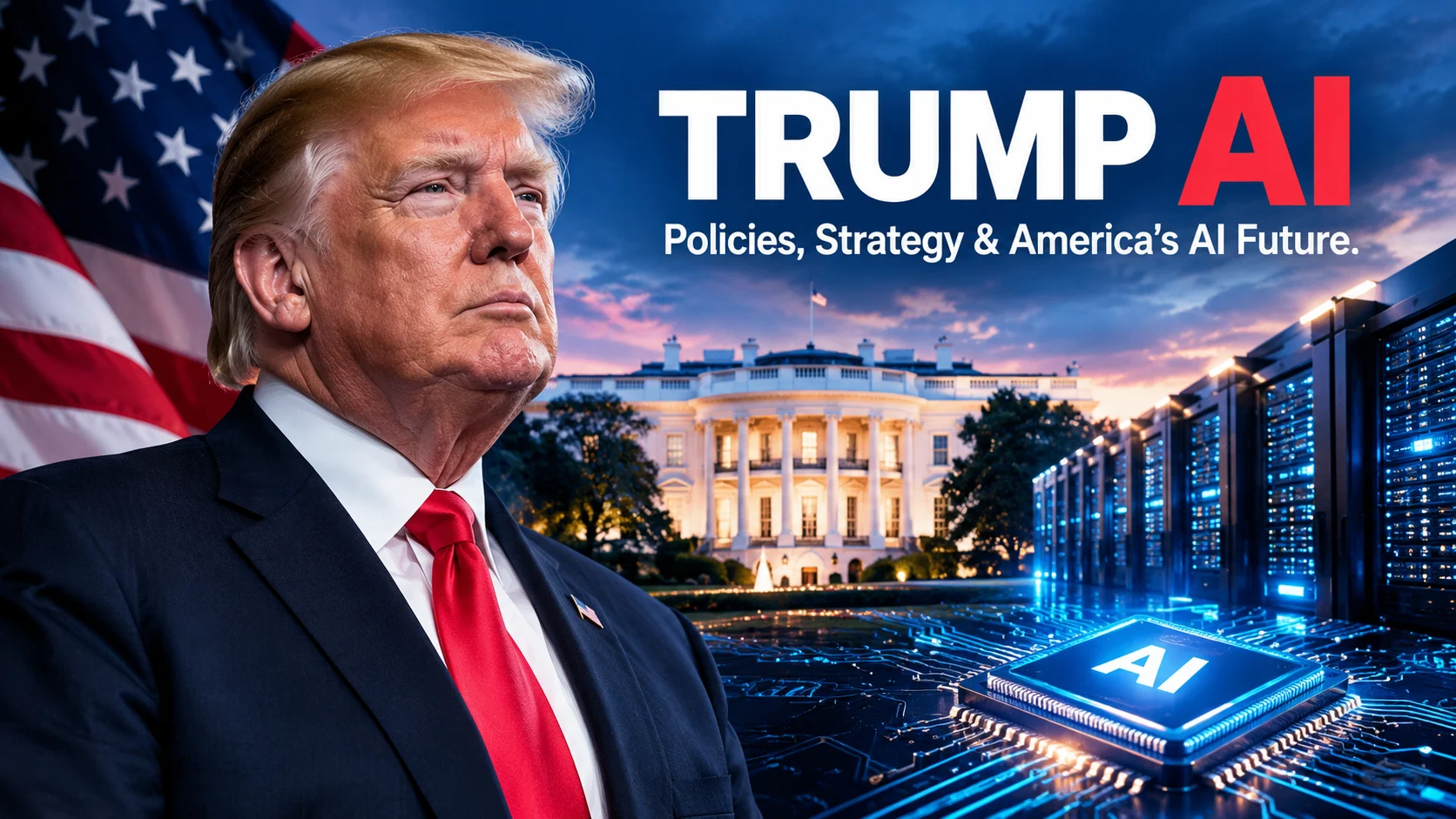
Trump AI refers primarily to President Donald Trump’s approach to artificial intelligence, including US innovation policy, AI infrastructure investment, national security, and regulation. His administration’s strategy emphasizes American technological leadership, faster AI development, expanded computing infrastructure, and a stronger competitive position against China.
Trump AI at a glance
Primary objective
Strengthen US leadership in artificial intelligence and compete globally.
Core policy document
America’s AI Action Plan, released by the White House on July 23, 2025. The White House
Major priorities
AI research, data centers, computing infrastructure, energy supply, and American AI exports.
Security focus
Protect critical infrastructure and assess advanced AI systems for potential cybersecurity risks.
Regulatory direction
Favor faster innovation and a more unified federal approach, while continuing debates about safeguards and state authority.
Important distinction
Trump AI is not the name of one official chatbot or AI model. It generally describes policies, government initiatives, and news related to Trump and AI.
What Does Trump AI Mean?
The keyword Trump AI has several related meanings. Most commonly, it refers to Donald Trump’s artificial intelligence policies and the initiatives his administration has introduced to influence the technology’s development in the United States.
It can also refer to news about Trump and AI, AI-generated images or videos depicting him, political deepfakes, and discussions about how artificial intelligence could affect elections, public communication, and government operations.
Understanding the distinction matters because these topics involve different questions. Someone searching for Trump’s AI policy needs an explanation of government decisions, while someone searching for a Trump AI image generator may be looking for a creative tool.
This article focuses on the administration’s AI strategy, its major policy decisions, the opportunities it aims to create, and the challenges those decisions raise.
Trump’s AI Strategy The Main Priorities
The Trump administration’s approach centers on making the United States a leading developer and exporter of artificial intelligence technology.
On July 23, 2025, the White House announced America’s AI Action Plan, a policy blueprint organized around three pillars: accelerating innovation, building American AI infrastructure, and strengthening international diplomacy and security. The White House+1
1. Accelerating AI Innovation
The administration argues that excessive regulation can slow research, product development, and commercial adoption.
Executive Order 14179, signed on January 23, 2025, established the administration’s direction for removing barriers to American AI leadership. It reversed the previous administration’s 2023 AI executive order and directed the development of a new action plan. The White House+1
The broader policy direction favors creating conditions in which technology companies, researchers, and startups can develop and deploy AI systems.
Potential beneficiaries include:
- AI startups developing new applications and services.
- Technology companies training advanced machine learning models.
- Businesses integrating AI into existing products.
- Research institutions exploring new AI capabilities.
- Developers building tools for healthcare, education, manufacturing, and other industries.
However, fewer regulatory barriers do not automatically guarantee safer systems, better products, or successful businesses. Those outcomes depend on implementation, competition, technical quality, and effective risk management.
2. Building AI Infrastructure
Modern AI depends on more than software. Training and operating advanced models require specialized chips, data centers, high-speed networking, and substantial electricity.
America’s AI Action Plan therefore emphasizes expanding domestic infrastructure and improving the conditions for constructing data centers, semiconductor facilities, and energy projects. The White House+1
This priority matters because computing capacity affects how quickly companies can train models, serve users, and develop more demanding applications.
Infrastructure expansion may also create demand for electrical equipment, cooling systems, construction services, cloud computing, and skilled technical workers.
The trade-offs deserve attention. Data centers can place pressure on local power grids, water resources, land use, and electricity costs. Faster construction must still account for environmental effects, community needs, and infrastructure reliability.
3. Strengthening National Security
AI can help defenders analyze cyber threats, identify software vulnerabilities, and respond to security incidents. The same capabilities can also help malicious actors discover weaknesses or develop more sophisticated attacks.
The administration has consequently placed greater emphasis on AI security within critical infrastructure and government systems.
On June 2, 2026, Trump signed Executive Order 14409, titled Promoting Advanced Artificial Intelligence Innovation and Security. The order includes measures for AI-enabled cybersecurity, vulnerability identification, and a voluntary framework for government engagement with developers of certain advanced AI models. The White House+2
The order calls for a classified benchmarking process to assess advanced models’ cyber capabilities. It also describes a voluntary framework that can provide the government and trusted partners with early access to qualifying models.
Importantly, the order explicitly says it does not authorize mandatory government licensing or preclearance for the development or release of AI models. The White House
The central challenge is balancing security with innovation. Government access to advanced systems could help identify serious risks, but the process also raises questions about confidentiality, intellectual property, oversight, and which models qualify for review.
Latest Trump AI Developments in 2026
Trump’s AI agenda has continued to evolve beyond the original 2025 action plan. Several developments are particularly relevant to anyone following US technology policy.
September 2026: The administration introduces “Super Intelligence”
On September 29, 2026, the White House announced an executive order titled Inaugurating the Era of Super Intelligence. The order directs executive branch departments and agencies to use “Super Intelligence” and “SI” instead of “Artificial Intelligence” and “AI” in specified official communications and documents. It also directs the administration to propose a federal definition of the new terminology. The White House+1
This is a terminology and policy initiative, not evidence that all AI technology has suddenly become more capable. The order also does not, by itself, change how commercial AI products function.
October 2026: Trump says he intends to ban the term AI
On October 27, 2026, Reuters reported that Trump said he would officially ban the term “AI” or “Artificial Intelligence” in relevant documents and other materials, arguing that “Super Intelligence” is a more accurate name. Reuters
There is an important distinction between announcing an intention and implementing a new rule. The Reuters report described Trump’s statement about a forthcoming ban; it did not establish that a separate, comprehensive ban covering all organizations and publications had already taken effect.
For readers following this story, the key questions are the eventual scope of the directive, which materials it covers, and whether it changes existing legal definitions. A change in terminology should not be confused with a ban on AI systems themselves.
December 2025: A push for a national AI policy framework
Executive Order 14365, signed on December 11, 2025, directed the administration to pursue a more unified national framework for AI regulation. It also called for an AI Litigation Task Force to challenge certain state laws considered inconsistent with the administration’s policy. GovInfo+1
This approach reflects a wider debate over whether AI companies should operate under one national framework or comply with a growing range of state-level requirements.
The executive order sets out the administration’s policy and directs government action. It should not be interpreted as meaning that every state AI law has automatically become invalid. The legal status of individual laws depends on applicable statutes, court decisions, and subsequent government action.
How Trump’s AI Policies Could Affect Businesses and Consumers
Government AI policy can influence the technology market without directly controlling every product a person uses. Its effects depend on how agencies implement policy, how Congress responds, and how businesses adapt.
Opportunities for technology companies
A policy environment that prioritizes AI development may benefit companies that build models, operate cloud infrastructure, manufacture semiconductors, or supply data-center equipment.
Potential effects include:
- More infrastructure investment: Demand for computing capacity may create opportunities for cloud providers, chipmakers, and construction firms.
- Faster product development: Reduced regulatory burdens may allow some companies to test and launch products with fewer administrative obstacles.
- Government technology contracts: Public agencies may increase their use of AI tools for approved operational and security purposes.
- International market expansion: The administration’s export strategy aims to promote American AI technologies and related infrastructure abroad. The White House+1
These are potential benefits, not guaranteed outcomes. Investment announcements, policy proposals, and executive orders do not automatically translate into completed projects, profitable companies, or new jobs.
Possible effects on consumers
Consumers may experience the effects indirectly through products, services, employment, and public-sector applications.
For example, businesses could introduce AI features into customer support, office software, education tools, and online services. Greater competition could also create new choices or put pressure on prices.
However, the direction of consumer prices and product quality depends on market competition, infrastructure costs, and company decisions. AI policy alone cannot establish whether a particular service will become cheaper, more accurate, or more reliable.
What workers should understand
AI adoption can automate parts of some jobs while increasing demand for other skills. The effect varies by occupation and task.
Employees who learn to use AI tools responsibly may find new ways to research, analyze information, and complete routine work. Employers still need to check outputs, protect confidential information, and retain appropriate human oversight.
Workers should avoid assuming that every AI-related announcement will create jobs or eliminate existing positions. The practical impact depends on how individual employers deploy the technology.
Benefits and Concerns of Trump’s AI Approach
The administration’s strategy offers a clear direction for US AI development, but its long-term results remain uncertain.
| Policy area | Potential benefit | Main concern |
|---|---|---|
| Reduced regulatory barriers | Faster experimentation and commercialization | Inadequate safeguards if oversight falls behind |
| Domestic infrastructure | More computing capacity and investment | Energy demand and local environmental pressures |
| National security | Better tools for cyber defense | Sensitive access and oversight challenges |
| Federal policy coordination | More consistent rules for businesses | Disputes over state authority |
| International AI exports | Wider adoption of US technology | Dependence on geopolitical and market conditions |
| Advanced-model assessment | Earlier identification of security risks | Confidentiality, transparency, and implementation |
The argument for faster innovation
Supporters of the administration’s approach argue that AI is developing rapidly and that excessive regulation can disadvantage smaller companies or slow useful applications.
A consistent federal framework could reduce the complexity of complying with different state rules. Investment in computing infrastructure could also help address bottlenecks that limit advanced AI research and deployment.
These arguments are especially relevant in markets where development costs are high and companies compete internationally.
The case for stronger safeguards
Critics of lighter-touch regulation worry that powerful AI systems may spread misinformation, expose private data, reproduce harmful biases, or enable sophisticated cyberattacks.
Some risks can be managed through technical testing, access controls, security reviews, and independent evaluation. Others require legal accountability and clear processes for addressing harm.
The important distinction is between reducing unnecessary administrative barriers and removing protections that address genuine risks. Neither rapid innovation nor strict regulation guarantees good outcomes on its own.
What remains uncertain
Policy announcements often describe intended outcomes rather than independently verified results. Evaluating success requires evidence about investment actually completed, adoption rates, system performance, security incidents, and economic effects.
The administration’s claims about American AI leadership should therefore be assessed alongside independent research, company disclosures, market data, and the eventual implementation of its policies.
Trump AI vs. AI Tools Is There an Official Trump AI Chatbot?
One common source of confusion is whether “Trump AI” refers to a chatbot, image generator, or official AI platform.
In the context of government policy, the term generally describes Trump’s AI strategy rather than a single software product. The policies discussed above do not establish a product called Trump AI with its own subscription plans, model specifications, or API.
If you encounter a website or application marketed as a Trump AI tool, evaluate it separately. The name alone does not establish that the product is affiliated with the US government, the White House, or Donald Trump.
How to evaluate an AI tool related to Trump
Before using a political AI website or application, check the following:
- Official affiliation: Look for a clear statement of ownership and verifiable links to an official organization.
- Pricing: Review subscription fees, usage limits, and cancellation terms before paying.
- Data privacy: Determine whether your prompts, uploaded files, and personal information are stored or used for model training.
- Content accuracy: Verify political claims against original documents and reputable reporting.
- Image and video authenticity: Check whether generated media is clearly identified as synthetic and whether it could mislead viewers.
For AI-generated political content, additional care is warranted. A realistic image or voice recording of a public figure is not proof that the person actually said or did what the content depicts.
How to Follow Reliable Trump AI News
Because AI policy can change through executive orders, agency decisions, legislation, and court rulings, use sources that distinguish official actions from political commentary.
The White House
Read executive orders, fact sheets, and official announcements to understand what the administration has proposed or directed.
Media Center | Awards | Reuters
Reuters
Use independent reporting to understand the context, timing, and implications of policy announcements.
Read Reuters technology coverage
Gov Info | Nashville Public Library
GovInfo
Consult official presidential documents and government publications when you need to verify the wording or status of a policy.
Search official government documents
A useful research method is to locate the original document, confirm its date, and compare its provisions with independent reporting. This helps separate binding directives from proposals, political statements, and predictions.
Who Should Pay Attention to Trump’s AI Policies?
Trump’s AI strategy is relevant to several groups, although the practical implications differ.
- Business owners: Monitor regulatory changes, AI procurement opportunities, and the costs of adopting new tools.
- Technology investors: Examine infrastructure spending, semiconductor demand, and policy risks rather than relying solely on political announcements.
- Developers and AI startups: Track federal requirements, cybersecurity expectations, and potential changes to state-level compliance.
- Researchers and students: Follow developments in AI governance, national security, computing infrastructure, and international competition.
- General consumers: Pay attention to privacy, deepfakes, employment changes, and the use of AI in public services.
- Journalists and content creators: Verify political media carefully and distinguish authentic recordings from synthetic content.
For businesses operating outside the United States, the administration’s policies may also matter through international technology exports, cloud services, semiconductor supply chains, and changing AI industry standards.
However, US executive orders do not automatically determine the law in every other country. Companies and individuals must also consider the laws that apply in their own jurisdictions.
Frequently Asked Questions About Trump AI
1. What is Trump AI?
Trump AI generally refers to Donald Trump’s policies and initiatives concerning artificial intelligence, including US innovation, infrastructure, national security, and regulation. It is not, by itself, the name of one officially established chatbot or AI model.
2. What is Trump’s AI Action Plan?
America’s AI Action Plan is a White House policy blueprint released on July 23, 2025. It focuses on accelerating AI innovation, building American AI infrastructure, and strengthening international diplomacy and security. The White House
3. Does Trump have an official AI chatbot?
The Trump AI policy initiatives discussed in this article do not establish a chatbot called Trump AI. If a service uses that name, verify its ownership, official affiliation, pricing, and privacy policy before using it.
4. What does Trump’s AI policy mean for businesses?
The policy direction favors AI innovation, infrastructure expansion, and a more unified federal regulatory framework. Businesses should monitor actual rule changes and implementation because the practical effects depend on their industry, location, and use of AI.
5. Is Trump banning artificial intelligence?
Trump said on October 27, 2026, that he intended to ban the term “Artificial Intelligence” in relevant documents and other materials in favor of “Super Intelligence.” That statement concerns terminology, not a ban on AI technology itself. Reuters+1
Conclusion
Trump AI is best understood as an evolving set of US policies and initiatives rather than a single artificial intelligence product. The administration’s priorities include accelerating innovation, expanding computing infrastructure, strengthening cybersecurity, and shaping a national approach to AI regulation.
The most important question is how these priorities translate into measurable results. Businesses, developers, and consumers should evaluate actual policy implementation, economic outcomes, privacy protections, and security safeguards rather than relying on announcements alone.
As the technology and political landscape evolve, checking original government documents alongside independent reporting remains the most reliable way to understand what Trump’s AI agenda means in practice.

Oliver Wilson is an AI researcher and tech writer living at the intersection of human creativity and machine intelligence. At AixOrbit.com, he decodes complex neural networks, generative AI and emerging tech trends into actionable insights making sure humans stay one step ahead of the algorithms.