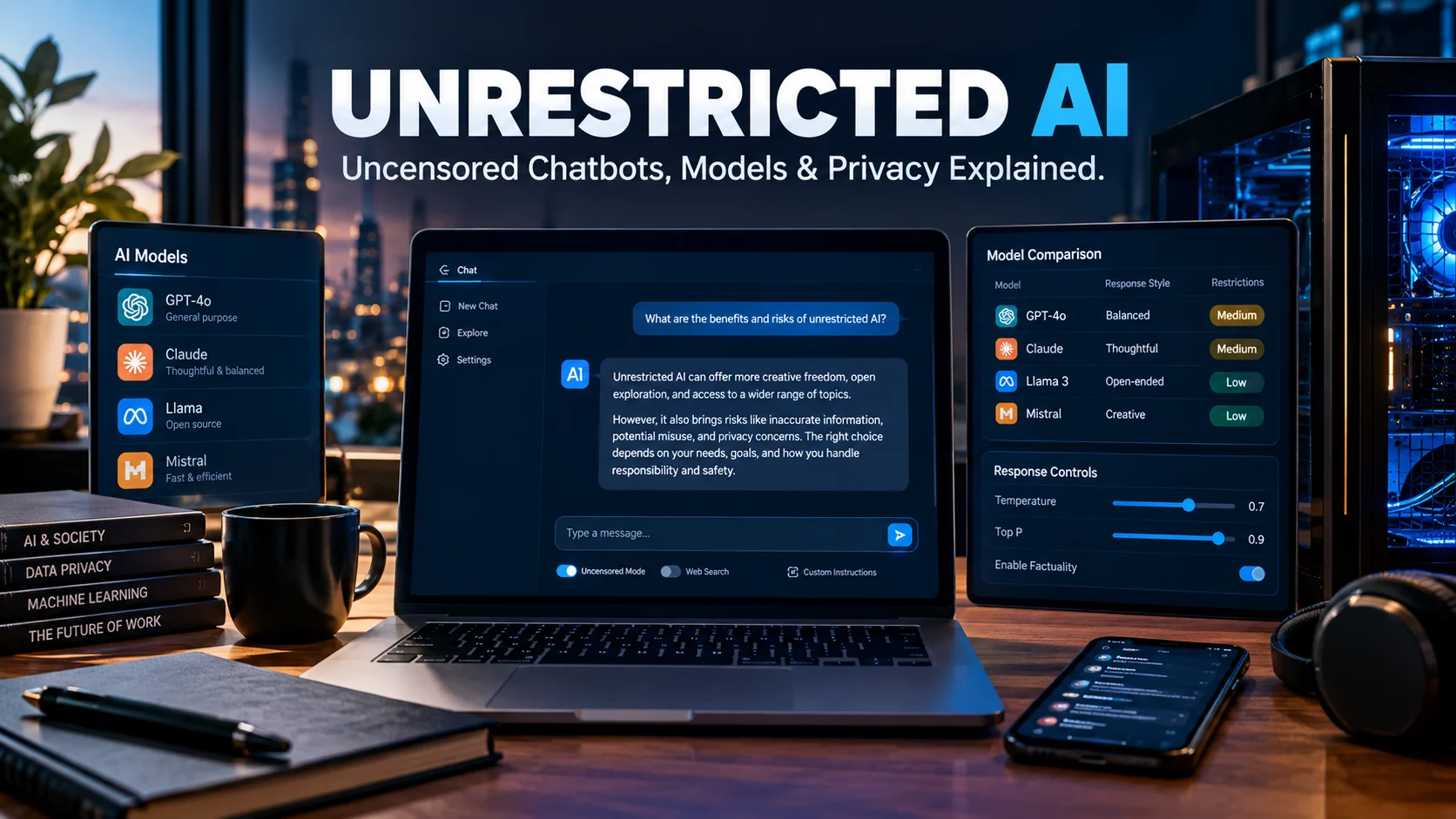
Unrestricted AI refers to AI chatbots and models designed to answer a broader range of prompts with fewer content restrictions than conventional assistants. These tools vary in capabilities pricing privacy and safeguards so users should evaluate the specific platform rather than assume that every unrestricted AI is fully uncensored or private.
At a Glance
- What it means: AI systems that impose fewer restrictions on certain prompts or topics.
- Common uses: Creative writing roleplay research coding and exploring controversial ideas.
- Main categories: Hosted uncensored chatbots modified language models and locally run open-weight models.
- Pricing: Some tools offer free access while others charge subscriptions or usage fees.
- Privacy: Unrestricted responses do not guarantee anonymous use or private data handling.
- Key consideration: Check model quality acceptable-use rules data retention licensing and safety protections before choosing a platform.
What Is Unrestricted AI?
Unrestricted AI is a broad term for artificial intelligence tools that place fewer limits on the questions they answer, the content they generate, or the tasks they support.
The phrase often refers to uncensored AI chatbots, less restrictive large language models (LLMs), and customized models designed to reduce refusals. Some platforms focus on adult-oriented creative writing while others emphasize open-ended research fictional roleplay, or direct answers to sensitive questions.
Unlike a single AI product, unrestricted AI describes a category of tools. The term can also appear in the name of a particular service so searchers should distinguish between the general technology and individual platforms.
For example, Unrestricted AI at unrestricted.chat markets an assistant with fewer refusals. Separately, unrestricted.ai publishes a model leaderboard focused on uncensored behavior and model capabilities. These are distinct websites with different purposes.
The important distinction is that fewer restrictions do not automatically mean better intelligence greater accuracy or complete freedom from safeguards.
How Does Unrestricted AI Work?
Unrestricted AI generally relies on the same underlying technologies as conventional AI assistants. The differences often come from model training fine-tuning system instructions deployment choices and moderation settings.
1. Large language models
An LLM generates text by predicting likely sequences of tokens based on its training and the context of a conversation. Modern models can support writing coding summarization reasoning and question answering.
A model’s output depends on its training architecture instructions and deployment environment. Its behavior is not determined by a single universal censorship switch.
2. Fine-tuning and alignment
Fine-tuning adjusts a pretrained model using additional examples or training methods. Developers may use it to improve writing style, follow instructions more closely or change how the model handles sensitive requests.
Alignment methods can encourage helpful responses while discouraging certain outputs. Some customized models attempt to reduce refusals for requests that mainstream assistants might decline.
However, removing or weakening a refusal behavior does not necessarily improve the model’s underlying knowledge. It can also increase the likelihood of fabricated answers harmful guidance or inappropriate output.
3. System prompts and moderation layers
Some restrictions operate outside the model itself. A hosted service may apply system instructions, input filters, output moderation or account-level rules.
Changing the model may not remove these separate controls. Conversely a permissive model can still operate inside a platform with strict usage policies.
4. Local deployment and open weights
Some users download open-weight models and run them on their own computers using tools such as Ollama or other compatible inference software.
This approach can provide greater control over model selection, configuration, and data handling. However, the available freedom depends on the model’s license hardware requirements and any safeguards the user chooses to implement.
Open weights are not the same as fully open-source AI. Access to model weights does not necessarily include the original training data complete training code or unrestricted commercial rights.
Key Features of Unrestricted AI Tools
Not every uncensored AI platform offers the same capabilities. Some provide a simple browser-based chat interface, while others give users control over model files and technical settings.
Common features include:
- Fewer refusals: More willingness to engage with sensitive or controversial subjects.
- Creative writing: Support for fictional characters, dialogue, roleplay, and alternative storytelling styles.
- Model choice: Access to different models with varying writing, reasoning, and coding abilities.
- Local execution: The option to run compatible models on personal hardware.
- Custom instructions: Control over tone, response format, and task-specific behavior.
- Web search: Some hosted assistants can retrieve current information, although this depends on the product and its configuration.
Treat these as features to verify, not guarantees attached to the term unrestricted AI.
For example, a chatbot might allow a broad range of creative writing but lack file uploads or web search. A locally hosted model might offer extensive configuration but require technical setup and suitable hardware.
What Can You Use Unrestricted AI For?
The most useful applications depend on the model’s capabilities and the user’s goals.
Creative writing and roleplay
Writers may use less restrictive AI tools to explore unusual characters, dark fiction, unconventional plots, or dialogue that mainstream assistants handle differently.
The quality of the output still depends on the model’s language skills and ability to follow instructions. A less restrictive model can produce repetitive or inconsistent writing, so editing remains important.
Research into controversial topics
Researchers, students, and journalists may want to examine contentious political ideas, historical controversies, or competing social arguments without receiving unnecessary refusals.
However, willingness to answer is not proof of neutrality or accuracy. Verify important claims against primary documents and reliable independent sources.
Coding and technical experimentation
Developers can experiment with open-weight models, customize prompts, test model behavior, and build local applications.
For technical tasks, measure code correctness, reasoning ability, tool compatibility, and performance rather than choosing a model solely because it has fewer restrictions.
Private experimentation
Running a model locally can help users process sensitive drafts or experiment with prompts without sending those prompts to a hosted chatbot.
This benefit depends on the complete setup. Cloud APIs, remote logging, browser extensions, synchronization services, and other connected components may still transmit information.
Content development
Bloggers and content teams can use these tools for brainstorming, outlines, fictional scenarios, and alternative versions of a draft.
Generated material should still undergo fact-checking, originality review, and editorial assessment. An unrestricted model may confidently invent statistics, quotations, or sources.
Unrestricted AI Platforms and Alternatives
There is no single platform that fits every definition of unrestricted AI. The following options represent different approaches: a hosted chatbot, a model directory, and a local model runtime.
Best suited to users seeking a hosted chatbot
The service advertises uncensored chat, web search, and incognito mode. Its pricing page lists limited free messaging and a Pro plan priced at $7.99 per week or $249.99 per year. These are published prices, not a guarantee that they will remain unchanged.
Best suited to model discovery and experimentation
The Hub hosts model repositories with information about intended uses, limitations, evaluation results, and licensing. Users can investigate specialized or less restrictive models, but each repository must be evaluated individually. Hugging Face+1
Best suited to users who want to run compatible models locally
Ollama lets users run supported models on their own machines and also provides access to cloud-hosted models. Local execution can keep prompts on the device, but cloud usage has a different data-handling arrangement. registry.ollama.com+1
Best suited to comparing model behavior
This site publishes a leaderboard that evaluates models for unrestricted responses and other capabilities. Its scores reflect its stated benchmark methodology and should not be treated as universal measures of quality. The Uncensored AI Model Leaderboard
Platform comparison
| Platform | Primary purpose | Pricing transparency | Main limitation |
|---|---|---|---|
| Unrestricted AI | Hosted chat | Free tier and published Pro prices | Hosted service policies and usage limits apply |
| Hugging Face Hub | Discover and evaluate models | Varies by model and deployment | Model quality and licenses differ |
| Ollama | Run compatible models locally or through cloud options | Software and model costs depend on setup | Local performance depends on hardware |
| Unrestricted.ai | Compare model behavior | Leaderboard access is publicly presented | Scores depend on benchmark design |
The pricing and feature descriptions above reflect the referenced public pages. Check the official sites before subscribing or deploying a model.
Is Unrestricted AI Free?
Some unrestricted AI tools offer free access, but free plans often include message limits, reduced capacity, or other restrictions. Paid plans may provide higher limits or additional features.
The important distinction is between free access to a hosted chatbot and the cost of running an open-weight model yourself.
For a specific example, Unrestricted AI’s published pricing page lists a free tier with limited messages and a Pro subscription at $7.99 per week or $249.99 per year. Its page advertises unlimited messages for Pro, but users should review the current terms and applicable usage policies before purchasing.
Local models can avoid a recurring chatbot subscription, but they are not necessarily cost-free. Hardware, electricity, storage, maintenance, and setup all have costs.
Before paying for any platform, check:
- The actual message or token allowance.
- Whether limits reset daily, weekly, or monthly.
- Whether web search, image generation, or file uploads cost extra.
- Whether unused credits expire.
- Whether subscription cancellation takes effect immediately or at the end of the billing period.
- Whether the advertised model is included in the plan or billed separately.
Do not assume a plan advertised as unlimited has unlimited access to every model or feature. Read the plan details carefully.
Privacy and Security: What Does Unrestricted Mean?
An unrestricted AI model is not automatically a private AI model. Content restrictions and data protection are separate properties.
A hosted chatbot may process prompts on remote servers. Depending on its policies and technical setup, it may collect account information, usage logs, IP addresses, or conversation content.
Unrestricted AI’s privacy policy, for example, describes account information and technical data collection, including IP addresses and interaction events. Its published policy should be reviewed alongside its product claims before sensitive information is entered.
Hosted AI versus local AI
| Privacy consideration | Hosted chatbot | Local model |
|---|---|---|
| Where prompts are processed | Provider infrastructure | Your own device, if genuinely local |
| Internet connection | Usually required | May work offline after setup |
| Provider access to prompts | Depends on service architecture and policy | Not inherently required for local inference |
| Data retention | Depends on provider terms | Depends on local logs, backups, and connected software |
| Technical maintenance | Mostly handled by provider | Often requires user maintenance |
| Hardware requirements | Mostly handled by provider | Your device must support the model |
Local execution can reduce exposure to third parties, but it does not guarantee complete security. Malware, insecure remote access, shared computers, and cloud synchronization can still expose data.
For hosted services, check the privacy policy for:
- Whether conversations are used for model training.
- How long prompts and uploaded files are retained.
- Whether deletion removes content from backups.
- Whether third-party model providers process the data.
- Whether incognito mode changes storage or retention behavior.
- Whether enterprise controls or contractual data protections are available.
A claim that a service does not train on conversations does not necessarily mean that it deletes them immediately. Similarly, a security certification does not automatically establish zero data retention.
Practical advice: Avoid entering passwords, financial account details, confidential business documents, or sensitive personal information into an AI service unless you understand its data-handling arrangements.
Limitations and Risks of Unrestricted AI
Reducing refusals can make a model more flexible, but it introduces trade-offs that users should understand.
1. Hallucinations and unreliable answers
AI models can invent facts, references, and explanations. A model that responds to more prompts may still be less accurate on a particular subject.
Verify medical, legal, financial, scientific, and other high-impact information with qualified sources.
2. Inconsistent quality
A model may perform well at creative writing but struggle with mathematics, coding, or complex reasoning. Custom fine-tuning can also introduce regressions in skills that the base model handled well.
Test the actual tasks you intend to perform rather than relying on labels such as uncensored, unrestricted, or advanced.
3. Harmful or inappropriate output
Less restrictive systems may generate content that is offensive, misleading, or unsuitable for certain audiences. They may also respond poorly to ambiguous instructions.
Users should evaluate content controls, age requirements, and moderation settings, particularly when children or shared workspaces are involved.
4. Licensing and intellectual property
Open-weight models can have different licenses and usage conditions. Some permit broad commercial use, while others impose restrictions or require specific notices.
Review the license attached to the exact model version. A model being downloadable does not automatically grant unrestricted rights to its output or commercial deployment.
5. Hardware and performance constraints
Large local models may need substantial RAM or GPU memory. Smaller or quantized models can reduce requirements, but quantization may affect output quality.
Hosted models avoid most local hardware demands, although they introduce dependence on internet access, provider availability, and service limits.
6. Vendor lock-in
A hosted service may make it difficult to transfer saved conversations, custom instructions, or workflows to another platform.
Local models provide more control over deployment, but applications built around specific model formats or APIs may still require substantial changes when switching providers.
How to Choose the Right Unrestricted AI Tool
Start with the task, not the marketing label. A creative writer, a developer, and a privacy-conscious researcher may need very different solutions.
Quick selection guide
For writing and roleplay
Look for consistent character behavior, writing quality, adjustable instructions, and clearly documented content rules.
For developers
Evaluate coding accuracy, API compatibility, context length, hardware needs, and the license governing commercial use.
For privacy-sensitive work
Consider genuinely local inference, offline operation, logging behavior, backups, and the security of your device.
For research
Prioritize source verification, reproducibility, model documentation, and transparent evaluation methods.
A simple evaluation checklist
Before committing to a platform, run a small test using representative prompts.
- Response quality: Does the model produce useful, coherent answers?
- Accuracy: Can you independently verify its factual claims?
- Instruction following: Does it follow your requested format and constraints?
- Transparency: Are the model identity, provider, and relevant limitations disclosed?
- Privacy: Can you understand how your prompts and files are handled?
- Cost: Does the plan fit your expected workload, including usage limits?
- Portability: Can you export your data or switch models without rebuilding everything?
For more technical comparisons, use the model documentation on Hugging Face and compare results on tasks relevant to your intended use. Published benchmarks can be informative, but scores from different tests are not necessarily comparable.
Frequently Asked Questions About Unrestricted AI
1. What is the best unrestricted AI to use?
There is no single option that suits every user. Compare hosted chatbots, locally run models, and model directories based on writing quality, task performance, privacy, cost, and the restrictions that matter to you.
2. Can I use unrestricted AI for free?
Yes. Some platforms offer free access with message limits, and some open-weight models can be run locally without a recurring chatbot subscription. Hardware, electricity, paid hosting, and other costs may still apply.
3. Is unrestricted AI completely uncensored?
No. The term has no universal technical definition. A model may have fewer refusal behaviors while still applying restrictions, and the hosting platform may enforce separate content policies.
4. Is unrestricted AI safe and private?
Not automatically. Privacy depends on where the model runs, what information the provider collects, how long data is retained, and which third-party services are involved. Review the provider’s current privacy policy before sharing sensitive information.
5. What is the difference between unrestricted AI and open-source AI?
Unrestricted AI generally describes a system’s response restrictions, while open-source AI concerns access to and licensing of its software and related components. An open-weight model may be restrictive, and a hosted chatbot may offer fewer refusals without revealing its underlying model.
Conclusion
Unrestricted AI covers a broad range of chatbots and language models designed to provide more flexible responses. The right choice depends on whether you prioritize creative freedom, research, coding, customization, or local control over your data.
Before choosing a platform, evaluate its real capabilities, model quality, privacy policy, licensing, and pricing. Fewer restrictions can be useful, but they do not guarantee accuracy, safety, or confidentiality.

Oliver Wilson is an AI researcher and tech writer living at the intersection of human creativity and machine intelligence. At AixOrbit.com, he decodes complex neural networks, generative AI and emerging tech trends into actionable insights making sure humans stay one step ahead of the algorithms.