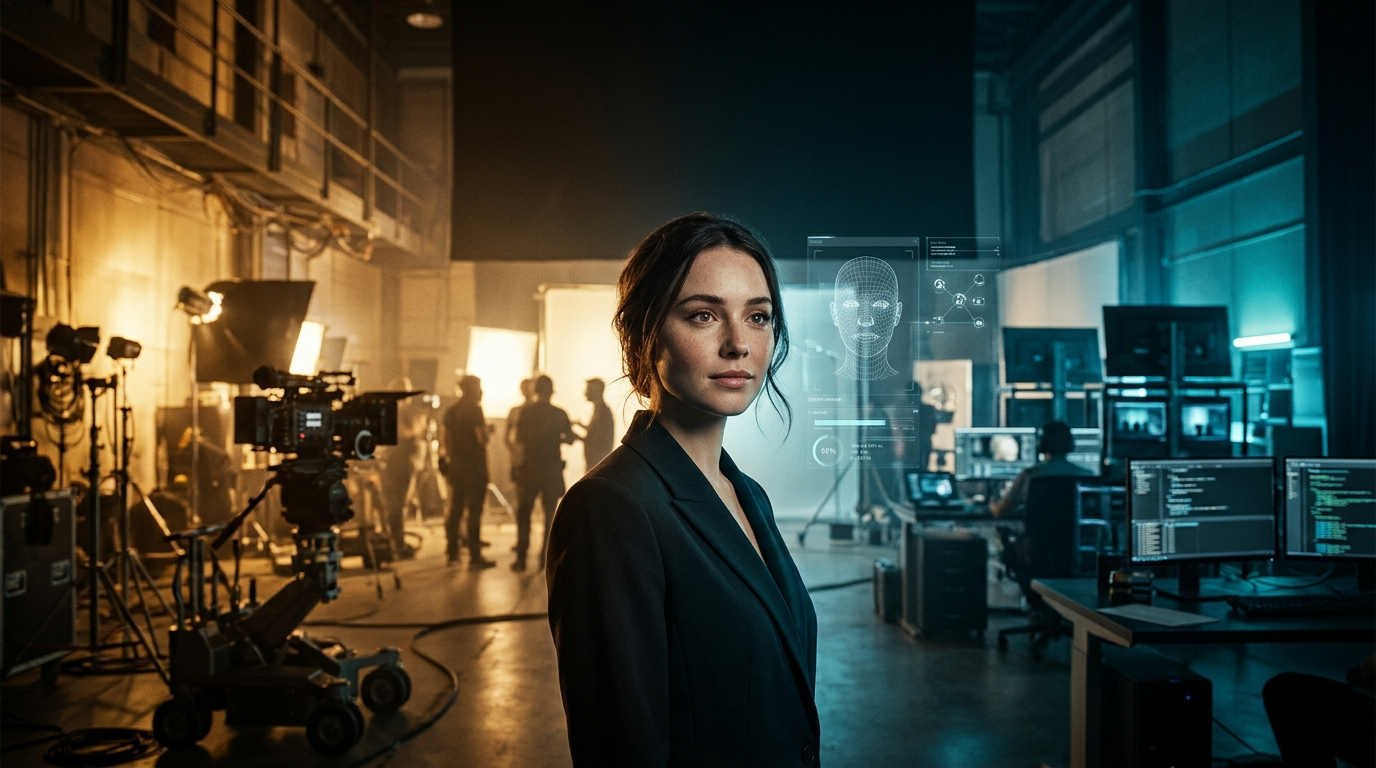
AI actress Tilly Norwood is a fictional digital performer created by Eline van der Velden and her production company using artificial intelligence and human creative direction. Her emergence has sparked a major Hollywood debate about AI-generated actors, employment opportunities, digital likeness rights, copyright and the future of entertainment.
Tilly Norwood at a Glance
- Identity: Tilly Norwood is an AI-generated fictional actress, not a real human being.
- Creator: Eline van der Velden, a Dutch actress, comedian, and entrepreneur.
- Production company: Particle6, an entertainment production company exploring AI-assisted filmmaking.
- Associated venture: Xicoia, an AI talent venture connected to digital entertainment personalities.
- First feature film: Misaligned, a comedy-drama announced as a project featuring Tilly.
- Main controversy: Concerns about human actors losing opportunities, digital likeness rights, consent, and creative ownership.
What Is AI Actress Tilly Norwood?
KI-Schauspielerin Tilly Norwood: Wie gefährlich ist KI für die deutsche Branche?
Tilly Norwood is a fictional AI-generated actress designed to participate in entertainment projects, including films, promotional content, and digital media.
Unlike traditional actresses, she does not have a physical body or personal human experiences. Her appearance, personality, and public identity exist through digital production and human creative direction.
The project was developed by Eline van der Velden through Particle6. The associated AI talent venture, Xicoia, helped position Tilly as a digital entertainment personality rather than simply another computer-generated image.
Her introduction attracted international attention because it challenged a traditional assumption about filmmaking: that actors appearing in productions must be human performers.
Tilly demonstrates how generative AI can help create realistic fictional characters with recognizable appearances and consistent identities.
However, an important distinction remains. Tilly is an AI character, not a conscious artificial intelligence being. Her apparent personality does not establish that she experiences genuine emotions, independently understands fame, or makes personal decisions.
Her significance comes from what she represents for the entertainment industry.
Who Created Tilly Norwood?
Tilly Norwood was created by Eline van der Velden, a Dutch actress, comedian, producer and technology entrepreneur.
Van der Velden founded Particle6, a production company exploring the combination of artificial intelligence and traditional entertainment production.
Her vision involved moving beyond individual AI-generated images and developing recognizable digital personalities capable of appearing across different media formats.
That concept became the foundation for Tilly Norwood.
What Is Particle6?
Particle6 is the production company behind Tilly Norwood.
Its work explores how artificial intelligence can support creative production, including character development, video creation, and digital storytelling.
The company’s approach combines AI-assisted workflows with human creative decisions.
Developing a convincing digital actress requires more than generating an attractive face. Production teams must consider appearance, expressions, personality, continuity, dialogue, and audience expectations.
In interviews, van der Velden has discussed the extensive experimentation involved in developing Tilly, including months of creative work and the use of different AI tools.
This demonstrates that creating a recognizable synthetic performer can involve substantial human involvement.
What Is Xicoia?
Xicoia is the AI talent venture associated with Tilly Norwood.
Its concept is to develop and represent digital personalities as entertainment talent.
Traditional talent agencies represent human actors, musicians, and other performers. An AI talent venture explores a different commercial model involving fictional digital personalities.
Such characters could potentially participate in advertising, film projects, promotional campaigns, and other entertainment activities.
Tilly is an early, highly visible example of this approach.
How Was Tilly Norwood Created Using Artificial Intelligence?
Creating a convincing digital actress involves several creative and technical processes.
The objective is not simply to generate one realistic photograph. A recognizable entertainment character needs a consistent appearance and personality across different situations.
Tilly Norwood’s development illustrates several important elements of AI-assisted entertainment production.
1. Character Design and Visual Identity
The first step involves establishing the character’s visual identity.
This includes facial features, hairstyle, clothing, expressions, skin texture, and overall appearance.
These elements help audiences recognize the character across different photographs and videos.
Consistency is particularly important for fictional digital personalities. Significant changes in appearance can make a character feel disconnected from previous content.
2. Generative AI and Image Production
Generative AI systems can create images and videos from written descriptions, reference material, and other inputs.
Different tools may support different production tasks.
For example, one system might help develop visual concepts, while another supports video generation or image refinement.
Human creators review the results and make adjustments to maintain the intended appearance.
The complete technical architecture behind Tilly has not been publicly documented. Therefore, attributing her creation to one particular AI model would be speculative.
3. Personality and Character Development
A successful digital actress also needs a recognizable personality.
This can involve:
- Character background and fictional history.
- Dialogue and communication style.
- Humor and conversational behavior.
- Personality guidelines.
- Responses to different situations.
- Consistency across public appearances.
These elements help make a synthetic character recognizable beyond her appearance.
However, simulated personality should not be confused with consciousness or genuine human emotions.
4. Human Creative Direction
Human involvement remains important throughout the production process.
Creative professionals decide how the character should look, which outputs meet quality standards, and how the character communicates.
They also manage storytelling, visual continuity, editing, and presentation.
This is an important part of understanding the AI entertainment industry. Generative AI can automate certain production tasks, but it does not eliminate the need for creative judgment.
Why Did Tilly Norwood Cause Controversy in Hollywood?
The controversy surrounding Tilly Norwood is about much more than whether audiences find an AI-generated actress convincing.
It concerns the economic, legal, and creative consequences of introducing synthetic performers into an entertainment industry built around human talent.
When Tilly attracted international attention in September 2025, discussions about AI-generated actors and potential talent representation became major entertainment news.
The reaction exposed disagreements about how artificial intelligence should be used in professional filmmaking.
SAG-AFTRA’s Response
SAG-AFTRA publicly criticized the project on September 30, 2025.
The union argued that synthetic performers should not replace human actors.
Its response highlighted concerns about performers’ creative work, digital likenesses, consent, and compensation.
These concerns are particularly important because SAG-AFTRA represents approximately 160,000 entertainment and media professionals.
The union’s position reflects several important industry issues:
- Unauthorized use of actors’ likenesses.
- Digital recreation of human performances.
- Reduced employment opportunities.
- Compensation for AI-generated performances.
- Consent and disclosure requirements.
It is important to distinguish industry concerns from proven legal findings. Public criticism does not establish that Tilly herself was created using unauthorized performances.
Could AI Actresses Replace Human Actors?
One of the biggest concerns is whether studios might eventually choose synthetic performers instead of hiring human actors.
A digital character could potentially appear in advertisements, promotional campaigns, and selected entertainment productions without conventional filming arrangements.
However, acting involves more than facial expressions and dialogue.
Human performers contribute emotional interpretation, improvisation, physical performance, lived experiences, and collaboration with other creative professionals.
AI-generated characters can reproduce certain aspects of performance, but that does not make them equivalent to human actors.
The more realistic concern is that AI could change specific jobs and production arrangements.
Copyright and Digital Likeness Concerns
Another major issue involves the material used to develop generative AI systems.
AI models may be trained using large collections of images, videos, text, and other creative works.
This creates questions about:
- Whether copyrighted material was included in training datasets.
- Whether performers gave permission.
- Whether creators received compensation.
- Whether generated outputs reproduce protected characteristics.
- Who owns the resulting digital performance.
These questions affect the wider AI industry, not just Tilly Norwood.
Legal protections also differ between jurisdictions. Therefore, companies developing synthetic performers must consider copyright, publicity rights, licensing, and applicable employment agreements.
Concerns About Authenticity
Some viewers question whether AI-generated performers can create the same emotional connection as human actors.
A digital character can deliver carefully constructed dialogue and convincing expressions.
However, it does not possess personal memories or genuine human experiences.
Audiences who value authentic human performances may remain skeptical.
Others may appreciate the creative possibilities of fictional digital characters.
Ultimately, audience acceptance will depend on storytelling, transparency, production quality, and expectations.
Is Tilly Norwood a Real Person or a Human Actress?
No. Tilly Norwood is not a real human being or a traditional actress.
She is a synthetic entertainment character created through AI-assisted production and human creative direction.
Her realistic appearance can make her seem like an ordinary actress. However, there is no human performer living the personal life represented through her digital identity.
Understanding this distinction is important because realistic AI-generated personalities can sometimes be mistaken for real people.
| Characteristic | Tilly Norwood | Traditional Actress |
|---|---|---|
| Physical body | No | Yes |
| Human emotions | No genuine human emotions | Yes |
| Personal experiences | Fictional character history | Real experiences |
| Appearance | Digitally generated | Human appearance |
| Performance | AI-assisted and human-directed | Human performance |
| Creative contribution | Human creative team and AI | Actor and production team |
| Digital identity | Created and managed | Belongs to a real person |
Tilly can simulate conversational behavior, humor, and personality.
However, these capabilities should not be confused with human consciousness.
Tilly Norwood’s First Feature Film Misaligned
One of the most significant developments in the Tilly Norwood story is her announced feature-film project.
Particle6 announced Misaligned, a comedy-drama featuring Tilly in a leading digital performance role.
The project is particularly interesting because it moves the character beyond social media appearances and promotional content.
Its story explores themes involving identity, artificial intelligence, human experiences, and the relationship between digital characters and reality.
The production has been described as combining traditional entertainment professionals with AI-assisted production methods.
What Makes Misaligned Different?
The project is notable for its hybrid production approach.
Its announced creative elements include:
- AI-assisted character production.
- Traditional film direction.
- Human writing and editing.
- Digital storytelling.
- Collaboration between creative professionals and AI specialists.
This approach could provide useful lessons for studios exploring synthetic performers.
However, an announced film project should not automatically be described as a completed theatrical release.
As of November 3, 2026, the official Tilly Norwood website lists Misaligned among its projects in development. Its final release date and distribution arrangements should be verified before publication.
What Is Tilly Norwood Doing in 2026?
Tilly’s public presence has expanded beyond her original introduction.
Her official website presents her as an ongoing entertainment character, with film, television, music and special-appearance projects.
The listed activities include:
| Project | Category | Listed Status |
|---|---|---|
| Misaligned | Feature film | In development |
| Architectrix | Short film | In development |
| Audition Tape | Film | Listed under 2026 |
| Take the Lead | Music video | Listed under 2026 |
| Keynotes | Special appearances | Listed under 2026 |
These listings suggest that the project is evolving into a broader digital entertainment identity.
They do not independently establish that every listed project has been released or completed.
Tilly’s Appearance at an Advertising Industry Event
Another interesting development occurred in October 2026.
Tilly appeared in an onstage interview at the Association of National Advertisers’ Masters of Marketing conference in Orlando.
According to Axios, she participated in a conversation with a journalist, demonstrating conversational responses, humor, and multilingual interaction.
The interview also brought attention to intellectual property and the environmental impact of AI production.
This appearance demonstrated how a synthetic character can participate in promotional and industry events through an AI-powered interaction setup.
It does not mean Tilly independently attended as a human performer.
How Could AI Actresses Change the Entertainment Industry?
Tilly Norwood represents a broader shift in how entertainment companies think about digital characters.
AI-generated personalities could eventually become part of advertising, film production, interactive entertainment, and virtual experiences.
However, their impact will differ across industries.
1. AI-Generated Advertising
Brands regularly invest in commercial production, photography, and promotional campaigns.
Digital personalities could provide another way to create advertising content.
For example, a company might develop a fictional AI spokesperson with consistent styling and messaging.
Such campaigns would still need to consider advertising regulations, disclosure, intellectual property, and audience trust.
2. Virtual Entertainment Personalities
AI-generated personalities could appear across several digital platforms.
A single fictional character might have:
- Social media content.
- Promotional appearances.
- Digital interviews.
- Music videos.
- Interactive conversations.
- Fictional film appearances.
This creates opportunities for entertainment companies to develop recognizable digital identities.
3. Lower-Cost Creative Experimentation
Traditional film production requires equipment, locations, performers, and substantial coordination.
AI-assisted workflows may reduce certain production requirements.
Independent filmmakers could experiment with visual concepts that previously required larger budgets.
However, AI production is not automatically inexpensive.
Model access, computing resources, professional editing, revisions, and quality control can still create substantial costs.
4. New Opportunities for Creative Professionals
AI adoption does not necessarily eliminate human creative involvement.
It may also create demand for different skills, including:
- AI production supervision.
- Digital character design.
- Generative video editing.
- Virtual performance direction.
- Synthetic voice production.
- AI-assisted storytelling.
The challenge will be ensuring that these opportunities do not come at the expense of fair compensation and existing creative rights.
Advantages and Limitations of AI-Generated Actresses
The Tilly Norwood project illustrates both the opportunities and challenges of synthetic performers.
| Potential Advantages | Important Limitations |
|---|---|
| Flexible digital appearances | No genuine human experiences |
| Consistent fictional identity | Requires ongoing creative supervision |
| New storytelling possibilities | Audience acceptance is uncertain |
| Potential production efficiencies | AI workflows still involve costs |
| Interactive digital experiences | Responses require appropriate safeguards |
| Reusable digital character assets | Consent and ownership questions remain |
Where AI Performers May Be Useful
AI performers could be particularly useful in projects that require fictional digital identities or unusual visual environments.
For example, a science-fiction production might create an entirely digital character that would be difficult to portray through conventional filming.
A marketing company might also develop a virtual spokesperson for a clearly disclosed advertising campaign.
These applications can complement human creativity.
Where Human Performers Still Matter
Human actors remain central to productions that depend on lived experience, emotional interpretation, improvisation, and authentic physical performance.
AI-generated characters may reproduce convincing expressions, but that does not make them equivalent to human performers.
The distinction becomes especially important when productions involve recognizable real people or recreate existing performances.
Ethical and Legal Challenges Surrounding Tilly Norwood
The debate surrounding AI actresses involves several interconnected issues.
Consent and Digital Likeness
Actors should have meaningful control over how their faces, voices, and performances are used.
A digital recreation of a performer can create serious concerns when consent is missing.
Clear licensing agreements and compensation arrangements are essential considerations.
Copyright and Training Data
Generative AI developers face continuing questions about copyrighted material.
The legal treatment of training data differs across jurisdictions and circumstances.
It is therefore inaccurate to assume that every AI-generated character has either violated copyright or received comprehensive rights clearance.
Disclosure and Audience Transparency
Audiences should understand when a performer is synthetic.
Transparent labeling can help distinguish AI-generated characters from human actors.
This is particularly important in news, advertising, political communication, and documentary-style entertainment.
Employment and Fair Compensation
Entertainment unions and professional organizations are concerned about the potential impact on human employment.
The industry needs practical agreements covering synthetic performers, digital replicas, compensation, and production responsibilities.
These issues require collaboration between studios, performers, technology companies, regulators, and creative professionals.
Tilly Norwood Compared With Other Virtual Personalities and AI Platforms
Tilly Norwood is not a conventional AI software product.
She is a digital entertainment character.
Comparing her directly with AI image generators or virtual influencer platforms requires understanding their different purposes.
Lil Miquela
A fictional digital influencer known for social media content, fashion, music, and brand collaborations.
Main distinction: An established virtual influencer identity rather than a dedicated AI acting project.
MetaHuman
Technology for creating realistic digital humans for games, films, and interactive experiences.
Main distinction: A character-production technology rather than one individual virtual actress.
Synthesia
A platform for creating AI-presenter videos and business communications.
Main distinction: Designed for video creation and presentations rather than developing a fictional entertainment star.
Runway
Generative video technology for creative professionals and filmmakers.
Main distinction: A creative production platform, not a virtual actress.
These examples demonstrate that the virtual entertainment market includes several different categories.
Tilly’s significance comes from her positioning as a continuing digital acting personality.
Who Should Follow the Tilly Norwood Story?
Tilly Norwood is relevant to several audiences, not just people interested in artificial intelligence.
| Audience | Why It Matters |
|---|---|
| Actors and performers | Digital likeness, consent, and employment protection |
| Filmmakers | AI-assisted production opportunities |
| Marketing professionals | Virtual brand personalities and synthetic advertising |
| AI researchers | Generative media and digital character development |
| Entertainment companies | New business models and intellectual property |
| General audiences | Authenticity, transparency, and future entertainment |
For filmmakers, the project offers a glimpse into emerging production methods.
For actors, it raises important questions about professional rights.
For technology enthusiasts, it provides a practical example of how generative AI can move from individual images into ongoing entertainment experiences.
What Does Tilly Norwood Tell Us About the Future of AI Entertainment?
Tilly Norwood is important because she represents a change in how people interact with AI-generated media.
Previously, many viewers encountered AI through chatbots, image generators, and automated video tools.
Tilly brings those capabilities together through a recognizable fictional identity.
Her project also highlights an important difference between technical possibility and responsible implementation.
Creating a realistic synthetic performer is one challenge. Establishing acceptable rules for its use is another.
Several developments will influence this industry’s future:
- Better digital identity consistency: Maintaining recognizable characters across different videos and appearances.
- Improved AI video production: More controllable expressions, movements, and visual continuity.
- Stronger licensing practices: Clear agreements covering creative rights and digital likenesses.
- Audience disclosure: Making synthetic performances identifiable to viewers.
- Hybrid production models: Combining human creative professionals with AI tools.
- Industry regulation: Developing enforceable protections for performers and creators.
A particularly important issue is the difference between an AI character and the technology used to generate it.
Tilly may have a recognizable personality, but the systems behind her are still products of human development and creative management.
The industry’s success will depend on whether it can balance innovation with accountability.
Frequently Asked Questions
1. Who is AI actress Tilly Norwood?
Tilly Norwood is a fictional AI-generated actress created by Eline van der Velden and the production company Particle6. She is a digital entertainment character designed to participate in film, television, promotional content, and other creative projects.
2. Is Tilly Norwood a real human actress?
No. Tilly Norwood is not a human actress. She is a computer-generated character whose appearance, personality, and performances are developed through artificial intelligence and human creative direction.
3. Who created Tilly Norwood?
Tilly Norwood was created by Eline van der Velden, founder of Particle6. The project is associated with Xicoia, an AI talent venture focused on digital entertainment personalities.
4. What movie will Tilly Norwood appear in?
Tilly Norwood has been announced as the lead digital performer in Misaligned, a comedy-drama developed by Particle6. The project combines traditional film professionals with AI-assisted production. Its final release date has not been established in the publicly available project information.
5. Why are actors and Hollywood concerned about Tilly Norwood?
Actors and entertainment organizations have raised concerns about employment, unauthorized use of creative work, digital likeness rights, consent, and compensation. SAG-AFTRA has publicly opposed replacing human performers with synthetic characters.
Conclusion
AI actress Tilly Norwood represents an important experiment in the evolution of digital entertainment.
Created by Eline van der Velden and Particle6, she demonstrates how artificial intelligence can support fictional performers with recognizable appearances and interactive personalities.
Her growing presence also exposes serious questions about copyright, consent, employment, and the value of human creativity.
For filmmakers and technology enthusiasts, she offers an interesting look at emerging production possibilities. For actors and entertainment professionals, she highlights the need for clear protections and fair compensation.
The future of acting will not depend on realistic digital faces alone. It will depend on responsible technology, human creativity, transparent production practices, and audience trust.
The most important lesson from Tilly Norwood is that technological innovation should expand creative possibilities without overlooking the people whose work makes entertainment possible.

Oliver Wilson is an AI researcher and tech writer living at the intersection of human creativity and machine intelligence. At AixOrbit.com, he decodes complex neural networks, generative AI and emerging tech trends into actionable insights making sure humans stay one step ahead of the algorithms.