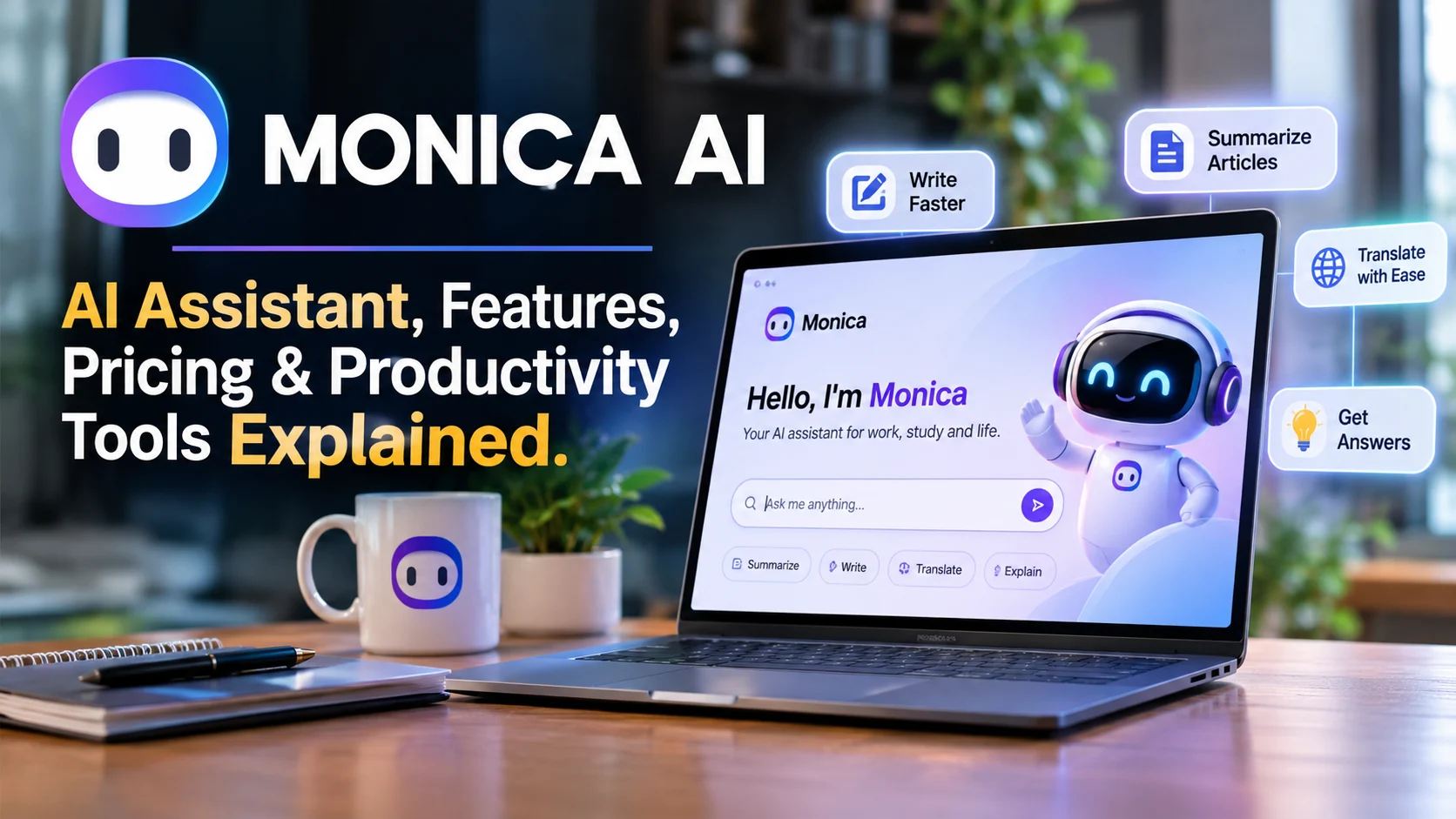
Monica AI is an all-in-one AI assistant that brings multiple AI models and productivity tools together for chatting writing research translation summarization and creative tasks. It works across browsers desktop computers and mobile devices offering free and paid plans with different usage limits.
Monica AI at a Glance
- Product category: All-in-one AI assistant and productivity platform.
- Main purpose: Combines AI chat, writing, research, translation, and content summarization.
- AI models: Provides access to multiple AI model families through one platform.
- Availability: Web, browser extensions, desktop, and mobile applications.
- Free access: Available with daily usage restrictions.
- Best suited for: Students, researchers, professionals, marketers, and content creators.
What Is Monica AI?
Understanding the platform
Monica AI is a multi-purpose AI productivity platform developed around the idea of bringing several AI capabilities into one workspace.
Instead of opening separate websites for every task, users can access different AI models and tools through Monica. These include conversational AI, writing assistance, research, translation, image generation, and content summarization.
The platform is available through its website, browser extensions, desktop applications, and mobile apps. This makes it useful for people who frequently switch between browsing, researching, writing, and communicating.
Monica is particularly interesting because it combines AI model access with tools that operate alongside everyday digital activities.
Is Monica AI the same as ChatGPT?
No. Monica AI and ChatGPT are separate products.
ChatGPT is an AI assistant developed by OpenAI. Monica is a third-party platform that provides access to multiple AI models and additional productivity features.
Depending on the plan and available model selection, Monica users can work with models from different providers without maintaining separate interfaces for every task.
This distinction matters because Monica’s features, usage limits, and model availability depend on its own subscription system.
How Does Monica AI Work?
Monica combines third-party AI models, its own interface, and productivity features into a single service.
A typical interaction follows this process:
- User input: You enter a question, upload a document, select webpage text, or choose a productivity tool.
- Task processing: Monica processes your request through the relevant feature.
- Model selection: Depending on the feature and your selection, an available AI model handles the request.
- AI response: The platform displays generated text, explanations, summaries, translations, or other outputs.
- Further editing: You can refine the result, request changes, or use it in another workflow.
The underlying models perform much of the language understanding and generation. Monica provides the interface and additional tools that connect these capabilities.
Does Monica AI develop its own language models?
Monica primarily presents itself as a platform for accessing models from established AI providers.
Its official website lists multiple model families, including GPT, Claude, and Gemini. The specific models available can change as providers update their offerings and Monica revises its integrations.
This means users should distinguish between:
- Model developers: Companies that build and train foundation models.
- Monica: The platform that integrates model access and productivity features.
- Third-party infrastructure: External services that may support individual AI capabilities.
Monica’s value is primarily in accessibility, workflow integration, and convenience rather than ownership of every underlying AI model.
Key Features of Monica AI
Monica offers a broad collection of tools. However, their availability and usage allowances depend on the subscription.
1. AI Chat and Multiple Models
The AI chat feature lets users ask questions, explore ideas, generate explanations, and solve everyday problems.
One important advantage is access to multiple AI model families from one interface.
Users can select available models according to their task. For example:
- Use a reasoning-oriented model for complicated questions.
- Use a writing-oriented model for editing and drafting.
- Use a faster model for everyday questions.
- Compare model responses when evaluating different answers.
However, having several models available does not automatically guarantee better results. Output quality still depends on the model, prompt, context, and task.
2. AI Writing Assistant
Monica includes writing tools for creating, editing, and improving digital content.
Common applications include:
- Writing blog introductions and conclusions.
- Drafting professional emails.
- Rewriting paragraphs.
- Correcting grammar and spelling.
- Improving sentence structure.
- Creating social media captions.
- Generating marketing copy.
Its browser-based workflow is particularly useful. Users can select existing text and ask Monica to explain, rewrite, translate, or summarize it.
The platform also advertises more than 80 writing templates, giving users starting points for common content tasks.
Practical consideration: AI-generated content still requires human editing. Writers should check factual accuracy, originality, tone, and source quality before publishing.
3. AI Search and Research
Monica includes AI-powered search capabilities designed to help users find information and explore questions.
Traditional search engines generally return lists of websites. AI search tools aim to provide synthesized responses based on available information.
Research applications include:
- Exploring unfamiliar subjects.
- Finding background information.
- Investigating market trends.
- Developing article outlines.
- Comparing products and services.
- Identifying additional research questions.
Some research features can involve more advanced AI workflows. The platform also lists Deep Research among its AI agent capabilities on eligible plans.
Users should still inspect source material before treating generated research as authoritative.
4. Webpage and YouTube Summarization
Reading lengthy articles and watching lengthy videos can consume significant time.
Monica offers summarization tools that help users extract the main ideas from webpages and YouTube videos.
These features can help with:
- Reviewing educational videos.
- Understanding lengthy articles.
- Extracting important discussion points.
- Preparing research notes.
- Identifying relevant sections of a video.
For example, a student researching renewable energy could summarize several educational videos before reading the original sources in detail.
A summary should remain a starting point, not a replacement for checking important details in the original material.
5. AI Translation
Monica includes translation tools for text and webpages.
Users can translate content into different languages and understand information that might otherwise be difficult to access.
Potential applications include:
- Translating international articles.
- Understanding foreign-language websites.
- Preparing multilingual communications.
- Improving bilingual reading.
- Translating business correspondence.
Monica’s official feature information also identifies different translation options across its subscription plan
For legal, medical, and technical documents, professional review remains important.
6. AI Image and Video Generation
Monica extends beyond text-based AI assistance.
Its platform lists image and video generation capabilities, including access to external generative models.
Users may explore these features for:
- Blog illustrations.
- Social media graphics.
- Creative concepts.
- Marketing visuals.
- Presentation assets.
- Short-form video concepts.
The exact models and generation allowances depend on the plan.
One important distinction is that access through Monica does not necessarily provide the same controls, settings, or usage rights as using a model directly through its original provider.
Creators should review the relevant generation terms before using outputs commercially.
7. ChatPDF and Document Assistance
Monica also provides document-related features, including ChatPDF.
These tools allow users to interact with supported documents using natural-language questions.
For example, a researcher could upload a report and ask:
- What are the main findings?
- Which sections discuss market growth?
- Summarize the conclusions.
- Explain a particular paragraph.
- Identify important figures.
This can simplify document exploration, especially when dealing with lengthy reports.
However, users should verify quotations, page references, figures, and extracted information against the original document.
8. Browser Extension and Smart Toolbar
One of Monica’s most distinctive features is its browser integration.
Instead of copying text into another AI website, users can access Monica while browsing supported webpages.
Its advertised browser capabilities include:
- Summarizing webpages.
- Explaining selected text.
- Rewriting paragraphs.
- Translating content.
- Drafting email responses.
- Summarizing YouTube videos.
- Accessing an AI sidebar.
The platform also documents the Ctrl + M shortcut for Windows and Cmd + M for macOS in its browser workflow.
This approach can reduce the friction involved in switching between applications.
Who Should Use Monica AI?
Monica’s combination of AI models and productivity features makes it relevant to several user groups.
| User | Potential application | Main benefit |
|---|---|---|
| Students | Research, summaries, translation | Faster information review |
| Bloggers | Writing and editing | Convenient content assistance |
| Marketers | Captions, copywriting, research | Multiple tools in one workspace |
| Researchers | Document analysis and AI search | Easier exploration |
| Professionals | Email and communication | Everyday productivity |
| Developers | Coding assistance | Access to supported coding models |
| Language learners | Translation and explanations | Multilingual support |
Monica AI for Students
Students can use Monica to understand difficult concepts, summarize reading material, and explore unfamiliar subjects.
It may also help with language learning and organizing study notes.
However, students should follow their institutions’ academic integrity policies and avoid submitting AI-generated work as their own when prohibited.
Monica AI for Content Creators
Content creators can use Monica for brainstorming, outlines, editing, captions, and research.
Its browser integration may be particularly useful for writers who work across several websites.
Still, it should support the editorial process rather than replace fact-checking and original expertise.
Monica AI for Businesses
Professionals can use Monica to draft communications, explore information, and prepare content.
However, its suitability for business use depends on privacy requirements, account management, usage restrictions, and available integrations.
The official FAQ states that Monica’s team subscription had not been officially launched in the documentation reviewed. Businesses should verify the latest commercial arrangements before adopting it across an organization.
Monica AI Pricing: Is It Free?
Monica offers a free plan and several paid subscription options.
The free version provides access to basic AI functionality, while paid plans offer higher usage allowances and additional capabilities.
Monica AI pricing comparison
The following figures reflect the official pricing page reviewed on November 4, 2026. Prices and promotional discounts can change.
| Plan | Displayed price | Main allowances |
|---|---|---|
| Free | $0 | 40 basic accesses daily |
| Pro | $8.30/month | 5,000 basic queries and 200 advanced queries monthly |
| Max | $16.60/month | Unlimited basic and advanced queries, plus 4,500 advanced credits |
| Ultra | $82.90/month | Unlimited basic and advanced queries, plus 20,000 advanced credits |
Paid monthly equivalents shown on the pricing page are based on annual billing. Check the checkout page for the actual payment amount.
What is the difference between Pro, Max and Ultra?
Pro: A reasonable starting point for regular users who need more than the free allowance. It provides monthly limits for basic and advanced model queries.
Max: Designed for heavier usage. It offers higher access allowances and more advanced credits for additional features.
Ultra: Targets users with demanding workflows who need substantially larger advanced-credit allowances.
Monica also explains that its Max plan has been subject to beta-related pricing and policy changes. Therefore, users should review the latest subscription terms before purchasing.
Understanding Monica’s advanced credits
This is an important detail that users should understand before upgrading.
Monica separates regular model queries from advanced credits.
According to its published credit rules:
- Free accounts receive 40 basic accesses daily.
- Pro includes 1,500 additional advanced credits monthly.
- Max includes 4,500 advanced credits monthly.
- Ultra includes 20,000 advanced credits monthly.
Advanced credits reset on the first day of each month. Certain advanced features consume these credits, and the amount depends on the operation.
This means an unlimited query allowance does not necessarily mean unlimited access to every premium feature.
My recommendation: Start with the free version, identify your actual usage requirements, and upgrade only when the available limits become restrictive.
Benefits of Monica AI
Monica’s strongest selling point is the combination of several AI capabilities in one environment.
Here are the advantages worth considering.
1. Multiple AI Models in One Place
Users can access different AI model families without constantly switching between separate provider interfaces.
This can make it easier to experiment with different approaches to the same problem.
2. Convenient Browser Integration
The browser sidebar and smart toolbar bring AI assistance closer to everyday browsing.
This is useful for people who frequently read, research, and write online.
3. Broad Productivity Features
Monica covers several common activities, including writing, translation, summarization, document assistance, and creative generation.
Users who need different types of AI assistance may appreciate this consolidated approach.
4. Cross-Device Availability
Monica supports major desktop and mobile platforms, alongside browser extensions.
Its help documentation describes access through Chrome, Edge, Windows, macOS, iOS, and Android.
5. Free Entry Point
Users can explore the platform without immediately purchasing a subscription.
This makes it easier to evaluate the interface and available tools before committing financially.
Limitations and Disadvantages of Monica AI
Although Monica offers many capabilities, it is not automatically the right choice for everyone.
Understanding its limitations is essential before relying on it regularly.
1. Usage Limits Can Be Confusing
The platform separates basic queries, advanced queries, and advanced credits.
Users may initially assume that an unlimited plan means every feature is unlimited.
That is not necessarily the case. Certain advanced operations consume separate credits.
2. Dependence on External AI Models
Monica integrates models from external providers.
This means model availability, response quality, and underlying capabilities can change when providers update their services or Monica changes its integrations.
Users who require a specific model should confirm its availability before subscribing.
3. AI Responses Can Be Incorrect
Monica does not eliminate the limitations of generative AI.
Its underlying models can produce:
- Incorrect factual information.
- Outdated explanations.
- Fabricated references.
- Incomplete summaries.
- Misleading technical recommendations.
Important information should always be checked against reliable sources.
4. Premium Features May Require Additional Credits
Some features consume advanced credits even when a subscription includes unlimited basic or advanced queries.
This can make actual usage costs difficult to estimate without testing the tools.
5. Less Direct Control Over Underlying Models
Using a model through Monica is not necessarily equivalent to accessing it directly.
The available settings, integrations, context handling, and feature controls may differ.
Developers and advanced users who require direct API access may prefer using the original model provider.
6. Not Every Workflow Belongs in One Platform
Monica combines many tools, but specialized applications can offer deeper functionality.
For example, dedicated research platforms may provide more suitable source-management workflows, while professional writing applications may offer more detailed editorial controls.
Convenience should not be confused with specialization.
Monica AI Privacy and Security
Privacy deserves particular attention because Monica can process text, documents, webpages, and other user-provided content.
The official privacy policy describes the collection of account information, technical information, usage information, and content submitted through the service. It also discusses sharing information with service providers and other third parties. Monica
There is another important detail.
The privacy policy available during this review displays a last-updated date of June 14, 2024. That is an older policy date relative to this article’s publication date.
Monica’s terms also contain a license allowing the company to use submitted content to operate the service and use content in aggregated form to improve services and create usage data.
These disclosures deserve careful consideration.
Is Monica AI safe for confidential information?
Users should not assume that an AI platform is suitable for confidential information simply because it offers account protection or paid subscriptions.
Before uploading sensitive documents, consider:
- What information the platform collects.
- How long submitted content is retained.
- Whether information is shared with external model providers.
- Whether uploaded files are stored.
- Whether users can request data deletion.
- Whether business-specific data-processing agreements are available.
- Whether a Zero Data Retention arrangement is explicitly documented.
Importantly, a SOC 2 report or certification, where applicable, would not automatically establish Zero Data Retention.
Practical advice: Avoid uploading passwords, financial records, confidential business documents, private customer information, or sensitive personal data unless you have verified the applicable contractual and technical protections.
Monica AI Alternatives
Monica competes in a broad AI assistant market.
However, not every alternative offers the same combination of models, browser integration, and productivity tools.
Here are four alternatives worth evaluating.
1. ChatGPT
ChatGPT is an AI assistant from OpenAI.
It supports conversational tasks, writing, research, coding, file analysis, and other AI-powered workflows.
Best for: Users who prefer a comprehensive assistant within the OpenAI ecosystem.
Difference from Monica: ChatGPT is a direct AI assistant product, while Monica emphasizes access to multiple model providers through one platform.
2. Claude
Claude is developed by Anthropic.
It is used for writing, reasoning, document analysis, coding, and long-form content workflows.
Best for: Writers, developers, and professionals who want an assistant centered on Anthropic’s models.
Difference from Monica: Claude provides direct access to Anthropic’s assistant experience rather than Monica’s multi-provider interface.
3. Google Gemini
Google Gemini is Google’s AI assistant platform.
It supports conversational assistance, research, content generation, and integrations with Google’s broader ecosystem.
Best for: People who regularly use Google products and services.
Difference from Monica: Gemini provides Google’s own AI experience, while Monica offers access to multiple AI model families.
4. Perplexity
Perplexity focuses on AI-powered search and research.
It is particularly relevant for people who want synthesized answers supported by web sources.
Best for: Researchers, students, and users who regularly investigate current information.
Difference from Monica: Perplexity is more focused on information discovery, while Monica combines research with writing, translation, document, and creative tools.
Monica AI vs. Its Main Alternatives
| Platform | Target user | Key strength | Pricing transparency | Main limitation |
|---|---|---|---|---|
| Monica AI | Multi-tool users | Multiple models and productivity tools | Public plan comparison | Separate usage allowances |
| ChatGPT | General AI users | Broad assistant ecosystem | Public plans | Primarily OpenAI ecosystem |
| Claude | Writers and developers | Anthropic model experience | Public plans | Anthropic-focused |
| Gemini | Google ecosystem users | Google AI integration | Public plans | Google-focused |
| Perplexity | Researchers | AI search and source discovery | Public plans | More research-focused |
Pricing structures and feature allowances change. Check each provider’s official pricing page before making a purchase.
How to Get Started With Monica AI
Getting started does not require advanced technical knowledge.
Follow these steps:
- Visit the official Monica website.
- Create an account or sign in.
- Explore the available AI chat interface.
- Select an available AI model.
- Test basic writing, translation, or summarization features.
- Install the browser extension if you want assistance while browsing.
- Explore the pricing page before choosing a paid plan.
Tips for Getting Better Results
The quality of an AI response often depends on how clearly you describe your task.
For better results:
- Provide relevant background information.
- Explain the intended audience.
- Specify the output format.
- Include examples when necessary.
- Break complicated tasks into smaller requests.
- Verify important facts independently.
For instance, instead of asking Monica to write an article, specify the subject, target audience, desired structure, and information requirements.
Clear instructions generally produce more useful results than vague requests.
Is Monica AI Worth Using in 2026?
Monica’s value depends on how frequently you use its different features.
For someone who regularly writes, researches, translates, and summarizes online content, having these capabilities in one platform can be convenient.
For someone who only needs occasional conversational assistance, a free standalone AI assistant may be sufficient.
The most important consideration is the relationship between subscription cost and actual usage.
Before upgrading, evaluate:
- Whether your preferred models are available.
- How many advanced queries you realistically need.
- Which features consume advanced credits.
- Whether the browser integration improves your workflow.
- Whether its privacy terms meet your requirements.
A platform with many features is not necessarily a better investment if you only use two of them.
Frequently Asked Questions
1. Is Monica AI free to use?
Yes. Monica offers a free plan with limited daily access to basic AI models. Users can upgrade to paid subscriptions for higher query allowances, advanced models, and additional productivity features.
2. Is Monica AI better than ChatGPT?
They serve different purposes. Monica provides access to multiple AI model families and combines them with productivity tools. ChatGPT offers OpenAI’s dedicated assistant experience. The better option depends on your preferred models and workflow.
3. Can Monica AI generate images and videos?
Yes. Monica lists image and video generation among its available capabilities. However, supported models, generation allowances, and access depend on the subscription plan and current feature availability.
4. Does Monica AI work on mobile devices?
Yes. Monica offers applications for Android and iOS, alongside desktop applications and browser extensions. Users can access supported AI features across different devices through their accounts.
5. Is Monica AI safe for personal and business use?
Monica publishes privacy and terms documentation describing how user information and submitted content may be processed. However, users should review current data-retention and third-party processing terms before submitting confidential or sensitive information.
Conclusion
Monica AI is a multi-purpose productivity platform that combines AI chat, writing, research, translation, summarization, and creative tools.
Its biggest advantage is convenience. Users can access different AI model families and productivity features without constantly switching applications.
It may suit students, bloggers, researchers, marketers, and professionals who regularly use multiple AI tools.
However, usage limits, advanced credits, external model dependencies, and privacy considerations deserve attention.
The smartest approach is to explore the free plan first, test the features you actually need, and compare the subscription cost against your usage.
Ultimately, Monica AI is worth considering if its combination of models and workflow tools genuinely makes your daily work easier.

Oliver Wilson is an AI researcher and tech writer living at the intersection of human creativity and machine intelligence. At AixOrbit.com, he decodes complex neural networks, generative AI and emerging tech trends into actionable insights making sure humans stay one step ahead of the algorithms.