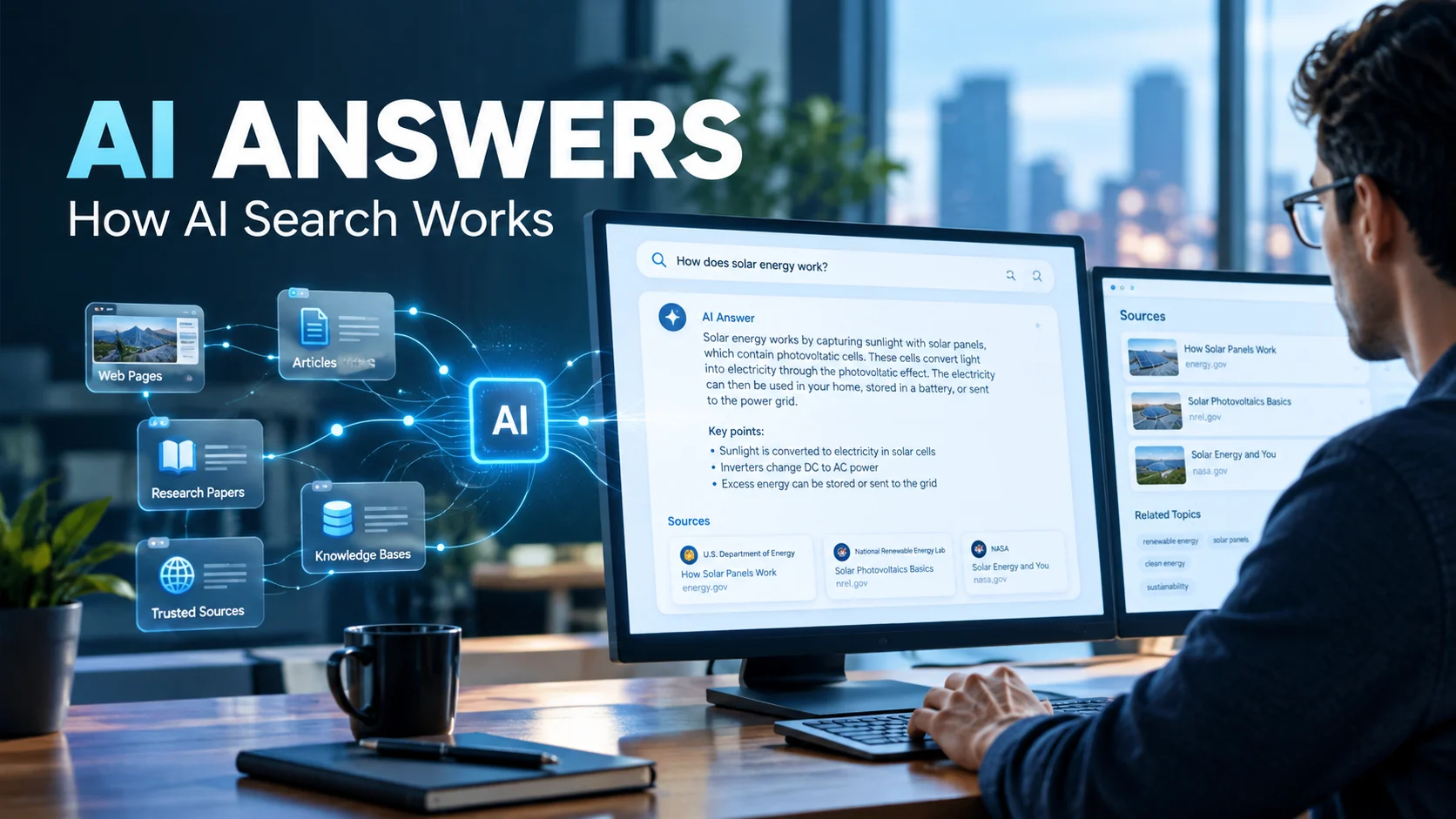
AI answers are responses generated by artificial intelligence systems to answer questions, summarize information, and help users solve problems. They can come from AI search engines, chatbots, website assistants, and customer support tools, with accuracy depending on the model, source material, and verification process.
At a Glance
- What AI answers are: Direct responses generated by AI instead of relying only on traditional lists of search links.
- How they work: AI models interpret a question, generate a response, and may retrieve information from external sources.
- Popular options: ChatGPT, Google AI Overviews, Google AI Mode, and Perplexity offer different approaches to AI-assisted answers.
- Main benefits: Faster research, summarized information, conversational follow-up questions, and automated customer support.
- Key limitation: AI can produce incorrect, incomplete, outdated, or poorly sourced information.
- SEO opportunity: Clear, useful, well-supported content can help people and AI-powered search systems understand your website, but visibility is never guaranteed.
What Are AI Answers?
AI answers are responses produced by artificial intelligence when someone asks a question in natural language. Instead of requiring users to find and combine information across multiple webpages, an AI system can summarize relevant information into a conversational response.
For example, a traditional search for “how does solar energy work?” may return links to educational websites, research articles, and product pages. An AI answer can explain the basic process directly, while providing sources or links when the system supports them.
The term AI answers covers several different technologies. These include general-purpose chatbots, AI-powered search features, question-answering systems trained on specific documents, and customer service assistants that respond using a company’s knowledge base.
The distinctions matter because not every AI answer is based on live web research. Some responses come primarily from a model’s learned patterns, while others use retrieved documents, search results, or connected business data.
AI Answers vs. Traditional Search Results
Traditional search engines generally organize results into links, snippets, maps, images, and other search features. Users then visit relevant sources and evaluate the information themselves.
AI answer systems can perform part of that synthesis automatically. They may combine information from several sources into a single response and provide links for further investigation.
Neither approach eliminates the need to evaluate information. Traditional results can contain unreliable pages, while AI-generated summaries can misinterpret otherwise reliable sources.
The practical difference is how the information is presented and how much research the user must perform.
How Do AI Answers Work?
AI answer systems typically combine language understanding, information generation, and sometimes information retrieval. The exact process depends on the product and the question.
1. User asks a question
The system receives a prompt, search query, voice request, or uploaded document.
2. AI interprets the request
A language model identifies the task, relevant context, and expected response.
3. Information is gathered when needed
The system may retrieve webpages, documents, databases, or connected knowledge sources.
4. The answer is generated
The model synthesizes information into a response, sometimes with citations and suggested follow-up questions.
The Role of Large Language Models
Large language models (LLMs) are trained to recognize patterns in language and generate contextually relevant text. They can explain concepts, summarize documents, compare options, and respond to follow-up questions.
However, a language model does not automatically verify every statement against a current, authoritative source. It can produce plausible-sounding errors, particularly when a question involves recent events, obscure facts, or missing context.
Retrieval-Augmented Generation
Retrieval-augmented generation, commonly called RAG, combines a language model with a retrieval system.
When a user asks a question, the system retrieves potentially relevant passages from a knowledge base or other permitted sources. The model then uses those passages to construct an answer.
RAG is particularly useful for:
- Answering questions about internal company documents.
- Supporting customer service with approved help articles.
- Searching product manuals and technical documentation.
- Responding to questions about a specialized collection of research papers.
RAG can improve grounding, but it does not guarantee correctness. The retrieval system might miss the right document, select outdated material, or provide passages that the model misinterprets.
Why Some AI Answers Include Sources
AI search products may retrieve webpages and connect claims to supporting sources. This gives users a way to investigate the answer rather than accepting it without question.
Google describes AI Overviews as AI-generated snapshots with links for further exploration. Its AI Mode also supports follow-up questions and provides links to relevant web information.
Still, a citation is useful only when the linked source actually supports the claim. Open important sources, check publication dates, and distinguish direct evidence from an AI-generated interpretation.
Popular AI Answers Tools and Platforms
Different platforms address different needs. Some are designed for everyday questions, others for web research, and some help businesses answer questions using their own content.
A general-purpose AI assistant for explanations, writing, brainstorming, analysis, and other tasks. Its web search feature can provide current information with citations when search is used.
Provides AI-generated summaries within Google Search, helping users understand a topic and explore related sources.
Supports more exploratory searches, complex questions, and conversational follow-ups within Google Search.
An AI answer engine designed to synthesize information from sources and support deeper research. Its advanced Pro Search feature supports more involved research tasks.
AI Answers for Websites and Customer Support
AI answers are not limited to public search engines. Businesses can add question-answering assistants to their websites, help centers, and support workflows.
These systems can use company-approved information to answer questions about opening hours, product specifications, policies, troubleshooting, and account procedures.
For example, AskBase publishes a service that combines a help center with an AI assistant and offers plans with different monthly answer allowances.
The main advantage is convenience. Customers can receive answers without searching through multiple support pages or waiting for an agent.
However, companies must define what happens when the assistant cannot answer confidently. An effective support system should provide an escalation path rather than inventing policies or making promises the business cannot honor.
Benefits of AI Answers
AI answers can make information easier to access, especially when a user needs a quick explanation or a starting point for research.
Faster information discovery
A conversational response can summarize a complicated topic without requiring users to open multiple pages immediately. This is useful for definitions, preliminary research, comparisons, and general explanations.
Natural follow-up questions
Users can refine a request instead of starting a new search each time. They might ask for a simpler explanation, request an example, or narrow the answer to a specific industry.
Support for complex research
AI search tools can help users explore unfamiliar subjects, identify relevant sources, and organize findings. They are useful as research assistants, although important claims still require independent verification.
More accessible customer service
Businesses can use AI-powered answers to handle routine questions outside normal support hours. This can help customers find basic information quickly and allow human staff to focus on more complex cases.
Personalized explanations
Some assistants can adapt explanations to the user’s stated experience level, goals, or preferred format. This makes technical or unfamiliar material easier to understand.
Personalization depends on the system’s capabilities and available context. Users should avoid sharing sensitive information unless the platform’s data practices are appropriate for that use.
Limitations and Risks of AI Answers
The convenience of AI-generated responses does not remove the need for critical thinking. The most important risks concern accuracy, source quality, recency, and privacy.
Hallucinations and factual errors
An AI system may generate a false statement, invent a detail, or combine facts incorrectly. The result can sound confident even when the evidence is weak.
Verify high-impact claims using authoritative sources, especially when dealing with medical information, legal obligations, financial decisions, or technical instructions.
Outdated information
A model’s learned knowledge may not include recent developments. Even a system that searches the web can retrieve an outdated page or miss a newly published update.
For current information, check the publication date and consult the original source whenever possible.
Incomplete or biased sources
An AI answer reflects the information it can access and the way the system processes that information. If important viewpoints, datasets, or documents are missing, the resulting answer may be incomplete.
For disputed topics, compare multiple credible sources and distinguish documented facts from interpretations.
Privacy and confidential information
Questions and uploaded files may contain personal information, customer records, or business secrets. Before using an AI answer service, review its data retention, training, access, and deletion policies.
Businesses should also check whether third-party models or search providers process submitted content. A general statement about security is not a substitute for understanding the specific service’s data handling.
Overreliance on generated responses
An AI answer is a starting point, not automatic proof. When the answer will influence a consequential decision, evaluate the evidence and consult a qualified professional when appropriate.
AI Answers and SEO: What Website Owners Need to Know
AI-powered search is changing how people discover information. Search experiences can now summarize topics, compare options, and answer questions before users visit a website.
For publishers, marketers, and SEO specialists, the goal is to create content that is genuinely useful, easy to understand, and supported by evidence. There is no guaranteed formula for appearing in AI-generated answers.
How AI Answers Affect Organic Search
Traditional organic search often encourages users to click a result and read the full page. AI-generated summaries may answer simple questions directly, reducing the need for some visits.
At the same time, citations and links can introduce users to relevant websites. The impact depends on the query, search feature, subject, and user intent.
This makes it important to measure more than rankings alone. Website owners should also monitor qualified traffic, conversions, brand mentions, and the usefulness of the visits they receive.
How to Improve Your Content’s Eligibility for AI Search
Answer the main question early
Give readers a clear, direct explanation near the beginning of the page. Add supporting context afterward rather than hiding the answer behind a lengthy introduction.
Use reliable evidence
Support factual claims with authoritative sources, primary documentation, original research, and clearly attributed statements.
Structure content logically
Use descriptive headings, concise explanations, relevant lists, and comparison tables where they improve understanding. Make each section address a distinct user question.
Maintain accuracy and freshness
Update changing facts, pricing, product features, and regulations. Show dates where they help readers judge whether information is current.
Demonstrate real expertise
Include useful original analysis, transparent methodology, firsthand experience where applicable, and specific examples that generic content does not provide.
Google’s guidance describes AI Overviews and AI Mode as search experiences that connect AI-generated responses with links to relevant information. Website owners should therefore continue to focus on useful content and sound technical SEO rather than relying on a separate set of guaranteed AI ranking tricks.
Does Schema Markup Guarantee AI Answers Visibility?
No. Structured data helps search engines interpret information on a page, but adding schema does not guarantee that a page will appear in an AI-generated response.
Use relevant schema types accurately, keep the markup consistent with visible page content, and validate the implementation. Do not add irrelevant structured data simply to target AI search.
How to Measure AI Search Visibility
Businesses can use several complementary signals:
- Organic search performance: Track impressions, clicks, and search queries using available search analytics.
- Referral traffic: Identify visits arriving from AI platforms when analytics can attribute them.
- Brand mentions: Check whether AI systems mention the business in relevant answers.
- Citation quality: Review whether the correct pages appear as sources for target questions.
- Business outcomes: Measure qualified leads, purchases, sign-ups, and other meaningful conversions.
AI answers can vary by prompt, location, date, user context, and platform. A single test is not enough to establish consistent visibility, and third-party tracking tools may not perfectly represent every user’s experience.
How to Choose the Right AI Answers Tool
The right platform depends on whether you need general assistance, web research, or automated answers based on your own information.
| Platform or tool | Primary audience | Key strength | Pricing transparency | Main limitation |
|---|---|---|---|---|
| ChatGPT | General users and professionals | Broad conversational assistance | Check current plan details | Answers need verification |
| Google AI Overviews | Everyday search users | Summaries integrated into search | Part of Google Search | Availability and presentation vary |
| Google AI Mode | Users exploring complex questions | Conversational search and follow-ups | Check current access conditions | Responses can contain errors |
| Perplexity | Researchers and information seekers | Source-oriented research workflow | Check current plan details | Citations still require checking |
| AskBase | Customer support teams | Answers grounded in a help center | Published plans and usage limits | Monthly answer allowances apply |
These platforms are not interchangeable. A public answer engine may be suitable for researching a market, while a business may need a dedicated assistant connected to approved documentation.
Questions to Ask Before Choosing
- Does the tool provide links or citations for important factual claims?
- Can it access current information when necessary?
- Can you upload documents or connect a trusted knowledge base?
- What are the usage limits, subscription costs, and overage rules?
- How does the provider retain, process, and delete submitted data?
- Can users escalate unanswered questions to a human?
- Does the tool support the languages and accessibility needs of your audience?
Test each shortlisted tool with the same realistic questions. Compare correctness, source quality, completeness, and the effort required to correct mistakes.
Best Practices for Getting Reliable AI Answers
You can improve the usefulness of AI-generated responses by asking better questions and verifying important details.
Provide enough context
Instead of asking, “What is SEO?”, try asking, “Explain technical SEO to a small business owner, using three practical examples and no advanced terminology.”
The second question specifies the audience, scope, and format. This gives the system clearer guidance.
Request supporting sources
For research questions, ask the system to identify authoritative references and distinguish confirmed facts from assumptions. Then open the cited sources yourself.
A request for citations can improve transparency, but it cannot guarantee that the sources exist or support every statement.
Separate facts from recommendations
Ask the system to explain what the evidence establishes before suggesting a course of action. This is especially useful for product comparisons, business strategy, and policy analysis.
Verify critical information independently
Check important dates, prices, legal requirements, calculations, and technical specifications against primary sources. If the evidence is contradictory or insufficient, treat the answer as unresolved.
Frequently Asked Questions About AI Answers
1. What are AI answers in Google Search?
AI answers in Google Search include features such as AI Overviews, which provide AI-generated summaries with links to relevant information. Google AI Mode offers a more conversational experience with follow-up questions and additional exploration.
2. Are AI answers always accurate?
No. AI systems can produce factual errors, misunderstand source material, or provide outdated information. Verify important claims against authoritative sources, particularly when decisions involve health, money, legal matters, or safety.
3. Which AI tool provides answers with sources?
Google AI search features and Perplexity can provide answers with links or citations to supporting information. ChatGPT can also provide citations when web search is used. Citation availability and completeness depend on the platform and response.
4. How can a website appear in AI answers?
Publish useful, accurate, clearly structured content that addresses real user questions. Maintain sound technical SEO, make relevant pages accessible to search crawlers, and support claims with credible evidence. These practices can help discovery, but no method guarantees inclusion in AI answers.
5. Can businesses use AI answers for customer support?
Yes. Businesses can deploy AI assistants that use approved help articles, product documentation, and policies to answer routine customer questions. They should establish usage limits, review privacy protections, monitor answer quality, and provide a human escalation path for unresolved issues.
Conclusion
AI answers are changing how people search for information, conduct research, and interact with businesses. Tools such as ChatGPT, Google AI Overviews, Google AI Mode, and Perplexity offer different ways to turn questions into useful responses.
Their value depends on the quality of the information, the reliability of the system, and the user’s ability to verify important claims. For businesses and website owners, clear content, credible evidence, and strong technical foundations remain practical priorities for AI search visibility.
Choose tools according to your needs, check their privacy and pricing terms, and treat generated responses as information to evaluate rather than unquestionable facts.

Oliver Wilson is an AI researcher and tech writer living at the intersection of human creativity and machine intelligence. At AixOrbit.com, he decodes complex neural networks, generative AI and emerging tech trends into actionable insights making sure humans stay one step ahead of the algorithms.