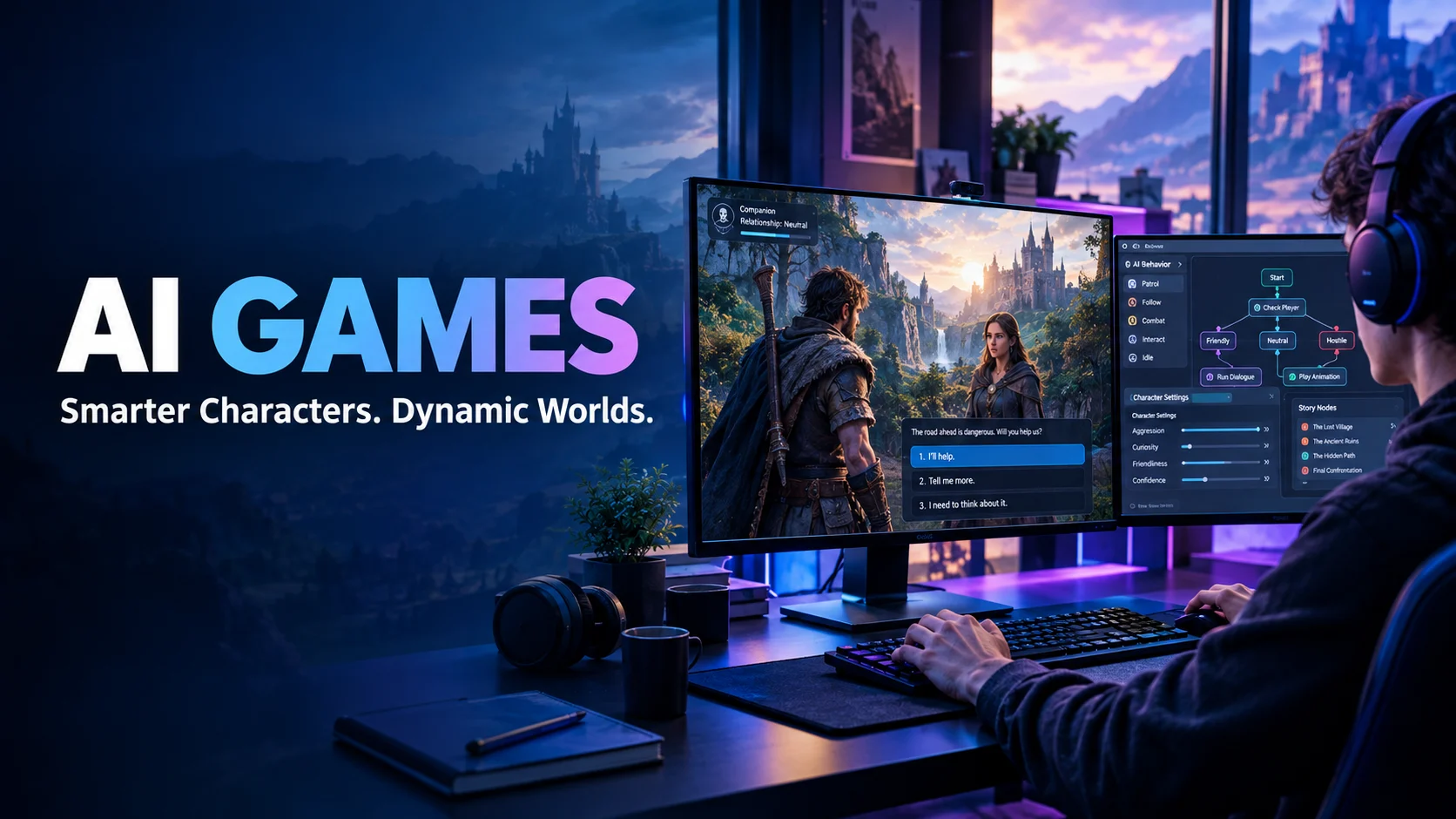
AI games use artificial intelligence to control characters, adapt challenges, generate stories, or create more responsive virtual worlds. Popular examples range from AI Dungeon’s interactive storytelling to traditional video games with intelligent opponents and developer tools that bring conversational characters to life.
At a Glance
- AI games explained: Video games that use AI for character behavior, gameplay, storytelling, or content generation.
- Popular categories: Interactive story games, simulation games, adaptive combat, AI-powered NPCs, and AI-assisted game creation.
- A game to try: AI Dungeon offers a free-to-play text adventure with customizable stories and scenarios.
AI Dungeon Guidebook+1
- Emerging technology: Generative AI can help characters respond to natural language and support more flexible interactions.
- Developer platforms: NVIDIA ACE and Inworld AI offer technologies for building AI-powered characters and interactive experiences.
- What to consider: Gameplay quality, supported devices, subscription limits, internet requirements, privacy, and the actual role of AI.
What Are AI Games?
AI games are video games that use artificial intelligence to influence how characters behave, how challenges unfold, or how players interact with virtual worlds. Some rely on established techniques such as pathfinding and decision-making rules, while newer experiences use generative AI to produce dialogue and interactive stories.
Traditional game AI has existed for decades. It helps enemies navigate environments, teammates coordinate actions, and simulated characters respond to events.
Generative AI introduces another layer. A character might respond to a player’s original question instead of choosing from a fixed list of dialogue options. A storytelling game might generate new narrative details as the player makes decisions.
However, AI-powered gameplay and generative AI are not the same thing. A game can have sophisticated opponents without using a large language model, and a game that generates dialogue may still rely on conventional rules for movement and combat.
This distinction matters when searching for AI games. Some players want smarter enemies, others want open-ended storytelling, and developers may be looking for tools to build their own interactive worlds.
Best AI Games to Try
The right choice depends on whether you want to explore a generated story, manage a simulated world, or experience more adaptive character behavior.
AI Dungeon lets players create adventures, choose actions, and guide open-ended narratives. Its official website describes customizable scenarios, character creation, and AI-powered storytelling. A free-to-play option is available, alongside paid memberships.
Why try it: You can explore fantasy quests, science fiction, mysteries, and other scenarios shaped by your choices.
Keep in mind: It depends on remote servers, so an internet connection is required. Generated stories can also lose continuity or produce unexpected details.
The Sims 4 lets players manage virtual lives, relationships, careers, and everyday activities. Characters can exhibit autonomous behavior within the game’s designed simulation systems.
Why try it: It is suitable for players who enjoy observing character interactions and shaping a virtual community.
Keep in mind: Its established simulation mechanics should not be confused with open-ended, generative AI conversations.
This action-adventure game is known for its Nemesis System, which develops persistent rivalries and relationships among enemy characters.
Why try it: It illustrates how designed game systems can make enemies and encounters feel more personal.
Keep in mind: The Nemesis System is a conventional game-system innovation, not proof that the game uses generative AI dialogue.
Minecraft combines exploration, construction, survival, and simulated creatures. Its standard gameplay uses programmed behaviors, while community modifications can add different kinds of AI functionality.
Why try it: It offers a flexible environment for building, experimenting, and exploring systems-driven gameplay.
Keep in mind: AI features added by modifications depend on the specific project and are not necessarily part of the base game.
These games illustrate different approaches to AI and simulation. They should not be treated as a direct performance ranking because their genres and purposes differ.
AI Games With Conversational Characters
One of the most interesting developments in gaming is the move from fixed dialogue to characters that can interpret and respond to natural language.
NVIDIA’s ACE technology, for example, provides models and developer tools for building conversational in-game characters. Its documented examples include AI teammates, game assistants, and characters that interact through speech and other AI components.
These technologies are primarily aimed at game developers and studios, rather than being standalone games that anyone can immediately download.
What makes an AI NPC different?
A non-player character, or NPC, is any character controlled by the game rather than directly by a human player.
Traditional NPCs usually respond through scripted dialogue, state machines, behavior trees, and predefined rules. Generative AI can extend these systems by allowing more flexible conversation and context-aware responses.
For example, imagine a fantasy game where a village guard answers questions about a missing traveler. Instead of selecting one of three predefined responses, you could ask about the traveler’s last known location, relationships, or suspicious behavior.
The character could generate a response using its assigned personality and relevant story information. The game would still need to validate important facts and prevent the character from inventing clues that break the mystery.
Examples of AI character technology
Provides technologies for speech, character intelligence, and animation, with options for cloud and on-device processing. Developers can use its components to build more interactive characters.
Offers developer technology for conversational characters and interactive applications. Its usefulness depends on the selected services, implementation, and integration requirements.
When evaluating these platforms, look beyond demonstration videos. Check whether the technology is available for your engine, whether usage is charged by consumption, and whether the character can act on game-state information safely and consistently.
How AI Games Work
AI games combine conventional game-engine systems with techniques that help software make decisions, generate content, or interpret player input.
1. Traditional game AI
Many games use programmed rules to decide how characters move, attack, defend, or cooperate. Pathfinding algorithms help characters navigate obstacles, while behavior trees and state machines determine what they do next.
These techniques can create sophisticated opponents without a generative AI model. They are often useful when gameplay needs predictable timing and repeatable outcomes.
2. Machine learning
Machine learning allows systems to identify patterns from data and use them to make predictions or decisions. Depending on the game, it may support player modeling, animation, opponent behavior, or other tasks.
Not every game needs machine learning. Conventional algorithms can be more practical for many gameplay systems.
3. Generative AI and large language models
Large language models, or LLMs, can interpret text and generate conversational responses. In a game, they may support character dialogue, quest descriptions, player instructions, and branching narratives.
A model’s context window determines how much conversation and supporting information it can process at once. If important story facts fall outside that context, characters may forget earlier events.
Developers can use retrieval-augmented generation (RAG) to supply relevant character profiles, lore, and quest details when generating a response. This can help maintain consistency, but it does not guarantee accurate outputs.
4. AI agents
An AI agent is a system that can interpret a goal, use available information, and take actions through defined tools or interfaces.
In gaming, an agent might help an NPC plan a route, interact with objects, or act as a teammate. The game must still enforce rules governing movement, inventory, combat, and other important state changes.
5. Local and cloud AI
Local AI runs on the player’s device or the game’s local hardware. Cloud AI sends requests to remote computing infrastructure.
Local processing may reduce dependence on an external service, while cloud processing can provide access to models that are impractical to run on a player’s device. The best choice depends on performance requirements, cost, privacy, and hardware.
Benefits of AI in Gaming
AI can create new gameplay possibilities when developers use it to solve specific problems.
- More flexible dialogue: Characters can respond to a broader range of player questions.
- Personalized experiences: Games can adjust assistance, encounters, or narrative details to suit player behavior.
- More varied stories: Generative systems can introduce new dialogue and narrative variations.
- Creative experimentation: AI-assisted tools can help developers prototype characters, environments, and dialogue.
- More responsive teammates: AI characters may interpret instructions and react to changing game situations.
- New ways to learn: In-game assistants can explain mechanics and offer contextual guidance.
These benefits are not automatic. They depend on the quality of the AI, the game’s design, and how carefully developers connect generated responses to the underlying game systems.
Limitations and Challenges of AI Games
AI can also introduce problems that conventional game systems avoid.
| Challenge | Why it matters | What to evaluate |
|---|---|---|
| Inconsistent dialogue | Characters may contradict earlier statements | Memory and story-state controls |
| Response delays | Waiting can interrupt gameplay | Local processing, streaming, and latency |
| Unpredictable outputs | AI may invent facts or ignore instructions | Validation and fallback dialogue |
| Ongoing costs | Cloud model requests consume resources | Subscription terms and usage-based pricing |
| Hardware demands | Local models need suitable computing resources | Memory, processor, and graphics requirements |
| Privacy concerns | Voice and chat may be processed remotely | Retention policies and data controls |
| Moderation challenges | Open-ended interactions can generate unsuitable content | Age settings and content safeguards |
AI can also reduce the sense of authorship when generated content feels generic or undermines a carefully designed story. In games built around precise puzzles, balanced combat, or competitive fairness, uncontrolled model behavior may create more problems than it solves.
A successful implementation keeps the freedom where it improves the experience and preserves strict rules where consistency matters.
AI Game Development Tools Compared
If you want to create an AI-powered game rather than play one, choose a tool based on your development experience and intended features.
| Platform | Target user | Key strength | Pricing transparency | Main limitation |
|---|---|---|---|---|
| NVIDIA ACE | Game studios and technical developers | Character intelligence, speech, and animation components | Check developer access and deployment terms | Requires integration and technical implementation |
| Inworld AI | Developers building interactive characters | Conversational AI and character experiences | Review current service and API pricing | Usage costs and integration requirements vary |
| Unity | Indie developers and studios | Game development tools and extensible workflows | Plans and licensing terms vary | Generative AI capabilities may require additional tools |
| Unreal Engine | Indie developers and professional studios | Advanced real-time 3D development | Review current licensing terms | Complex projects can require substantial technical expertise |
These products serve different purposes. NVIDIA ACE and Inworld focus on AI character technology, while Unity and Unreal Engine provide broader game development environments.
For pricing, check the official provider’s current terms. Development tools may have separate costs for commercial licensing, model usage, cloud infrastructure, and third-party services.
Are AI Games Free to Play?
Some AI games are free to play, while others require a purchase, subscription, or additional credits for advanced features.
AI Dungeon, for example, offers free access to its basic experience and paid membership options. Its exact feature availability can change between plans.
Before choosing an AI game, check:
- Free usage limits: Are there daily message or generation caps?
- Subscription benefits: Does payment unlock additional models, longer stories, or faster generation?
- Credit systems: Are credits consumed for each action, and do they expire?
- Online access: Can you play offline, or does the AI require a server connection?
- Platform support: Are the same features available on desktop, mobile, and consoles?
A game advertised as free may still restrict its most resource-intensive AI features. Test the free version before paying if you are unsure whether the experience suits you.
Privacy and Safety in AI Games
Conversational games can collect information that traditional games do not need, including free-form text, voice recordings, or information shared during roleplay.
Before using an AI game, review its privacy policy and determine whether conversations are stored, processed by external providers, or used to improve its models.
For games played by children, also consider the possibility of inappropriate generated dialogue, interactions with other players, and exposure to content beyond the game’s original script.
Useful precautions include:
- Avoid sharing passwords, addresses, or other sensitive personal information.
- Check whether voice and chat features can be disabled.
- Review age ratings and parental controls.
- Prefer providers that clearly explain data retention and deletion.
- Confirm whether offline play is possible if you want to avoid cloud processing.
Local AI can reduce reliance on external servers, but it requires appropriate hardware and configuration. It does not automatically guarantee complete privacy.
How to Choose the Right AI Game
Use these steps to narrow your options:
- Choose your preferred experience. Decide whether you want generated stories, simulated characters, strategic opponents, or a creative sandbox.
- Verify the AI features. Distinguish between traditional scripted behavior, adaptive systems, and generative AI.
- Check compatibility. Confirm supported devices, operating systems, hardware requirements, and regional availability.
- Compare total costs. Include subscriptions, credits, downloadable content, and any paid AI features.
- Evaluate privacy. Review voice, chat, and account-data policies before sharing personal information.
- Watch actual gameplay. Look for independent demonstrations that show how the AI behaves outside promotional examples.
For developers, add model latency, integration complexity, usage costs, and the ability to enforce game rules to your evaluation.
Frequently Asked Questions
1. What are the best AI games to play?
The right choice depends on your interests. AI Dungeon focuses on interactive storytelling, The Sims 4 offers life simulation, and Middle-earth: Shadow of Mordor is known for its Nemesis System. Each demonstrates a different approach to AI or simulated behavior.
2. Are there free AI games online?
Yes. AI Dungeon offers a free-to-play text adventure with basic features, alongside paid membership options. Other games may include AI-powered gameplay without a separate subscription. Check current access limits, platform availability, and payment terms before playing.
3. Can AI games generate stories and dialogue in real time?
Some AI games generate dialogue, narrative details, or character responses during gameplay. Their capabilities depend on the model, available context, and game design. Generated content can be inconsistent, so developers need safeguards that preserve important story facts and gameplay rules.
4. Do AI games require a powerful PC?
Not always. Games using conventional AI can run on their supported hardware without dedicated generative AI processing. Games that run large AI models locally may require more memory and computing power, while cloud-based AI features depend on internet access and server availability.
5. Are AI games safe for children?
Some AI games are suitable for children, but suitability depends on their content, conversational features, privacy practices, and moderation. Parents should check age ratings, review how AI interactions work, and enable available parental controls before allowing children to play.
Conclusion
AI games combine traditional gameplay systems with increasingly flexible tools for character behavior, storytelling, and content generation. AI Dungeon is a practical starting point for interactive narratives, while simulation and action games demonstrate other ways intelligent systems can shape gameplay.
The right game depends on your preferred genre, budget, device, and desired level of interaction. For conversational AI experiences, also consider privacy, internet requirements, and the reliability of generated content.
For developers, the central challenge is making AI useful without sacrificing performance, consistency, or player trust.

Oliver Wilson is an AI researcher and tech writer living at the intersection of human creativity and machine intelligence. At AixOrbit.com, he decodes complex neural networks, generative AI and emerging tech trends into actionable insights making sure humans stay one step ahead of the algorithms.