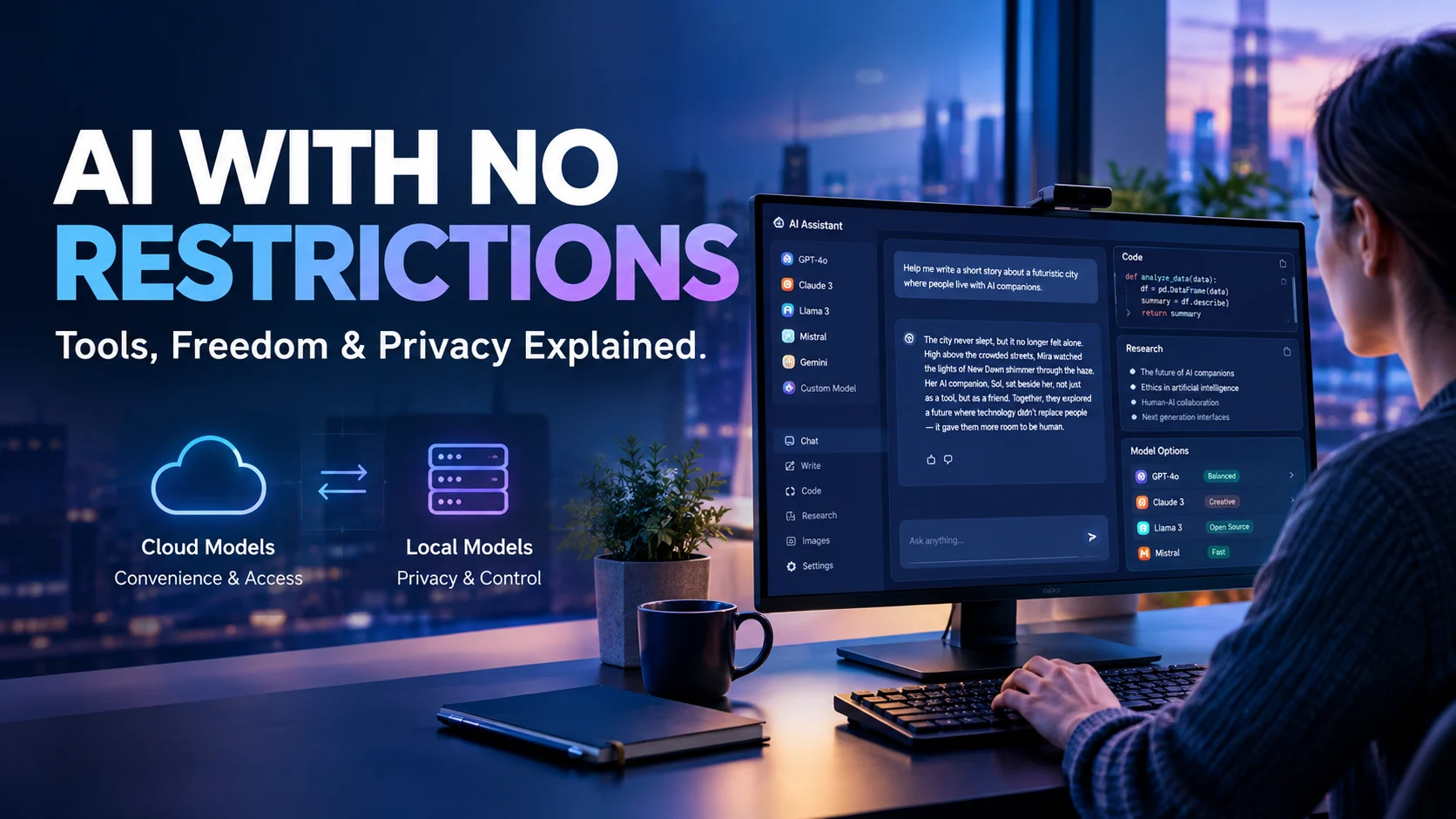
AI with no restrictions refers to AI chatbots or models designed to answer a broader range of questions with fewer content filters or refusal rules. These tools can support creative writing, research, coding, and open-ended discussions, but their capabilities, privacy protections, usage limits, and safety policies vary by platform.
At a Glance
- What it means: AI software that allows broader conversations and fewer unnecessary refusals.
- Main options: Unfiltered AI chatbots, open-weight language models, self-hosted AI systems, and multi-model platforms.
- Common uses: Fiction, roleplay, technical research, brainstorming, coding, and sensitive-topic discussions.
- Privacy matters: A chatbot advertised as unrestricted does not automatically protect your conversations.
- Free versus paid: Free access may include message caps, slower responses, limited models, or restricted features.
- Best selection strategy: Evaluate answer quality, transparency, data handling, costs, and actual restrictions before committing.
What Is AI With No Restrictions?
AI with no restrictions is a broad search term for artificial intelligence tools that impose fewer limitations on conversations, creative tasks, and information requests than conventional assistants. People often use it to find an uncensored AI chatbot that can discuss controversial subjects, support unrestricted storytelling, or provide more direct answers without unnecessary refusals.
However, no restrictions is a marketing phrase, not a standardized technical category. One service may allow mature fictional roleplay, while another focuses on open-ended research, uncensored text generation, or locally running AI models.
The distinction matters because not every platform offers the same degree of freedom. Some services host third-party models, some modify models to reduce refusals, and others provide access to models through a shared interface.
There is also a difference between fewer content filters and better answers. An AI system can respond to more prompts while still producing inaccurate information, biased conclusions, or fabricated sources.
The practical goal is to find an AI tool that handles legitimate requests without unnecessary interference while providing acceptable privacy, reliability, and control.
Why Are People Searching for Unrestricted AI?
The growing interest in unrestricted AI reflects several common frustrations with conventional AI assistants.
1. Fewer unnecessary refusals
Some users encounter refusals when discussing controversial history, fictional violence, sensitive social issues, or other subjects that can have legitimate educational or creative purposes.
A more flexible chatbot may handle these discussions with greater context instead of treating the entire subject as prohibited.
2. More creative freedom
Writers, game developers, and roleplayers may want help creating morally complex characters, realistic conflicts, dark fiction, or unconventional dialogue.
AI tools with fewer restrictions can provide more room for experimentation, although their policies still vary.
3. More control over AI behavior
Developers and advanced users may prefer models they can configure, fine-tune, or run on their own computers. This can provide greater control over system prompts, model selection, and data storage.
4. Better support for technical research
Researchers and cybersecurity professionals sometimes need to examine sensitive topics or study potentially harmful behavior in controlled environments. Flexible AI systems can support legitimate analysis, subject to applicable laws and appropriate safeguards.
Not every request should receive unrestricted assistance, however. Freedom to discuss a subject is different from providing instructions that facilitate real-world harm.
Types of AI With No Restrictions
Before choosing a tool, understand the main categories. They differ in flexibility, technical difficulty, privacy, and ongoing costs.
These browser-based services are designed to answer a wider range of prompts. They are convenient for casual conversations, creative writing, and roleplay, but their underlying models and policies can differ.
Example: Uncensored AI offers chat and content-generation features. Its published acceptable-use policy still prohibits certain activities, so the service is not literally unrestricted.
These models run on your computer instead of sending every prompt to a remote chatbot. Depending on your hardware and configuration, they can offer greater control over data, model selection, and customization.
Example: Ollama provides tools for running compatible models locally. Its privacy policy says locally processed prompts are not visible to Ollama, while cloud-hosted models follow a different processing arrangement.
Open-weight models provide downloadable model parameters, allowing eligible users to run or adapt them. Depending on the model and license, users may be able to customize behavior and deploy the system independently.
Example: Hugging Face Hub helps users discover models and inspect documentation, licenses, and model cards. Open weights do not automatically mean unrestricted use.
4. Multi-model AI platforms
These services let users access multiple models through one interface. They can be useful when different models perform better at writing, coding, research, or image generation.
Example: Uncensored.com advertises chat, media generation, web search, and access to different models. Check which model handles each request and which terms apply to the service.
Best AI With No Restrictions Tools to Explore
There is no single platform that is unrestricted in every respect. The following options represent different approaches rather than a definitive performance ranking.
| Platform | Target user | Key strength | Pricing transparency | Main limitation |
|---|---|---|---|---|
| Uncensored AI | General users and creators | Chat and multiple content-generation capabilities | Review current plans and limits | Service policies and model behavior still apply |
| Ollama | Developers and privacy-conscious users | Runs compatible models locally | Software and model availability can be checked directly | Hardware and setup requirements |
| Hugging Face Hub | Researchers and developers | Broad model discovery and documentation | Model access and licenses vary | Requires evaluation and sometimes technical setup |
| Futurepedia | People comparing AI products | Directory of AI tools and categories | Depends on each listed provider | Listings are not a guarantee of quality or unrestricted access |
Sources: official platform descriptions and documentation.
Which option should you choose?
- For quick access: Try a browser-based chatbot with a clear explanation of its limits.
- For private local experimentation: Investigate Ollama and compatible models.
- For customization: Explore open-weight models on Hugging Face and read each model’s license.
- For comparing products: Use Futurepedia as a discovery directory, then verify details on the provider’s own website.
A useful distinction: Futurepedia helps users find tools, while Ollama helps users run models. Hugging Face provides model discovery and hosting infrastructure, while an uncensored chatbot offers a more immediately accessible conversational experience.
What Can You Do With Unrestricted AI?
The most useful applications are often ordinary tasks that benefit from flexible conversation and creative control.
Creative writing and roleplay
Writers can explore complicated characters, darker fictional settings, unconventional dialogue, and multiple narrative outcomes. A flexible model can also help rewrite scenes without automatically softening every character’s language.
For example, a novelist might ask an AI to produce three versions of a tense fictional confrontation, each with a different character motivation.
Research and open-ended discussions
An AI chatbot can help organize arguments, explain controversial historical events, compare competing viewpoints, and summarize complex subjects.
However, a lack of content filtering does not guarantee neutrality. Ask for evidence, counterarguments, and links to primary sources when accuracy matters.
Coding and software development
Some flexible AI models can help explain code, debug errors, generate tests, and suggest alternative implementations.
Developers should review generated code, test it in an isolated environment, and avoid running commands they do not understand. A model that rarely refuses can still introduce security vulnerabilities.
Brainstorming and content creation
Marketers, bloggers, and content creators can use these systems to develop outlines, generate campaign ideas, test writing styles, and refine drafts.
The best results come from clear instructions, audience details, factual references, and human editing. Unrestricted generation alone does not produce original research or publishable quality.
Learning and technical exploration
Students and professionals can investigate difficult subjects through follow-up questions, alternative explanations, and hypothetical examples.
Treat the model as a learning assistant rather than an unquestionable authority. Verify important claims independently.
How Does AI With No Restrictions Work?
Most unrestricted AI tools use the same broad technology as conventional chatbots: large language models, or LLMs.
An LLM learns patterns from training data and generates responses based on the conversation and its learned parameters. Developers can influence its behavior through several mechanisms.
Model training and fine-tuning
Fine-tuning adapts a pretrained model using additional examples. Depending on the training process, this may change the model’s style, subject knowledge, instruction-following behavior, or tendency to refuse certain requests.
Some developers also use preference optimization to encourage particular response patterns.
However, fine-tuning does not guarantee complete removal of refusals. A model may still have learned limitations, and its host platform may apply additional restrictions.
System instructions and moderation
A chatbot’s behavior is not determined by its model alone. System instructions, input moderation, output filters, and account-level policies can affect what users receive.
This explains why the same underlying model may behave differently across two services.
APIs and model routing
Some platforms connect users to external models through application programming interfaces, or APIs. A model router may select different models depending on the request, subscription, or available capacity.
This can improve convenience, but it also introduces dependencies. Provider policies, rate limits, model availability, and pricing can affect the experience.
Local deployment
When a compatible model runs entirely on your computer, prompts can remain on that device rather than being transmitted to a cloud AI provider.
The degree of control depends on the software, integrations, telemetry settings, and whether any connected feature sends information elsewhere. Local execution does not automatically guarantee that every component is private.
Is AI With No Restrictions Free?
Some tools provide free access, but free access does not necessarily mean unlimited access.
Platforms can limit the number of messages, available models, context length, response speed, file uploads, or advanced features. Paid subscriptions may remove some restrictions while introducing other usage policies.
Before paying, check these details:
- Daily message limits: How many requests can you make?
- Model access: Are the advertised models included in your plan?
- Context limits: How much text can the model process in one conversation?
- Credit expiration: Do purchased credits expire?
- Feature restrictions: Are image generation, voice, file analysis, and APIs included?
- Renewal terms: Does the subscription renew automatically?
- Cancellation: Can you cancel easily, and when does access end?
For local AI, the cost structure is different. The software may be free, but electricity, hardware, storage, and setup time still matter.
Cloud models can also require ongoing usage fees. For developers, compare the cost per request, token limits, latency, and model quality rather than relying on a platform’s advertised starting price.
Pricing changes frequently, so verify the current plan and terms directly before subscribing.
Privacy and Security: What Users Should Check
Privacy deserves as much attention as model flexibility. Some services advertise anonymous use, confidential conversations, or enhanced privacy, but these phrases need to be evaluated against the actual policy and technical design.
Does an unrestricted AI chatbot store conversations?
It depends on the provider. A service may retain conversation history, collect account information, process prompts through external model providers, or use limited telemetry.
Read the privacy policy to understand what is collected, why it is collected, how long it is retained, and whether third parties receive it. For example, Uncensored AI publishes a privacy policy explaining its data-handling practices, but users should review the current terms rather than relying on the product’s name or marketing alone.
What about Zero Data Retention?
Zero Data Retention (ZDR) generally refers to an arrangement in which a provider does not retain specified customer data after processing, subject to the scope and exceptions in the agreement.
Do not confuse ZDR with encryption, anonymous access, or SOC 2 compliance. These address different aspects of security and data governance.
For business use, ask the provider:
- Are prompts and responses stored?
- Are conversations used to train models?
- Do third-party model providers process submitted data?
- Are logs retained for abuse monitoring or legal compliance?
- Can administrators delete conversation records?
- Is there a documented retention period or contractual ZDR commitment?
A SOC 2 report can provide information about a service organization’s controls, but it does not automatically establish zero data retention.
Is local AI more private?
Local AI can reduce exposure to external providers because prompts can be processed on your own hardware. Ollama states that it does not see prompts or data when the software runs locally. Its cloud service has separate processing terms.
Still, check browser extensions, connected tools, remote integrations, and telemetry. Avoid entering passwords, financial credentials, confidential client information, or sensitive personal records into systems you have not evaluated.
Benefits and Limitations of Unrestricted AI
The right choice depends on the balance between flexibility, reliability, and control.
| Benefits | Limitations |
|---|---|
| Fewer unnecessary refusals on legitimate topics | Policies and filters can still apply |
| Greater flexibility for fiction and roleplay | Output quality varies by model |
| More control through local deployment | Local models may need capable hardware |
| Options for customization and fine-tuning | Customization can require technical skills |
| Access to different models through some platforms | Hosted services may impose fees and usage caps |
| Potentially reduced cloud exposure with local execution | Poor configuration can still create privacy risks |
The central trade-off is simple: removing some restrictions can expand what a model will discuss, but it does not automatically improve accuracy, reasoning, or trustworthiness.
A responsible user evaluates both what the model will answer and how well it answers.
Common Mistakes When Choosing an Unrestricted AI
Assuming that uncensored means unlimited
A provider may advertise unrestricted chat while maintaining rules against illegal activity, exploitation, or other prohibited uses. Read the terms before choosing a platform.
Trusting every generated answer
An AI can confidently invent citations, misinterpret evidence, or produce incorrect code. Verify important claims with primary sources, documentation, or qualified professionals.
Ignoring third-party models
A platform may serve as an interface rather than the developer of the model itself. Your prompts might pass through another provider, creating additional privacy and availability considerations.
Installing unknown model files
Downloading an AI model from an unfamiliar source introduces supply-chain risks. Check the publisher, model documentation, license, file format, and recommended loading methods.
Paying before testing
Try a representative set of prompts before subscribing. Evaluate the tool on your actual tasks, including longer conversations, difficult questions, and any required file or media workflows.
How to Choose the Right AI With No Restrictions
Use this practical evaluation process instead of relying on marketing claims.
- Define your goal. Decide whether you need open-ended chat, creative writing, research, coding, roleplay, image generation, or local model control.
- Test representative prompts. Use several realistic examples and record unnecessary refusals, factual errors, and response quality.
- Identify the actual model. Find out which model powers the service and whether it changes between requests or subscription tiers.
- Read the privacy terms. Check retention, training use, external processors, deletion options, and available contractual protections.
- Compare total costs. Include subscriptions, usage credits, API charges, hardware, and potential integration expenses.
- Check licensing and usage rules. If you plan to fine-tune, redistribute, or use a model commercially, read its actual license and applicable service terms.
For a fair comparison, test every candidate with the same prompts. Assess usefulness, factual accuracy, consistency, latency, and policy behavior separately.
This produces a more meaningful result than choosing the platform with the boldest promise of unrestricted access.
Who Should Use Unrestricted AI?
AI with fewer restrictions can be useful for several groups, provided the tool fits their needs.
- Writers and roleplayers: People who want greater flexibility in character development, dialogue, and fictional scenarios.
- Researchers and students: Users exploring sensitive or controversial subjects who need contextual explanations and verifiable sources.
- Developers: People who want to test different models, adjust prompts, or run compatible models locally.
- Content creators: Bloggers and marketers who need brainstorming support and adaptable writing styles.
- Privacy-conscious users: People willing to configure local software and maintain their own computing environment.
Businesses handling confidential information should apply stricter evaluation standards. They may need contractual data protections, access controls, auditability, and approved deployment arrangements.
Users who need highly reliable medical, legal, financial, or safety-critical advice should prioritize accuracy, source verification, and professional oversight over a lack of content filters.
Frequently Asked Questions
1. What is the best AI with no restrictions?
There is no universally best unrestricted AI. The right option depends on your purpose, preferred model, privacy needs, and budget. Browser-based chatbots offer convenience, while local models can provide greater control. Test several options against your real tasks before deciding.
2. Is there a free AI with no restrictions?
Some platforms offer free access to uncensored or low-restriction AI tools. However, free plans may impose message limits, restrict certain models, or charge for advanced features. Local models may avoid subscription fees, but they still require suitable hardware and setup.
3. Is unrestricted AI safe and private?
Not automatically. A chatbot may still store conversations, process prompts through third parties, or generate inaccurate information. Review its privacy policy, retention practices, and acceptable-use terms. Local models can reduce cloud exposure when configured properly, but security depends on the entire setup.
4. Can I run an unrestricted AI locally on my computer?
Yes. Compatible open-weight models can run locally through software such as Ollama, depending on your operating system, available memory, and hardware. Local execution can offer more control over data and configuration, although model licenses, capabilities, and usage restrictions still vary.
5. What is the difference between uncensored AI and open-source AI?
Uncensored AI describes behavior with fewer content restrictions, while open-source AI refers to the availability of source code and other materials under an applicable license. Open-weight models provide access to trained parameters, but may not include all training data or source code. A model can be open-weight without being unrestricted.
Conclusion
AI with no restrictions describes a broad range of tools that aim to reduce unnecessary limits on conversations, research, and creative work. Options range from convenient online chatbots to customizable open-weight models that can run locally.
The right choice depends on your intended use, not simply how a platform markets itself. Compare actual model behavior, response quality, privacy policies, usage limits, licensing, and total cost before making a decision.
For most users, the best starting point is a tool that handles their legitimate tasks reliably, explains its limitations clearly, and offers privacy protections appropriate to the information they share.

Oliver Wilson is an AI researcher and tech writer living at the intersection of human creativity and machine intelligence. At AixOrbit.com, he decodes complex neural networks, generative AI and emerging tech trends into actionable insights making sure humans stay one step ahead of the algorithms.