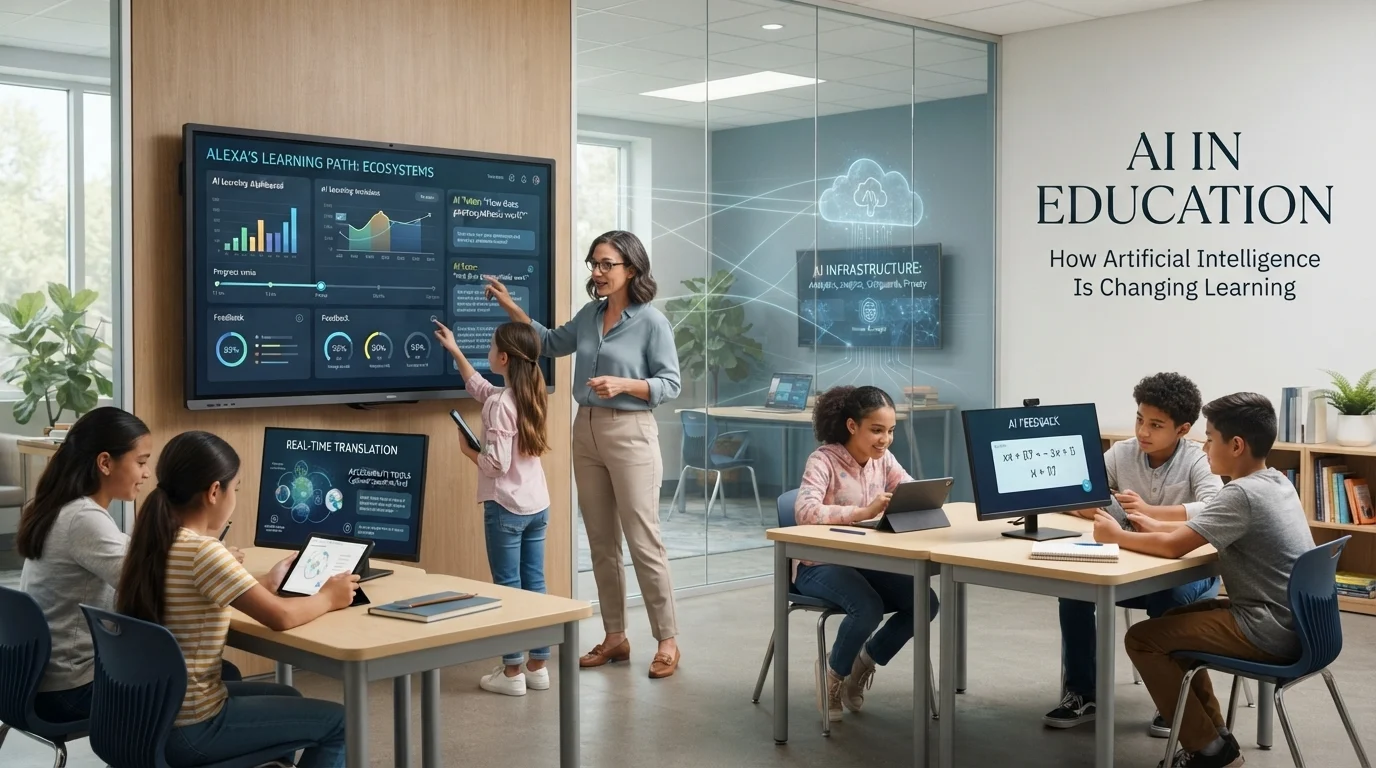
AI in education means using artificial intelligence to support teaching, learning, assessment, administration, accessibility, and personalized educational experiences. Its value comes from helping teachers and students work more effectively, not from replacing human judgment, relationships, or critical thinking.
AI in Education at a Glance
- Personalized learning: AI can adapt explanations, practice, feedback, and learning materials to individual needs.
- Teacher support: Educators can use AI for lesson planning, content creation, differentiation, feedback, and administrative tasks.
- Generative AI: Tools powered by large language models can explain concepts, create practice activities, summarize material, and support research.
- Accessibility: AI can assist with translation, speech recognition, text generation, reading support, and other accommodations.
- Major risks: Hallucinations, bias, privacy problems, over-reliance, academic integrity issues, and unequal access require active oversight.
- Human oversight matters: UNESCO emphasizes a human-centered approach that prioritizes inclusion, equity, safety, and human agency.
What Is AI in Education?
AI in education refers to the use of artificial intelligence technologies to improve or automate parts of the educational process.
That can include intelligent tutoring systems, adaptive learning platforms, automated feedback, AI-powered educational search, speech and language tools, recommendation systems, predictive analytics, and generative AI.
The technology is not limited to chatbots. Traditional machine learning can identify patterns in student activity, while natural language processing can analyze written responses. Modern generative AI can produce explanations, questions, examples, lesson materials, and other educational content.
The important distinction is how AI is used.
An AI tutor that asks a student guiding questions can encourage learning. An AI system that simply completes the student’s assignment may reduce the opportunity to practice the underlying skill.
UNESCO therefore advocates a human-centered approach to AI that focuses on inclusion, equity, human agency, and meaningful educational outcomes.
How AI Works in Education
Different educational AI systems use different technologies. The underlying process usually involves collecting an input, processing it through an AI model, and producing a recommendation, prediction, explanation, or generated response.
Machine Learning
Machine learning systems identify patterns in data and use those patterns to make predictions or recommendations.
In education, this might help identify students who need additional support or recommend learning resources based on previous performance.
These systems depend heavily on data quality. Poor or biased data can produce poor recommendations.
Generative AI and Large Language Models
Generative AI can create new text, images, audio, or other content based on a user’s instructions.
Large language models, or LLMs, are particularly relevant to education because they can process natural-language questions and generate conversational responses.
Students can use them to ask for alternative explanations. Teachers can use them to brainstorm activities or adapt reading material for different ability levels.
However, an LLM does not automatically know whether every statement it generates is correct. It can produce convincing but inaccurate information, often called a hallucination.
That makes verification essential for academic work.
Retrieval-Augmented Generation
Some educational AI systems use retrieval-augmented generation, or RAG, to ground responses in selected documents.
For example, a university could connect an AI assistant to an approved course handbook. Instead of relying only on the model’s general training, the system can retrieve relevant institutional information before generating an answer.
RAG can improve grounding, but it does not guarantee accuracy. Incorrect, outdated, or incomplete source material can still produce misleading answers.
How AI Is Used in Education
AI is already being applied across classrooms, universities, online learning platforms, and administrative workflows.
1. Personalized Learning
One of the strongest use cases is adapting learning to individual students.
An AI system can potentially adjust:
- Difficulty level
- Practice questions
- Explanations
- Learning pace
- Revision material
- Feedback
- Recommended resources
For example, a student struggling with algebra could receive additional examples before moving to more difficult problems.
The goal is not simply to give every learner a different worksheet. Effective personalization should respond to demonstrated learning needs.
2. AI Tutoring
AI tutors can provide conversational assistance outside traditional classroom hours.
A student might ask:
“Why does this equation require this step?”
Instead of immediately providing the answer, a well-designed tutor can ask a question, provide a hint, explain the relevant principle, and gradually increase support.
This approach is closer to guided learning than answer generation.
Khan Academy’s Khanmigo is one current example. In 2026, Google and Khan Academy expanded their collaboration around AI-powered learning tools, including interactive diagrams designed to support mathematics and science learning.
3. Lesson Planning and Teacher Workflows
Teachers can use AI to brainstorm lesson structures, generate discussion questions, create differentiated materials, and develop practice activities.
Google has expanded Gemini-based capabilities for educators, including tools integrated with Google Classroom. Its 2025 Classroom announcement described more than 30 AI tools for tasks such as brainstorming and content creation.
The most useful role is often first-draft assistance.
Teachers still need to check the material for factual accuracy, age appropriateness, curriculum alignment, cultural context, and learning objectives.
4. Assessment and Feedback
AI can help analyze written responses and provide preliminary feedback.
It can identify possible grammar problems, highlight areas requiring revision, or generate practice questions from course material.
However, automated evaluation becomes more sensitive when grades affect students’ academic progression.
A system should not be treated as an unquestionable authority simply because it produces a numerical score.
5. Accessibility and Inclusion
AI can support students with different learning needs through technologies such as:
- Speech-to-text
- Text-to-speech
- Translation
- Caption generation
- Reading assistance
- Simplified explanations
- Language support
These applications can reduce barriers to educational content.
At the same time, accessibility tools should be evaluated with the people who actually use them. A technically impressive system can still fail if its interface or outputs do not match real learner needs.
6. Research and Study Support
Students increasingly use AI to summarize documents, brainstorm research questions, explain difficult concepts, and organize study plans.
Newer educational tools are moving beyond simple chat interfaces.
For example, Google has introduced study-oriented AI features involving Gemini, NotebookLM, and Google Classroom, including tools designed to work with course materials.
The key question is whether AI helps students understand the material or merely helps them finish the task.
Benefits of AI in Education
The strongest arguments for AI in education involve productivity, personalization, access, and support.
More Personalized Support
Teachers cannot provide unlimited one-to-one assistance during every lesson.
AI can provide additional explanations or practice between teacher interactions.
That does not replace a teacher. It can extend the amount of support available to learners.
Reduced Administrative Work
Educators spend substantial time preparing materials and completing administrative tasks.
AI can help with routine drafting, organization, brainstorming, and content adaptation.
Time saved can potentially be redirected toward teaching, mentoring, and student interaction.
Faster Feedback
Students often benefit from receiving feedback while they are still working on a concept.
AI systems can provide immediate responses, although important feedback should remain subject to human review when accuracy matters.
Greater Access to Learning
AI-powered translation, speech tools, and conversational interfaces can make educational content easier to access for some learners.
This is particularly relevant in multilingual and geographically distributed learning environments.
New Forms of Learning
Generative AI can make it easier to simulate conversations, create examples, generate scenarios, and explore different perspectives.
That creates opportunities for more interactive learning experiences.
Risks and Limitations of AI in Education
AI’s educational benefits come with significant risks.
1. Hallucinations and Incorrect Information
Generative AI can produce false citations, incorrect explanations, fabricated facts, and misleading answers.
Students may have difficulty recognizing errors when the response sounds confident.
For this reason, AI output should be treated as a starting point, not automatically as a source of truth.
2. Over-Reliance and Reduced Critical Thinking
If students routinely outsource writing, calculations, research, and problem-solving, they may practice fewer of the skills education is supposed to develop.
The problem is not simply whether a student uses AI. The more important question is whether the AI use preserves the student’s intellectual work.
UNESCO’s guidance explicitly highlights the need to consider how generative AI affects learning, assessment, knowledge, and human agency.
3. Academic Integrity
Generative AI has changed the meaning of traditional take-home assignments.
A student can now ask an AI system to produce an essay, solve a problem, or rewrite an assignment within seconds.
Schools and universities therefore need clearer policies defining acceptable and unacceptable AI assistance.
Some assessments may also need redesigning around oral explanations, drafts, project work, classroom activities, and demonstrations of understanding.
4. Privacy and Student Data
Education involves sensitive information.
Depending on the system, AI applications may process student names, assignments, conversations, behavioral data, academic records, or other personal information.
Institutions should examine:
- What data is collected
- Why it is collected
- Where it is stored
- Who can access it
- How long it is retained
- Whether it is used to train models
- Whether administrators can delete it
- What happens when the vendor relationship ends
A vendor’s general security certification should not be treated as proof of every specific privacy practice. SOC 2, for example, does not automatically mean that a service offers Zero Data Retention.
5. Bias and Unequal Outcomes
AI systems can reproduce or amplify biases found in training data, evaluation methods, or product design.
This can affect automated recommendations, language processing, assessment, or student support.
Testing across different populations is therefore important before deploying AI at scale.
6. The Digital and AI Divide
AI can increase educational inequality if high-quality tools are available only to students with better devices, faster internet, paid subscriptions, or greater technical support.
UNESCO has warned that the existing digital divide is increasingly becoming an AI divide.
AI in Education: Privacy and Responsible Use
Responsible adoption starts with governance rather than technology.
Schools and universities should create clear rules before deploying AI across large groups of students.
A practical policy should address:
- Permitted use: What students and teachers may use AI for.
- Restricted use: Which assignments or assessments prohibit AI assistance.
- Disclosure: When students must identify AI-assisted work.
- Data handling: What information can be entered into AI systems.
- Human review: Which decisions require educator oversight.
- Age requirements: Which tools are appropriate for different age groups.
- Vendor accountability: What happens to institutional and student data.
- Evaluation: How the institution will measure whether AI actually improves learning.
UNESCO’s guidance recommends privacy protection, age-appropriate use, ethical validation, and human-centered implementation rather than treating AI adoption as a purely technical decision.
AI in Education in 2026: What Is Changing?
The education AI market is moving beyond standalone chatbots.
AI Is Becoming More Embedded in Learning Platforms
Instead of asking students to open a separate AI website, educational providers are integrating AI into existing classroom environments.
Google’s 2026 education updates, for example, include AI capabilities across Gemini, Google Classroom, and related learning experiences.
This shift matters because context can improve usefulness. An AI assistant connected to a specific course can potentially work with relevant materials rather than responding only from general knowledge.
AI Tutors Are Becoming More Interactive
AI tutoring is also moving toward richer interfaces.
Khanmigo’s 2026 updates include interactive visual aids for mathematics and science rather than relying solely on conversational text.
This reflects a broader trend toward multimodal learning, where AI can work with text, images, diagrams, audio, and other formats.
AI Literacy Is Becoming Part of Education
Students increasingly need to understand not only how to use AI, but also how AI systems fail.
Important AI literacy skills include:
- Writing effective prompts
- Checking sources
- Recognizing hallucinations
- Understanding bias
- Protecting personal data
- Citing AI assistance appropriately
- Comparing AI output with authoritative sources
- Knowing when human expertise is necessary
UNESCO has developed AI competency frameworks for both students and teachers to support this broader approach to AI literacy.
How Schools Should Evaluate an AI Education Tool
Buying an AI product should not begin with the question, “How advanced is the model?”
Start with the educational problem.
Evaluate the Learning Value
Ask:
- What learning outcome does this tool improve?
- Does it encourage active thinking?
- Does it provide useful feedback?
- Can teachers control how it is used?
- Does it work with the curriculum?
- How will success be measured?
Evaluate the Technology
For more technical deployments, institutions should also examine:
- Model provider
- API dependencies
- Context-window limits
- Response latency
- Integration requirements
- Usage limits
- Data retention
- Model update policies
- Reliability
- Cost per user or interaction
An impressive demonstration does not necessarily translate into a reliable school-wide system.
Evaluate Vendor Risk
Institutions should understand the difference between a product’s marketing claims and independently verified capabilities.
Ask for documentation covering security, privacy, data processing, retention, access controls, incident response, and compliance where relevant.
Avoid assuming that a familiar AI brand automatically provides the right educational safeguards.
Common Mistakes When Using AI in Education
Treating AI as a Teacher Replacement
AI can support instruction, but education involves motivation, relationships, judgment, classroom management, mentorship, and social development.
Those functions cannot be reduced to generating answers.
Allowing AI to Do All the Thinking
Students learn through effort.
If AI completes every difficult step, students may produce better-looking work without developing stronger underlying skills.
Entering Sensitive Student Information
Teachers should not paste confidential student records into consumer AI tools without understanding the provider’s data practices and institutional policy.
Using AI Detection as Absolute Proof
AI-generated text detection is not a perfect measure of authorship.
Schools should avoid treating automated detection scores as unquestionable evidence of misconduct. A broader assessment of the student’s process and understanding is more defensible.
Measuring Adoption Instead of Outcomes
A school can have thousands of AI interactions and still see little educational improvement.
The meaningful metric is not how often students use AI. It is whether the technology contributes to better learning, teaching, access, or efficiency.
Who Should Use AI in Education?
AI can be useful across the education ecosystem, but the appropriate use differs by audience.
| User | Potential Value | Main Consideration |
|---|---|---|
| Students | Tutoring, practice, research, explanations | Avoid outsourcing learning |
| Teachers | Planning, differentiation, feedback, resources | Verify AI-generated content |
| Schools | Administration, analytics, learning support | Governance and privacy |
| Universities | Research, teaching, student services | Data and institutional policy |
| Researchers | Literature support, analysis, coding assistance | Source verification |
| Education technology teams | Personalized products and automation | Model reliability and cost |
| Parents | Homework support and learning guidance | Age appropriateness and supervision |
The Future of AI in Education
The future is unlikely to be defined by one universal AI teacher.
Instead, education may develop ecosystems in which teachers, students, learning platforms, AI assistants, and institutional systems work together.
AI agents could eventually handle more multi-step administrative workflows. More education platforms may use retrieval systems to ground AI responses in approved course materials. Multimodal models may make tutoring more visual and interactive.
But technological progress does not eliminate the central educational question:
Does the technology help people learn?
That question should remain more important than model size, flashy demonstrations, or the number of AI features a platform offers.
UNESCO’s current work continues to emphasize human-centered implementation, AI competencies, inclusion, and the need to address the risks that accompany rapid technological development.
Frequently Asked Questions
What is AI in education?
AI in education is the use of artificial intelligence to support teaching, learning, assessment, accessibility, research, and educational administration. Examples include AI tutors, adaptive learning systems, automated feedback, generative AI assistants, translation tools, and personalized learning platforms.
How can AI help students learn?
AI can provide explanations, practice questions, personalized feedback, study support, translation, and tutoring-style interactions. Its effectiveness depends on how it is designed and used, because simply giving students answers does not necessarily improve understanding.
What are the main disadvantages of AI in education?
Major concerns include inaccurate AI-generated information, academic integrity problems, privacy risks, bias, over-reliance on automated assistance, unequal access, and possible reductions in independent thinking when students use AI to complete work instead of learning the underlying material.
Will AI replace teachers?
AI is more likely to change teachers’ work than eliminate the need for teachers. AI can assist with routine tasks and provide additional learning support, while teachers remain responsible for relationships, judgment, pedagogy, classroom context, mentoring, and many decisions that require human understanding.
Is AI safe for students?
AI is not automatically safe simply because it is marketed for education. Schools and families should evaluate age appropriateness, privacy practices, data retention, accuracy, bias, content safeguards, vendor policies, and human oversight before allowing students to use an AI system.
Conclusion
AI in education is becoming a practical part of teaching and learning rather than a distant experiment. Its strongest applications include personalized support, tutoring, teacher assistance, accessibility, research, and educational administration.
The technology also introduces serious challenges. Hallucinations, privacy risks, bias, academic integrity, unequal access, and over-reliance can undermine learning when institutions deploy AI without clear safeguards.
The most useful approach is therefore neither unrestricted adoption nor blanket rejection.

Oliver Wilson is an AI researcher and tech writer living at the intersection of human creativity and machine intelligence. At AixOrbit.com, he decodes complex neural networks, generative AI and emerging tech trends into actionable insights making sure humans stay one step ahead of the algorithms.