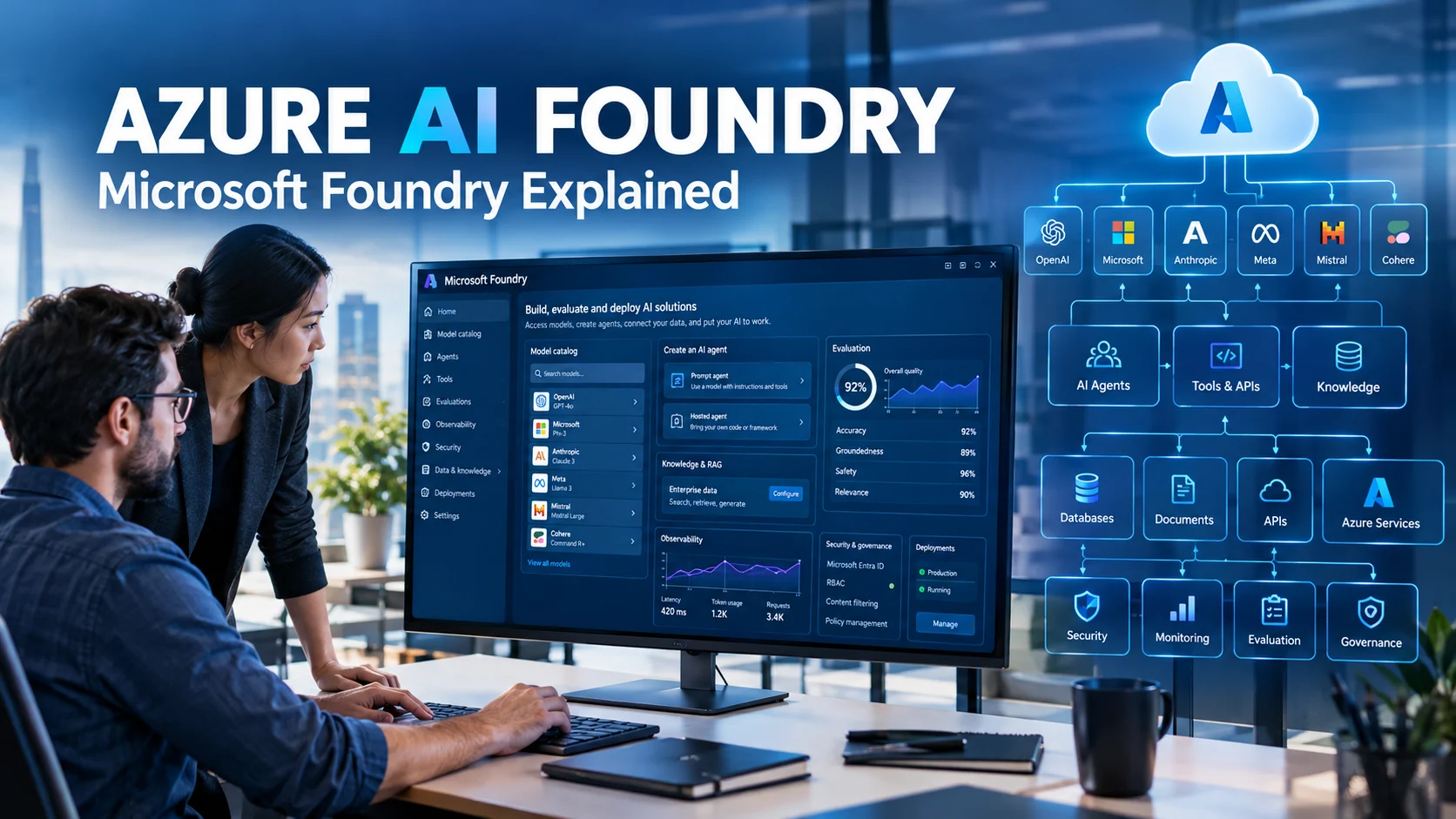
Azure AI Foundry is Microsoft’s AI development platform, now branded Microsoft Foundry, for building, deploying, evaluating, and governing generative AI applications and agents. It brings together AI models, agent services, tools, evaluation, observability, security, and Azure infrastructure in one platform.
For developers searching for Azure AI Foundry today, the most important distinction is that the product has evolved beyond its former Azure AI Studio and Azure AI Foundry branding into Microsoft Foundry, while the underlying goal remains the same: helping organizations move AI projects from experimentation to production.
At a Glance
- Current name: Microsoft Foundry. Azure AI Foundry is the legacy name many users still search for.
- Primary purpose: Build, customize, deploy, evaluate, monitor, and govern AI applications and agents.
- Models: The Foundry catalog spans models from Microsoft, OpenAI, Anthropic, Meta, DeepSeek, Mistral, Cohere, Hugging Face, and other providers.
- Agent development: Foundry Agent Service supports managed prompt agents and hosted agents built with your own code or frameworks.
- Enterprise controls: Microsoft Entra ID, RBAC, networking, policies, content filtering, observability, and governance features are integrated into the platform.
- Pricing: The Foundry platform itself is free to explore, but the models, agents, tools, monitoring, evaluations, and other consumed services are billed according to their individual pricing models.
What Is Azure AI Foundry?
Azure AI Foundry was Microsoft’s platform for developing generative AI applications on Azure. Microsoft has since renamed the product Microsoft Foundry, consolidating capabilities that previously appeared across Azure AI Studio, Azure AI Foundry, Azure OpenAI, and other Azure AI experiences.
The change is more than a branding exercise. The current Foundry experience puts models, agents, tools, evaluations, observability, and governance into a more unified development and management environment.
That makes Foundry different from a simple chatbot builder or model API.
A developer can use it to select a model, create an AI application, connect enterprise data, add tools, evaluate outputs, monitor production behavior, and apply organizational controls.
For organizations already using Azure, the biggest attraction is the connection between AI development and the broader Azure ecosystem.
Why Did Azure AI Foundry Become Microsoft Foundry?
The name changed as Microsoft’s AI platform expanded.
Microsoft’s current documentation lists Azure AI Studio / Azure AI Foundry as the previous brand and Microsoft Foundry as the current brand. The newer architecture also moves toward a unified Foundry resource and project model instead of requiring developers to work across multiple older resource patterns.
This matters if you’re researching older tutorials.
You may still find references to:
- Azure AI Studio
- Azure AI Foundry
- Foundry classic
- Azure OpenAI Studio
- Azure AI Services
- Assistants API
- Azure AI inference packages
Some of those terms describe older product experiences.
For new projects, Microsoft’s documentation increasingly points developers toward Microsoft Foundry, the Foundry SDK, the current project model, and newer agent APIs.
So, if you search for “Azure AI Foundry,” you are generally looking for what Microsoft now calls Microsoft Foundry.
How Does Microsoft Foundry Work?
Foundry acts as a development and management layer around AI models and applications.
A typical workflow looks like this:
- Create a Foundry project
- Choose an AI model
- Test the model with your prompts and data
- Build an application or agent
- Connect tools or enterprise knowledge
- Evaluate quality and safety
- Deploy the workload
- Monitor performance and usage
- Apply governance and security controls
The important idea is that the model is only one component.
A production AI application also needs authentication, data access, monitoring, evaluation, cost management, safety controls, and deployment infrastructure. Foundry attempts to bring these concerns into one Azure-centered environment.
Microsoft Foundry Models
One of Foundry’s most important components is its model catalog.
Microsoft currently describes Foundry as providing access to more than 11,000 models, including models from Microsoft, OpenAI, Anthropic, Meta, and other providers.
The exact catalog changes over time, so model availability should always be checked before making an architectural decision.
What Types of Models Are Available?
Depending on availability and deployment method, the catalog can include:
- Large language models
- Reasoning models
- Small language models
- Multimodal models
- Embedding models
- Image-generation models
- Audio models
- Domain-specific models
- Open models
- Industry-focused models
The catalog is broadly divided into models sold by Azure and models from partners and the community.
That distinction is important.
Models sold by Azure are hosted and operated by Azure and are covered by Microsoft service terms and support arrangements. Partner and community models can have different providers, deployment options, licensing terms, regional availability, and data-processing arrangements.
Do not assume every model in the Foundry catalog has identical privacy, support, or compliance characteristics.
Can You Compare AI Models?
Yes.
Foundry provides model discovery and evaluation capabilities designed to help developers compare models against their own tasks and datasets.
That is more useful than choosing a model solely because it has a high public benchmark score.
A model that performs well on a general benchmark may not be the most suitable choice for a company’s internal documents, customer-support workflow, coding tasks, or structured data.
Microsoft Foundry Agent Service
AI agents are a major part of the current Foundry platform.
An AI agent combines a model with instructions, tools, data, and a runtime that allows it to perform tasks rather than simply generate text.
Foundry Agent Service provides a managed environment for building, deploying, and scaling agents.
Developers can choose different approaches depending on how much control they need.
Prompt Agents
Prompt agents are the simpler route.
You define instructions, select a model, and attach available tools. Foundry manages much of the runtime infrastructure.
This approach is useful when the agent’s behavior can be described primarily through instructions and tool configuration.
Hosted Agents
Hosted agents provide more control.
You can bring your own agent code or framework and have Foundry host it with managed infrastructure, scaling, identity, and related capabilities.
This is more appropriate when an application requires custom logic, dependencies, or a specific agent framework.
Tools and Knowledge
Agents can work with tools such as:
- Web search
- File search
- Code execution
- Custom functions
- MCP servers
- Retrieval systems
- Enterprise data sources
This is where an agent becomes more useful than a conventional chatbot.
Instead of only answering a question, an agent can retrieve information, call a service, process data, and return an action-oriented result.
RAG and Enterprise Knowledge
Retrieval-Augmented Generation, or RAG, is another important concept when evaluating Microsoft Foundry.
RAG allows an AI application to retrieve relevant information from a knowledge base and provide that information as context to the model.
For example, a company could build an internal support assistant that retrieves approved information from documentation before generating an answer.
This can reduce the need to put every piece of company information directly into a model’s training process.
However, RAG is not automatically accurate.
Poor document quality, weak retrieval, bad chunking, irrelevant search results, and outdated information can still produce poor answers.
Foundry includes evaluation capabilities for RAG systems, including evaluators that can assess document retrieval quality.
Evaluation and Observability
This is one of the areas where Foundry becomes particularly relevant for production AI teams.
A prototype can look impressive after ten successful prompts.
A production system needs much more evidence.
You need to know:
- How often the model produces incorrect answers
- Whether retrieval returns useful documents
- How long requests take
- How many tokens are consumed
- Whether agents call the correct tools
- Whether failures increase after a model change
- Whether safety controls are triggered
- Whether quality changes between versions
Foundry provides evaluation and observability capabilities for these tasks.
AI Evaluation
Foundry can evaluate models, agents, datasets, and captured traces.
Teams can create evaluation datasets, select evaluators, run tests, and establish quality baselines.
This supports a more disciplined development cycle:
build → test → evaluate → change → evaluate again → deploy
That process is especially important for AI systems because model outputs are probabilistic.
Tracing and Monitoring
Foundry observability can capture information about agent interactions, including latency, exceptions, model calls, tool activity, and retrieval operations.
Application Insights can be connected for telemetry and monitoring.
One practical advantage is that monitoring can reveal problems that are invisible from the final answer alone.
For example, an agent might return a plausible response while taking the wrong tool path or retrieving irrelevant documents.
Fine-Tuning in Microsoft Foundry
Foundry also supports model customization where supported.
Fine-tuning means adapting an existing pretrained model using additional task-specific data.
It can make sense when a model repeatedly needs to perform a specialized task and prompting alone is not sufficient.
However, fine-tuning is not the default answer to every AI problem.
Consider RAG first when the main issue is access to changing company information.
Consider prompting when the task can be solved through clearer instructions and examples.
Consider fine-tuning when the model needs to learn consistent behavior, formatting, or task-specific patterns from suitable training data.
Fine-tuning also introduces additional costs, training requirements, evaluation work, and model lifecycle considerations.
Microsoft Foundry Pricing
One of the easiest mistakes is to ask, “How much does Azure AI Foundry cost?” as if Foundry were a single flat-rate application.
It is not.
Microsoft states that the Foundry platform is free to explore, while individual capabilities and services are billed according to their normal pricing models.
That means your total cost depends on what you actually use.
Potential cost components include:
- Model inference
- Input and output tokens
- Agent operations
- Fine-tuning
- Managed compute
- Storage
- Monitoring
- Application Insights
- Evaluations
- Content safety
- Networking
- Other Azure services
This creates an important budgeting issue.
A low-cost model does not automatically mean a low-cost AI application.
An agent can make multiple model calls, perform retrieval, invoke tools, generate long responses, and create telemetry. Those operations can increase the final bill.
What Should You Calculate Before Deployment?
Estimate at least:
| Cost factor | Why it matters |
|---|---|
| Input tokens | Long prompts and retrieved context increase usage |
| Output tokens | Longer responses increase inference cost |
| Model choice | Different models have different pricing |
| Agent calls | Multi-step agents can make several model requests |
| Retrieval | Search and vector infrastructure may add cost |
| Monitoring | Logs and traces can create additional Azure usage |
| Evaluation | Automated testing can consume models and compute |
| Fine-tuning | Training and deployment introduce separate costs |
For serious workloads, estimate cost per user, per request, and per completed task rather than relying only on model token pricing.
Security, Privacy, and Data Governance
Microsoft Foundry is designed for enterprise Azure environments, with controls including Microsoft Entra identity, role-based access control, network isolation, policies, content filters, and governance integrations.
But “Microsoft Foundry is secure” is too broad a statement to be useful.
Security depends on the architecture you deploy.
You still need to configure identity, permissions, networking, logging, data access, application security, and AI-specific controls correctly.
Does Foundry Mean Zero Data Retention?
No.
This distinction is critical.
SOC 2, Azure security controls, encryption, and Zero Data Retention are different concepts.
Microsoft documentation describes data processing and storage behavior for different Foundry models and features. Some capabilities intentionally store data, such as conversations, uploaded files, evaluation artifacts, or telemetry.
Zero Data Retention also depends on the specific model, resource, deployment type, agreement, and Microsoft eligibility or approval requirements.
Do not assume that enabling Foundry automatically gives every model or feature zero-retention behavior.
The situation can also differ for third-party models.
For example, Anthropic models available through Foundry can have different data-processing arrangements because Anthropic remains involved in processing those model requests.
For sensitive workloads, evaluate the exact:
- Model provider
- Hosting location
- Deployment type
- Data retention policy
- Abuse monitoring behavior
- Logging configuration
- Application telemetry
- Agent state
- Storage services
- Contractual terms
This is far more reliable than treating “enterprise AI” as a blanket privacy guarantee.
Azure AI Foundry vs Amazon Bedrock vs Google Vertex AI
Microsoft Foundry is not alone.
Its closest major cloud-platform competitors include Amazon Bedrock and Google Cloud Vertex AI.
| Platform | Target User | Key Strength | Pricing Transparency | Core Limitation |
|---|---|---|---|---|
| Microsoft Foundry | Azure-centric developers and enterprises | Azure integration, models, agents, governance | Usage-based and service-specific | Can become complex across Azure services |
| Amazon Bedrock | AWS developers and enterprises | Broad model access and AWS integration | Usage-based | AWS architecture can add operational complexity |
| Google Vertex AI | Google Cloud and ML teams | Model development, Gemini ecosystem, ML tooling | Usage-based | Best fit often depends on existing Google Cloud architecture |
Amazon Bedrock provides access to multiple foundation-model providers through AWS and supports agents, knowledge bases, model evaluation, and customization.
Google Vertex AI similarly provides model and AI development capabilities within Google Cloud.
The practical choice is usually less about which platform has the largest model list.
Instead, consider where your data already lives, which identity system you use, which cloud services your application depends on, your compliance requirements, your preferred development stack, and which models you actually need.
Key Benefits of Microsoft Foundry
One Environment for Multiple AI Workflows
Foundry brings model discovery, agent development, evaluation, and governance closer together.
That can reduce the number of disconnected tools an enterprise team needs to manage.
Broad Model Choice
The model catalog gives teams access to models from multiple providers instead of forcing every application onto one model family.
This can support model experimentation and workload-specific selection.
Strong Azure Integration
Organizations already using Azure can connect Foundry with existing identity, networking, monitoring, security, storage, and data services.
That integration can be more important than an isolated feature comparison.
Production-Oriented Evaluation
The ability to evaluate models and agents against datasets and production traces addresses a major weakness of casual AI experimentation.
Teams can measure changes rather than relying only on subjective testing.
Enterprise Governance
Foundry can fit into broader Azure governance through Microsoft Entra, RBAC, Azure Policy, Defender for Cloud, Microsoft Purview, and related controls.
Limitations and Potential Drawbacks
Foundry is powerful, but it is not automatically simple.
Azure Complexity
New Azure users can face a steep learning curve.
You may encounter subscriptions, resource groups, projects, managed identities, RBAC roles, regions, deployment types, quotas, networking, monitoring resources, and separate billing meters.
Pricing Can Be Difficult to Forecast
There is no single “Foundry subscription price” that represents your complete AI workload.
Real costs depend on architecture and usage.
Model Availability Varies
A model may not be available in every region or through every deployment method.
Third-party models can also have different commercial and data-processing conditions.
Enterprise Features Require Configuration
Governance features do not eliminate the need for good architecture.
An organization still has to define permissions, data policies, monitoring practices, retention rules, and acceptable AI behavior.
Preview Features Need Caution
Some Foundry capabilities remain in preview.
Preview services can have limitations and may not provide the same production guarantees as generally available features.
Who Should Use Microsoft Foundry?
Microsoft Foundry is particularly relevant to:
- Enterprise developers building production AI applications
- Azure teams adding generative AI to existing applications
- AI engineers building agents and RAG systems
- ML teams evaluating and customizing models
- Platform teams governing AI deployments across an organization
- Businesses that need identity, networking, monitoring, and policy controls around AI
It may be excessive for someone who simply wants a basic chatbot or a lightweight personal AI experiment.
For those users, a direct model API or consumer AI application may be much simpler.
Common Mistakes to Avoid
Treating Foundry as a Single AI Model
Foundry is a platform, not one model.
The quality of your application depends on the model, prompts, data, retrieval system, tools, orchestration, evaluation, and application architecture.
Choosing Models by Benchmark Alone
Benchmarks are useful signals, not universal proof.
Test models against your actual tasks.
Ignoring Third-Party Model Terms
A model available inside Foundry does not necessarily have identical terms to a Microsoft-hosted model.
Check the provider’s conditions and deployment architecture.
Forgetting Observability Costs
Monitoring and tracing provide valuable operational visibility, but they can create additional Azure usage and data-retention considerations.
Assuming RAG Eliminates Hallucinations
RAG can improve grounding, but retrieval quality matters.
Bad documents or irrelevant retrieval can still produce unreliable answers.
Azure AI Foundry: What Matters Most in 2026?
The biggest change for anyone researching Azure AI Foundry is the transition to Microsoft Foundry.
The platform has evolved toward a broader AI application and agent factory rather than simply being a model-development workspace.
Its current value comes from combining several layers:
models + agents + tools + knowledge + evaluation + observability + governance
That combination is particularly relevant as companies move from isolated AI prototypes toward production systems.
The important question is therefore not simply, “Does Azure AI Foundry have the model I want?”
Ask instead:
- Can it support my application architecture?
- Is my required model available in my region?
- What will the complete workload cost?
- Where will prompts and outputs be processed?
- What data is retained?
- Which tools and agent features store state?
- Can my team evaluate quality continuously?
- Can my existing Azure security policies govern the workload?
- How difficult will it be to migrate if the preferred model changes?
Those questions produce a much more useful buying decision.
Frequently Asked Questions
Is Azure AI Foundry still available?
Azure AI Foundry has evolved into Microsoft Foundry, which is Microsoft’s current branding for the platform. You may still see Azure AI Foundry and Azure AI Studio in older documentation, tutorials, search results, and existing projects.
Is Microsoft Foundry free?
The Foundry platform is free to explore, but the services and capabilities you consume are billed separately. Model inference, agent operations, evaluations, monitoring, storage, and other Azure resources can create charges depending on your architecture and usage.
What models are available in Microsoft Foundry?
Microsoft Foundry provides a large model catalog containing models from Microsoft, OpenAI, Anthropic, Meta, DeepSeek, Mistral, Cohere, Hugging Face, and other providers. Availability, deployment options, regions, pricing, and terms vary by model.
Is Microsoft Foundry the same as Azure OpenAI?
No. Azure OpenAI is a model service within the broader Microsoft AI ecosystem, while Microsoft Foundry is a broader platform for working with models, agents, tools, evaluation, observability, and governance. Foundry can provide access to Azure OpenAI models alongside other models.
Is Microsoft Foundry suitable for enterprise AI?
It can be, particularly for organizations already invested in Azure. Foundry provides enterprise-oriented identity, access control, networking, policy, monitoring, evaluation, and governance capabilities, but teams still need to configure and manage those controls correctly for their workload.
Conclusion
Azure AI Foundry is now Microsoft Foundry, and that naming change reflects how much the platform has expanded.
It is no longer just a place to experiment with AI models. Foundry brings together model access, AI agents, tools, enterprise knowledge, evaluation, observability, security, and governance.
For Azure-focused development teams, that unified approach can be valuable when moving AI applications into production.
The main caution is complexity. Pricing, model availability, data processing, retention, third-party provider terms, and preview features all require careful evaluation.
If you’re comparing Microsoft Foundry with another AI platform, evaluate the complete workload, not just the model catalog. Your existing cloud environment, security requirements, data architecture, model needs, and expected usage will ultimately determine whether Foundry is a practical fit.

Oliver Wilson is an AI researcher and tech writer living at the intersection of human creativity and machine intelligence. At AixOrbit.com, he decodes complex neural networks, generative AI and emerging tech trends into actionable insights making sure humans stay one step ahead of the algorithms.