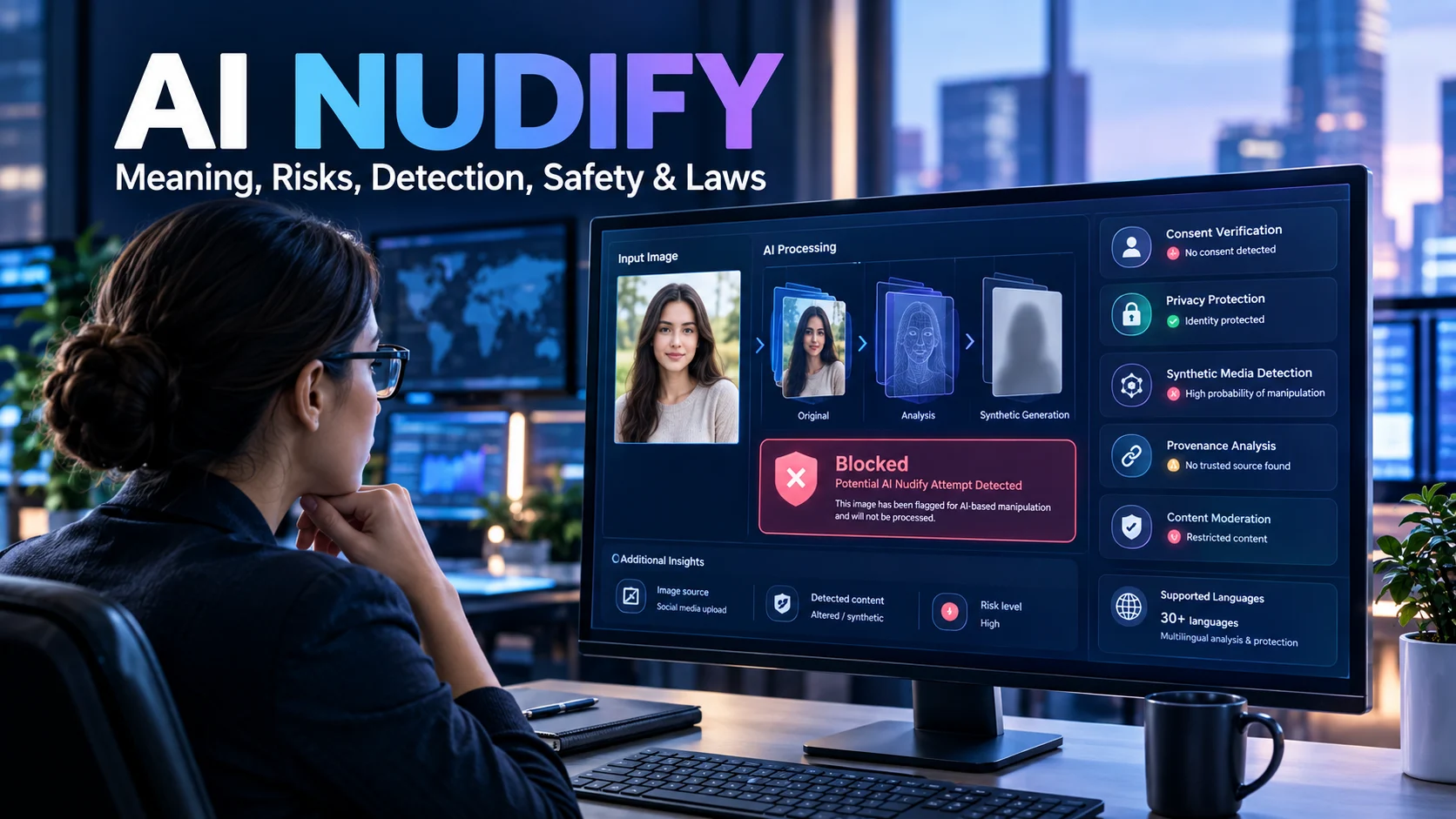
AI nudify refers to generative AI systems that manipulate an image to create a simulated nude or sexually explicit depiction of a person, often without that person’s consent. Because these systems can produce realistic non-consensual intimate imagery, their misuse raises serious privacy, harassment, exploitation, and legal concerns.
AI Nudify at a Glance
- AI nudify usually refers to AI-powered “nudification” or “undressing” systems that digitally alter images.
- The most serious concern is non-consensual intimate imagery (NCII) involving identifiable people.
- The output can be fabricated even though it may appear visually realistic.
- Major platforms increasingly prohibit the creation, promotion, or distribution of non-consensual intimate imagery.
- Removal tools such as StopNCII.org and Google’s NCII reporting process can help victims respond to abuse.
- Laws and regulations are tightening, including U.S. federal enforcement under the TAKE IT DOWN Act and new European restrictions targeting AI nudifier systems.
What Is AI Nudify?
“AI nudify” is a broad internet term for artificial intelligence tools that attempt to transform ordinary photographs into simulated nude or sexually explicit images.
These systems generally fall under the broader category of AI image manipulation and synthetic media. Unlike traditional photo editing, they can use machine-learning models to infer or synthesize visual details that were never present in the original photograph.
The technology has become particularly controversial when someone uploads another person’s photograph without permission.
In that situation, the resulting image may constitute non-consensual intimate imagery, even though the depicted nudity is entirely fabricated.
This distinction is important. The absence of a real photograph of the person’s body does not eliminate the harm caused by creating or distributing a realistic sexual depiction of that person.
Google explicitly includes fake, AI-generated, or synthetic sexual imagery within its definition of NCII when it is created or distributed without consent. (Google Support)
Why Has AI Nudify Become a Major AI Safety Issue?
Generative AI has reduced the technical barrier for sophisticated image manipulation.
Earlier forms of image editing required significant knowledge of software, masking, compositing, retouching, and visual effects. Modern generative systems can automate much of the process.
That accessibility creates a serious asymmetry.
A person can become the subject of a convincing fabricated image without participating in its creation. The victim may not even know the image exists until someone shares it, threatens them with it, or posts it publicly.
Meta has described the growth of “nudify” applications as a significant safety problem and has taken action against services that promote them. Its policies prohibit non-consensual intimate imagery whether the material is real or AI-generated. (About Facebook)
The issue is therefore no longer simply about questionable image-editing software. It has become part of the wider debate around AI safety, privacy, digital identity, online abuse, and synthetic media.
How Does AI Nudification Technology Work?
At a high level, these systems use generative image models to predict and synthesize visual content.
A typical AI image-generation pipeline can involve several technical components:
Image Analysis
The system first analyzes the supplied image.
Computer-vision models can identify features such as:
- Face position
- Body posture
- Clothing
- Background
- Lighting
- Skin boundaries
- Image composition
This information helps the model understand the structure of the source photograph.
Generative Reconstruction
A generative model then creates new pixels based on patterns learned during training.
Modern image models commonly use architectures derived from diffusion-based generation or related generative techniques. They do not simply reveal hidden information underneath clothing.
That point is crucial.
There is no camera data showing the person’s actual body underneath the clothing.
The system generates a synthetic representation based on learned visual patterns.
Identity Preservation
Some systems attempt to preserve recognizable characteristics from the source photograph.
This can make a synthetic image appear more convincing because the face, pose, lighting, and surrounding environment may remain similar to the original.
The resulting image can therefore look authentic even though the depicted event never occurred.
Why the Output Can Be Misleading
Humans often judge photographic realism quickly.
If facial identity, lighting, body position, and background appear consistent, viewers may assume that an image represents a real event.
That creates a misinformation problem as well as a privacy problem.
A fabricated sexual image can be distributed without an obvious visual indication that it is synthetic.
AI Nudify vs. Traditional Photo Editing
Traditional editing and AI-generated manipulation are not identical.
| Technology | Basic Approach | Main Difference |
|---|---|---|
| Traditional photo editing | Human manually changes pixels | Requires manual editing decisions |
| Face swapping | Replaces or synthesizes facial identity | Focuses primarily on identity |
| Generative image editing | AI regenerates selected areas | Can synthesize new visual content |
| AI nudification | Generates a simulated intimate depiction | Creates sexualized imagery from a non-intimate source |
| Deepfake video | Synthesizes identity or appearance across frames | Extends manipulation into motion |
The technical boundaries can overlap.
An AI-generated intimate image can also be considered a form of deepfake, synthetic media, or image-based abuse depending on how it is produced and used.
The Biggest Risk: Non-Consensual Intimate Imagery
The most important issue surrounding AI nudify technology is consent.
Consent should not be assumed simply because:
- The original photograph was publicly available.
- The person previously shared ordinary photos online.
- The image was generated rather than photographed.
- The person consented to another type of image.
- The manipulated image is obviously fake to the creator.
- The person is a celebrity or public figure.
Google specifically recognizes fake or AI-generated sexual depictions as potential NCII and provides a removal process for them. (Google Support)
The U.S. Federal Trade Commission also describes digitally altered images and AI deepfakes as forms of image-based abuse when intimate material is created, shared, or threatened without permission. (Consumer Advice)
Why “It Isn’t Real” Is Not a Sufficient Defense
A common misconception is that a fabricated nude image cannot cause meaningful harm because it does not depict the person’s actual body.
That reasoning ignores the social and psychological consequences.
A convincing fabricated image can be:
- Sent to friends or colleagues
- Used to harass someone
- Posted on social media
- Used in blackmail or extortion
- Used to damage someone’s reputation
- Used to impersonate or humiliate someone
- Reposted across multiple websites
The victim can therefore experience consequences even when the underlying image is entirely synthetic.
The FTC identifies motivations for image-based abuse that can include retaliation, coercion, control, harassment, and financial extortion. (Consumer Advice)
AI Nudify and Minors
Sexualized AI imagery involving minors is an especially serious category.
Do not create, request, possess, distribute, or facilitate sexual imagery involving anyone under 18.
This includes synthetic or AI-generated material.
Google’s reporting guidance specifically warns users not to upload or share screenshots containing child sexual abuse imagery when submitting removal requests. (Google Support)
Parents, educators, platforms, and technology companies increasingly treat synthetic sexual imagery involving children as a major child-safety risk.
This is also one reason why modern AI safety systems increasingly use age-related safeguards and block sexual-image generation involving minors.
Can AI Nudify Images Be Detected?
Sometimes, but detection is not guaranteed.
There is no universal detector that can reliably identify every AI-generated intimate image.
Detection systems may examine:
- Image artifacts
- Compression patterns
- Facial inconsistencies
- Anatomical irregularities
- Lighting inconsistencies
- Metadata
- Generation fingerprints
- Pixel-level statistical patterns
- Provenance information
However, sophisticated generative models can produce increasingly realistic images.
Images can also be resized, compressed, screenshot, cropped, edited, or reposted. Those transformations may make forensic analysis more difficult.
Why AI Detection Is Difficult
AI-generated imagery is constantly evolving.
A detector trained to identify one generation method may perform differently on images produced by another system.
This means a “real” or “fake” classification should not automatically be treated as definitive evidence.
For victims, the practical priority is often documentation, reporting, removal, and legal support, rather than trying to prove the image’s technical origin themselves.
What to Do If Someone Creates an AI Nude Image of You
If you discover a fabricated intimate image of yourself, avoid engaging with the person responsible if doing so could increase the risk.
Instead, focus on preserving evidence and reporting the material.
1. Preserve Relevant Evidence
Record:
- The page URL
- Username or account name
- Date and time
- Platform name
- Relevant messages
- Threats or extortion demands
- Public posts containing the material
Avoid unnecessarily downloading or redistributing the intimate image itself.
2. Report the Content
Use the platform’s reporting system and identify the material as non-consensual intimate imagery or a fake sexual depiction.
Google currently provides a dedicated process for requesting removal of fake sexual or intimate imagery involving you from Search. (Google Support)
Google says its NCII policy covers fake, AI-generated, or synthetic intimate imagery and can apply across services including Search, Drive, and Photos. (Google Support)
3. Consider StopNCII
For eligible adults, StopNCII.org provides a free tool that creates a digital fingerprint, or hash, of an intimate image directly on the user’s device.
The service says the original image is not uploaded to StopNCII. Instead, participating platforms can use the hash to identify matching content. (StopNCII)
Eligibility requirements apply, so users should check the service’s current guidance before relying on it.
4. Report Extortion
If someone threatens to publish intimate imagery unless you provide money, additional images, or other demands, treat the situation as potential extortion.
Do not assume paying will permanently solve the problem.
Preserve the evidence and consider contacting local law enforcement or an appropriate victim-support organization.
Current U.S. Legal Developments
The legal landscape around AI-generated intimate imagery is changing rapidly.
In the United States, the TAKE IT DOWN Act has become a major federal development.
The FTC began enforcing the law in May 2026. The agency says covered platforms must provide a way for victims to request removal of non-consensual intimate images, including AI-generated material, and must remove the images and known identical copies within 48 hours of a valid request. (Federal Trade Commission)
Federal prosecutors have also begun using the law in actual cases.
In May 2026, the U.S. Department of Justice announced arrests involving alleged publication of AI-generated deepfake pornography under the TAKE IT DOWN Act. (Department of Justice)
In September 2026, the Justice Department announced a 15-year prison sentence in a case involving cyberstalking, AI-generated sexually explicit imagery, and publication of digital forgeries. (Department of Justice)
These cases demonstrate that AI-generated sexual imagery is not merely a theoretical policy issue.
European Regulation Is Also Tightening
Europe is moving toward stronger restrictions on AI systems used for non-consensual intimate imagery.
The European Parliament reported in June 2026 that new AI Act measures were being introduced to ban AI systems that create child sexual abuse material or non-consensual intimate material, including realistic depictions of identifiable people in sexual situations without specific consent. (European Parliament)
The corresponding EU regulatory text describes “nudification” applications as a serious risk and establishes restrictions around systems intended to generate or manipulate non-consensual intimate material. (EUR-Lex)
The exact obligations and implementation dates depend on the relevant EU legal provisions and national enforcement framework.
For businesses operating internationally, the important takeaway is simple: consent, safety controls, privacy, and misuse prevention are becoming core AI compliance issues.
Platform Policies Are Changing Too
Technology companies are increasingly treating AI-generated sexual abuse as a distinct safety category.
Meta says it prohibits non-consensual intimate imagery regardless of whether the material is real or AI-generated. It also says it removes promotion of nudify applications and has restricted related search terms and links on its platforms. (About Facebook)
Google likewise defines NCII broadly enough to include AI-generated intimate imagery. (Google Support)
Google Play also states that its policies prohibit applications that facilitate, create, or distribute non-consensual sexual content. (Android Developers Blog)
These policies create an important distinction between general image-generation technology and applications deliberately designed to facilitate sexual exploitation.
AI Nudify and Privacy
Privacy is another major concern because these systems can rely on identifiable photographs.
An ordinary social-media photograph can contain information about:
- A person’s identity
- Face
- Location
- Social relationships
- Employer
- School
- Family
- Online accounts
When an AI system processes such an image for an intimate transformation, the privacy implications can become substantially more serious.
AI developers therefore need safeguards that go beyond basic content filtering.
Important technical controls can include:
- Input-image screening
- Identity protection
- Age estimation
- Consent verification
- Abuse reporting
- Rate limits
- Account monitoring
- Hash matching
- Watermarking or provenance systems
- Rapid removal processes
- Human review for high-risk cases
The 2026 joint statement from European privacy authorities and other regulators called for robust safeguards, meaningful transparency, effective removal mechanisms, and enhanced protections for children in AI-generated imagery systems. (European Data Protection Board)
What Responsible AI Image Platforms Should Offer
A responsible image-generation platform should make misuse difficult rather than simply relying on users to behave responsibly.
Consent Controls
Platforms working with identifiable people should consider mechanisms for establishing meaningful consent where appropriate.
Consent should be specific and informed. It should not be inferred merely because someone uploaded a photograph.
Safety Filters
Models can apply image and prompt moderation before generation.
High-risk requests should be blocked rather than generated and reviewed afterward.
Abuse Reporting
Users need a clear way to report harmful outputs.
A reporting system that is difficult to find can significantly reduce the practical value of safety policies.
Rapid Removal
When harmful imagery is reported, platforms should have an efficient process for investigation and removal.
Provenance and Detection
Content provenance systems can help identify where and how synthetic media was generated.
These technologies are not perfect, but they can strengthen the broader safety ecosystem.
AI Nudify Alternatives for Ethical Image Editing
Not every use of AI clothing or body editing is inherently abusive.
There are legitimate applications where the subject has provided appropriate consent and the purpose is non-exploitative.
Examples can include:
- Virtual fashion try-on
- Costume visualization
- Character design
- Medical visualization
- Non-sexual body visualization
- Artistic editing involving fictional subjects
- Background and wardrobe replacement
The key distinction is who is depicted, what is being generated, and whether the person has freely consented to that specific use.
A general AI image editor with strong safety controls is therefore fundamentally different from a service designed to sexualize identifiable people without their permission.
Common Misconceptions About AI Nudify
“If the original photo is public, anyone can manipulate it.”
False.
Public availability does not automatically grant permission to create or distribute sexualized depictions of the person.
“Fake images cannot be legally harmful.”
False.
Laws increasingly recognize synthetic or digitally altered intimate imagery.
The U.S. TAKE IT DOWN Act specifically addresses AI-generated digital forgeries, while European law is also expanding protections around non-consensual sexual imagery. (Federal Trade Commission)
“AI detectors can always prove an image is fake.”
False.
Detection methods have limitations and can produce uncertain results.
“Removing the original post solves everything.”
Not necessarily.
Copies may exist on other platforms, websites, private groups, or search indexes.
That is why hash-based tools, platform reporting, search-result removal, and legal remedies can work together.
Who Needs to Understand AI Nudify Risks?
This topic matters to more than AI developers.
Individuals
People should understand that ordinary photographs can be misused to create fabricated intimate imagery.
Parents and Educators
Adults working with young people should understand the risks of synthetic sexual imagery and online extortion.
Businesses
Organizations need policies covering AI-generated content, employee photographs, customer data, and synthetic media.
AI Developers
Developers need safeguards at the model, application, and platform levels.
Social Platforms
Platforms need effective reporting, detection, hash matching, moderation, and removal systems.
Search Engines
Search providers play a critical role in reducing the discoverability of abusive material, although removing a result from Search does not necessarily remove the source content.
Frequently Asked Questions
What does AI nudify mean?
AI nudify generally refers to artificial intelligence systems that digitally alter photographs to create simulated nude or sexually explicit depictions. When the image involves an identifiable person without that person’s consent, it can constitute non-consensual intimate imagery and may violate platform rules or applicable laws.
Are AI nudify images real?
Usually, the generated intimate details are synthetic rather than hidden information recovered from the original photograph. Generative AI creates new visual content based on learned patterns, which means a realistic-looking image can depict an event or body that never existed.
Is creating an AI nude image of someone without consent illegal?
It can be illegal or subject to civil or platform enforcement depending on the jurisdiction and circumstances. Laws are changing rapidly, and the United States now has federal restrictions covering certain non-consensual publication of AI-generated intimate imagery. (Federal Trade Commission)
What should I do if someone creates a fake nude image of me?
Preserve relevant evidence, report the content to the platform, request search-result removal where available, and consider using an appropriate NCII support service such as StopNCII if you meet its eligibility requirements. If someone is threatening or extorting you, consider contacting law enforcement or a qualified victim-support organization. (Google Support)
Can Google remove fake nude images of me?
Google provides a removal process for fake or AI-generated sexual imagery involving you. Its current guidance says people can request removal of qualifying NCII from Google services, including Search, and Google may also attempt to remove copies it identifies. (Google Support)
Conclusion
AI nudify technology sits at the intersection of generative AI, image manipulation, privacy, and online abuse.
The central issue is not whether an intimate image was captured with a camera. A convincing synthetic depiction can still violate a person’s dignity, privacy, and consent.
For users, the priority should be understanding the risks, protecting personal images, preserving evidence, and knowing where to report abusive material. For developers and platforms, responsible design requires strong safeguards, consent protections, detection systems, and rapid removal mechanisms.
The legal environment is also moving quickly. U.S. enforcement under the TAKE IT DOWN Act, European regulatory developments, and increasingly strict platform policies all point toward greater accountability for non-consensual synthetic intimate imagery. (Federal Trade Commission)
The safest way to evaluate any AI image technology is therefore to look beyond what the model can generate. Ask how it handles consent, privacy, age safety, abuse prevention, provenance, reporting, and removal.

Oliver Wilson is an AI researcher and tech writer living at the intersection of human creativity and machine intelligence. At AixOrbit.com, he decodes complex neural networks, generative AI and emerging tech trends into actionable insights making sure humans stay one step ahead of the algorithms.