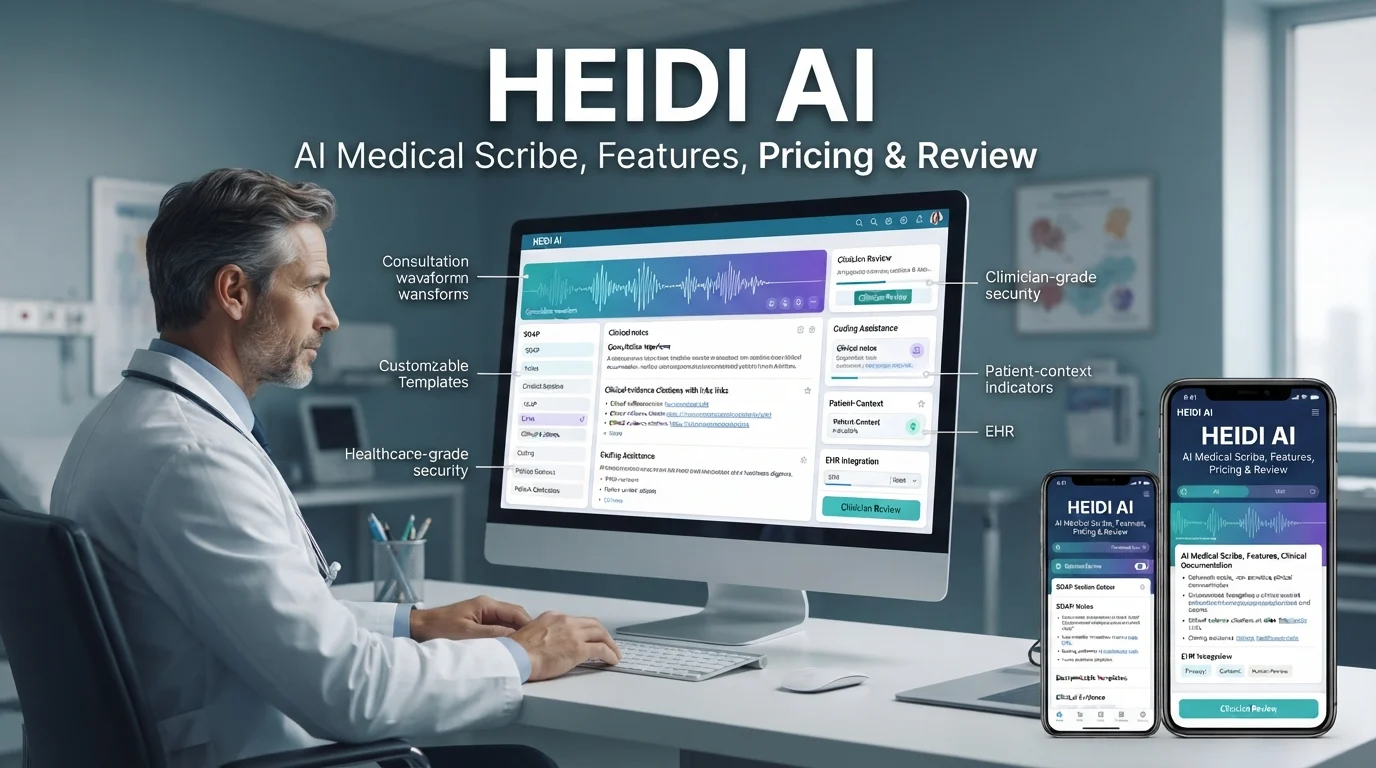
Heidi AI is a healthcare-focused AI platform that turns clinical conversations and dictation into structured documentation while adding evidence search, templates, coding, and workflow tools. Its current offering includes a free plan, paid clinician and practice tiers, EHR integrations, and enterprise controls designed for different clinical workflows.
Heidi AI at a Glance
| Key area | What to know |
|---|---|
| Primary purpose | AI-assisted clinical documentation and workflow support |
| Core product | Heidi Scribe for transcription, notes, templates, and documentation |
| Clinical research | Heidi Evidence provides citation-backed answers from medical sources |
| Free plan | Unlimited standard transcription and note generation, with 10 advanced actions per month |
| Paid plans | Clinician, Practice, and enterprise options, with pricing varying by region |
| Best evaluation criteria | Note quality, EHR workflow, privacy, specialty fit, regional availability, and clinician review |
What Is Heidi AI?
Heidi AI is the healthcare AI platform developed by Heidi Health for clinical documentation and related workflows.
Its original core use case is AI medical scribing. Heidi can listen to a consultation, transcribe the interaction, and turn the conversation into structured clinical documentation. The platform has since expanded beyond basic transcription into templates, coding support, evidence retrieval, patient and session context, document generation, and workflow automation. (Heidi AI)
That makes Heidi different from a general-purpose large language model.
A chatbot such as ChatGPT can help with many tasks, but Heidi is designed around healthcare workflows. Its product architecture focuses on the information clinicians generate during patient encounters and the documentation that follows.
The platform currently targets a broad range of healthcare professionals, including medical doctors, nurses, psychologists, dietitians, podiatrists, allied-health professionals, and veterinarians. (Heidi Health Support)
What Does Heidi AI Do?
Heidi’s main job is to reduce the manual documentation burden surrounding a patient consultation.
A typical workflow looks like this:
- A clinician starts a Heidi session.
- Heidi captures and transcribes the consultation.
- AI processes the conversation and relevant context.
- The system generates a clinical note or other document.
- The clinician reviews and edits the output.
- The final documentation can be transferred into the practice’s record system where supported.
This distinction matters: Heidi generates documentation, but the clinician remains responsible for reviewing the clinical record.
AI-generated notes can contain omissions, incorrect interpretations, or inappropriate clinical wording. An efficient workflow therefore still requires professional oversight.
How Heidi AI Works
Ambient Transcription
Heidi can transcribe clinical conversations in real time.
The underlying workflow combines speech recognition with language processing to identify relevant information from a consultation and organize it into useful documentation.
The objective is not simply to produce a transcript. The platform turns conversational information into structured clinical output.
Templates and Customisation
Clinical documentation differs substantially between specialties.
A psychologist, dentist, general practitioner, veterinarian, and surgeon may all need different structures and terminology.
Heidi supports standard and customized templates so clinicians can shape the format of generated documentation. Its current plans distinguish between standard templates on Free and advanced customization on paid tiers. (Heidi Health Support)
This is one of the more important evaluation points for practices.
A technically impressive transcription system is less useful if its output does not fit the way a clinic actually documents care.
Ask Heidi
Ask Heidi functions as an AI assistant within the platform.
According to Heidi’s current documentation, clinicians can use it to edit notes, generate documents, create templates, ask clinical questions, and perform other documentation-related tasks. (Heidi Health Support)
Examples include:
- Restructuring a clinical note
- Creating a referral letter
- Producing a handover summary
- Generating another document from session information
- Working with custom templates
- Asking questions about clinical terminology
The availability and usage limits depend on the plan and region.
Heidi Evidence
Heidi Evidence extends the product beyond documentation.
It is designed to provide clinical answers backed by citations from medical literature, guidelines, and other sources. Heidi says key statements can be paired with citations that clinicians can open and review. (Heidi Health Support)
This is potentially valuable because it separates two tasks that are often confused:
Documentation: What happened during the consultation?
Evidence: What does the medical literature say about a clinical question?
The two workflows require different safeguards. Heidi’s privacy policy specifically says Evidence is not designed to process patient health information and advises practitioners not to enter patient-identifiable information into Evidence queries. (Heidi AI)
Coding and Clinical Tasks
Heidi’s current product pages also list coding and task-oriented capabilities.
The platform is moving toward a broader clinical assistant model rather than remaining a simple ambient scribe. Its feature set includes coding, customization, templates, context, tasks, and document workflows. (Heidi AI)
That expansion can reduce the number of separate tools clinicians need, but it also increases the importance of permissions, workflow controls, and human review.
Heidi AI Features
Clinical Documentation
The central feature remains AI-generated clinical notes.
Heidi supports transcription, standard templates, customized documentation, and additional outputs derived from consultation information. (Heidi Health Support)
Dictation
Clinicians can also use dictation rather than relying exclusively on ambient consultation capture.
Heidi’s desktop application is designed to allow dictation anywhere on the screen and can capture telehealth audio directly from calls. (Heidi AI)
Desktop App
Heidi provides desktop applications for macOS and Windows.
The desktop workflow is designed to reduce the need to repeatedly switch between browser windows, particularly when clinicians work across telehealth or other digital workflows. (Heidi AI)
Evidence With Citations
Heidi Evidence is available across plans, although some in-session functionality has regional restrictions.
The current help documentation states that Evidence outside sessions is unlimited on all plans, including Free. In-session Evidence has additional restrictions in the UK and EU. (Heidi Health Support)
EHR Integrations
EHR connectivity is an important area to evaluate before purchasing.
Heidi currently lists integrations with systems including Epic and several regional practice-management and electronic-record platforms. Its integration directory shows that availability varies by product, country, and workflow. (Heidi AI)
This is more important than simply asking whether a vendor “supports EHRs.”
The practical questions are:
- Can Heidi write directly into your EHR?
- Which version or module is supported?
- Is the integration available in your country?
- Is it included in your plan?
- Does it require enterprise procurement?
- Which note sections can be transferred?
- Can clinicians review the output before write-back?
Those details can materially affect the value of an AI scribe.
Heidi AI Pricing
Heidi’s pricing changed during 2026, so older articles can be misleading.
The current plan structure includes Free, Clinician, Practice, and enterprise-oriented options, with regional pricing. Heidi’s help center states that monthly and annual billing are available for self-serve plans, while team and enterprise pricing can require sales contact. (Heidi Health Support)
Current published U.S.-dollar reference pricing from Heidi’s 2026 materials includes:
| Plan | Published price | Main positioning |
|---|---|---|
| Free | $0 | Standard transcription, notes, and Evidence |
| Evidence Plus | $30/user/month | Advanced Evidence features and premium sources |
| Clinician | $110/user/month | Advanced templates, Evidence in visits, patient-context features |
| Practice | About $180/user/month | Team workflows and full Scribe functionality |
| Enterprise | Custom | Larger organizations, governance, SSO, EHR and support options |
Heidi states that pricing is regionally adjusted, so these figures should be treated as current published reference prices rather than a universal global price list. (Heidi AI)
The Free Plan Has an Important Limit
The Free plan is more capable than a conventional trial.
Heidi says Free provides unlimited transcription and note generation using standard templates, plus unlimited Evidence access outside sessions. However, advanced features share a pool of 10 actions per month. (Heidi Health Support)
Those actions can include:
- Custom-template note generation
- Ask Heidi
- Custom documents
- Form filling
- Patient and session linking
- Certain agentic tasks
That distinction matters.
A clinician can use Heidi regularly without paying, but advanced customization and workflow features are not unlimited on Free.
Heidi AI Privacy and Security
Healthcare AI requires a much higher privacy standard than ordinary productivity software.
Heidi’s privacy documentation says sensitive health information processed through Scribe undergoes pseudonymisation, and the company states that patient data is not used to train, develop, or improve its AI models. (Heidi AI)
Heidi also states that it does not sell patient or clinician data.
Its August 2026 security documentation says real-time consultation transcripts are not stored after the session. Users can alternatively upload recordings for transcription and consent to transcript storage for later analysis or review. The documentation also says users can configure transcript storage duration for auditing or other purposes. (Heidi Health Support)
Security Certifications
Heidi’s current app listing identifies compliance and certification claims including HIPAA, GDPR, PIPEDA, NHS DSP Toolkit, Australian Privacy Principles, SOC 2 Type II, ISO 42001, and ISO 27001. (Google Play)
However, certification should not be interpreted as a blanket guarantee of security.
SOC 2, for example, describes controls assessed against defined criteria. It does not automatically mean Zero Data Retention.
Organizations should still examine the applicable data-processing agreement, retention settings, hosting arrangements, user permissions, EHR integration architecture, and regional requirements.
Heidi AI and Data Retention
Data retention is particularly important for an AI medical scribe.
Heidi’s current security documentation makes a distinction between real-time sessions and uploaded recordings. Real-time audio transcripts are described as not being stored, while uploaded recordings can involve transcript storage when the user consents. (Heidi Health Support)
That means procurement teams should ask exactly which data path their workflow uses.
A clinic using live transcription may have different retention characteristics from a clinic uploading recorded consultations.
The privacy policy also distinguishes Scribe from Evidence. Heidi says Evidence queries and outputs are stored in chronological chat form and advises clinicians not to enter patient-identifiable information into those queries. (Heidi AI)
Heidi AI: Who Is It For?
Heidi is primarily aimed at healthcare professionals rather than consumers.
Solo Clinicians
The Free plan makes Heidi particularly accessible to individual clinicians who want to test AI-assisted documentation without immediately committing to a paid subscription.
The main limitation is the monthly cap on advanced actions.
Small Practices
Small practices may benefit from shared templates, standardized documentation, and team workflows.
The Practice plan adds team-oriented features such as template sharing, document and session sharing, onboarding, and broader EHR functionality. (Heidi Health Support)
Larger Healthcare Organizations
Enterprise deployments require a different evaluation.
Heidi’s enterprise offering includes organization-level controls such as SSO, multi-team management, EHR write-back integrations, and an organization-wide BAA. (Heidi Health Support)
At this level, price is only one consideration. IT governance, identity management, integration depth, auditability, and data-processing arrangements become equally important.
Heidi AI vs. Competitors
The AI medical scribe market now includes several established platforms.
| Platform | Target user | Key strength | Pricing transparency | Core consideration |
|---|---|---|---|---|
| Heidi AI | Solo clinicians, practices, healthcare organizations | Broad documentation and clinical workflow platform with a free tier | High for self-serve plans | Advanced features and integrations vary by plan and region |
| Abridge | Health systems and enterprise providers | Deep ambient documentation and enterprise EHR workflows | Lower | Enterprise procurement and pricing |
| Nabla | Clinicians and healthcare organizations | Ambient documentation and multilingual workflows | Partial | Pricing and integrations vary by deployment |
| Suki AI | Clinicians and health systems | Voice-first clinical assistant | Lower | Enterprise-oriented procurement |
| Microsoft Dragon Copilot | Large healthcare organizations | Microsoft ecosystem and clinical documentation | Lower | Enterprise deployment complexity |
Independent market analyses also place Heidi alongside Abridge, Nabla, Suki, DeepScribe, Ambience Healthcare, and Microsoft Dragon Copilot in the broader AI medical scribe category. (PitchBook)
The comparison should not be reduced to a simple feature count.
For a solo clinician, free access and ease of setup may matter most. For a hospital, direct EHR integration, governance, security review, and deployment support can matter far more than the consumer-facing feature list.
What Makes Heidi AI Different?
One of Heidi’s more notable characteristics is the attempt to combine several clinical workflows into one platform.
Traditional AI scribes primarily answer:
“Can this system create my clinical note?”
Heidi increasingly addresses additional questions:
“Can it help me research a clinical question?”
“Can it turn my note into another document?”
“Can it work with my templates and patient context?”
“Can it integrate with my existing record system?”
That broader approach may reduce tool switching.
It can also increase complexity. More capabilities mean more opportunities for regional restrictions, usage limits, configuration requirements, and governance considerations.
Technical Considerations Before Choosing Heidi AI
Healthcare organizations should evaluate Heidi differently from a general AI application.
Accuracy
Test the platform using realistic clinical conversations from your specialty.
Look for:
- Incorrect medications
- Missing symptoms
- Wrong negations
- Incorrect dosages
- Misinterpreted speaker statements
- Hallucinated findings
- Incorrect clinical terminology
A note that sounds polished can still be clinically wrong.
Specialty Fit
A general medical template may not work well for a highly specialized workflow.
Test the actual note formats your clinicians use before rolling the platform out across a practice.
EHR Integration
Integration depth can have a bigger impact than transcription quality.
Copy-and-paste workflows create different administrative costs from structured EHR write-back.
Heidi’s current integration materials show that support varies across systems and regions. (Heidi AI)
Regional Availability
Healthcare data requirements differ between jurisdictions.
Heidi says it has implemented data-localization solutions for users in Australia, Canada, the United States, and the United Kingdom, with jurisdiction-specific standards including HIPAA and GDPR among those referenced in its documentation. (Heidi Health Support)
Organizations elsewhere should confirm the applicable arrangement rather than assuming that another region’s configuration applies to them.
Common Mistakes When Evaluating Heidi AI
Comparing Only Monthly Prices
A cheap subscription can become expensive if clinicians still spend significant time moving notes into the EHR.
Measure the entire workflow.
Assuming Unlimited Means Everything Is Unlimited
Heidi’s Free plan provides unlimited core documentation, but advanced features consume a 10-action monthly pool. (Heidi Health Support)
Read the feature limits carefully.
Treating AI Notes as Final Clinical Records
AI-generated notes require professional review.
The correct workflow is generally generate, review, correct, then sign.
Ignoring Evidence Restrictions
Heidi Evidence is not a substitute for a patient’s medical record or unrestricted clinical decision support.
Its privacy policy specifically warns users not to enter patient-identifiable information into Evidence queries. (Heidi AI)
Assuming Compliance Equals Risk-Free
HIPAA, GDPR, SOC 2, ISO standards, or other certifications do not eliminate implementation risk.
Security depends on the entire workflow, including devices, accounts, integrations, permissions, staff behavior, and configuration.
Is Heidi AI Worth Considering?
Heidi AI is most relevant when a healthcare professional wants more than basic transcription.
Its current product combines AI scribing, documentation, templates, clinical evidence, dictation, coding, workflow tools, and EHR connectivity. That breadth makes it a different proposition from a narrow transcription application. (Heidi AI)
The free plan also gives individual clinicians a practical way to evaluate core documentation before purchasing.
The main questions are not simply whether Heidi can generate a note. They are whether the output fits your specialty, whether your EHR integration works as expected, whether the regional data setup meets your requirements, and whether the advanced-plan limits match your workload.
For a solo clinician, the Free tier may be enough for basic documentation. For practices and health systems, integration, governance, privacy, and workflow design deserve a much deeper evaluation.
Frequently Asked Questions
What is Heidi AI used for?
Heidi AI is primarily used for AI-assisted clinical documentation. It can transcribe consultations, generate structured notes, support customized templates, provide clinical evidence with citations, and assist with additional documentation and workflow tasks.
Is Heidi AI free?
Yes. Heidi currently offers a Free plan with unlimited transcription and note generation using standard templates. The Free plan also provides unlimited Evidence access outside sessions, but advanced features share a limit of 10 actions per month.
How much does Heidi AI cost?
Heidi has regional pricing and multiple plans. Current published reference prices include $30 per user per month for Evidence Plus and about $110 per user per month for Clinician, while Practice and enterprise pricing can vary by configuration and region.
Is Heidi AI HIPAA compliant?
Heidi states that it supports HIPAA requirements and lists HIPAA among its healthcare security and compliance standards. However, organizations should evaluate their specific deployment, data-processing agreement, configuration, integrations, and organizational responsibilities rather than treating compliance claims as a complete security assessment.
Does Heidi AI integrate with EHR systems?
Yes. Heidi provides EHR integrations, including Epic and several regional systems. Integration availability and depth vary by platform, plan, region, and deployment, so healthcare organizations should verify their specific EHR workflow before purchasing.
Conclusion
Heidi AI has evolved from an AI medical scribe into a broader clinical workflow platform.
Its core strength is still documentation, but current features extend into evidence retrieval, templates, coding, dictation, document generation, workflow automation, and EHR integration. The permanent Free plan also makes basic testing easier than with many enterprise-focused competitors.
The most important evaluation criteria are clinical note quality, specialty fit, EHR integration, privacy, data retention, regional availability, and advanced-feature limits.
For individual clinicians, Heidi can be evaluated without an immediate subscription commitment. For larger healthcare organizations, the decision should involve clinical, IT, privacy, security, compliance, and procurement teams.
As with any clinical AI system, the technology should support the clinician rather than replace professional judgment. The strongest implementation is one where AI reduces documentation work while humans remain responsible for reviewing and signing the clinical record.

Oliver Wilson is an AI researcher and tech writer living at the intersection of human creativity and machine intelligence. At AixOrbit.com, he decodes complex neural networks, generative AI and emerging tech trends into actionable insights making sure humans stay one step ahead of the algorithms.