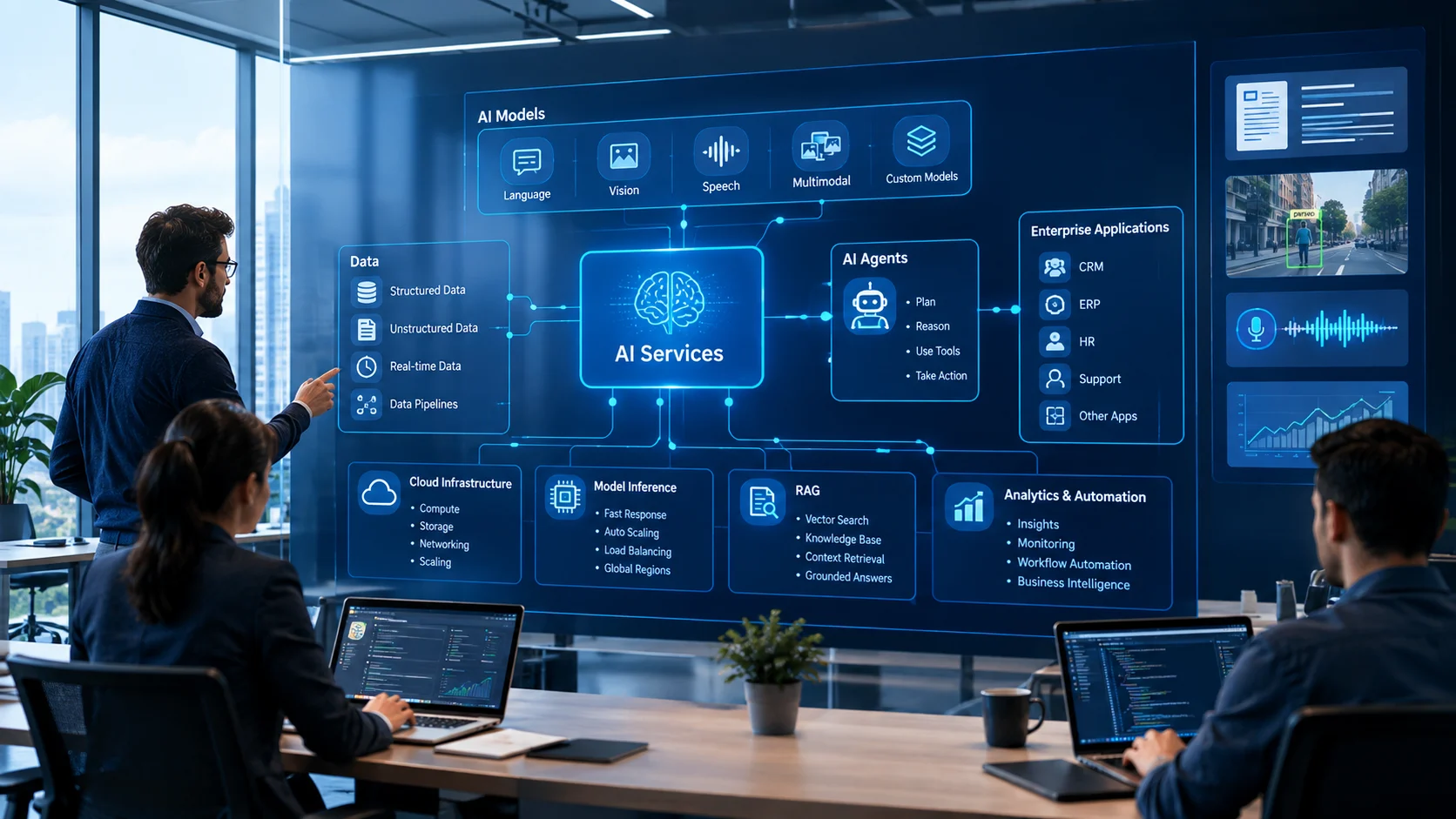
AI services are cloud platforms, APIs, software capabilities, and professional services that help individuals and organizations build, deploy, integrate, or use artificial intelligence without developing every component from scratch.
They range from generative AI and machine learning APIs to AI consulting, managed infrastructure, agents, data services, and enterprise implementation, so the right choice depends on the business problem, data, budget, and technical requirements.
At a Glance
- AI services cover multiple categories, including AI APIs, cloud platforms, consulting, development, infrastructure, and managed services.
- AWS, Microsoft Azure, Google Cloud, OpenAI, Anthropic, and Hugging Face are among the major technology platforms involved in different parts of the AI services ecosystem.
- AI consulting and implementation services help organizations move from experiments to production systems.
- Pricing varies widely, from usage-based API billing to project fees, subscriptions, infrastructure costs, and enterprise contracts.
- Privacy, data retention, model choice, latency, integration, and vendor lock-in matter as much as model quality.
- The best AI service is not necessarily the most powerful model. It is the service that delivers the required outcome at an acceptable cost and risk level.
What Are AI Services?
AI services are technology products and professional offerings that provide access to artificial intelligence capabilities.
The term can describe a simple API that converts speech to text, a cloud platform for building AI agents, a managed machine learning environment, or a consulting firm that designs and deploys an enterprise AI system.
This makes “AI services” a broad category rather than a single type of software.
For example, AWS groups its AI portfolio around foundation models, agent development, machine learning infrastructure, and purpose-built services such as transcription, text-to-speech, document extraction, and computer vision. (Amazon Web Services, Inc.)
Microsoft similarly positions Azure AI and Microsoft Foundry around AI applications, agents, models, search, machine learning, and governance. (Microsoft Azure)
The commercial market is also substantial. Gartner forecasts worldwide spending on AI services at about $585.5 billion in 2026, up from $436.4 billion in 2025. Gartner defines this market separately from AI software, models, infrastructure, and other AI-related spending. (Gartner)
That distinction matters because someone searching for AI services could be looking for very different things.
The main categories of AI services
| Type | What it provides | Typical users |
|---|---|---|
| AI APIs | Ready-to-use AI capabilities | Developers, startups |
| Generative AI platforms | LLMs, image, audio, video, agents | Businesses, creators, developers |
| Cloud AI platforms | Models, data, deployment, governance | Technical teams, enterprises |
| AI consulting | Strategy, architecture, implementation | Enterprises |
| AI development services | Custom applications and integrations | Businesses, startups |
| Managed AI infrastructure | Hosting, inference, scaling | Developers, ML teams |
| AI data services | Data preparation, labeling, enrichment | ML teams, researchers |
| AI automation services | Agents and workflow automation | Operations, sales, support |
| AI model hosting | Deployment of proprietary or open models | Developers, enterprises |
How Do AI Services Work?
Most modern AI services operate through a combination of models, APIs, data, computing infrastructure, and application logic.
A simplified workflow looks like this:
User or application → API or platform → AI model → processing → response or action
For example, a customer-support application might send a question to an AI API. The service processes the request with a language model, retrieves relevant company information through RAG, and returns an answer to the application.
More advanced systems can use AI agents.
An agent can combine a model with tools, memory, APIs, databases, and business rules. Instead of only generating text, it can perform actions such as retrieving information, updating a record, analyzing a document, or triggering another workflow.
AI services do not always mean training a new model
This is one of the most important distinctions for buyers.
A business usually does not need to train its own foundation model to deploy useful AI.
It may instead use:
- A hosted foundation model
- An API
- Retrieval-augmented generation
- Fine-tuning
- An AI agent framework
- An open-source model
- A managed inference service
- A combination of several models
AWS Bedrock, for example, provides access to multiple foundation models through a managed service and supports application development, customization, RAG, and agents. (Amazon Web Services, Inc.)
Hugging Face takes another approach by offering managed inference infrastructure for deploying models from its Hub into production environments. (Hugging Face)
The practical lesson is simple: choose the architecture based on the problem, not the novelty of the model.
What Do AI Services Include?
Generative AI services
Generative AI services can produce or transform text, images, audio, video, code, and other content.
Common applications include:
- Content generation
- Document summarization
- Coding assistance
- Research
- Translation
- Image generation
- Voice generation
- Video creation
- Conversational assistants
The underlying technology often includes large language models, multimodal models, diffusion models, speech models, or specialized AI systems.
AI and machine learning APIs
APIs provide specific capabilities without requiring developers to build the underlying model.
Examples include:
- Speech recognition
- Text-to-speech
- Translation
- Computer vision
- Document extraction
- Classification
- Embeddings
- Moderation
- Forecasting
These services are particularly useful when a company wants to add one AI capability to an existing application.
AI development and consulting services
AI consulting is different from an AI API.
A consulting provider may help with:
- Identifying useful AI opportunities
- Evaluating data readiness
- Selecting models and platforms
- Designing the architecture
- Building prototypes
- Integrating AI into existing systems
- Establishing governance
- Deploying production applications
- Monitoring performance
- Training internal teams
IBM Consulting, for example, describes its AI offering around strategy, data, architecture, security, governance, and building and scaling AI and agentic AI solutions. (IBM)
The difference is important when comparing vendors. Buying an API gives you technology. Hiring an AI services firm can give you expertise, implementation, and ongoing support.
Popular AI Services and Platforms
There is no single universal AI services provider. Different platforms specialize in different layers of the technology stack.
| Platform or service category | Typical target user | Key strength | Pricing transparency | Main consideration |
|---|---|---|---|---|
| AWS AI services | Developers and enterprises | Broad cloud AI ecosystem | Generally strong for usage-based services | AWS architecture can become complex |
| Microsoft Foundry / Azure AI | Enterprises and developers | Models, agents, data, governance | Generally strong | Best fit often depends on Azure ecosystem |
| Google Cloud Vertex AI | ML and enterprise teams | Models, ML tooling, data and deployment | Generally strong | Broader Google Cloud knowledge may be useful |
| OpenAI API | Developers and product teams | General-purpose and multimodal AI APIs | Strong usage-based pricing | Costs depend on model and usage |
| Hugging Face | Developers and ML teams | Open models and managed inference | Varies by service | Model quality and deployment choices vary |
| AI consulting firms | Enterprises | Strategy and implementation | Often quote-based | Project scope can affect total cost |
| AI directories | General users and buyers | Discovery and comparison | Usually free to browse | Listings are not equivalent to technical validation |
OpenAI publishes API pricing by model and token usage, illustrating how AI infrastructure can move beyond a simple monthly subscription. (OpenAI Developers)
Google Cloud similarly publishes usage-based pricing for Vertex AI generative AI services. (Google Cloud)
For discovery, platforms such as Futurepedia organize AI products across productivity, video, text, business, image, and other categories. (futurepedia) Product Hunt also categorizes AI products into areas such as AI agents, LLMs, AI infrastructure, chatbots, and predictive AI. (Product Hunt)
These directories are useful for finding candidates, but a directory listing should not be treated as independent proof of performance, security, or enterprise readiness.
AI Services Use Cases
AI services now support a wide range of business and technical workflows.
Customer service
Companies can deploy AI assistants that answer questions, retrieve knowledge-base information, summarize conversations, and route complex issues to human agents.
The important factor is not just response quality. Integration with customer records, permissions, escalation workflows, and monitoring can determine whether the system is actually useful.
Software development
AI services can assist with:
- Code generation
- Code explanation
- Testing
- Documentation
- Debugging
- Repository analysis
- Code review
- Software agents
The latest generation of AI products increasingly emphasizes agents that can complete multi-step development tasks rather than simply autocomplete code. Product Hunt’s current AI categories reflect this shift toward AI agents and AI infrastructure. (Product Hunt)
Marketing and content
Businesses use AI services for:
- Content drafts
- Product descriptions
- Search optimization
- Campaign ideation
- Personalization
- Image generation
- Video production
- Customer segmentation
Human review remains important for brand accuracy, factual claims, originality, and compliance.
Document processing
AI services can extract information from invoices, contracts, forms, PDFs, and other documents.
This can combine OCR, computer vision, language models, classification, and structured data extraction.
AWS, for example, offers Textract for extracting text and data from scanned documents. (Amazon Web Services, Inc.)
Data analysis
AI can help users query datasets, identify patterns, summarize reports, generate visualizations, and support decision-making.
However, organizations should validate outputs before using them for financial, legal, medical, or other high-impact decisions.
AI agents and workflow automation
Agentic AI is becoming a major part of the services landscape.
An AI agent can reason through a task, call tools, retrieve information, and perform actions. This creates more value than simple text generation in some workflows, but it also creates additional risks.
An agent with permission to change records, send messages, execute code, or access sensitive systems needs stronger controls than a basic chatbot.
How Much Do AI Services Cost?
There is no standard price for AI services.
Costs can include:
- Monthly subscriptions
- Per-user licensing
- Per-request charges
- Token-based model usage
- GPU or compute costs
- Storage
- API calls
- Data processing
- Implementation fees
- Consulting fees
- Enterprise support
- Monitoring and security tools
For API-based AI, the major cost variables can include input tokens, output tokens, caching, context length, model selection, processing speed, and request volume.
OpenAI’s current API pricing, for example, varies by model, context length, processing mode, and token type. (OpenAI Developers)
This creates an important purchasing lesson: a low advertised price does not necessarily mean a low total cost.
A cheaper model may require more calls, produce lower-quality outputs, need additional retrieval, or require more human review.
Calculate total cost of ownership
Before choosing a service, estimate:
Model cost + infrastructure + integration + storage + monitoring + human review + support
For enterprise projects, implementation and operational costs can exceed the underlying model cost.
Privacy and Security: What Buyers Should Check
Privacy should be evaluated at the specific service level, not inferred from a vendor’s brand name.
Ask these questions before sending sensitive information:
- Is customer data used for model training?
- How long are prompts and outputs retained?
- Are logs stored?
- Where is data processed?
- Can data residency be configured?
- Are third-party models involved?
- Who can access the data?
- Can administrators control permissions?
- Is encryption used in transit and at rest?
- What happens when an account is terminated?
- Are backups retained?
- Does the service have enterprise security documentation?
Do not assume that SOC 2 automatically means Zero Data Retention. Compliance certifications and data-retention policies address different questions.
Microsoft’s current documentation for models sold through Azure states that customer prompts, completions, embeddings, and training data are not used to train generative AI foundation models without permission or instruction. It also documents circumstances where certain features store data, so buyers still need to evaluate the exact service and configuration. (Microsoft Learn)
Google Cloud similarly states that it will not use customer data to train or fine-tune AI/ML models without prior permission or instruction under its applicable terms. (Google Cloud Documentation)
The takeaway is to read the actual data-processing terms and service documentation, not just a security badge.
What Are the Biggest Limitations of AI Services?
AI services can reduce development time and expand access to sophisticated capabilities, but they introduce trade-offs.
Vendor lock-in
An application tightly coupled to one model provider can become expensive or difficult to migrate.
Using abstraction layers, portable data formats, multiple model options, or open models can reduce some dependency.
Unpredictable costs
Usage-based AI can create variable bills.
High-volume applications should monitor token usage, request rates, model selection, caching, and other consumption drivers.
Model changes
Cloud AI services evolve quickly.
Models can be retired, updated, replaced, or repriced. Production systems should therefore include model evaluation and migration plans.
Hallucinations
Language models can produce plausible but incorrect information.
RAG can improve grounding by retrieving relevant information, but it does not guarantee correctness.
Latency
A highly capable model may not be suitable for a workflow that requires near-instant responses.
For real-time applications, evaluate API latency, throughput, regional availability, and fallback behavior.
Data quality
AI cannot compensate for consistently poor source data.
An organization with fragmented, outdated, or inaccessible information may need a data project before an AI project.
How to Choose the Right AI Service
Start with the business requirement rather than the model name.
1. Define the task
Write down the exact outcome you need.
For example:
“Reduce average customer-support handling time by 20%.”
That is more useful than:
“We need generative AI.”
2. Decide whether you need a tool, API, platform, or service provider
A small team may need an off-the-shelf AI application.
A software company may need an API.
A large organization may need a cloud AI platform plus consulting and integration support.
3. Evaluate model quality against your real workload
Do not rely only on public benchmarks.
Create a representative test set and measure:
- Accuracy
- Hallucination rate
- Response quality
- Latency
- Cost
- Reliability
- Tool-use performance
4. Check integration requirements
Look for:
- APIs
- SDKs
- Authentication
- Webhooks
- Data connectors
- Database support
- Existing enterprise integrations
- Monitoring
- Access controls
5. Model the total cost
Calculate expected usage rather than comparing headline prices.
Include infrastructure and human review where applicable.
6. Review privacy before deployment
Sensitive data should never be sent to an AI service until the organization’s legal, security, and privacy requirements have been checked.
7. Plan for failure
Production AI needs fallbacks.
A mature architecture might route different requests to different models, switch to deterministic software for certain operations, or escalate uncertain cases to humans.
Common Mistakes When Buying AI Services
The most common mistake is choosing technology before defining the problem.
Other frequent errors include:
- Selecting the largest model automatically
- Ignoring integration costs
- Comparing only subscription prices
- Assuming benchmarks predict real-world performance
- Ignoring data retention
- Giving AI agents excessive permissions
- Failing to monitor production usage
- Treating a directory listing as independent validation
- Skipping a migration or vendor-exit strategy
- Automating a broken business process
The last mistake deserves special attention.
AI can make an inefficient process faster without making it better. Organizations should simplify the workflow before adding automation whenever possible.
AI Services vs. AI Tools
The terms are often used interchangeably, but there is a useful distinction.
An AI tool is usually a user-facing product designed to perform a particular task.
An AI service can be broader. It may provide the underlying API, infrastructure, model access, consulting, deployment, or managed capability that powers a product.
For example, a writing application may be an AI tool, while the model API powering its text generation is an AI service.
This distinction matters most for developers and businesses building their own applications.
Latest AI Services Trend: From Models to Agents
The market is moving beyond standalone model access toward systems that combine models, tools, data, and workflows.
Cloud providers increasingly package agent development, retrieval, governance, and deployment into integrated platforms. Microsoft Foundry, for example, brings together models, agent services, tools, search, machine learning, governance, and related capabilities. (Microsoft Azure)
AWS similarly positions Bedrock and AgentCore around building, deploying, and operating AI agents. (Amazon Web Services, Inc.)
This changes what buyers should evaluate.
Instead of asking only:
“Which model is smartest?”
organizations increasingly need to ask:
“Which platform can reliably complete this workflow within our cost, security, latency, and governance requirements?”
That is a much more useful purchasing question.
Who Should Use AI Services?
AI services can be useful for:
- Small businesses that need automation without building AI infrastructure
- Startups that want to add AI capabilities quickly
- Developers building AI-powered applications
- Enterprises integrating AI into existing systems
- Marketing teams producing and analyzing content
- Customer-service teams automating repetitive interactions
- Researchers experimenting with models and inference
- Data teams deploying machine learning workflows
The right service depends on technical maturity.
A small company may benefit more from a managed application than from a complex cloud AI stack. A large enterprise may need deeper control over identity, networking, data residency, model routing, monitoring, and governance.
FAQs About AI Services
What are AI services used for?
AI services provide ready-made or managed artificial intelligence capabilities for applications and business workflows. Common uses include generative AI, chatbots, document processing, speech recognition, computer vision, predictive analytics, AI agents, automation, and custom AI application development.
What is the difference between AI services and AI tools?
AI tools are usually user-facing applications built for specific tasks, while AI services can provide APIs, models, infrastructure, managed platforms, or professional implementation. An AI tool may therefore use one or more AI services behind the scenes.
How much do AI services cost?
AI service pricing varies by provider and use case. Costs may include subscriptions, per-user licenses, API calls, token usage, compute, storage, implementation, consulting, support, and monitoring. Usage-based pricing can make total costs vary significantly with demand.
Are AI services secure?
Security depends on the specific provider, product, configuration, and data being processed. Buyers should review encryption, access controls, retention, data residency, training policies, third-party processing, compliance documentation, and administrative controls instead of assuming that every AI service has the same protections.
How should a business choose an AI service?
Start by defining the business outcome, then evaluate model quality, integration, cost, latency, scalability, privacy, security, reliability, governance, and vendor dependency. Testing candidate services against real business data and representative workloads is more useful than relying solely on public benchmarks or marketing claims.
Conclusion
AI services now span almost the entire artificial intelligence stack, from model APIs and cloud infrastructure to agents, automation, consulting, and managed deployment.
The right choice depends on the job you need the technology to perform. Before committing, compare real-world performance, total cost, data handling, integration requirements, scalability, latency, governance, and vendor lock-in.
For simple tasks, an off-the-shelf AI tool may be enough. For custom applications, an API or cloud platform may make more sense. Larger organizations may need a combination of AI infrastructure, implementation expertise, governance, and ongoing support.
The most useful AI service is ultimately the one that solves a defined problem reliably and economically, while fitting your organization’s technical and data requirements.

Oliver Wilson is an AI researcher and tech writer living at the intersection of human creativity and machine intelligence. At AixOrbit.com, he decodes complex neural networks, generative AI and emerging tech trends into actionable insights making sure humans stay one step ahead of the algorithms.