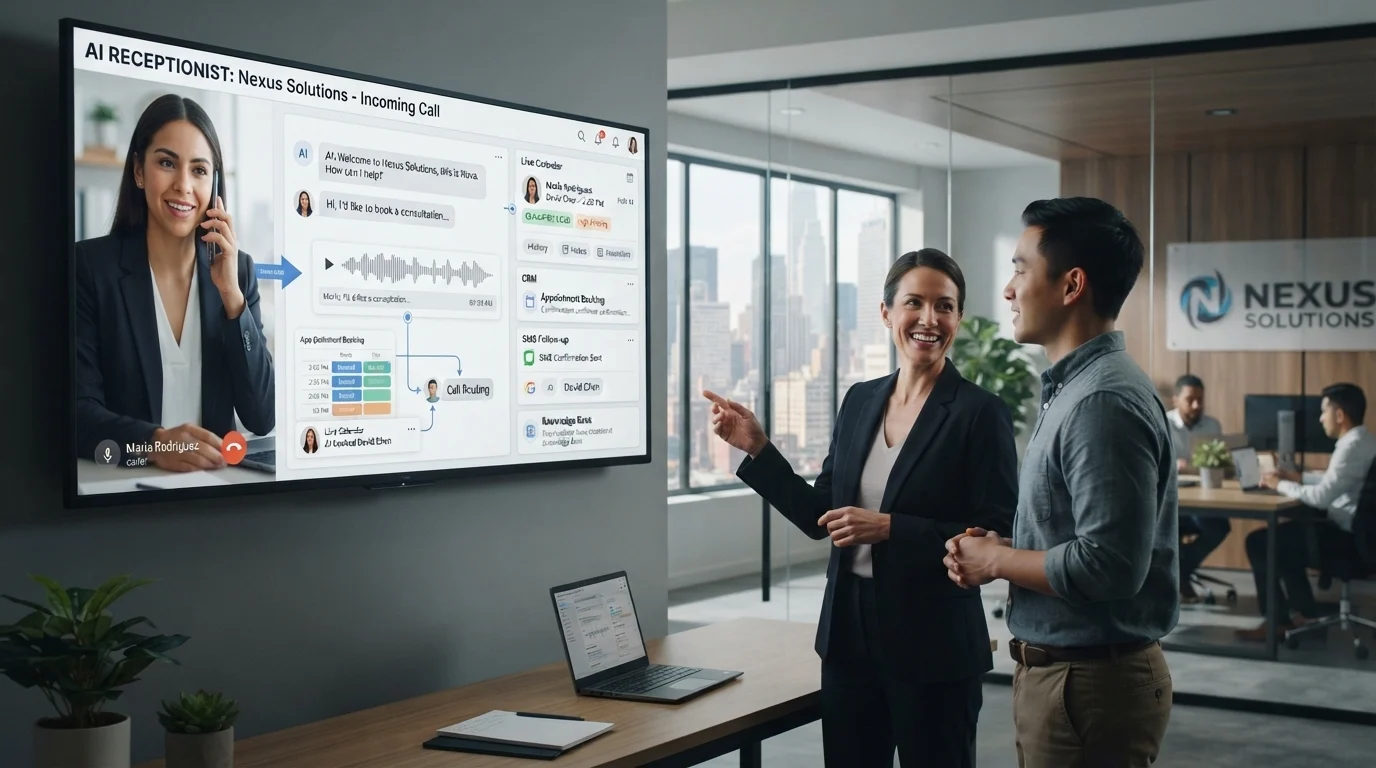
An AI receptionist is software that answers business calls, understands what callers need, and handles tasks such as answering questions, booking appointments, capturing leads, and routing calls.
Modern AI receptionists use conversational voice AI to provide automated phone coverage, but their real value depends on integrations, call-handling accuracy, pricing, privacy controls, and human escalation options.
At a Glance
- AI receptionists answer business calls using conversational voice AI instead of traditional keypad-based menus.
- They can book appointments, qualify leads, answer FAQs, capture information, send messages, and transfer calls.
- Pricing varies significantly, with vendors using per-call, per-minute, per-customer, credit-based, or bundled subscription models.
- Small businesses often benefit most when they receive frequent calls but cannot staff a phone line continuously.
- Healthcare, legal, home services, real estate, salons, dental practices, and appointment-based businesses are common use cases.
- Before choosing one, test voice quality, latency, scheduling, CRM integration, escalation, data retention, and total monthly cost.
What Is an AI Receptionist?
An AI receptionist is a conversational AI system designed to handle the front-desk responsibilities associated with business phone calls.
Instead of sending callers to voicemail or asking them to press numbers through an IVR menu, the system can hold a natural conversation. It can determine why someone is calling and then perform an appropriate action.
Typical tasks include:
- Answering common questions
- Taking messages
- Capturing lead information
- Qualifying prospects
- Scheduling appointments
- Rescheduling or canceling appointments
- Routing calls
- Sending follow-up texts
- Updating CRM records
- Escalating complex calls to employees
The category is broader than simple automated answering. A modern AI receptionist can connect a phone conversation with calendars, CRMs, knowledge bases, business rules, and other software.
That makes it closer to a voice-based AI agent than a traditional answering machine.
How Does an AI Receptionist Work?
An AI receptionist combines several technologies that work together in real time.
1. The phone system receives the call
A caller dials the company’s existing number or a number assigned to the AI receptionist.
Depending on the setup, the AI may answer every call, handle overflow calls, or take calls only outside business hours.
Goodcall, for example, allows businesses to configure an AI agent as the first line of support or use it for overflow when employees cannot answer.
2. Speech recognition converts the caller’s voice
The system processes spoken language using speech recognition technology.
The caller does not need to use specific keywords. They might say:
“I need to move my appointment from Thursday to Friday.”
The system must recognize the intent, relevant details, and required next action.
3. An AI model interprets the conversation
A language model or voice-agent system determines what the caller wants and generates an appropriate response.
The AI also needs conversation state. It may need to remember the caller’s name, appointment time, service type, or other information during the call.
4. The receptionist accesses business information
A useful AI receptionist needs more than a language model.
It may retrieve information from:
- A knowledge base
- Calendar
- CRM
- Booking platform
- Customer database
- Business website
- Internal documentation
This is where integrations become important.
5. The system takes action
The AI may then:
- Book a time
- Transfer the call
- Create a lead
- Send an SMS
- Record a message
- Update customer information
- Escalate the conversation
The difference between a chatbot that talks and an AI receptionist that actually helps often comes down to this action layer.
Key Features to Look For
Not every AI receptionist provides the same capabilities.
Conversational call answering
The system should understand ordinary speech rather than force callers through rigid menus.
Good conversational design also includes interruption handling. A caller should be able to correct themselves without restarting the entire conversation.
Appointment scheduling
Scheduling is one of the strongest use cases for AI receptionists.
Look for integrations with the calendar or booking platform your business already uses.
The AI should understand availability rules, appointment types, duration, and other restrictions rather than simply offering a generic booking link.
Lead qualification
For sales-oriented businesses, the receptionist can collect information before a salesperson follows up.
For example, a home-services business might ask:
- What service do you need?
- Where is the property?
- How urgent is the issue?
- When would you like an appointment?
- What is the best contact number?
This can turn a phone call into structured lead data.
Call routing and human handoff
A good AI receptionist should know when not to continue.
Human escalation can be triggered by:
- A caller requesting an employee
- An urgent situation
- A complaint
- A complex question
- A task outside the AI’s instructions
- Low confidence
- Sensitive information
The handoff process matters as much as the AI itself. Ideally, the human receives the relevant conversation context instead of asking the caller to repeat everything.
Smith.ai takes a hybrid approach, with its AI Receptionist able to transfer complex calls to its live receptionist network. Its current AI pricing includes a free tier and paid per-call plans.
Call transcripts and summaries
Transcripts help businesses review conversations and identify missed opportunities.
Summaries can also reduce the need for employees to listen to entire recordings.
However, transcripts and recordings create additional data-retention and privacy considerations.
AI Receptionist vs. Traditional IVR
An AI receptionist and an IVR system solve related problems differently.
| Feature | Traditional IVR | AI Receptionist |
|---|---|---|
| Caller interaction | Menu-based | Conversational |
| Natural language | Limited | Core capability |
| Appointment booking | Usually requires integration | Common use case |
| Lead qualification | Basic | More flexible |
| Complex conversations | Poor fit | Better fit |
| Human transfer | Yes | Yes |
| Setup complexity | Usually predictable | Depends on platform |
| Main limitation | Rigid menus | AI can misunderstand callers |
IVR still makes sense for structured routing.
For example, “Press 1 for sales, 2 for support” can be perfectly adequate for a large organization with established call flows.
An AI receptionist becomes more useful when callers ask questions, provide information, or expect the system to complete a task.
What Can an AI Receptionist Be Used For?
Small businesses
Small businesses often have a simple problem: the phone rings while everyone is busy.
An AI receptionist can provide coverage without requiring an employee to remain beside the phone.
It can answer routine questions, capture leads, and handle calls after closing.
Home services
Contractors, plumbers, electricians, cleaners, landscapers, and repair businesses often receive calls while workers are on job sites.
An AI receptionist can capture the customer’s location, service request, urgency, and preferred appointment time.
Dental and medical practices
Medical offices can use AI receptionists for administrative tasks such as appointment requests, basic office information, reminders, and routing.
However, healthcare requires much greater attention to privacy and compliance.
If a cloud service creates, receives, maintains, or transmits electronic protected health information on behalf of a covered entity, HHS says the service provider can be a business associate and generally requires an appropriate Business Associate Agreement.
Do not choose a healthcare AI receptionist solely because a vendor uses terms such as “HIPAA-ready” or “secure.” Review the actual contractual and technical requirements.
Law firms
Law firms can use AI receptionists for lead intake, consultation scheduling, basic qualification, and routing.
Legal intake is also where human escalation becomes particularly important.
A receptionist should not improvise legal advice simply because a caller asks a legal question. The workflow should define what the AI can say and when a qualified person must take over.
Real estate
Real estate teams can use voice AI to capture buyer and seller inquiries, collect property requirements, schedule appointments, and route urgent leads.
The system becomes more useful when it connects directly to calendars, CRM systems, and lead-management workflows.
Salons and appointment-based businesses
Salons, spas, clinics, fitness studios, and similar businesses often have repetitive booking calls.
An AI receptionist can answer availability questions and schedule appointments while staff focus on customers in front of them.
How Much Does an AI Receptionist Cost?
There is no universal AI receptionist price.
Current providers use several billing models.
Per-call pricing
Smith.ai currently offers a free AI Receptionist tier for 25 calls per month, with its Pro plan starting at $150 per month for 75 calls. Its published pricing also includes lower per-call rates at higher volumes.
This model can work well when calls vary significantly in length because a six-minute conversation does not consume six billable minutes.
The trade-off is that businesses with high call volume can accumulate charges quickly.
Per-customer pricing
Goodcall currently uses a different model.
Its Starter plan is listed at $79 per month per agent and includes unlimited minutes and tokens, with an allowance for 100 unique customers. Additional unique customers are charged separately. Its Growth and Scale plans increase those allowances.
This can make costs easier to predict for repeat callers because multiple calls from the same customer can count as one unique customer under the published definition.
Bundled subscription pricing
My AI Front Desk currently lists Business-in-a-Box at $99 per month, or $79 per month when billed annually. The plan includes 200 voice minutes plus web chat, SMS, CRM, and automation features.
This model may appeal to businesses looking for more than phone answering.
Usage-based voice infrastructure
Developer platforms use another model entirely.
Retell AI currently advertises pay-as-you-go voice agents with published AI voice-agent pricing ranging from $0.07 to $0.31 per minute, depending on configuration and usage.
This type of service is better suited to developers building customized voice agents than to a small business owner who simply wants a ready-to-use receptionist.
The hidden cost is integration
The monthly subscription is only part of the calculation.
Businesses should also consider:
- Setup time
- Phone-number migration
- CRM configuration
- Calendar integration
- Workflow design
- Call testing
- Human escalation
- SMS charges
- Usage overages
- Support
- Custom integrations
- Internal monitoring
A $50 plan can become expensive if it requires substantial technical work.
A $150 plan can be more economical if it works immediately with the systems your team already uses.
AI Receptionist Pricing Models Compared
| Provider or model | Typical billing approach | Best fit | Main consideration |
|---|---|---|---|
| Smith.ai AI Receptionist | Subscription plus per-call usage | Businesses wanting AI with human escalation | Per-call costs can rise with volume |
| Goodcall | Per-agent subscription with unique-customer allowance | Small businesses wanting predictable phone costs | Customer-based limits still matter |
| My AI Front Desk | Subscription plus usage credits | Businesses wanting phone, SMS, chat, CRM | Included voice minutes are limited |
| Retell AI | Usage-based voice infrastructure | Developers building custom agents | Requires more technical implementation |
| Human answering service | Usually per-minute or per-call | High-touch conversations | Higher operating cost at scale |
Pricing changes frequently, so treat these figures as current published examples rather than permanent rates.
What Are the Benefits of an AI Receptionist?
24/7 coverage
An AI receptionist can answer outside normal office hours without creating another employee shift.
This is particularly useful when customers call evenings, weekends, or during holidays.
Fewer missed opportunities
A business cannot follow up on a lead it never captures.
Answering calls automatically can help collect information even when employees are unavailable.
Lower marginal cost
AI can handle additional routine conversations without adding another receptionist for every increase in call volume.
The economics depend on the provider’s pricing model and your actual call pattern.
Faster response
Customers can receive immediate answers rather than waiting for a callback.
That matters when the caller is comparing several businesses.
Consistent information
A properly configured AI receptionist can follow the same business rules for every caller.
This reduces variation in routine answers.
What Are the Limitations?
AI receptionists are not universal replacements for human receptionists.
Complex conversations remain difficult
A caller may provide incomplete information, change topics, use slang, become emotional, or ask something outside the AI’s knowledge.
The system needs a safe fallback.
AI can misunderstand callers
Speech recognition can struggle with background noise, accents, unusual names, poor connections, or ambiguous language.
A strong demo call does not guarantee perfect production performance.
Integrations determine usefulness
A receptionist that can only answer FAQs may have limited business value.
The larger opportunity comes from connecting the phone agent to the systems where work actually happens.
Variable pricing can surprise buyers
Per-minute and credit-based plans can become expensive when call volume increases.
Per-call and unique-customer plans have different trade-offs.
Always calculate your expected monthly usage before choosing a plan.
Privacy and Security Considerations
AI receptionists can process names, phone numbers, appointment details, customer messages, recordings, and transcripts.
That makes data handling a core buying criterion.
Ask vendors:
- Are calls recorded?
- Are transcripts stored?
- How long are recordings retained?
- How long are transcripts retained?
- Is customer data used to train models?
- Which third-party AI providers process the conversation?
- Where is data stored?
- Can retention periods be configured?
- Can data be deleted?
- Is encryption used?
- Are administrative access controls available?
- Can the vendor sign required data-processing agreements?
Do not assume that SOC 2 means Zero Data Retention.
They address different issues. A compliance report does not automatically tell you how long an AI vendor stores call recordings or prompts.
For healthcare deployments, determine whether the provider can meet applicable HIPAA requirements and whether the necessary BAA is available. HHS specifically notes that cloud providers handling ePHI can fall under the business-associate rules.
Be careful with outbound calls
An inbound AI receptionist is different from an AI system that makes automated outbound calls.
In the United States, the FCC has confirmed that AI-generated human-like voices fall under the TCPA’s restrictions on artificial or prerecorded voice calls.
Businesses using outbound voice automation should therefore review applicable consent, telemarketing, recording, and disclosure requirements for their jurisdiction.
AI Receptionist vs. AI Voice Agent
These terms overlap, but they usually describe different levels of abstraction.
An AI receptionist is typically a ready-made business product.
It handles phone answering, scheduling, lead capture, routing, and other front-desk tasks with limited technical work.
An AI voice agent platform provides building blocks for creating your own conversational phone system.
Developer platforms such as Retell AI expose APIs, webhooks, analytics, simulation tools, model options, and other infrastructure for custom voice agents.
The choice is straightforward:
Choose a receptionist product when you want the business outcome. Choose a voice-agent platform when you want control over the underlying system.
How to Choose an AI Receptionist
1. Calculate your call volume
Measure at least 30 days of calls if possible.
Track:
- Calls per day
- Average call duration
- Peak hours
- After-hours volume
- Repeat callers
- Appointment calls
- Sales calls
- Spam calls
2. Test real conversations
Do not judge a receptionist from a scripted demo alone.
Test difficult scenarios.
Ask:
- What happens if the caller interrupts?
- What happens if the caller changes the appointment?
- What happens if the calendar has no availability?
- What happens if the caller asks something unknown?
- Can the caller reach a human?
- Does the system preserve context during transfer?
3. Check integrations
Prioritize integrations with the systems your staff already uses.
A receptionist that can book appointments but cannot update your workflow may still create manual work.
4. Compare the billing unit
Ask whether you pay by:
- Minute
- Call
- Unique customer
- Credit
- User
- Monthly subscription
Then calculate the expected bill at both normal and peak volume.
5. Define escalation rules
Decide exactly when AI should stop.
For sensitive businesses, escalation may be more important than voice quality.
6. Review data policies
Understand recording, transcription, retention, model training, third-party processors, deletion, and data residency before connecting sensitive systems.
Common AI Receptionist Mistakes
Businesses often make these mistakes during deployment:
- Choosing based only on voice quality
- Ignoring overage pricing
- Skipping real-world call testing
- Giving the AI access to more systems than necessary
- Using outdated business information
- Failing to define escalation rules
- Assuming an AI receptionist can replace every human interaction
- Ignoring call recording and privacy requirements
- Testing only easy questions
- Forgetting to measure business outcomes
The last point is especially important.
Track metrics such as qualified leads, appointments booked, transfers, abandoned calls, successful resolutions, and cost per handled call.
A more natural voice is not necessarily a better business result.
Who Should Use an AI Receptionist?
An AI receptionist is usually a strong candidate for businesses that:
- Receive frequent inbound calls
- Miss calls during busy periods
- Book appointments
- Handle repetitive questions
- Need after-hours coverage
- Depend on inbound leads
- Have predictable call workflows
- Want to automate administrative tasks
It may be less suitable when almost every call requires human judgment, emotional support, complex negotiation, or highly specialized expertise.
In those situations, a hybrid model can make more sense.
What Should You Look for in 2026?
The category is moving from simple phone answering toward agentic front-office automation.
Modern platforms increasingly connect voice conversations with calendars, CRMs, messaging, knowledge bases, and workflow automation.
That means the important question is changing.
Instead of asking:
“Does this AI sound human?”
businesses should ask:
“Can this system reliably complete the work that happens after the phone is answered?”
That shift separates a voice demo from a useful business system.
FAQs About AI Receptionists
Can an AI receptionist replace a human receptionist?
An AI receptionist can automate many routine phone tasks, but it does not replace every responsibility of a human receptionist. Businesses should use AI for predictable workflows and define clear human escalation for complex, sensitive, or unusual conversations.
How much does an AI receptionist cost per month?
Pricing varies by provider and billing model. Current examples include subscription plans, per-call pricing, unique-customer pricing, and usage-based voice platforms. The total cost depends on call volume, duration, integrations, overages, and the amount of human support required.
Can an AI receptionist book appointments?
Yes, many AI receptionists can connect to calendars or scheduling systems and handle appointment requests. Before buying, verify that the specific provider supports your calendar, appointment rules, rescheduling process, and required integrations.
Are AI receptionists safe for medical practices?
They can be used in healthcare workflows, but safety and compliance depend on the specific implementation. Practices handling protected health information should verify the provider’s HIPAA arrangements, BAA availability, data handling, access controls, retention policies, and integration architecture.
What is the difference between an AI receptionist and an AI voice agent?
An AI receptionist is generally a ready-made product for business phone handling, while an AI voice agent platform provides infrastructure for developers to build custom conversational phone systems. The former prioritizes convenience; the latter provides more technical control.
Conclusion
An AI receptionist is more than an automated phone voice. It is a conversational system that can answer calls, understand requests, collect information, schedule appointments, route conversations, and connect phone interactions to business workflows.
For small businesses, the biggest value may come from answering calls that would otherwise reach voicemail. For larger organizations, the value can come from integrating voice AI with CRM, scheduling, customer service, and automation systems.
Before choosing a provider, compare billing structure, integrations, voice quality, latency, escalation, privacy, data retention, reliability, and total cost.
Most importantly, test the system with realistic calls. The best AI receptionist for your business is the one that consistently completes the right tasks within your operational, financial, and compliance requirements.

Oliver Wilson is an AI researcher and tech writer living at the intersection of human creativity and machine intelligence. At AixOrbit.com, he decodes complex neural networks, generative AI and emerging tech trends into actionable insights making sure humans stay one step ahead of the algorithms.