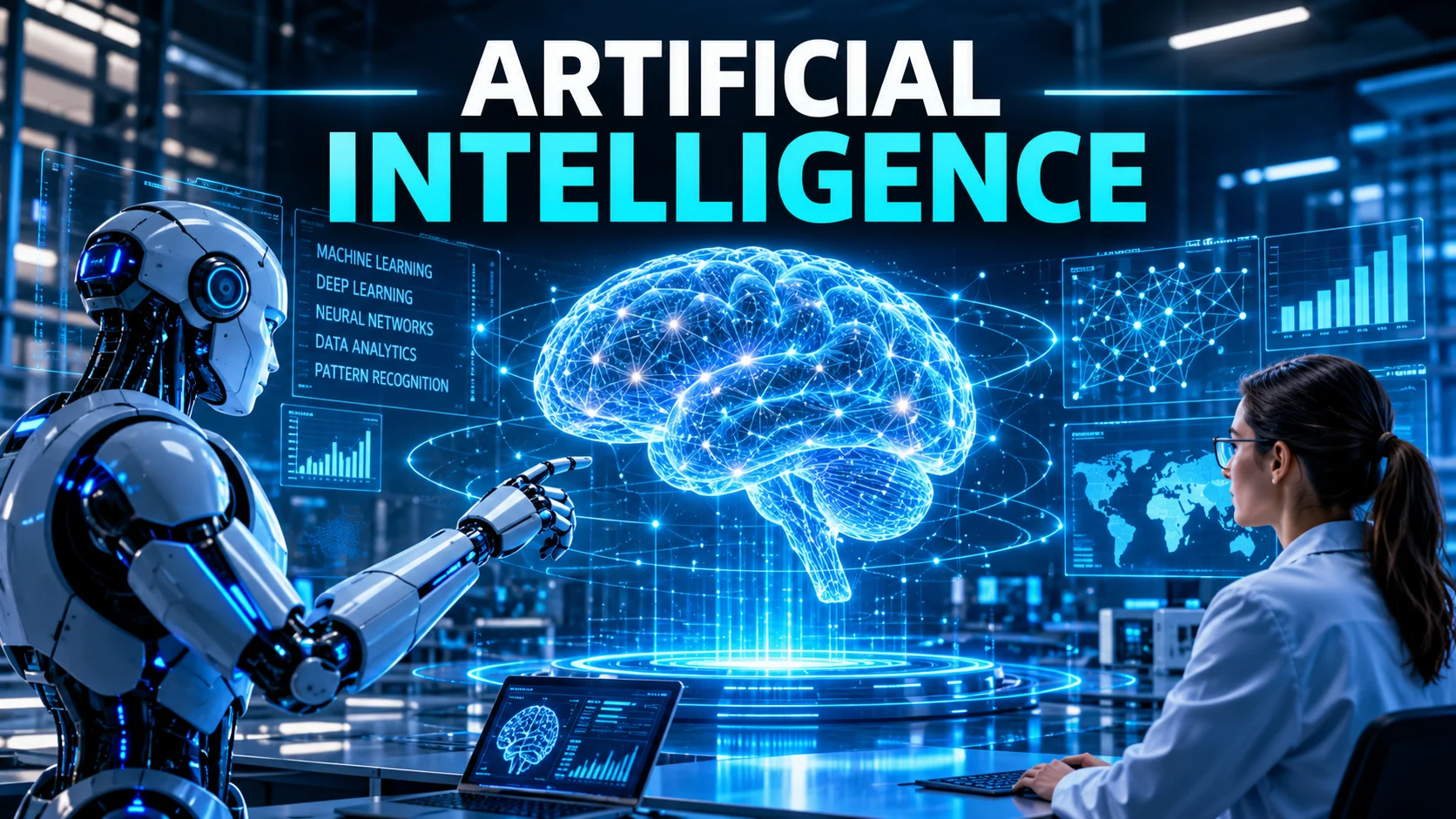
Artificial intelligence (AI) is technology that enables computers to perform tasks associated with human intelligence including learning reasoning understanding language recognizing patterns and solving problems. It uses techniques such as machine learning deep learning and generative models to analyze information make predictions create content and assist with complex decisions.
Artificial Intelligence at a Glance
- Definition: Artificial intelligence enables machines to perform tasks that typically require human intelligence.
- Core technologies: Machine learning, deep learning, neural networks, natural language processing, and computer vision.
- Popular applications: Chatbots, healthcare, education, finance, cybersecurity, transportation, and automation.
- Major categories: Narrow AI, general AI, and the theoretical concept of superintelligence.
- Key benefits: Productivity, faster analysis, automation, personalization, and improved decision support.
- Main challenges: Bias, misinformation, privacy concerns, security vulnerabilities, employment disruption, and accountability.
What Is Artificial Intelligence?
Artificial intelligence is a branch of computer science focused on developing systems that perform tasks associated with human intelligence.
These systems process information, identify patterns, generate predictions, and respond to instructions. Some can also learn from experience and improve their performance through additional training.
Traditional software follows instructions written by developers. Many AI systems instead learn patterns from data and use those patterns to produce outputs.
For example, traditional email software follows predefined rules to filter messages. An AI-powered email system can examine language, identify suspicious patterns, and estimate whether a message is spam.
Artificial intelligence is not a single technology. It includes several interconnected disciplines, models, algorithms, and computing methods.
Today, AI powers applications that people use for communication, research, entertainment, business operations, and scientific discovery.
Why Is Artificial Intelligence Important?
Artificial intelligence matters because it changes how people interact with information and technology.
Instead of manually completing every repetitive task, users can delegate suitable work to intelligent software.
Businesses can analyze large datasets, identify operational problems, and improve customer experiences. Researchers can use AI to explore scientific questions and process complex information.
However, AI does not automatically produce correct decisions. Its usefulness depends on data quality, model capabilities, implementation, and human supervision.
How Does Artificial Intelligence Work?
Artificial intelligence works through algorithms, training data, computational resources, and mathematical models.
The exact process depends on the AI system. A recommendation engine operates differently from a large language model or an image recognition system.
However, most modern machine learning systems follow a similar development process.
1. Data Collection
AI systems need information to learn patterns or perform specific tasks.
Data may include:
- Text documents and conversations.
- Images and videos.
- Audio recordings.
- Financial transactions.
- Sensor readings.
- Scientific measurements.
The quality and relevance of this information strongly influence system performance.
Poorly collected or biased data can produce unreliable results.
2. Data Processing
Raw information often contains errors, duplicates, missing values and irrelevant details.
Developers prepare datasets by cleaning, organizing, labeling, and transforming information into formats suitable for machine learning.
For language models, text is commonly divided into smaller units called tokens.
For image recognition, systems may process pixels, visual features, and image representations.
3. Model Training
During training, an AI model learns statistical relationships from examples.
Machine learning algorithms adjust internal parameters to reduce errors and improve predictions.
Deep learning systems use neural networks containing multiple computational layers. These layers learn increasingly complex patterns from training data.
Training can require substantial computing power, particularly for large models.
4. Inference and Output Generation
After training, the model receives new information and generates an output.
This process is called inference.
Depending on the application, the output might be:
- A text response.
- An image or video.
- A product recommendation.
- A fraud detection alert.
- A predicted sales figure.
- A classification or decision-support result.
An important distinction is that most deployed models do not automatically retrain themselves after every interaction. Learning during development and generating predictions during deployment are separate processes.
5. Evaluation and Improvement
Developers evaluate AI systems using testing datasets, performance measurements, safety assessments, and real-world feedback.
They may update training data, adjust model parameters, improve instructions, or introduce additional safeguards.
Continuous evaluation helps identify weaknesses that ordinary demonstrations may not reveal.
What Are the Main Types of Artificial Intelligence?
Artificial intelligence can be classified according to its capabilities and the techniques it uses.
Understanding these classifications helps explain what current AI systems can accomplish and what remains theoretical.
1. Narrow AI (Artificial Narrow Intelligence)
Narrow AI is designed to perform specific tasks or a defined range of tasks.
Examples include:
- Voice assistants.
- Facial recognition systems.
- Recommendation algorithms.
- Spam filters.
- AI translation software.
- Image recognition applications.
Most artificial intelligence applications currently available belong to this category.
Even highly capable general-purpose chatbots remain limited by their underlying models, tools, permissions, and operating environments.
2. Artificial General Intelligence (AGI)
Artificial general intelligence refers to a hypothetical level of AI that can learn, understand, and perform a broad range of intellectual tasks with flexibility comparable to humans.
AGI remains a debated research concept. There is no universally accepted test that establishes when a system qualifies as AGI.
Today’s advanced AI models demonstrate impressive abilities, but that does not establish that they possess human-like general intelligence.
3. Artificial Superintelligence (ASI)
Artificial superintelligence describes a hypothetical system that would substantially exceed human intellectual capabilities across a broad range of fields.
It remains theoretical rather than an established real-world technology.
Researchers discuss ASI in connection with long-term AI development, governance, safety, and control.
Types of AI Based on Technology
| Technology | What it does | Example |
|---|---|---|
| Machine learning | Learns patterns from data | Fraud detection |
| Deep learning | Uses multilayer neural networks | Image recognition |
| Natural language processing | Processes human language | Translation |
| Computer vision | Interprets visual information | Medical imaging |
| Generative AI | Creates new content | Text and image generation |
| Reinforcement learning | Learns through rewards and feedback | Robotics |
These technologies can overlap. A single AI application may use several of them simultaneously.
Understanding the Core Technologies Behind AI
Artificial intelligence combines different technical approaches. The following technologies form an important part of modern AI development.
Machine Learning
Machine learning is a field of AI that enables systems to learn patterns from data rather than relying entirely on manually written rules.
For example, a bank can train a machine learning model to recognize suspicious financial transactions.
The model examines historical examples and identifies patterns associated with fraudulent activity.
Common machine learning approaches include:
- Supervised learning: Trains models using labeled examples.
- Unsupervised learning: Finds patterns in data without predefined labels.
- Reinforcement learning: Uses rewards and feedback to improve behavior.
Machine learning is widely used in forecasting, recommendation systems, fraud prevention, and predictive maintenance.
Deep Learning and Neural Networks
Deep learning is a specialized area of machine learning that uses neural networks with multiple computational layers.
These networks can identify complex patterns in text, images, audio, and other data.
Deep learning supports technologies such as speech recognition, facial detection, autonomous perception, and advanced language models.
Its main limitation is resource consumption. Training large neural networks can require extensive computing infrastructure, electricity, and specialized hardware.
Natural Language Processing
Natural language processing (NLP) allows computers to process and interpret human language.
It supports:
- Language translation.
- Text summarization.
- Sentiment analysis.
- Question answering.
- Speech-to-text conversion.
- Conversational AI.
Modern language models have significantly expanded NLP capabilities by learning relationships between words, sentences, and broader contexts.
Generative AI
Generative AI creates new content based on patterns learned during training.
It can generate text, images, audio, video, software code, and other digital outputs.
Popular applications include writing assistants, image generators, coding tools, and AI video platforms.
However, generated content is not automatically accurate or original in the legal sense. Users should review outputs, especially when factual accuracy or copyright matters.
Large Language Models (LLMs)
Large language models are AI models trained to process and generate human language.
They learn statistical relationships between tokens and use those relationships to generate responses.
Examples include models powering ChatGPT, Claude, and Gemini.
Some LLM-based applications also connect to external tools, databases, and retrieval systems.
For instance, retrieval-augmented generation (RAG) allows an AI application to retrieve relevant documents before generating an answer.
This can improve access to current or specialized information, although retrieval does not guarantee accuracy.
Real-World Applications of Artificial Intelligence
Artificial intelligence is no longer limited to research laboratories. Organizations use it to improve services, automate operations, and analyze information.
Here are some of its most important applications.
1. Healthcare and Medical Research
Healthcare is one of the most important areas for AI development.
AI systems can analyze medical images, organize patient information, and support clinical research.
Common applications include:
- Medical image analysis.
- Early disease detection support.
- Drug discovery research.
- Patient scheduling and administration.
- Clinical documentation.
- Hospital resource management.
For example, computer vision models can help radiologists identify suspicious patterns in medical scans.
However, AI-generated medical assessments require appropriate clinical validation. They should not replace qualified healthcare professionals.
2. Education and Online Learning
AI is changing how students access educational resources.
Personalized learning applications can adapt explanations and exercises to individual learning needs.
Teachers can also use AI to prepare lesson materials, generate practice questions, and organize educational content.
Popular applications include:
- AI tutoring assistants.
- Automated feedback.
- Language learning.
- Research assistance.
- Educational content generation.
- Learning progress analysis.
The main challenge is maintaining academic integrity and ensuring students understand the material instead of simply copying generated answers.
3. Finance and Banking
Financial institutions use AI to analyze transactions, identify suspicious behavior, and improve risk assessment.
Important applications include:
- Fraud detection.
- Credit risk analysis.
- Customer support.
- Financial forecasting.
- Anti-money-laundering monitoring.
- Algorithmic trading.
AI can process large transaction datasets much faster than manual review.
Nevertheless, financial institutions must monitor model bias, explainability, and regulatory compliance.
4. Business and Marketing
Businesses use AI to improve productivity and understand customer behavior.
Marketing teams can analyze campaign performance, generate content drafts, and segment audiences.
Sales teams can use predictive analytics to prioritize potential customers.
Other business applications include:
- Customer relationship management.
- Automated reporting.
- Market research.
- Inventory forecasting.
- Document processing.
- Customer service automation.
The strongest implementations connect AI to measurable business objectives rather than adopting it simply because it is popular.
5. Transportation and Autonomous Vehicles
AI supports modern transportation through computer vision, sensor analysis, and predictive algorithms.
Applications include:
- Driver assistance systems.
- Traffic prediction.
- Route optimization.
- Fleet management.
- Predictive vehicle maintenance.
- Autonomous driving research.
Self-driving technology requires complex environmental perception and decision-making.
Its safe deployment depends on extensive testing, reliable sensors, appropriate operating conditions, and human oversight where required.
6. Cybersecurity
Cybersecurity teams use AI to analyze network activity and detect suspicious patterns.
AI-powered systems can help identify unusual login behavior, classify malicious files, and prioritize security alerts.
However, attackers also use AI to improve phishing messages, automate reconnaissance, and develop malicious tools.
This creates an ongoing competition between defensive and offensive applications.
7. Entertainment and Content Creation
Generative AI has expanded digital content production.
Creators can use AI tools to produce:
- Blog drafts.
- Marketing graphics.
- Video concepts.
- Voiceovers.
- Music ideas.
- Animation assets.
- Social media content.
Human review remains important for factual accuracy, creative direction, copyright considerations, and brand consistency.
Benefits of Artificial Intelligence
Artificial intelligence offers several practical advantages when organizations implement it responsibly.
Improved Productivity
AI can automate repetitive tasks and reduce the time needed to complete routine work.
Employees can spend more time on planning, communication, creative work, and complex decisions.
Faster Data Analysis
AI systems can identify patterns across datasets that would be difficult to examine manually.
This helps organizations investigate trends and generate predictions.
Better Personalization
Recommendation systems can adapt content, products, and services to individual preferences.
Streaming platforms and online retailers commonly use these techniques.
Improved Accessibility
AI-powered translation, speech recognition, captions, and text-to-speech applications can help people access digital information.
These technologies can also support communication across language barriers.
Support for Scientific Research
Researchers use AI to analyze scientific data, explore molecular structures, and accelerate selected research workflows.
The 2026 International AI Safety Report also describes advances in scientific capabilities alongside the need for stronger evaluation and risk management. International AI Safety Report
Disadvantages and Risks of Artificial Intelligence
1. Algorithmic Bias
AI models learn patterns from their training data.
If that data contains historical discrimination or inadequate representation, the model may reproduce those patterns.
This is particularly concerning in recruitment, lending, healthcare, and public services.
2. Privacy and Data Protection
Some AI applications process sensitive information, including personal documents, business records, and customer data.
Users should understand:
- What information the provider collects.
- Whether prompts are used for model training.
- How long uploaded information is retained.
- Whether information is shared with third parties.
- Whether enterprise privacy controls are available.
A privacy policy, security certification, and zero data retention are different things.
For example, SOC 2 is an assurance framework concerning organizational controls. It does not automatically establish that a provider offers Zero Data Retention (ZDR).
3. Misinformation and Hallucinations
Generative AI can produce convincing but incorrect information.
These errors are often called hallucinations.
A language model may invent references, misinterpret a question, or provide outdated information.
Users should independently verify important claims, particularly in medical, legal, financial, and academic contexts.
4. Employment Disruption
AI can automate parts of existing jobs and change the skills employers require.
Some tasks may disappear, while new roles emerge in AI development, governance, integration, and evaluation.
The actual impact will depend on industry, occupation, adoption speed, and organizational decisions.
5. Security Threats
AI applications can introduce new vulnerabilities.
Examples include:
- Prompt injection.
- Data leakage.
- Model manipulation.
- Unauthorized tool access.
- Automated phishing.
- Insecure integrations.
Organizations must treat AI security as part of their broader cybersecurity strategy.
6. Cost and Environmental Impact
Developing and operating advanced AI models requires computing infrastructure.
Large-scale training and inference can consume significant electricity, hardware resources, and cooling capacity.
Costs also increase when applications process large amounts of information or make repeated model requests.
Popular Artificial Intelligence Platforms and Tools
The AI market includes general-purpose assistants, specialized applications, model providers, and open-model ecosystems.
Different platforms serve different audiences. A useful comparison should consider capabilities, integrations, cost, data controls, and technical flexibility.
| Platform | Target user | Key strength | Pricing transparency | Main limitation |
|---|---|---|---|---|
| ChatGPT | General users and businesses | General-purpose AI assistance and tools | Public plans and API pricing | Usage and feature limits vary by plan |
| Google Gemini | Individuals and Google ecosystem users | Multimodal AI and Google integrations | Public plan information | Capabilities depend on product and account |
| Claude | Professionals and developers | Writing, analysis, and coding workflows | Public plans and API pricing | Limits and availability vary |
| Microsoft Copilot | Individuals and organizations | Microsoft product integration | Different consumer and business offerings | Capabilities depend on licensing |
| Hugging Face | Developers and researchers | Model discovery and open-model ecosystem | Public platform and service pricing | Deployment and model management require technical knowledge |
These are different kinds of products, not interchangeable AI models. Some are consumer assistants, while others provide model infrastructure and development tools.
For example, Microsoft distinguishes between Copilot Chat and more deeply integrated Microsoft 365 Copilot experiences. Microsoft Learn
Anthropic also publishes model documentation and API pricing separately from its consumer assistant offerings. Claude Platform Docs
Where Can You Discover More AI Tools?
Several directories and developer communities help users explore the growing AI ecosystem.
- Futurepedia: A directory for discovering AI applications across different categories.
- There’s An AI For That: Helps users discover tools for specific tasks.
- Hugging Face Hub: A resource for discovering models, datasets, and machine learning projects.
- Product Hunt: Features newly launched software products, including AI applications.
These platforms help with discovery, but directory listings should not be treated as independent proof of product quality or security.
How to Choose an AI Platform
Before selecting an AI tool, evaluate:
- Task suitability: Does it solve your actual problem?
- Accuracy: How reliably does it perform on your own examples?
- Pricing: Are usage limits, API costs, and additional fees clear?
- Privacy: What happens to your uploaded data and prompts?
- Integration: Does it work with your existing software?
- Reliability: Does it perform consistently under realistic conditions?
- Portability: Can you move your data and workflows to another provider?
For businesses, testing several products against the same tasks is more useful than relying on marketing claims.
Artificial Intelligence Trends in 2026
Artificial intelligence continues to develop across research, business, infrastructure, and consumer applications.
The 2026 Stanford AI Index reports that organizational AI adoption reached 88% in its reported survey, while generative AI reached an estimated 53% population adoption within three years. These figures illustrate rapid expansion, although adoption varies considerably between countries and organizations. Stanford HAI
Several developments deserve attention.
1. Growth of AI Agents
AI agents extend beyond traditional question-and-answer chatbots.
They can combine language models with tools, memory, software integrations, and planning capabilities to complete multi-step tasks.
For example, an agent might research a topic, organize findings, prepare a document, and request human approval before taking an external action.
However, agents can make mistakes, misunderstand instructions, or misuse permissions.
NIST announced its AI Agent Standards Initiative in February 2026, highlighting the importance of interoperability and security as these systems develop. NIST
2. Multimodal Artificial Intelligence
Multimodal AI can process or generate different forms of information.
Depending on the model, these may include:
- Text.
- Images.
- Audio.
- Video.
- Structured data.
This creates opportunities for more natural interfaces and applications that combine visual and language understanding.
3. AI in Scientific Discovery
AI is increasingly used in scientific research.
Applications include biological analysis, material discovery, weather modeling, and research automation.
These applications can accelerate selected workflows, but scientific findings still require appropriate experimental validation.
4. Open-Weight AI Models
Open-weight models allow developers to access model parameters under their respective licenses.
This can provide more control over deployment, customization, and infrastructure choices.
However, open weights do not necessarily mean that training data, complete source code, or unrestricted commercial rights are available.
5. AI Regulation and Responsible Development
Governments and organizations are developing policies for AI safety, accountability, transparency, and data protection.
The International AI Safety Report 2026 emphasizes that capabilities are advancing while existing evaluation and risk-management methods still have important limitations. International AI Safety Report
Open-Source vs Proprietary Artificial Intelligence
One important decision in AI development is whether to use an open-weight model or a proprietary service.
Both approaches have advantages and limitations.
| Factor | Open-weight AI | Proprietary AI |
|---|---|---|
| Model access | Weights may be downloadable | Access controlled by provider |
| Customization | Often greater flexibility | Depends on provider |
| Hosting | Can support self-hosting | Usually provider-managed |
| Infrastructure | May require technical resources | Provider handles much of the infrastructure |
| Transparency | Varies by model and license | Internal details may be restricted |
| Costs | Infrastructure and maintenance costs | Subscription or API usage costs |
Open-weight models can suit organizations that need deployment flexibility and greater control.
Proprietary services can suit teams that prefer managed infrastructure and simpler integration.
Neither approach automatically guarantees better privacy, accuracy, or security.
What Is the Future of Artificial Intelligence?
The future of artificial intelligence will depend on improvements in model capabilities, computing infrastructure, scientific research, and responsible governance.
Several developments are likely to influence the next generation of AI applications.
More Capable AI Agents
AI agents may increasingly handle complex workflows across business applications.
Instead of responding to individual instructions, they can plan tasks, use external tools, and coordinate multiple steps.
Human approval will remain important when actions involve money, sensitive information, legal obligations, or irreversible changes.
Personalized AI Assistants
Future AI assistants may become more useful through contextual information, user preferences, and software integrations.
They could help users manage schedules, organize projects, research information, and complete routine work.
However, personalization also increases the importance of consent, privacy, and access controls.
Advances in Robotics
Combining AI with robotics could improve industrial automation, warehouse operations, agriculture, and healthcare assistance.
Robots may become better at interpreting their surroundings and adapting to changing environments.
Physical-world reliability remains a major engineering challenge.
AI-Powered Scientific Innovation
AI could accelerate research by helping scientists analyze complex datasets and investigate potential solutions.
Drug discovery, materials science, and climate research are important areas of development.
Nevertheless, AI-generated hypotheses must still undergo scientific testing.
Stronger AI Governance
As AI becomes more widely integrated into society, organizations will need better evaluation methods and accountability systems.
Future governance will likely place greater emphasis on:
- Model transparency.
- Data protection.
- Human oversight.
- Security testing.
- Risk assessment.
- Responsible deployment.
The objective should be to develop useful AI systems while reducing preventable harm.
How Can You Start Learning Artificial Intelligence?
You do not need to become a professional programmer to begin understanding AI.
The right learning path depends on your interests and career goals.
For Beginners
Start with fundamental concepts:
- Understand what artificial intelligence means.
- Learn the difference between AI and machine learning.
- Experiment with conversational AI applications.
- Explore practical uses in writing, research, and productivity.
- Learn how to verify AI-generated information.
For Students and Developers
Develop a stronger technical foundation:
- Learn Python programming.
- Study basic statistics and linear algebra.
- Understand machine learning algorithms.
- Explore neural networks and deep learning.
- Experiment with APIs.
- Explore Hugging Face models and datasets.
Useful learning resources include Google AI, DeepLearning.AI, and Hugging Face.
For Business Owners
Focus on business applications rather than technical complexity.
Identify repetitive tasks, evaluate suitable AI tools, and run small pilot projects.
Measure time savings, output quality, operating costs, and customer impact before expanding deployment.
Technical Considerations Before Implementing AI
Businesses and developers should consider several technical factors before adopting AI.
Model Selection and Benchmarking
Different AI models perform differently across tasks.
A model that excels at writing may not be the most appropriate choice for mathematical reasoning or document extraction.
Test models using representative examples instead of relying exclusively on public benchmark rankings.
Context Windows
A context window determines how much information a model can process within an interaction.
Larger context windows can help with lengthy documents and complex conversations.
However, a larger context window does not guarantee that a model will accurately understand every detail.
APIs and Integration
An application programming interface (API) allows software systems to communicate with AI models.
APIs make it possible to integrate AI into websites, mobile applications, customer support systems, and business workflows.
Before choosing an API, examine documentation, usage limits, latency, rate limits, and pricing.
Fine-Tuning and RAG
Fine-tuning adapts a pretrained model through additional training on task-specific examples.
Retrieval-augmented generation (RAG) connects a model to external information sources before it generates an answer.
These methods solve different problems. Fine-tuning can help adapt behavior, while RAG can provide access to specific documents and updated information.
Inference Costs
Training a model is not the only expense.
Every request made to a deployed model can create inference costs, depending on the provider, model, and amount of information processed.
Organizations should estimate expected usage, test smaller models where appropriate, and monitor spending.
Frequently Asked Questions
1. What is artificial intelligence in simple words?
Artificial intelligence is technology that enables computers to perform tasks associated with human intelligence. These tasks include learning from data, recognizing patterns, understanding language, making predictions, and generating content.
2. What are the four main types of artificial intelligence?
AI is sometimes classified into four theoretical capability categories: reactive machines, limited-memory AI, theory-of-mind AI, and self-aware AI. Most modern practical AI systems fall within the limited-memory category, while the latter two remain theoretical.
3. What is the difference between AI and machine learning?
Artificial intelligence is the broader field of developing systems that perform intelligent tasks. Machine learning is a subset of AI that allows systems to learn patterns from data and use them to make predictions or decisions.
4. Can artificial intelligence replace human jobs?
Artificial intelligence can automate certain tasks and change the responsibilities associated with many occupations. Its impact varies by industry, and it may also create new opportunities in AI development, oversight, integration, and other fields.
5. Is artificial intelligence safe to use?
Artificial intelligence can be useful, but its safety depends on the application, data, model, and safeguards. Users should verify important outputs, protect sensitive information, and maintain human oversight for high-impact decisions.
Conclusion
Artificial intelligence is transforming how people work, learn, communicate and solve problems.
Its capabilities extend across machine learning, deep learning, natural language processing, generative AI, computer vision, and intelligent automation.
However, successful AI adoption requires more than choosing a popular tool. Accuracy, privacy, security, cost, transparency, and human oversight all matter.
For beginners, experimenting with practical AI applications is a useful starting point. Businesses should evaluate measurable benefits before investing in large-scale implementations.
Ultimately, artificial intelligence should complement human knowledge and decision-making. Its long-term value will depend on how responsibly people develop, deploy, and govern it.

Oliver Wilson is an AI researcher and tech writer living at the intersection of human creativity and machine intelligence. At AixOrbit.com, he decodes complex neural networks, generative AI and emerging tech trends into actionable insights making sure humans stay one step ahead of the algorithms.