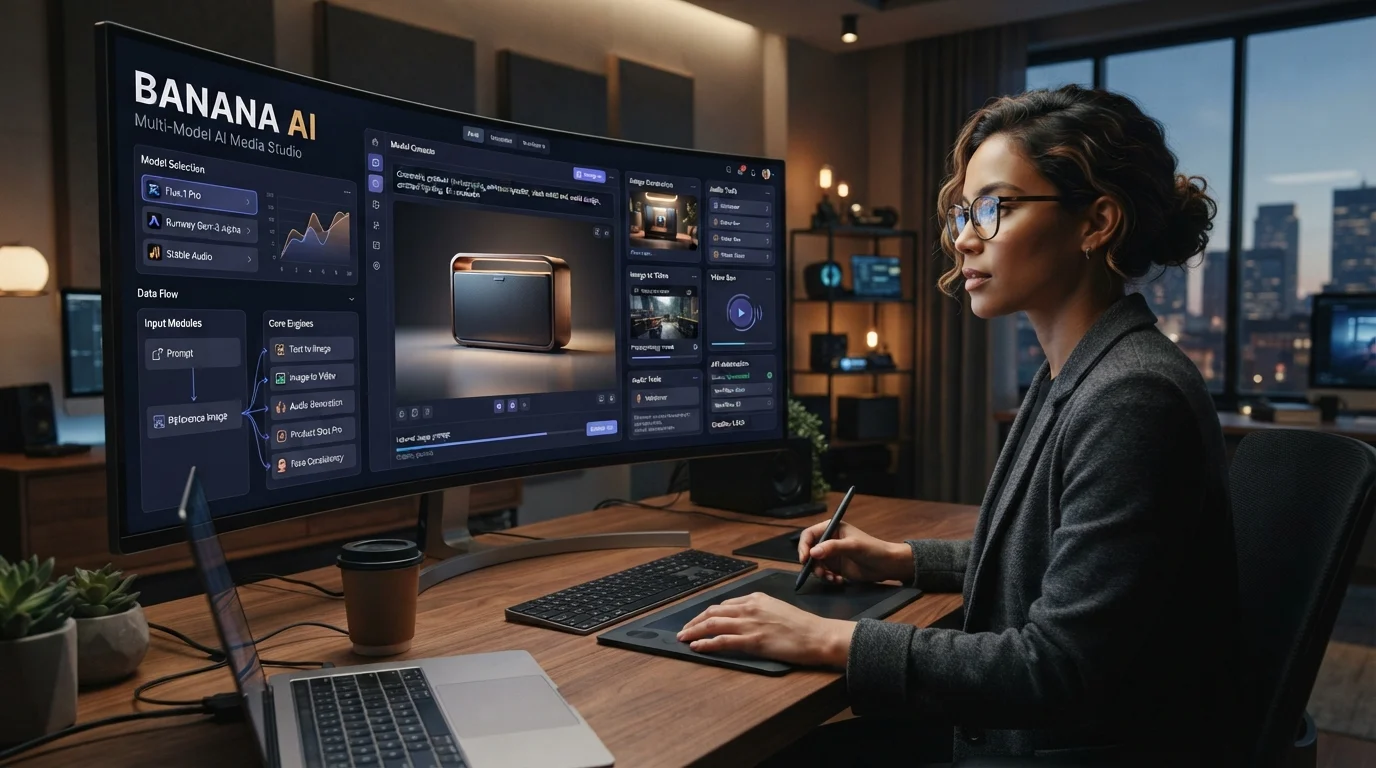
Banana AI is a browser-based multi-model AI media platform for generating and editing images, videos, audio, and other creative content from text or reference files.
It combines models such as Nano Banana, GPT Image, Grok, Kling, and Seedance in one workspace, with a particular focus on Persian-language creative workflows.
Banana AI at a Glance
| Key point | What it means |
|---|---|
| What is Banana AI? | A multi-model AI content creation platform with image, video, audio, editing, and automation tools. |
| Primary audience | Persian-speaking creators, designers, marketers, freelancers, small studios, and businesses. |
| Image generation | Supports models including Nano Banana, GPT Image, Grok, and Seedream. |
| Video generation | Supports multiple video models, including Seedance, Kling, Grok Imagine Video, and Gemini-based options. |
| Developer access | Offers a REST API for image, video, audio, chat, and related workflows. |
| Main caveat | Credits, model availability, pricing, retention periods, and third-party model terms need to be checked before production use. |
What Is Banana AI?
Banana AI, officially branded as BananaAI, is an online AI media studio designed to bring several generative AI models into one browser-based workspace.
Instead of requiring users to maintain separate accounts for different image and video models, Banana AI provides a central interface for selecting models, entering prompts, uploading reference images, generating content, and downloading results.
The platform is primarily positioned for Persian-speaking users. Its official materials describe support for both Persian and English prompts, with different models offering different levels of Persian-language understanding.
This makes Banana AI different from Nano Banana, Google’s name for its Gemini image-generation model family.
That distinction matters.
Nano Banana is a model family from Google DeepMind. Banana AI is a separate platform that provides access to multiple AI models, including Nano Banana.
BananaAI’s own documentation identifies the service as an Iranian AI media platform and lists image, video, audio, conversational AI, and developer API capabilities. (هوش مصنوعی بنانا)
How Banana AI Works
Banana AI follows a relatively simple workflow.
1. Choose a creative workflow
Depending on the task, users can select image generation, image editing, image-to-video, video generation, audio, or other tools.
The platform also promotes specialized workflows for product photography, face identity, explanatory videos, visual pipelines, and other content-production tasks.
2. Enter a prompt or upload a reference
For text-to-image generation, users describe the desired scene.
For image-to-image workflows, they can upload an existing image and describe the changes they want.
This distinction is useful for commercial work. A brand may want to preserve the actual shape of a product while changing the environment, lighting, or composition.
3. Select a model
Banana AI is designed around model choice.
Its current API documentation lists image models such as Nano Banana 2, Nano Banana Lite, Nano Banana Pro, Grok Imagine, GPT Image 2.5 variants, and Seedream 5 Pro. Its video catalog includes models such as Kling, Seedance, Wan, Grok Imagine Video, Gemini Omni, and Veo. (هوش مصنوعی بنانا)
The exact model catalog can change, so users should treat the live model list as the source of truth.
4. Generate and refine
The platform uses a credit system. Different models, resolutions, and media types can consume different amounts of credits.
Failed API generations are not supposed to permanently consume the reserved credits. BananaAI’s API documentation says credits are deducted after successful completion, while failed tasks release the reserved amount. (هوش مصنوعی بنانا)
5. Download or integrate
Creators can download completed assets.
Developers can also use Banana AI’s API to connect generation workflows to their own applications, websites, automation systems, or internal tools.
Key Banana AI Features
Text-to-Image Generation
Banana AI supports text-to-image generation through multiple underlying models.
Users can describe a product, person, environment, illustration, advertisement, thumbnail, or other visual concept and select a suitable model.
The platform specifically emphasizes Persian prompt support, although its own documentation warns that Persian text rendered inside generated images may not always be accurate. (هوش مصنوعی بنانا)
That is an important practical limitation for posters, menus, packaging, and Persian social graphics.
Image-to-Image Editing
Image-to-image generation lets users start with an existing visual rather than creating everything from scratch.
Typical applications include:
- Background replacement
- Style transformation
- Product-scene creation
- Lighting changes
- Image variations
- Creative retouching
- Advertising concepts
- Character consistency
BananaAI says its image-to-image workflow is designed to preserve the original composition while changing style and details. (هوش مصنوعی بنانا)
The quality of preservation will still depend on the underlying model and prompt.
Image-to-Video
Banana AI also connects image workflows with video generation.
This allows a still image to become a short moving scene, which can be useful for social media content, product demonstrations, advertisements, and short-form video.
The current platform lists several video models rather than relying on one proprietary video engine. (هوش مصنوعی بنانا)
AI Video Generation
The platform supports text-to-video and other video workflows through models including Seedance, Kling, Wan, Grok Imagine Video, Gemini-based models, and Veo.
This multi-model approach can be useful when different projects require different combinations of speed, style, motion, resolution, or prompting behavior.
However, the presence of a model in a platform does not automatically mean its performance will match direct access to that model through the original provider.
Product Photography
Product photography is one of the more commercially useful Banana AI workflows.
A merchant can start with a basic product image and generate a more polished environment around it.
For example, a skincare bottle could be placed in a premium bathroom scene, while a shoe could be presented in an editorial fashion setting.
The important rule is to preserve the real product accurately.
AI-generated product images can accidentally alter packaging, logos, dimensions, colors, or labels. Those changes matter when the image represents something customers will actually purchase.
Face Identity
Banana AI promotes a face-identity workflow designed to keep a person’s appearance consistent across multiple generated scenes.
This can help creators develop recurring characters or produce multiple pieces of content around the same person.
However, identity preservation should not be treated as perfect. Users should review generated images for facial changes, distortions, and unintended alterations.
Audio Tools
Banana AI has expanded beyond visual generation.
Its API documentation currently includes text-to-speech and speech-to-text capabilities, including Persian-language voice workflows. The text-to-speech endpoint supports single-speaker and multi-turn dialogue formats. (هوش مصنوعی بنانا)
This gives the platform a broader role in content production than a conventional image generator.
Banana AI Models and the Multi-Model Approach
One of Banana AI’s most important characteristics is that it is not built around a single AI model.
Instead, it acts as a unified interface over several model providers.
That creates an obvious benefit: users can choose a different engine for different tasks without changing creative platforms.
It also creates a potential trade-off.
Why model choice matters
Image models can differ significantly in:
- Text rendering
- Character consistency
- Photorealism
- Prompt adherence
- Editing accuracy
- Resolution
- Reference-image handling
- Generation speed
- Cost
For example, Google’s current Nano Banana family includes Nano Banana 2, Nano Banana 2 Lite, and Nano Banana Pro, each positioned for different combinations of speed, quality, and creative complexity. (Google AI for Developers)
Banana AI exposes some of these models inside its own platform.
That means users should evaluate the platform and the model separately.
A good result may come primarily from the underlying model rather than from Banana AI’s interface.
Banana AI Pricing and Credits
Banana AI uses a credit-based pricing system.
Its public pages currently advertise 24 free credits for new users. The platform says this is enough for roughly six images or two videos, although actual consumption depends on the selected model and task. (هوش مصنوعی بنانا)
The public pricing information deserves closer attention.
An indexed BananaAI pricing page currently shows:
| Plan | Listed price on current indexed page | Credits | Positioning |
|---|---|---|---|
| Free | 0 تومان | 24 | Testing |
| Explorer | 590,000 تومان | 280 | Entry-level use |
| Creative | 1,590,000 تومان | 800 | Designers and freelancers |
| Studio | 3,590,000 تومان | 1,950 | Teams and businesses |
However, another official BananaAI information page lists different paid-plan figures, including 770,000 تومان for Explorer and 1,890,000 تومان for Creative. (BananaAI)
This inconsistency is important.
Do not treat an older indexed price as a guaranteed current checkout price. Verify the live pricing page before purchasing.
Credit consumption also varies by model and output quality. BananaAI’s API model documentation currently lists different credit rates for different image models and resolutions. (هوش مصنوعی بنانا)
Banana AI API for Developers
Banana AI is not limited to its visual interface.
The platform offers a REST API with Bearer-token authentication. Developers can integrate image, video, audio, chat, and related generation workflows into their own applications. (هوش مصنوعی بنانا)
This changes the product’s audience.
A casual creator may only need the web studio. A technical team could use Banana AI as a centralized generation layer.
API workflow
A typical asynchronous image or video request works like this:
- Create an API key.
- Send a generation request.
- Receive a task ID.
- Poll the task status or use a webhook.
- Retrieve the completed asset.
- Process or publish the result.
BananaAI supports webhooks for completed API tasks, allowing developers to receive signed callbacks instead of repeatedly polling the API. (هوش مصنوعی بنانا)
API rate limits
The current documentation lists different request limits by plan:
| Plan | API requests per minute |
|---|---|
| Explorer / Creative | 30 |
| Studio | 60 |
| Ultra | 120 |
Exceeding the limit produces a rate-limit response rather than silently consuming credits. (هوش مصنوعی بنانا)
For production applications, this matters because generation capacity is not the same thing as API throughput.
Privacy and Security Considerations
Privacy deserves careful attention before uploading confidential material.
BananaAI’s current privacy policy says it may collect information including phone numbers, account information, credit usage records, generated content, IP addresses, and browser information. It says this information is used for service delivery, security, support, abuse prevention, and platform improvement. (هوش مصنوعی بنانا)
The policy also states that information may be shared with infrastructure providers, payment processors, or technical service partners when operationally necessary.
Generated images and outputs have retention periods that can vary by plan. The policy says data may be deleted or disabled after the relevant retention period. (هوش مصنوعی بنانا)
This leads to an important conclusion:
Banana AI should not be described as a Zero Data Retention service based on the available privacy documentation.
Its published privacy policy does not establish ZDR as a general guarantee.
Organizations handling confidential client files, unreleased products, private photographs, or sensitive business information should review the current privacy terms before uploading those materials.
Content Ownership and Commercial Use
BananaAI’s terms state that, under applicable law and subject to the terms, rights to outputs generated by the user belong to the user when the input does not violate third-party rights.
The same terms place responsibility for checking legal and licensing compatibility on the user. They also describe outputs as being provided “as is” and do not guarantee that every output is accurate or suitable for a particular purpose. (BananaAI)
This is an important distinction.
Having permission to download an AI-generated image does not automatically mean every element inside that image is legally risk-free.
Users should be especially careful with:
- Trademarks
- Copyrighted characters
- Celebrity likenesses
- Client-owned images
- Product packaging
- Logos
- Stock imagery used as references
- Commercial advertising claims
For professional campaigns, keep records of source assets, prompts, editing steps, and applicable model terms.
Banana AI vs Alternatives
Banana AI competes less directly with a single image generator and more with multi-tool creative platforms.
| Platform | Target User | Key Strength | Pricing Transparency | Core Limitation |
|---|---|---|---|---|
| Banana AI | Persian-speaking creators, marketers, freelancers, small businesses | Multiple image, video, audio, and AI models in one workspace | Public credit plans, but current pages should be checked for consistency | Third-party model dependency and credit-based usage |
| Canva | General creators, marketers, businesses | AI generation combined with a mature design editor | Public plans and usage rules | AI generation is part of a broader design ecosystem |
| Adobe Firefly | Professional creatives and enterprise teams | Image, video, audio, design, and multiple model providers | Public plans and credit systems | Broader Adobe ecosystem can be more complex |
| Leonardo AI | Creators, designers, game and visual-content teams | Image generation, editing, control, and creative workflows | Public plans | More focused on visual creation than an all-in-one media API |
| Google Gemini / Nano Banana | General users and developers | Native Gemini image generation and editing | Access varies by Gemini plan and API usage | Not the same as a multi-provider local media studio |
Canva’s Magic Media supports image, graphic, and video generation inside its design workflow. (Canva)
Adobe Firefly now combines Adobe’s own models with partner models, including Google’s Nano Banana 2, and supports image, video, audio, and design workflows. (Adobe)
Leonardo focuses strongly on AI image creation, editing, consistency, and creative control. (Leonardo.ai)
The choice therefore depends on the workflow.
If the goal is a broad Persian-language creative studio with multiple models, Banana AI has a distinct positioning. If the priority is a mature design ecosystem, other platforms may offer a different experience.
Who Should Use Banana AI?
Banana AI is particularly relevant to:
Persian-Speaking Content Creators
Its Persian interface and prompt support are central to the platform’s positioning.
Social Media Teams
Teams can create images, short videos, variations, product scenes, and other social assets from one workspace.
E-commerce Businesses
Product photography and image editing can reduce the need for repeated studio-style visual production.
Freelancers
Freelancers can use several models without maintaining multiple creative subscriptions.
Marketing Teams
Marketing teams can experiment with concepts, advertisements, product visuals, and campaign assets.
Developers
The API makes Banana AI more relevant to technical teams that want to embed generative media into their own products.
Technical Considerations Before Choosing Banana AI
The most important technical issue is model abstraction.
Banana AI makes several models available through one interface. That is convenient, but it also means the underlying providers remain important.
A workflow can depend on:
- Model availability
- Provider latency
- Credit pricing
- Model version changes
- API limits
- Output resolution
- Reference-image limits
- Provider policies
A model that works well today may be replaced, updated, renamed, or repriced later.
For production systems, developers should avoid hard-coding assumptions about model availability. BananaAI itself recommends querying its model endpoint because new models and pricing changes can appear there. (هوش مصنوعی بنانا)
This is a classic trade-off between convenience and vendor dependency.
Common Banana AI Mistakes
Confusing Banana AI With Nano Banana
This is the biggest search and product confusion.
Banana AI is a platform. Nano Banana is Google’s image-model family.
Banana AI can provide access to Nano Banana models, but the two names should not be treated as interchangeable.
Using One Model for Every Task
Different models have different strengths.
Test several options before deciding which engine belongs in a recurring production workflow.
Ignoring Credit Consumption
A low-cost model may be suitable for drafts, while a higher-quality model may be better for final assets.
Track the cost per successful output rather than simply comparing the monthly subscription price.
Uploading Sensitive Material Without Checking Retention
Review the privacy policy and plan-specific retention terms before uploading confidential assets.
Assuming AI Output Is Automatically Commercially Safe
Review trademarks, likenesses, source images, and other third-party rights before commercial publication.
Expecting Perfect Persian Text Rendering
BananaAI itself notes that Persian text inside generated images may not always be accurate. For important typography, generate the visual separately and add the final text in a conventional design application.
How to Get Better Results With Banana AI
Good prompting remains important even when the platform supports several advanced models.
A useful image prompt can specify:
Subject + environment + composition + lighting + camera + materials + style + aspect ratio + required details
For example:
Premium skincare bottle on pale travertine, warm morning sunlight from the left, soft natural shadows, minimal luxury bathroom, editorial product photography, realistic glass reflections, shallow depth of field, clean beige palette, centered composition, 4:5 aspect ratio.
For image editing, describe what must remain unchanged.
For example:
Keep the product shape, label layout, bottle proportions, colors, and logo unchanged. Replace only the background with a modern luxury bathroom and add soft window lighting.
This reduces ambiguity and makes it easier to evaluate whether the generated image actually serves the commercial purpose.
Latest Banana AI Developments
BananaAI has expanded beyond a basic image-generation interface.
Its current platform presents a broader creative ecosystem that includes image generation, video generation, audio, product workflows, face identity, visual pipelines, an Explore gallery, and API access. (هوش مصنوعی بنانا)
The API has also become more structured, with asynchronous tasks, webhooks, model discovery, rate limits, and multiple media endpoints.
That shift matters because the platform is increasingly positioned as AI media infrastructure for creators and developers, rather than only a consumer image generator.
At the same time, the multi-model approach means users should evaluate the underlying models, pricing, retention, and provider terms instead of judging the platform solely by its interface.
Frequently Asked Questions
Is Banana AI free?
Yes. BananaAI currently offers a free starting tier with 24 credits. The platform says those credits are enough for roughly six images or two videos, although actual usage depends on the selected model and generation settings.
Is Banana AI the same as Nano Banana?
No. Banana AI is a multi-model AI media platform. Nano Banana is Google’s name for its Gemini image-generation model family. Banana AI can provide access to Nano Banana models, but the products are not the same.
Does Banana AI support an API?
Yes. BananaAI provides a REST API for supported image, video, audio, chat, and related workflows. Image and video generation requests can run asynchronously, with task-status endpoints and webhook support for completed jobs.
Does Banana AI support Persian prompts?
Yes. BananaAI’s interface supports Persian and English prompts. However, the platform notes that Persian text rendered inside generated images may not always be accurate, and some underlying models have stronger Persian understanding than others.
Can Banana AI outputs be used commercially?
BananaAI’s terms state that, subject to applicable law and its terms, rights to qualifying user-generated outputs belong to the user when the input does not violate third-party rights. Users remain responsible for checking copyright, trademark, likeness, licensing, and other legal requirements before commercial use.
Conclusion
Banana AI is best understood as a multi-model AI media studio, not as another name for Google’s Nano Banana.
Its main proposition is convenience: users can access multiple image, video, audio, and conversational AI models from one workspace, while developers can connect supported generation workflows through an API.
The platform may be particularly relevant to Persian-speaking creators, marketers, e-commerce businesses, freelancers, and small production teams.
The main issues to evaluate are equally practical: credit consumption, changing model availability, API limits, privacy and retention, commercial-use terms, and the difference between BananaAI’s interface and the underlying third-party models.
Before adopting it for production, test the exact models and workflows you need. Check current pricing at checkout, review the privacy and usage terms, and compare the total cost against direct access to the underlying AI providers or competing creative platforms.

Oliver Wilson is an AI researcher and tech writer living at the intersection of human creativity and machine intelligence. At AixOrbit.com, he decodes complex neural networks, generative AI and emerging tech trends into actionable insights making sure humans stay one step ahead of the algorithms.