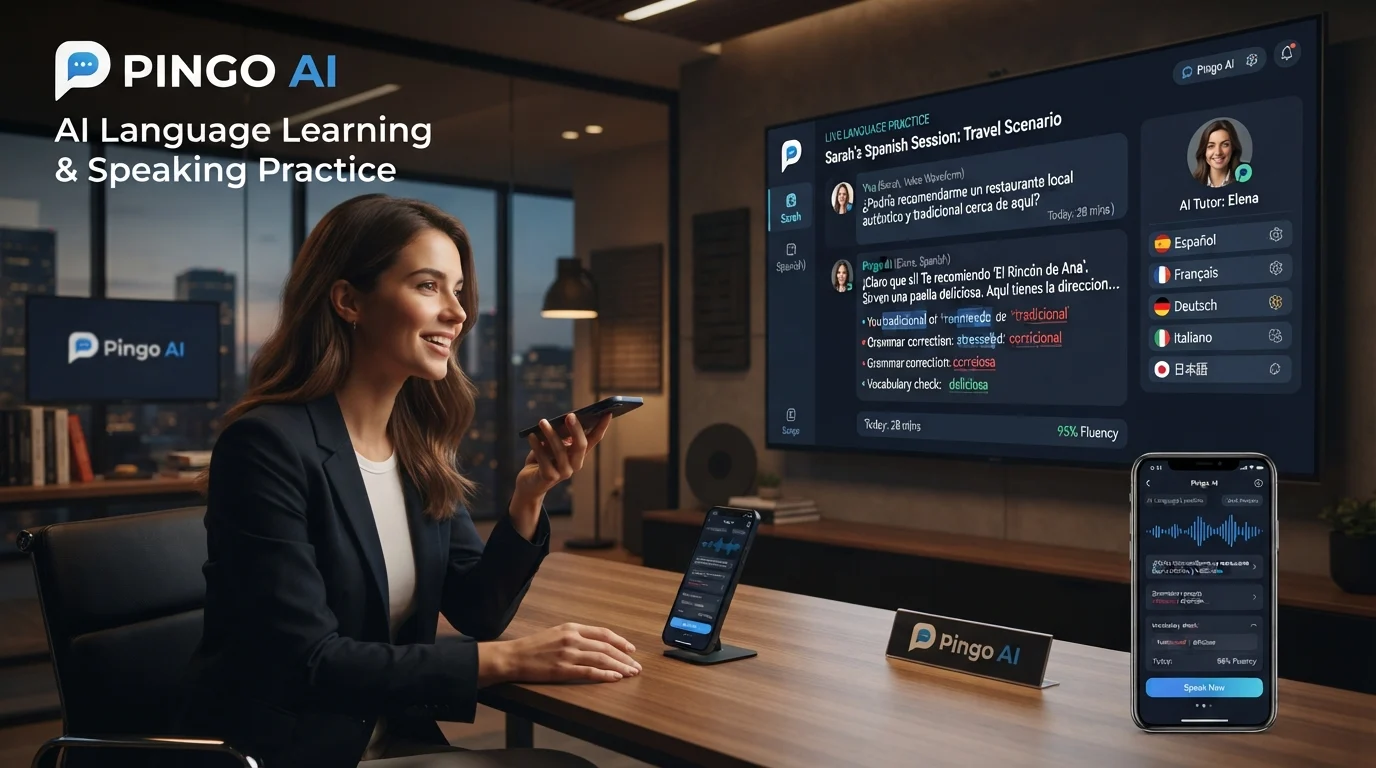
Pingo AI is an AI-powered language learning app focused on real-time speaking practice, personalized conversations, and feedback across 25+ target languages. (Pingo AI)
It is designed primarily for learners who want to practice speaking without relying on a human conversation partner, but its subscription model, data practices, and AI limitations are worth checking before paying. (Pingo AI)
At a Glance
| Pingo AI detail | What you should know |
|---|---|
| Primary purpose | AI-powered language speaking practice |
| Target languages | 25+ |
| Native-language support | 15+ teaching languages |
| Core experience | Voice conversations, roleplay, feedback, personalized learning |
| Platforms | iOS and Android |
| Free access | Free trial, with Pingo Pro required for full features |
| Paid plans | Monthly and annual subscriptions |
| Developer | Pingo AI, Inc. |
| Best suited to | Learners who need more speaking practice |
| Main limitation | AI conversation quality and correction can vary |
Pingo AI sits in a growing category of language-learning apps that use conversational AI instead of relying mainly on flashcards, quizzes, and fixed lessons.
Its central idea is straightforward: practice speaking by actually talking.
That makes Pingo AI particularly relevant for learners who understand a language but struggle to produce sentences quickly. It also gives users a low-pressure environment for practicing situations such as travel, interviews, everyday conversations, and hobbies. (Pingo AI)
However, Pingo AI is not simply a chatbot with a language-learning interface. Its product is built around personalized learning goals, conversation practice, feedback, and continuity between sessions.
The important question is therefore not just whether Pingo AI can speak with you. It is whether its conversational approach fits the way you actually learn.
What Is Pingo AI?
Pingo AI is an AI language-learning application developed by Pingo AI, Inc. It uses conversational AI to help users practice speaking and learn through realistic dialogue.
Instead of asking learners to complete only predetermined exercises, Pingo encourages them to discuss subjects relevant to their goals.
For example, a learner could practice:
- Ordering food while traveling
- Preparing for a job interview
- Making small talk
- Discussing hobbies
- Practicing business conversations
- Talking about daily routines
- Preparing for a specific trip
- Exploring entertainment or cultural topics
Pingo says it remembers a learner’s level, mistakes, vocabulary, and goals so later sessions can build on previous practice. (Pingo AI)
The app currently advertises 25+ target languages, including English, Spanish, French, German, Japanese, Korean, Chinese, Italian, Portuguese, Arabic, Hindi, Thai, Vietnamese, Turkish, Persian, Ukrainian, and others. (App Store)
Pingo also says it supports instruction through 15+ native languages.
That distinction matters. A target language is the language you are learning, while a native or interface language helps explain the learning experience.
How Does Pingo AI Work?
Pingo’s workflow is built around conversational practice.
1. Set your language goals
You tell Pingo what you want to learn, your approximate level, and the situations that matter to you.
The app then uses this information to create a learning path around your goals. (Pingo AI)
2. Start a conversation
Instead of simply selecting a multiple-choice answer, you speak with Pingo.
The conversation can focus on everyday situations, professional scenarios, travel, interests, or other topics.
This gives the learner an opportunity to practice language production, not just recognition.
3. Receive feedback
Pingo provides feedback related to areas such as pronunciation and grammar.
The company also describes transcripts and corrections as part of its learning experience. (App Store)
4. Continue from previous sessions
Pingo says it remembers relevant learning information across sessions.
The goal is continuity. You should not have to restart your language-learning context every time you open the app. (Pingo AI)
This is one of the more important differences between a dedicated AI tutor and a generic chatbot.
Key Pingo AI Features
AI Conversation Practice
Conversation is the center of Pingo AI.
The app is designed to let learners speak naturally rather than simply repeat isolated phrases.
This approach can be useful for people who know vocabulary but hesitate when forming complete sentences.
Personalized Learning
Pingo builds its experience around the learner’s stated goals.
The company says the system adapts to the user’s level, mistakes, words, and objectives. (Pingo AI)
Personalization is particularly useful when the learner has a specific objective.
For example, someone preparing for an interview needs different vocabulary from someone preparing for a vacation.
Real-Life Scenarios
Pingo promotes conversations based on situations that learners may actually encounter.
That includes travel, interviews, hobbies, everyday activities, and other practical scenarios. (Pingo AI)
This makes the app more production-focused than a purely vocabulary-driven tool.
Pronunciation and Grammar Feedback
The App Store listing says Pingo provides instant feedback on pronunciation and grammar during language conversations. (App Store)
However, users should remember that AI feedback is not equivalent to feedback from a professional human language teacher.
Speech recognition can misunderstand accents, incomplete sentences, background noise, or unusual phrasing.
Progress Continuity
Pingo’s current product messaging emphasizes remembering previous learning progress.
That can make repeated practice more coherent because the learner does not always start from zero. (Pingo AI)
Mobile Accessibility
Pingo AI is distributed through the Apple App Store and Google Play.
The Google Play listing identifies Pingo AI, Inc. as the developer and shows more than 1 million Android downloads, while the company itself promotes a substantially larger overall learner figure. (Google Play)
Because these numbers come from different sources and measurement methods, they should not be treated as identical metrics.
Which Languages Does Pingo AI Support?
Pingo currently advertises 25+ target languages.
The published list includes:
- English
- Spanish
- French
- German
- Japanese
- Korean
- Italian
- Chinese
- Portuguese
- Russian
- Arabic
- Dutch
- Turkish
- Polish
- Vietnamese
- Hindi
- Thai
- Hebrew
- Greek
- Indonesian
- Swedish
- Norwegian
- Danish
- Persian
- Ukrainian
The exact availability can change as the service expands, so users should verify their preferred language inside the current app experience. (App Store)
Pingo’s broader language coverage is significant because many competing AI tutors concentrate heavily on English or a smaller group of major languages.
Is Pingo AI Free?
Pingo AI can be downloaded for free, but full conversation and personalized-learning functionality requires Pingo Pro. The company says it offers a free trial before subscription. (Pingo AI)
The important distinction is:
Free download does not mean unlimited free use.
Pingo’s Terms explain that paid subscriptions can be monthly or yearly, with the exact price and billing terms presented through the applicable payment provider. (Pingo AI)
Pingo AI Pricing
Pricing can vary by country, platform, and offer.
For example, the U.S. App Store currently lists several Pingo Pro purchase prices, including $14.99, $17.99, $83.99, and $99.99, rather than presenting one universal global price. (App Store)
A separate Apple pricing tracker observed a $14.99 monthly U.S. Pingo Pro price in September 2026. (App Price Atlas)
That means the safest way to evaluate the cost is to check the actual checkout screen for your country.
Also note that Pingo’s terms say subscriptions can renew automatically according to the terms presented by Apple, Google Play, or Stripe. (Pingo AI)
If you subscribe, check:
- Billing frequency
- Trial duration
- Renewal date
- Renewal price
- Currency
- Cancellation procedure
Pingo specifically states that deleting the app does not cancel a subscription. (Pingo AI)
Pingo AI Privacy and Security
Privacy deserves special attention because language-learning conversations can contain personal information.
Pingo’s privacy policy, updated August 11, 2026, says the company may collect information including account details, usage information, device information, voice recordings, and other data generated through the service. (Pingo AI)
The policy also states that Pingo may use text prompts, chat messages, voice recordings, corrections, feedback, usage logs, and metadata to improve its AI models, algorithms, and language-learning services. (Pingo AI)
Does Pingo AI Use Third-Party AI Providers?
Yes.
Pingo’s privacy policy says its current third-party AI service providers include OpenAI and Groq. It says chat messages and voice recordings may be shared with those providers to generate responses and power conversations. (Pingo AI)
Pingo also states that these providers are not permitted to use the information to train their own models under the arrangements described in its privacy policy. (Pingo AI)
That does not mean users should assume zero data retention.
Pingo’s privacy policy says personal information is retained for as long as needed or permitted for the relevant purposes and applicable law. (Pingo AI)
Therefore, users should not describe Pingo as a Zero Data Retention service unless Pingo explicitly provides such a guarantee for the relevant data and service.
Can You Delete Your Pingo AI Data?
Pingo provides an account-deletion option.
Its help documentation says deleting an account removes profile information, usage data, and conversation history. It also says transaction records may be retained for legal compliance for up to one year. (Pingo AI)
For privacy-conscious users, this is worth reviewing before entering sensitive personal information into conversations.
Pingo AI: Strengths and Limitations
Potential strengths
- Strong emphasis on speaking practice
- 25+ target languages
- Personalized conversation scenarios
- Real-life conversational practice
- Pronunciation and grammar feedback
- Progress continuity
- Available on iOS and Android
- Useful for learners without a speaking partner
Potential limitations
- Full use requires a subscription
- Pricing varies by market and platform
- AI feedback can be imperfect
- Speech recognition can occasionally misinterpret users
- It is not a replacement for a comprehensive human-led course
- Privacy involves collection and processing of voice and conversation data
- Mobile-first usage may not suit people seeking a desktop learning environment
Recent app-store reviews also report issues such as interruptions, speech-recognition problems, and dissatisfaction with the trial or subscription experience. These are user reports, not independently verified measurements of the entire product. (Google Play)
That distinction is important when evaluating review sentiment.
Pingo AI vs Other AI Language Learning Apps
Pingo operates in a competitive market that includes AI-first language platforms such as Speak, Praktika, and Talkpal.
| Platform | Target user | Key strength | Pricing transparency | Potential limitation |
|---|---|---|---|---|
| Pingo AI | Learners seeking conversational practice | 25+ languages and personalized AI conversations | Prices vary by store and region | Paid access and variable AI feedback |
| Speak | Learners focused on structured speaking | Curriculum plus AI conversation and pronunciation practice | Pricing varies by market | Smaller target-language selection than Pingo |
| Praktika | Learners wanting AI tutors and structured practice | AI tutors, study plans, pronunciation and grammar feedback | Subscription pricing varies | More tutor/avatar-centered experience |
| Talkpal | Broad multilingual AI practice | 130+ languages and multiple AI modes | Public pricing page | Free tier has usage limits |
Speak currently advertises a 7-day trial, structured curriculum, AI conversations, pronunciation feedback, and two main subscription tiers. (Speak)
Praktika emphasizes AI tutors, personalized study plans, and real-time corrections, and currently lists a broader set of language-learning features around its AI tutor model. (Intercom)
Talkpal advertises 130+ languages. Its current pricing page lists a free Basic plan with a 10-minute daily limit and a Premium plan at $19.99 per month. (Talkpal)
The important point is that these platforms are not identical products.
Pingo emphasizes conversational breadth and continuity, while competitors may put more weight on structured courses, AI tutor personas, pronunciation training, or broader language coverage.
Who Should Use Pingo AI?
Pingo AI may be worth considering if you:
- Already know some vocabulary but need speaking practice
- Feel nervous speaking with real people
- Want short conversation sessions
- Need practice for travel or everyday situations
- Want to practice less-common languages
- Prefer voice interaction to typing
- Want an AI tutor available whenever you have time
It may be less suitable if your primary goal is:
- Deep grammar instruction
- Formal academic language study
- Human teacher feedback
- Completely free unlimited practice
- Offline learning
- A traditional textbook-style curriculum
The difference comes down to learning philosophy.
Pingo is designed around using the language through conversation.
That can complement, rather than replace, grammar study, reading, writing, listening, and human interaction.
How to Get Better Results From Pingo AI
AI language tools become more useful when you give them specific goals.
Instead of saying:
“Teach me Spanish.”
Try:
“I am an A2 Spanish learner. Help me practice ordering food at a restaurant. Speak slowly and correct only important mistakes.”
You can also ask for targeted scenarios.
Examples include:
- “Practice a hotel check-in with me.”
- “Interview me for a customer-service job.”
- “Help me practice Japanese travel vocabulary.”
- “Use simple French because I am a beginner.”
- “Correct my pronunciation after I finish speaking.”
- “Make me use five new words during the conversation.”
This makes the interaction more focused.
It also helps you identify whether the app’s AI actually adapts to your needs instead of simply generating generic dialogue.
Common Mistakes to Avoid
Treating AI conversation as complete language learning
Speaking practice is valuable, but fluency requires several skills.
Combine Pingo with reading, listening, writing, vocabulary review, and real-world communication.
Assuming every correction is correct
AI systems can make mistakes.
If a correction sounds strange, verify it with a reliable dictionary, grammar reference, teacher, or native speaker.
Ignoring subscription renewal
A trial can convert into a paid subscription according to the terms displayed at checkout.
Set a reminder before renewal if you are only testing the app.
Sharing sensitive information
Pingo processes conversation and voice data.
Avoid putting passwords, financial information, private business information, or other unnecessary sensitive data into AI conversations.
Is Pingo AI Worth Trying?
That depends on what you want from a language-learning app.
If your main problem is lack of speaking practice, Pingo’s conversational design directly addresses that problem.
If you want a comprehensive course with extensive grammar instruction, you may need to combine it with another learning resource.
The strongest reason to test Pingo is its emphasis on conversation across a relatively broad selection of languages. The strongest reason to be cautious is that subscription costs, AI accuracy, and privacy considerations deserve closer attention than a simple app-store rating can show.
The free trial gives potential users an opportunity to test the experience before committing. (Pingo AI)
Frequently Asked Questions
Is Pingo AI actually an AI language tutor?
Yes. Pingo AI is designed as an AI-powered language-learning companion that uses conversational interaction, personalized learning paths, and feedback to help users practice speaking. The company says the system remembers learning goals, mistakes, vocabulary, and progress across sessions. (Pingo AI)
Is Pingo AI free?
Pingo AI is free to download and offers a free trial, but full conversation and personalized-learning features require Pingo Pro. Subscription prices vary according to market, platform, and offer, so users should check the current checkout price before subscribing. (Pingo AI)
How many languages does Pingo AI support?
Pingo currently advertises more than 25 target languages. Its published list includes major languages such as English, Spanish, French, German, Japanese, Korean, Chinese, Arabic, Hindi, Italian, Portuguese, and several others. (App Store)
Does Pingo AI use your voice data?
Yes. Pingo’s privacy policy says it collects voice recordings and may process chat messages and voice recordings through third-party AI service providers, including OpenAI and Groq, to provide its conversational services. (Pingo AI)
Can Pingo AI replace a human language teacher?
Not completely. Pingo can provide convenient conversation practice and automated feedback, but AI feedback can be imperfect and does not provide all the context, expertise, and personalized judgment of a qualified human teacher. It is better viewed as a practice tool than a complete replacement for language education.
Conclusion
Pingo AI is a conversational language-learning platform built around one clear idea: give learners more opportunities to speak.
Its 25+ target languages, personalized conversations, pronunciation and grammar feedback, and continuing learning context make it relevant for people who need practical speaking practice. (App Store)
Before subscribing, however, check the exact price in your country, understand the trial and renewal terms, and review how your voice and conversation data are handled.
For learners who need regular speaking practice without coordinating with another person, Pingo AI is a platform worth evaluating. Its real value depends on how accurately its AI understands you, how useful its corrections are, and whether its subscription cost fits your learning routine.

Oliver Wilson is an AI researcher and tech writer living at the intersection of human creativity and machine intelligence. At AixOrbit.com, he decodes complex neural networks, generative AI and emerging tech trends into actionable insights making sure humans stay one step ahead of the algorithms.