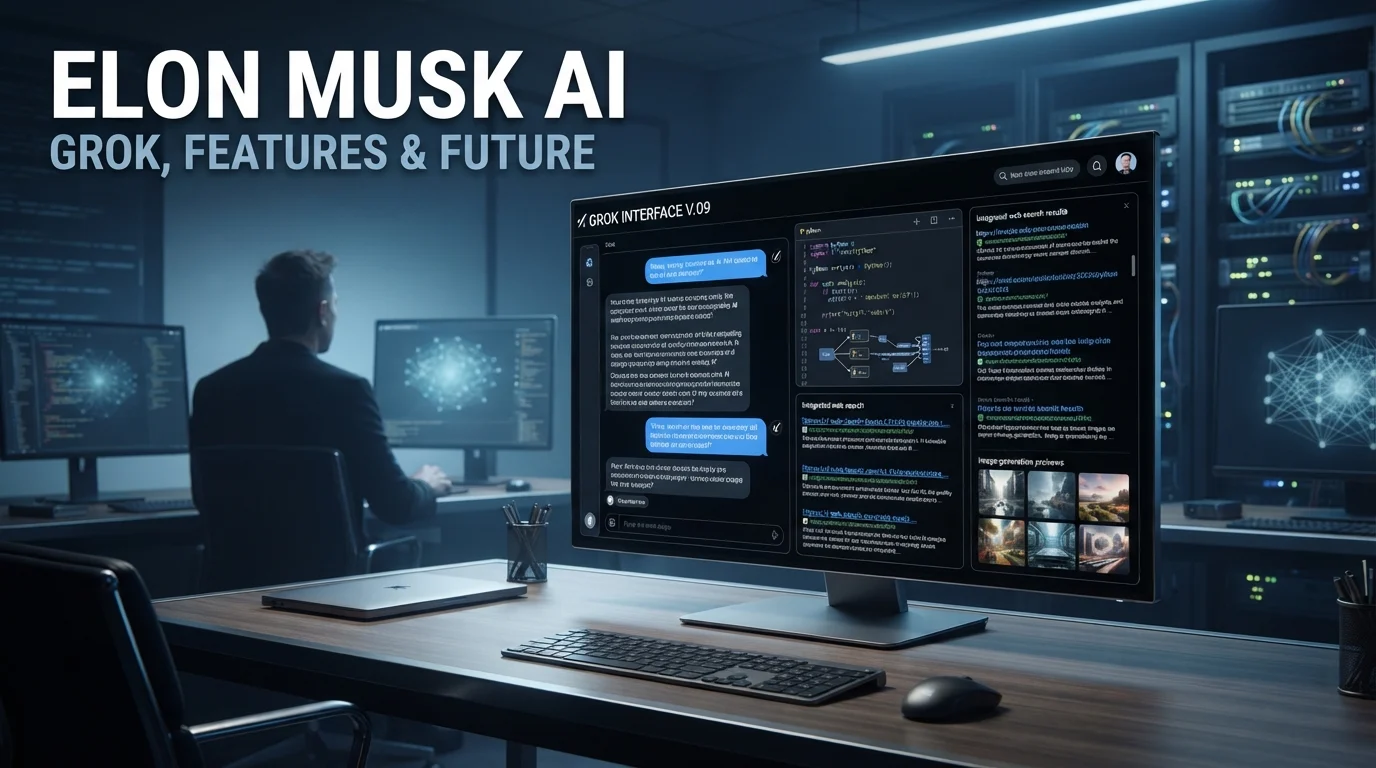
Elon Musk AI primarily refers to Grok, the artificial intelligence assistant developed by xAI, the AI company founded by Elon Musk. Grok offers conversational AI, reasoning, coding assistance, web and X search, and generative media capabilities, while Musk’s broader AI ambitions also extend into Tesla’s autonomous driving technology and humanoid robotics.
How Does Elon Musk AI Work?
Grok is built around large language models (LLMs), a type of AI trained on large collections of data to understand prompts and generate responses. These models learn patterns in language, code, and other information, then use those patterns to answer questions and complete tasks.
Modern Grok products can also use external tools. Depending on the model, interface, and settings, those tools may include web search, X search, code execution, or function calling.
The process typically follows these steps:
1. The user submits a prompt
You ask a question, upload an image, request code, or describe a task.
2. The model processes the request
The AI interprets your instructions and generates a response using its learned patterns and available context.
3. Tools may retrieve additional information
When enabled, search and other tools can provide information beyond the model’s training data.
4. Grok returns an answer or result
The system produces text, code, or supported media, depending on the product and model.
One distinction matters: having access to current information is not the same as knowing every fact accurately. Search results can be outdated or misleading, and the model can still misinterpret sources. Important claims require independent verification.
Key Features of Elon Musk AI
Grok’s capabilities vary by model and product. Its developer platform documents several major categories.
1. Conversational AI and reasoning
Grok can explain concepts, answer questions, summarize information, draft content, and help users work through complex problems.
Reasoning-focused models can spend additional computation working through challenging tasks. However, a detailed explanation does not guarantee that the conclusion is correct.
2. Web and X search
Grok can retrieve information from the web and public X content when the relevant search tools are available. This makes it useful for researching developing stories, public discussions, and recent announcements.
For time-sensitive questions, check the sources and their publication dates rather than relying solely on the generated summary.
3. AI coding assistance
Developers can use Grok to generate code, explain unfamiliar functions, identify potential bugs, and support software development. The developer API also supports tool calling and code execution in compatible configurations.
Generated code should still be tested. Review security-sensitive operations, dependencies, permissions, and edge cases before deploying it.
4. Image and video generation
The Grok Imagine family supports image creation and editing, while its video tools support video generation and related media workflows. Exact capabilities, resolutions, and costs depend on the model and interface.
These features can help creators develop concepts, produce draft visuals, and experiment with creative ideas. Users should also consider copyright, consent, impersonation, and platform rules when generating or publishing media.
5. Voice interaction
Grok’s voice tools support speech-related applications, including speech-to-speech interaction and speech transcription. The API gives developers options for building voice-enabled applications.
Potential uses include conversational interfaces, customer support, and hands-free assistance. Actual performance depends on the model, language, audio conditions, and integration.
6. AI agents and automated workflows
AI agents go beyond responding to individual prompts. They can use tools and carry out multiple steps toward a defined goal, subject to their permissions and configuration.
The company’s product announcements describe agent-oriented systems for business workflows and persistent tasks. Such systems can reduce manual work, but they require clear permissions, monitoring, and safeguards before handling important operations.
How to Use Elon Musk AI
For most people, the easiest starting point is Grok’s consumer interface. Developers can instead explore the API.
- Open Grok. Visit Grok’s official website or use an official app or supported integration.
- Sign in if required. Available access, usage limits, and features can depend on your account and region.
- Write a specific prompt. Describe the task, desired format, audience, and any relevant constraints.
- Enable tools when needed. Use available search features for current information or supported media tools for creative work.
- Review the result. Check factual claims, citations, code, and any content intended for publication or business use.
For example, instead of asking, “Tell me about AI,” try:
Explain how generative AI works in simple language. Give three real-world examples, identify two limitations, and cite reliable sources for current claims.
A well-defined prompt gives the model clearer instructions. It does not eliminate factual errors, so verification remains important.
What Can Elon Musk AI Be Used For?
The most useful applications depend on whether you’re using Grok as an everyday assistant, a creative tool, or a developer service.
| Use case | Example task | What to check |
|---|---|---|
| Research | Summarize a topic and find supporting sources | Source quality and recency |
| Writing | Draft articles, emails, and outlines | Accuracy, originality, and tone |
| Education | Explain difficult concepts and generate practice questions | Correctness and curriculum fit |
| Programming | Debug code and explain functions | Tests, security, and dependencies |
| Marketing | Brainstorm campaigns and social content | Brand accuracy and audience fit |
| Creative work | Generate image or video concepts | Usage rights and output quality |
| Business automation | Assist with repetitive workflows | Permissions, reliability, and human oversight |
| Voice applications | Build conversational assistants | Latency, transcription quality, and cost |
For students and everyday users
Grok can simplify difficult topics, summarize material, brainstorm ideas, and help organize information. Students should use it to support learning rather than submit unverified responses as their own work.
For developers and technical teams
The API can support applications that need text generation, image understanding, search, or tool calling. Before committing to a model, test it against your actual workload instead of relying on promotional claims.
For businesses
AI can assist with document processing, customer service, research, and internal workflows. Start with a low-risk task, define measurable success criteria, and introduce human approval before expanding automation.
Elon Musk AI Pricing: Is Grok Free?
Grok’s consumer access and its developer API use different pricing structures. The availability of free access and included usage can change with account type, region, subscription, and product policy.
For developers, the API uses usage-based billing. The official documentation lists the following prices for Grok 4.7 as of October 22, 2026.
| API component | Published price |
|---|---|
| Input tokens, below the long-context threshold | $2 per million tokens |
| Cached input tokens, below the threshold | $0.50 per million tokens |
| Output tokens, below the threshold | $6 per million tokens |
| Input tokens for prompts above 200,000 tokens | $4 per million tokens |
| Output tokens for prompts above 200,000 tokens | $12 per million tokens |
These are API rates, not the price of a consumer subscription. Image, video, voice, and search tools may have separate charges.
What affects the actual cost?
- Input length: Long prompts and conversation histories consume more tokens.
- Output length: Longer answers increase output usage.
- Caching: Eligible cached inputs can cost less than standard inputs.
- Tool calls: Search and other server-side tools may add charges.
- Media generation: Image and video creation have separate pricing structures.
- Long-context requests: Higher rates can apply once the prompt crosses the published threshold.
Check the official API pricing documentation before budgeting a project. For a production application, estimate costs using representative prompts and actual usage patterns.
Privacy and Security: What Should You Know?
Before using Elon Musk AI for personal or business tasks, understand which product you’re using and how it handles your information.
Grok’s consumer services and developer API have separate policies and controls. The published privacy policy distinguishes consumer services from business offerings, including the API, where separate terms may apply.
Consider these precautions:
- Avoid sensitive uploads: Do not enter passwords, payment details, confidential client documents, or proprietary source code unless your use case and applicable terms permit it.
- Review data settings: Check the current privacy controls, conversation settings, and applicable policy before sharing personal information.
- Understand enterprise controls: The official API documentation describes enterprise options including single sign-on, audit logging, regional processing, and Zero Data Retention for eligible configurations. Confirm availability and terms for your account.
SpaceXAI+1
- Distinguish certifications from retention policies: SOC 2 Type II relates to audited controls. It does not automatically mean prompts and outputs are never retained.
- Apply human oversight: Review generated content before using it in legal, medical, financial, or other high-impact decisions.
Does Grok always provide accurate answers?
No. Like other generative AI systems, Grok can make factual errors, misinterpret context, or generate convincing but unsupported statements.
For important research, open the original sources, check whether they support the answer, and compare independent evidence. For business use, evaluate error rates using representative tasks before giving the model access to consequential workflows.
Elon Musk AI vs. ChatGPT, Gemini, and Claude
Grok competes in a market that includes several general-purpose AI assistants. The right choice depends on your tasks, preferred tools, integrations, budget, and privacy requirements.
The comparison below describes broad product positioning, not a universal ranking. Features and plans change over time.
| AI platform | Typical strengths | Pricing approach | Main consideration |
|---|---|---|---|
| Grok | X-related search, general assistance, coding, and generative media | Consumer access options and usage-based API | Check available features, source quality, and usage limits |
| ChatGPT | General-purpose assistance, writing, analysis, and supported tools | Free and paid plans; API billed separately | Access depends on plan and feature availability |
| Google Gemini | Google’s AI ecosystem, multimodal tasks, and supported Workspace integrations | Free and paid options; developer pricing varies | Some capabilities depend on account and Google services |
| Claude | Writing, coding, document analysis, and extended work with text | Free and paid options; API billed separately | Limits and available tools depend on the plan |
Official starting points: Grok, ChatGPT, Gemini, and Claude.
Which platform should you choose?
- Choose Grok if its search features, ecosystem, or model capabilities suit your workflow.
- Consider ChatGPT if its available tools and supported workflows match your needs.
- Consider Gemini if Google services and integrations are central to your work.
- Consider Claude if your priorities include writing, coding, or document-heavy tasks.
These are starting points, not fixed rankings. Test the same representative prompts across your shortlisted platforms and compare correctness, output quality, time saved, and total cost.
Elon Musk AI Beyond Grok: Tesla and Robotics
Elon Musk’s broader AI interests also include systems designed to interact with the physical world. These projects are related to his wider technology ambitions, but they are not simply additional features inside the Grok chatbot.
Tesla’s autonomous driving technology
Tesla develops AI systems for vehicle perception, planning, and autonomy. Its official AI and robotics materials also describe specialized inference hardware designed to run AI workloads in vehicles.
These systems process information from the physical environment and make decisions in a vehicle context. They have different safety requirements from a chatbot that drafts text or answers general questions.
Tesla Optimus
Optimus is Tesla’s humanoid robotics project. The stated goal is a general-purpose bipedal robot that can perform repetitive, unsafe, or undesirable tasks.
Achieving this requires more than language understanding. A capable robot must perceive its surroundings, maintain balance, navigate spaces, manipulate objects, and respond safely to changing conditions.
What connects these projects?
The shared theme is the use of AI to solve tasks in digital and physical environments. However, a breakthrough in one area does not prove that another system is equally capable.
Grok’s performance on a reasoning benchmark, for example, does not establish that a vehicle can safely handle every driving scenario or that a humanoid robot can reliably perform every household task.
Latest Developments in Elon Musk AI
As of October 22, 2026, the official product announcements point to several developments worth watching.
- Grok 4.7: The developer documentation lists Grok 4.7 as a model for coding, agentic tasks, and knowledge work, with a 500,000-token context window. Its published API pricing depends on prompt length.
SpaceXSI Docs+1
- Grok Voice 3.0: Announced on October 14, 2026, this model targets speech-to-speech applications. The company’s announcement reports benchmark results, but those are company-reported launch claims and should be interpreted within the benchmark’s scope.
- More agent-based workflows: The company’s updates describe systems designed to carry out ongoing tasks and support business operations. Real-world reliability still depends on permissions, integrations, and the task itself.
These announcements show the direction of development, not proof that every capability works equally well for every user. Before choosing a product, verify its current availability, account requirements, and documentation.
Limitations of Elon Musk AI
Grok offers a broad set of capabilities, but several limitations deserve attention.
1. Hallucinations and outdated information
An AI model may invent details or present uncertain information confidently. A search-enabled model can also retrieve weak or misleading sources.
What to do: Request sources, inspect the original material, and verify important facts independently.
2. Access and usage limits
Consumer subscriptions and API accounts may have different limits, model availability, and feature access. Heavy reasoning, media generation, and long-running tasks can also consume more resources.
What to do: Check current plan details and test your expected workload before depending on a particular feature.
3. Dependence on external services
API-based applications rely on service availability, rate limits, model versions, and compatible integrations. Changes can require updates to an application or its prompts.
What to do: Build error handling, monitor usage, and test model changes before deploying them.
4. Privacy and compliance responsibilities
A provider’s security controls do not automatically make every use case compliant with an organization’s legal or regulatory obligations.
What to do: Evaluate data handling, retention, access controls, and contractual terms against your actual requirements.
5. No guarantee of superior performance
Model capabilities vary across reasoning, coding, writing, research, and multimodal tasks. A model that performs well in one benchmark may perform less well on your real workload.
What to do: Compare candidate models using a consistent evaluation set and judge results against practical success criteria.
Who Should Use Elon Musk AI?
Grok may be a useful option for:
- Everyday users who want a conversational assistant for questions, brainstorming, and general tasks.
- Students and researchers who need help understanding concepts or organizing information, provided they verify the results.
- Developers who want to experiment with language models, APIs, tool calling, and AI-assisted coding.
- Content creators and marketers who need writing support or generative media tools.
- Businesses exploring AI-powered support and workflow automation with appropriate oversight.
It may be less suitable when a task requires guaranteed factual accuracy, fully autonomous high-stakes decisions, or privacy guarantees that have not been established for the chosen service.
The key question is not whether Grok can do something in a demonstration. It is whether it performs reliably enough for your particular task, at an acceptable cost and risk.
Frequently Asked Questions About Elon Musk AI
1. What is Elon Musk AI called?
Elon Musk’s best-known AI assistant is Grok, developed by xAI, the AI company he founded in 2023. Grok supports conversational AI, reasoning, coding assistance, search, and generative media, depending on the product and model.
2. Is Elon Musk AI free to use?
Grok offers consumer access options, but available features and usage limits vary by account and plan. Its developer API uses usage-based pricing, with separate charges for certain models and tools.
3. How can I access Elon Musk AI?
You can access Grok through its official website at grok.com, supported apps, and available integrations. Developers can explore the API documentation at docs.x.ai to build applications using Grok models.
4. Is Grok better than ChatGPT?
Neither platform is universally better for every task. Compare Grok and ChatGPT using your own writing, research, coding, and reasoning tasks, then evaluate accuracy, available features, cost, and privacy controls.
5. Can Elon Musk AI generate images and videos?
Yes. Grok’s Imagine tools support image generation and editing, while its video-generation tools support creating video content. Availability, output options, and prices depend on the specific product and model.
Conclusion
Elon Musk AI is most commonly associated with Grok, a conversational AI platform that supports research, writing, coding, search, voice, and generative media. The broader ecosystem also includes Tesla’s work on autonomous driving and humanoid robotics.
Grok is worth exploring if its capabilities fit your needs, but choosing an AI platform requires more than comparing feature lists. Evaluate factual reliability, actual performance, pricing, privacy controls, and integration requirements before making it part of an everyday or business workflow.

Oliver Wilson is an AI researcher and tech writer living at the intersection of human creativity and machine intelligence. At AixOrbit.com, he decodes complex neural networks, generative AI and emerging tech trends into actionable insights making sure humans stay one step ahead of the algorithms.