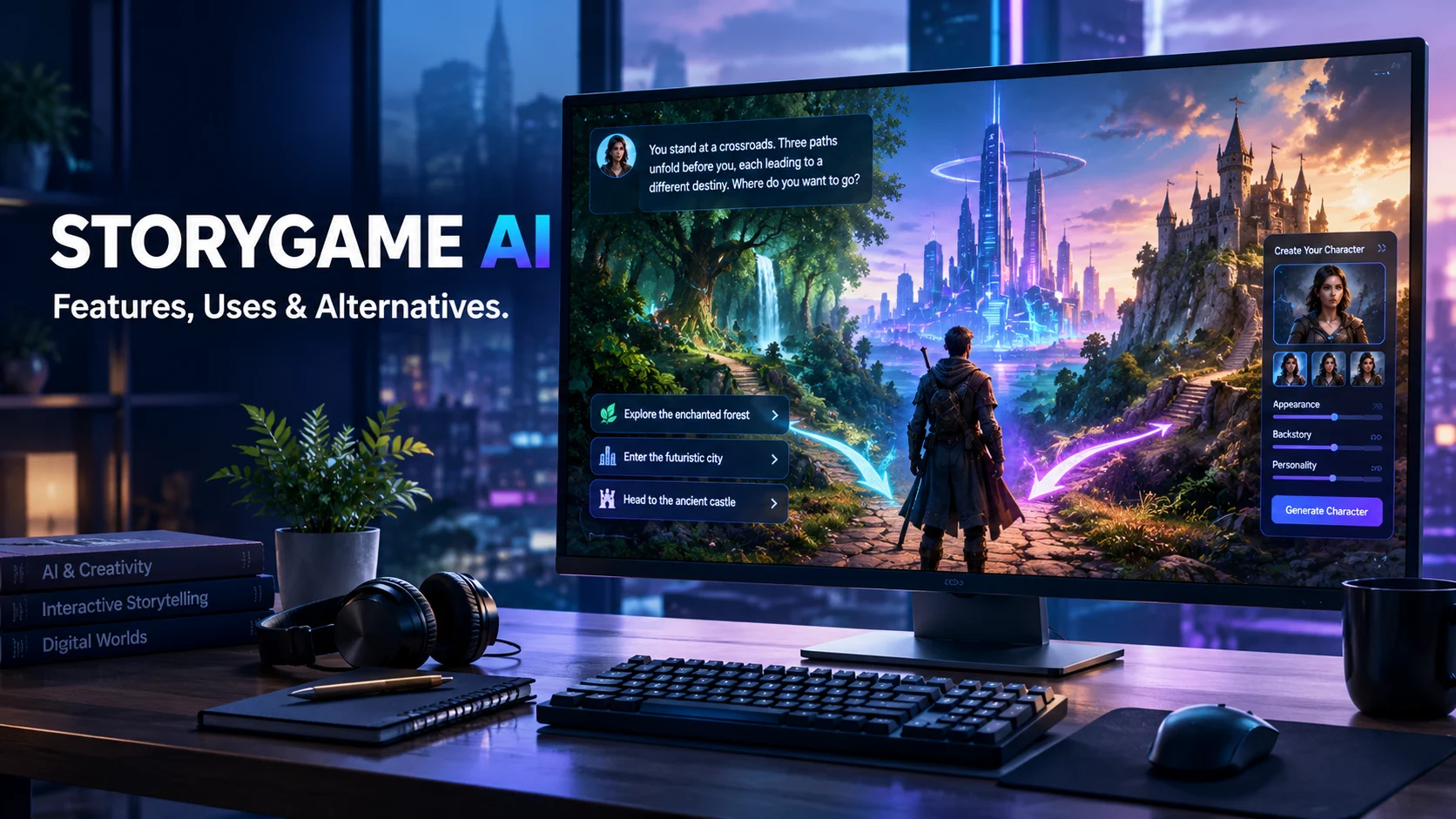
Storygame AI refers to AI-powered interactive storytelling experiences that let users create characters, explore fictional worlds, and influence narratives through their choices. The name also appears across different products, so users should distinguish the StorygameAI website from Buildbox’s separate StoryGames AI game-creation feature before choosing a platform.
At a Glance
- Main purpose: Create or experience interactive stories with AI-assisted characters and branching narratives.
- StorygameAI website: storygameai.com presents character creation, interactive scenes, story choices, and saved characters or unfinished stories.
S…
- Separate product: Buildbox StoryGames AI helps users generate visual-novel-style games with story chapters, artwork, and player choices.
Video Game Software+1
- Best-fit audience: People who enjoy creative writing, role-playing, fantasy adventures, and choice-based storytelling.
- Main limitation: Generated dialogue and plot developments may require guidance, editing, or a fresh attempt to achieve the desired result.
- Before using it: Check the current access requirements, pricing, content rules, and privacy terms for the exact product you intend to use.
What Is Storygame AI?
Storygame AI is a term associated with interactive experiences in which artificial intelligence helps create or advance a fictional story. Instead of simply reading a completed narrative, users can influence events by choosing actions, interacting with characters, or defining a story’s setting.
The experience combines elements of interactive fiction, role-playing games, conversational AI, and branching narratives. Depending on the platform, users may create their own characters, start with an existing scenario, or generate a visual novel from a story idea.
However, StorygameAI and Buildbox StoryGames AI should not be treated as the same product.
The website at storygameai.com describes a character-centered experience where users create AI personas, enter scenes, make choices, and return to saved stories.
By comparison, Buildbox’s official documentation describes StoryGames AI as a feature for generating visual-novel-style games within its game-development ecosystem. Its documented workflow includes story chapters, generated artwork, interactive options, and editing tools.
This distinction matters because the products serve different needs. Someone looking for an interactive story to play may prefer a character-based experience, while someone developing a game may need a visual editor and export options.
How Does Storygame AI Work?
AI storytelling tools typically combine a language model with instructions about characters, settings, plot events, and the user’s latest action. The model uses this context to generate dialogue or narrative text that fits the ongoing scene.
The precise architecture of storygameai.com is not publicly established by the website information reviewed here. The following explanation describes the general technology behind AI-driven storytelling rather than claiming to reveal that platform’s internal implementation.
1. Define a character or story idea
The process often starts with a premise. You might create a detective investigating a missing artifact, a wizard protecting an ancient kingdom, or a space explorer discovering an abandoned station.
A useful character description includes:
- Name and role
- Personality and motivations
- Background and relationships
- Setting and genre
- Speaking style and behavioral boundaries
Specific details give the AI a stronger foundation than a vague instruction such as “make an interesting story.”
2. Enter an interactive scene
Once a scenario begins, the user interacts with the story through dialogue, choices, or other available controls.
For example, a detective might discover a locked room. The player could question a witness, search for clues, or follow a suspicious figure. Each action gives the storytelling system new information to use.
The result may feel more flexible than a conventional story with fixed dialogue, although the degree of freedom depends on the product.
3. Generate the next narrative response
A generative AI model predicts a suitable continuation based on the supplied instructions and available conversation history.
It can produce descriptions, character dialogue, possible consequences, and new plot developments. However, plausible writing does not automatically guarantee consistent world-building or logical consequences.
4. Maintain story continuity
Longer adventures require the system to retain important details. These might include the protagonist’s goals, previous decisions, character relationships, discovered objects, and unresolved mysteries.
A platform may preserve context through conversation history, summaries, structured game state, or retrieval systems. The specific method used by StorygameAI has not been independently verified.
When continuity matters, users should check whether the product reliably preserves information between sessions.
Key Features of Storygame AI
The following features are based on the publicly presented experience at storygameai.com, not an assumption that every AI story platform offers identical functionality.
AI character creation
The website presents a character-creation workflow built around details such as name, role, world, and tone. It also displays example personas from fantasy, cyberpunk, exploration, and other fictional settings.
This approach can help users develop characters without writing every line of dialogue in advance.
Branching interactive stories
Branching storytelling lets users influence what happens next. Instead of following only one predetermined route, the narrative can respond to choices and actions.
The meaningful question is whether those choices change subsequent events or merely produce different wording. Strong interactive design connects decisions to consequences, character development, or new information.
Reusable characters and unfinished stories
StorygameAI presents options for keeping favorite characters and returning to unfinished stories.
These features can support longer creative sessions. However, the public presentation alone does not establish how much history is retained, how saving works across devices, or whether account registration is required.
Multiple fictional settings
The example characters shown on the website suggest possible uses in fantasy, science fiction, mystery, and adventure.
Users can explore different genres or build a setting around a particular idea. Actual customization limits and available content categories should be checked directly.
Creative control
AI can suggest plot developments, but the user should remain responsible for the story’s direction. Clear instructions, consistent character descriptions, and deliberate choices can improve the experience.
A useful platform gives users enough control to redirect an uninteresting scene without requiring them to restart the entire adventure.
Main Use Cases for Storygame AI
The value of an AI storytelling tool depends on what you want to create or experience.
Interactive entertainment
Players can explore fictional worlds, test different decisions, and discover alternative story developments. This format suits people who enjoy narrative games but want more flexibility than a conventional, fixed storyline.
Creative writing and brainstorming
Writers can use AI characters to test dialogue, explore conflicts, and develop possible plot directions. For example, a writer developing a fantasy novel could role-play a conversation between a reluctant hero and an unreliable mentor.
The output should be treated as a creative draft, not automatically as finished prose.
Role-playing and character development
Role-playing enthusiasts can experiment with character personalities, fictional relationships, and imaginary situations. A clearly defined character brief can make these sessions more consistent and engaging.
Prototyping narrative games
Independent game creators can use AI-generated scenes and dialogue to explore ideas before investing in a full production.
For a more structured visual-novel workflow, Buildbox StoryGames AI is the more directly relevant product. Its documentation describes generating a ten-chapter game and then editing scenes, artwork, and decision paths.
Benefits of Storygame AI
AI-powered storytelling offers several practical advantages, particularly during early creative exploration.
- Faster experimentation: Test several story premises without writing every scene manually.
- Interactive experiences: Influence character dialogue and narrative direction through your decisions.
- Creative flexibility: Explore different genres, personalities, and hypothetical situations.
- Lower entry barriers: Beginners can experiment with storytelling without first learning a full game-development workflow.
- Reusable ideas: Character profiles and saved stories can help organize ongoing creative projects where the platform supports them.
- Rapid prototyping: Writers and developers can identify promising concepts before committing to detailed production.
These benefits are potential advantages of the format, not guarantees that every generated story will be original, coherent, or enjoyable.
Limitations and Potential Problems
AI storytelling is creative, but it still has technical and editorial limitations.
Inconsistent character behavior
A character may act differently from one scene to the next. A cautious detective might suddenly reveal a secret, or a loyal companion might forget an earlier promise.
To reduce this problem, define a character’s motivations, knowledge, personality, and boundaries before starting. Restate critical details when necessary.
Repetitive dialogue and predictable plots
Generative models sometimes reuse familiar expressions, repeat information, or introduce conventional plot twists. Longer sessions can become repetitive if the system lacks meaningful story-state management.
Give the AI specific objectives for each scene. Ask it to introduce a new clue, create a meaningful conflict, or develop an existing relationship rather than simply continuing indefinitely.
Limited control over the final result
A generated scene may not match your intended tone or direction. You might need to revise the prompt, regenerate a response, or redirect the story.
If you are creating a game for other people, human editing and playtesting remain important.
Unclear technical transparency
The public-facing information reviewed for storygameai.com does not establish which language model powers the experience, how large its context window is, or whether it uses retrieval-augmented generation (RAG).
RAG is a technique that retrieves relevant information before a model generates a response. It can help a system use a defined knowledge base, but its presence should not be assumed without evidence.
Likewise, there is no verified basis here for comparing StorygameAI’s model quality, response speed, or inference costs with specific providers.
Storygame AI Pricing: Is It Free?
The pricing status of storygameai.com could not be independently confirmed from the available public information. Check the official website for any current free access, subscription plans, account requirements, or usage restrictions before committing.
It is particularly important to distinguish this website from Buildbox StoryGames AI, which is part of a separate product ecosystem.
Buildbox’s official pricing pages list different Classic plans with varying story-game creation allowances and export capabilities. The published plan information has changed over time, so the price and allowances displayed at checkout should take precedence over older articles.
Before paying for any AI story tool, check the following:
- Whether free access has a daily or monthly generation limit.
- Whether paid plans impose character, message, or story limits.
- Whether unused credits expire.
- Whether saving, exporting, or publishing requires an upgrade.
- Whether a subscription renews automatically.
- Whether cancellation affects saved stories or exported projects.
Do not assume that an unlimited story-generation claim means unlimited access to every feature.
Privacy and Security: What Should Users Check?
AI storytelling can involve personal writing, fictional conversations, and unpublished creative ideas. Those inputs deserve consideration even when the activity appears casual.
For storygameai.com, the available evidence reviewed here was insufficient to verify specific data-retention periods, model-training practices, encryption standards, or security certifications.
That does not establish that the platform is unsafe. It means those claims should remain unverified until supported by its current privacy documentation.
Before using the service, review these questions:
- Conversation storage: Are chats saved, and can you delete them?
- Training practices: Can submitted prompts or conversations be used to improve AI models?
- Third-party processing: Does the service share data with external AI providers or other processors?
- Account security: What account protections and recovery options are available?
- Age and content rules: What restrictions apply to younger users and sensitive fictional content?
- Creative ownership: What rights do you retain over your stories, characters, and generated material?
Avoid entering passwords, confidential business information, personal identifiers, or private details about other people into an AI storytelling service unless its data practices support that use.
Storygame AI vs. Alternatives
Different platforms serve different purposes. A character-based story experience is not necessarily interchangeable with a game engine or a general-purpose writing assistant.
The following comparison identifies relevant alternatives by use case. Features and commercial terms should be checked on each provider’s official website.
| Platform or tool | Target user | Key strength | Pricing transparency | Main limitation |
|---|---|---|---|---|
| StorygameAI | Interactive story players | Character creation and branching scenes | Current terms not verified | Limited independently verified technical details |
| Buildbox | No-code game creators | Visual-novel generation, editing, and game exports | Official pricing pages available | More involved than simply playing a story |
| FicMachine | Interactive fiction fans | AI-assisted story continuation and community scenarios | Check the current project page | Different interface and feature set |
| Narraive | Casual story gamers | AI-generated interactive stories and imagery | Check current access terms | Not a direct substitute for a full game editor |
| Hakawati | Technical role-playing enthusiasts | Story modes, scenario building, and support for compatible model endpoints | Software is listed as free and open-source; model costs may vary | Setup and model configuration can require technical knowledge |
Sources for the alternative descriptions include the respective project listings and official Buildbox documentation.
Which alternative should you choose?
- Choose StorygameAI if you want to explore the character-centered experience presented on its website.
- Choose Buildbox if your goal is to create, customize, and export a visual-novel-style game.
- Explore FicMachine if you prefer interactive fiction built around AI-assisted story continuation.
- Consider Narraive if you want to explore AI-generated narratives with visual elements.
- Consider Hakawati if you want more control over the model provider or prefer experimenting with compatible local and cloud models.
These are use-case recommendations, not a ranking based on independently verified performance benchmarks.
Who Should Use Storygame AI?
Storygame AI may suit several types of users.
Casual gamers can explore interactive adventures without committing to a long conventional game.
Writers and storytellers can test dialogue, character motivations, and alternative plot directions.
Role-playing enthusiasts can experiment with fictional personas and evolving scenes.
Beginner creators can explore AI-assisted storytelling before learning more complex development tools.
Professional game developers may find the format useful for prototyping, but should assess narrative control, integration options, licensing, reproducibility, and production costs before using generated content in a commercial release.
If you need precise narrative control, reliable multiplayer mechanics, advanced game-state systems, or predictable dialogue for a shipped product, a dedicated game engine and a carefully designed narrative system may be more appropriate.
How to Get Better Results from Storygame AI
The quality of an interactive story depends partly on how clearly you define the experience.
Start with a focused premise
Instead of asking for a fantasy adventure, try a more specific setup:
Create a mystery story set in a remote mountain hotel during a snowstorm. My character is a skeptical journalist investigating a missing guest. Use atmospheric descriptions, realistic dialogue, and meaningful choices. Keep the central mystery unresolved until enough clues have appeared.
This gives the AI a setting, a protagonist, a goal, a tone, and a pacing requirement.
Establish rules for important characters
Describe what characters know, what they want, and how they behave under pressure. Include details that should remain consistent throughout the story.
For example, a character might be distrustful of strangers but fiercely protective of their younger sibling. This creates a useful behavioral constraint rather than just a superficial personality label.
Make choices consequential
Ask for choices that reflect different strategies, risks, or values. A good decision might reveal a clue while damaging a relationship, or protect an ally while allowing a suspect to escape.
Choices become more interesting when they change the situation rather than merely changing the next sentence.
Correct continuity problems early
If a character forgets a critical event, restate the relevant fact and ask the system to continue from the correct situation.
For a longer project, maintain a separate story bible containing character details, timelines, locations, rules, and unresolved plot points. This is useful even if the platform offers its own saving features.
Review content before publishing
AI-generated material may contain factual errors, accidental similarities to existing works, inconsistent characterization, or unsuitable content. Review the output before using it in a public game, commercial project, or classroom setting.
Human judgment remains essential when originality, quality, and audience expectations matter.
Frequently Asked Questions
1. What is Storygame AI used for?
Storygame AI is used for interactive storytelling, AI-assisted character creation, role-playing, and branching narrative experiences. Depending on the specific product, it may also support creating visual-novel-style games.
2. Is StorygameAI the same as Buildbox StoryGames AI?
No. Storygameai.com presents a character-based interactive storytelling experience, while Buildbox StoryGames AI is a separate game-creation feature documented within the Buildbox ecosystem.
3. Is Storygame AI free to use?
The current pricing and access requirements of storygameai.com could not be verified from the available information. Check the official website for current plan details, usage limits, and any payment requirements.
4. Can Storygame AI create a complete video game?
AI storytelling can help generate narrative content, but a complete game may also require gameplay mechanics, interface design, testing, asset management, and publishing. Buildbox documents a workflow for generating and editing visual-novel-style games, but users should confirm current capabilities and export requirements.
5. Is Storygame AI safe for private stories?
Its specific privacy and data-retention practices were not independently verified in this review. Read the platform’s current privacy policy before sharing sensitive information or unpublished material.
Conclusion
Storygame AI sits at the intersection of interactive fiction, generative AI, and character-driven entertainment. Its appeal lies in letting users participate in a story instead of merely reading a predetermined narrative.
The most important step is choosing the correct product. StorygameAI is presented as a character-centered storytelling website, whereas Buildbox StoryGames AI focuses on generating and editing visual-novel-style games.
For casual players and creative writers, interactive storytelling can be a useful way to explore ideas. For developers and commercial creators, narrative consistency, licensing, export options, privacy, and ongoing costs deserve closer examination.
Before signing up or paying, verify the product’s current features and terms, then test a short story to see whether its output matches your expectations.

Oliver Wilson is an AI researcher and tech writer living at the intersection of human creativity and machine intelligence. At AixOrbit.com, he decodes complex neural networks, generative AI and emerging tech trends into actionable insights making sure humans stay one step ahead of the algorithms.