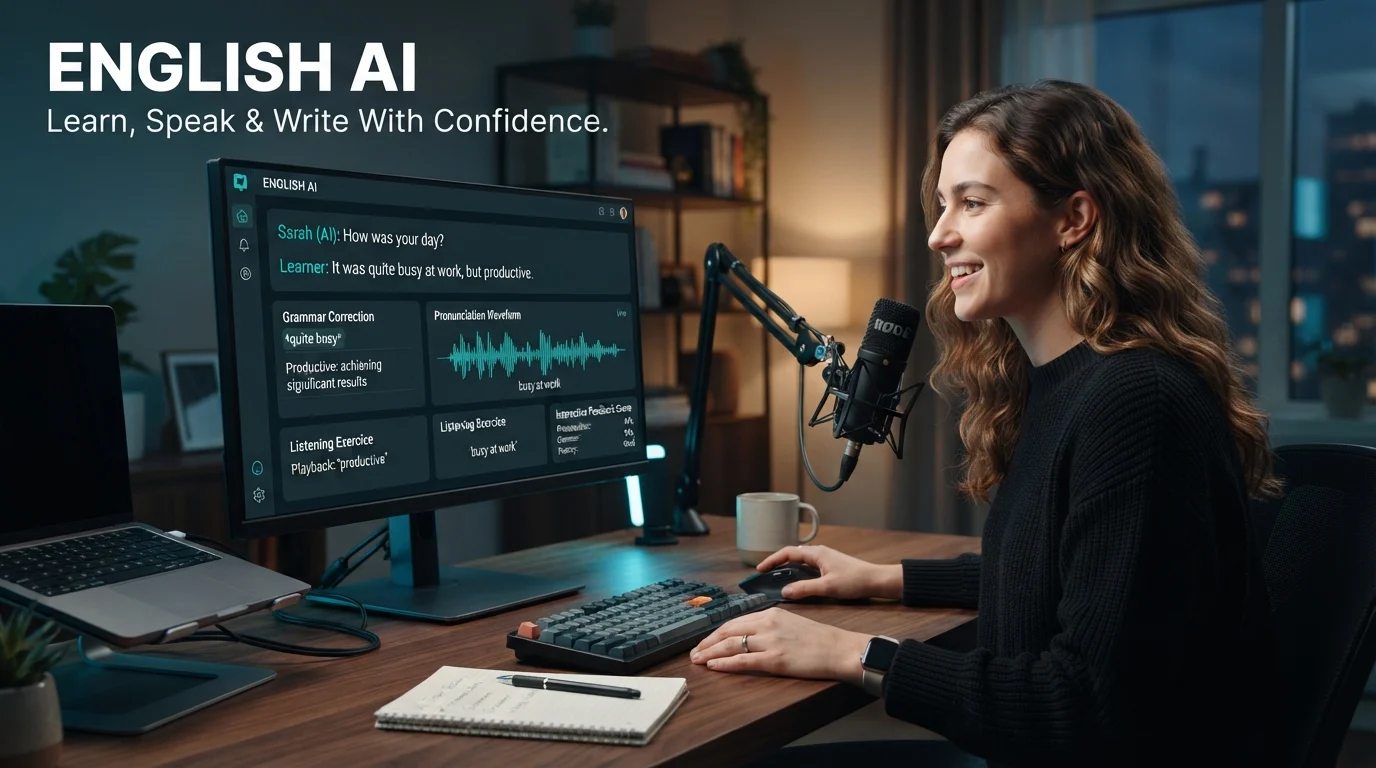
English AI refers to artificial intelligence tools that help people learn English, improve grammar, practice conversations, write clearly, and build vocabulary. These tools use technologies such as language models and speech recognition to provide feedback, explanations, translations, and interactive practice.
At a Glance
- Main purpose: Improve English speaking, writing, reading, listening, and grammar.
- Common tools: AI tutors, grammar checkers, translation tools, pronunciation assistants, and conversational chatbots.
- Best use: Combine AI practice with reading, listening, speaking, and regular writing.
- Key benefit: Receive explanations and practice tailored to your current level.
- Main limitation: AI can make grammatical, factual, and pronunciation-related mistakes.
- Privacy tip: Avoid sharing confidential documents or sensitive personal information with learning tools.
What Is English AI?
English AI describes the use of artificial intelligence to learn, understand, write, speak, or teach the English language. It includes dedicated language-learning applications, general-purpose AI assistants, writing tools, speech technologies, and translation systems.
Unlike a traditional dictionary or grammar book, an AI-powered tool can respond to a specific question. It can explain why a sentence sounds unnatural, suggest alternative vocabulary, generate exercises, or simulate a conversation.
For example, a learner might enter the sentence “He go to school every day.” An AI tutor can identify the subject-verb agreement error, correct the sentence to “He goes to school every day,” and explain the grammar rule.
English AI can support beginners, students, professionals, teachers, and people preparing for English-language examinations. However, different tools specialize in different tasks, so choosing one depends on your learning goals.
How Does English AI Work?
English AI tools combine several technologies to understand language and generate useful responses. The exact technology varies by application.
1. Natural language processing
Natural language processing, or NLP, helps computers analyze and work with human language. It supports tasks such as identifying grammatical patterns, recognizing sentence structure, classifying text, and extracting meaning.
An English learning application may use NLP to identify a spelling error, recognize a question, or determine whether a sentence follows a particular grammatical pattern.
2. Large language models
Large language models, commonly called LLMs, generate text based on patterns learned during training. They can explain grammar, suggest synonyms, rewrite sentences, and conduct simulated conversations.
Their flexibility makes them useful for open-ended learning. However, fluent responses are not always correct, so learners should verify important explanations.
3. Speech recognition and text-to-speech
Speech recognition converts spoken language into text. English speaking applications can use it to interpret a learner’s response and provide feedback.
Text-to-speech technology converts written text into spoken audio. It can help learners hear word pronunciation, sentence rhythm, and examples of natural conversation.
Some tools also estimate pronunciation quality. These scores should be treated as guidance rather than perfect measurements of speaking ability.
4. Adaptive learning
Some language-learning systems adjust exercises based on a learner’s answers, progress, or performance history.
A beginner may receive basic vocabulary exercises, while an advanced learner may practice professional presentations or complex sentence structures. The quality of this personalization depends on the application’s design and the information it collects.
What Can You Do With English AI?
English AI is useful for more than correcting grammar. The most effective approach is to choose exercises that address a specific weakness.
Improve English speaking
Conversational AI lets learners practice everyday situations without arranging a lesson with another person.
You can simulate a job interview, ask for directions, practice ordering food, or explain your opinion about a topic. After each conversation, ask for corrections and more natural ways to express your ideas.
For example, try this prompt:
Act as my English conversation tutor. Ask me one question at a time about daily life. Correct important grammar mistakes, explain them in simple English, and give me a more natural version of each answer.
Speaking aloud is especially important. Reading AI responses alone will not build the same skills as actively forming sentences and responding to questions.
Learn grammar and sentence structure
AI grammar assistants can explain common errors involving tenses, articles, prepositions, word order, and subject-verb agreement.
Instead of asking only for a correction, ask the tool to explain the rule and provide additional examples. This encourages understanding rather than dependence on automatic rewriting.
Consider the difference:
- Incorrect: “I am living here since 2020.”
- Correct: “I have been living here since 2020.”
- Explanation: Use the present perfect continuous for an activity that began in the past and continues into the present.
English grammar includes exceptions and differences between dialects. When an explanation seems questionable, compare it with a trusted grammar reference.
Improve writing and vocabulary
English AI can help with emails, essays, reports, presentations, and professional messages.
Useful tasks include:
- Correcting spelling and punctuation.
- Replacing vague words with precise alternatives.
- Simplifying complicated sentences.
- Adjusting tone for formal or informal communication.
- Explaining collocations, idioms, and phrasal verbs.
- Identifying repetitive language.
For vocabulary practice, ask for the meaning, pronunciation, common collocations, and two example sentences for each new word.
Avoid accepting a rewritten paragraph without reviewing it. Your original meaning, personal voice, and intended tone should remain intact.
Practice listening and pronunciation
Speech-enabled tools can combine spoken input with spoken responses. This makes them useful for practicing listening comprehension and conversational timing.
Dedicated pronunciation applications may analyze individual sounds, stress, intonation, or fluency. ELSA Speak, for example, describes its use of speech recognition to provide pronunciation feedback.
ELSA Speak FAQs
+1
For better results, repeat short recordings, compare your speech with the reference, and practice difficult sounds in complete sentences.
Remember that pronunciation scores are estimates. They should help you communicate more clearly, not pressure you to erase your natural accent.
Prepare for exams and interviews
AI can generate practice questions, writing prompts, vocabulary exercises, and mock interviews. It can also help you organize an answer and identify areas that need further work.
For IELTS, TOEFL, or another formal examination, use official preparation materials to verify the test format and assessment criteria. AI-generated scores are not official exam results.
English AI Tools Compared
Several established products offer different approaches to English learning. The following comparison focuses on their documented purposes rather than declaring one universal winner.
Best for flexible practice
Use it for grammar explanations, vocabulary, writing feedback, role-play, and spoken conversation. Voice features support natural spoken exchanges, although availability depends on the account and interface.
OpenAI Help Center
Pricing: Free and paid options may be available; check the current plan details.
Duolingo
Best for structured lessons
Duolingo combines guided language lessons with game-like exercises. Its AI-supported features have included conversational practice and explanations, with availability depending on the course and subscription.
Duolingo Blog
+1
Pricing: Free and paid plans; AI features may require an eligible subscription.
ELSA Speak
Best for pronunciation practice
Its speech-recognition tools provide feedback on pronunciation and related speaking skills. AI role-play features can also support practice in everyday and professional scenarios.
ELSA Speak
+1
Pricing: Free access and paid options may be available; check current regional terms.
Grammarly
Best for editing written English
Grammarly focuses on writing assistance, including grammar, clarity, and tone. It is particularly relevant to people who already write in English and want to improve their drafts.
Pricing: Free and paid offerings; confirm current feature limits before subscribing.
These products serve overlapping but different needs. A conversational assistant offers flexibility, a structured learning app provides guided practice, and a writing assistant focuses on written communication.
Free English AI Tools and Learning Resources
You do not need to pay for an AI tutor immediately. Several free resources can help you build a strong learning routine.
- Cambridge Dictionary: Check word meanings, example sentences, grammar explanations, and pronunciation.
Cambridge Dictionary+1
- Cambridge Write & Improve: Practice writing and receive automated feedback through a tool developed by Cambridge English.
Cambridge English
- ChatGPT: Use a suitable available plan for interactive grammar lessons, role-play, and writing practice.
- Duolingo: Explore its available free lessons and structured exercises.
- ELSA Speak: Check the free features available for pronunciation and speaking practice.
Free access does not always include every feature. Limits may apply to AI conversations, lesson availability, daily usage, and advanced feedback.
How to Choose the Right English AI Tool
The best choice depends on your current English level, learning goals, preferred learning style, and budget.
| Your goal | Suitable tool type | What to evaluate |
|---|---|---|
| Learn basic English | Structured learning app | Beginner lessons, explanations, and repetition |
| Speak more confidently | Conversational AI tutor | Voice interaction and useful corrections |
| Improve pronunciation | Speech analysis app | Sound-level feedback and accent options |
| Write better essays | Writing assistant | Grammar explanations and clarity suggestions |
| Prepare for IELTS | Exam-focused practice tool | Relevant question formats and assessment criteria |
| Improve workplace English | General AI assistant or business course | Professional vocabulary and realistic role-play |
| Learn new words | Dictionary and vocabulary app | Examples, audio, and spaced repetition |
Before subscribing, test the product with a task you regularly need. For example, ask it to correct a short paragraph, explain three errors, and generate a follow-up exercise.
A useful tool should help you understand your mistakes rather than simply produce polished answers.
Limitations of English AI
AI can make language learning more accessible, but it cannot replace every part of human communication or formal instruction.
Incorrect explanations
An AI tutor may give an incomplete grammar explanation or suggest a sentence that changes your intended meaning. Check important rules against trusted references, particularly when preparing academic work or formal documents.
Limited understanding of context
A sentence can be grammatically correct but inappropriate for a particular situation. Humor, politeness, regional expressions, cultural context, and professional etiquette may require more than a simple grammar check.
Pronunciation differences
Speech recognition can struggle with background noise, unfamiliar accents, and certain speech patterns. A pronunciation score should not be treated as a definitive measure of your ability to communicate.
Overdependence on corrections
If you ask AI to rewrite every sentence, you may become better at producing edited text without becoming better at writing independently.
To avoid this, write your own answer first. Review the corrections, explain the rules in your own words, and then attempt a similar exercise without assistance.
Privacy and data protection
Some learning tools process conversations, voice recordings, documents, or learning histories. Their practices differ, so read the relevant privacy policy before sharing personal or confidential information.
For students and teachers, this is particularly important when prompts include school records, examination material, or identifiable student information.
A Practical Daily English AI Study Plan
A short, consistent routine can help you practice different language skills without spending hours on a single application.
5 minutes: Vocabulary
Learn five words and write an original sentence for each.
10 minutes: Speaking
Discuss one everyday topic with a voice-enabled tutor or practice aloud.
5 minutes: Writing
Write a short paragraph, request feedback, and correct your mistakes.
5 minutes: Review
Revisit errors from previous sessions and write the corrected examples from memory.
Total study time: 25 minutes per day.
This routine is a practical starting point, not a guarantee of a particular learning outcome. Adjust it to your level and spend more time on your weakest skill.
Common Mistakes When Using English AI
Avoid these habits to get more value from AI-powered language learning.
- Using vague prompts: Specify your level, goal, and the kind of feedback you need.
- Memorizing every correction: Focus on recurring errors and the rules behind them.
- Practicing only reading: Include speaking, listening, and writing in your routine.
- Trusting every answer: Verify important grammar explanations and exam-related guidance.
- Ignoring natural usage: Ask for examples from everyday conversations, not just formal textbook sentences.
- Choosing too many tools: Start with one main tutor and one reliable reference resource.
- Skipping independent practice: Try to answer questions before requesting hints or corrections.
The most useful English AI workflow is interactive. You produce language, receive feedback, understand the correction, and try again.
Frequently Asked Questions About English AI
1. What is the best AI tool for learning English?
The right tool depends on your goal. Conversational AI assistants are useful for flexible practice, structured learning apps support daily lessons, pronunciation tools provide speech feedback, and writing assistants help refine grammar and clarity.
2. Can I learn English with AI for free?
Yes. Free AI access and learning resources can help you practice vocabulary, grammar, writing, and conversation. Some applications limit advanced features, voice interactions, or daily usage, so check their current plans before relying on a particular feature.
3. Can English AI improve my speaking skills?
English AI can provide conversation practice, vocabulary suggestions, and feedback on spoken responses when voice features are available. However, your progress also depends on regular practice, listening to natural English, and applying what you learn in real conversations.
4. Which English AI tool is best for beginners?
Beginners may benefit from a structured learning app combined with an AI tutor that explains mistakes in simple language. Start with everyday vocabulary, basic grammar, and short conversations before moving to advanced writing or complex discussions.
5. Is AI better than a human English teacher?
AI provides convenient practice and quick feedback, while human teachers can offer richer contextual guidance, assess individual needs, and respond to subtle communication difficulties. Combining AI practice with human instruction can be useful, particularly when preparing for important examinations or professional communication.
Conclusion
English AI uses artificial intelligence to make language learning, speaking practice, grammar correction, and writing support more interactive. It can help beginners build confidence and allow advanced learners to refine specific skills.
The key is choosing a tool that matches your goals, checking its feedback, and practicing consistently. Start with a simple routine, use reliable language references, and treat AI as a learning assistant rather than a replacement for independent thinking or real conversation.

Oliver Wilson is an AI researcher and tech writer living at the intersection of human creativity and machine intelligence. At AixOrbit.com, he decodes complex neural networks, generative AI and emerging tech trends into actionable insights making sure humans stay one step ahead of the algorithms.