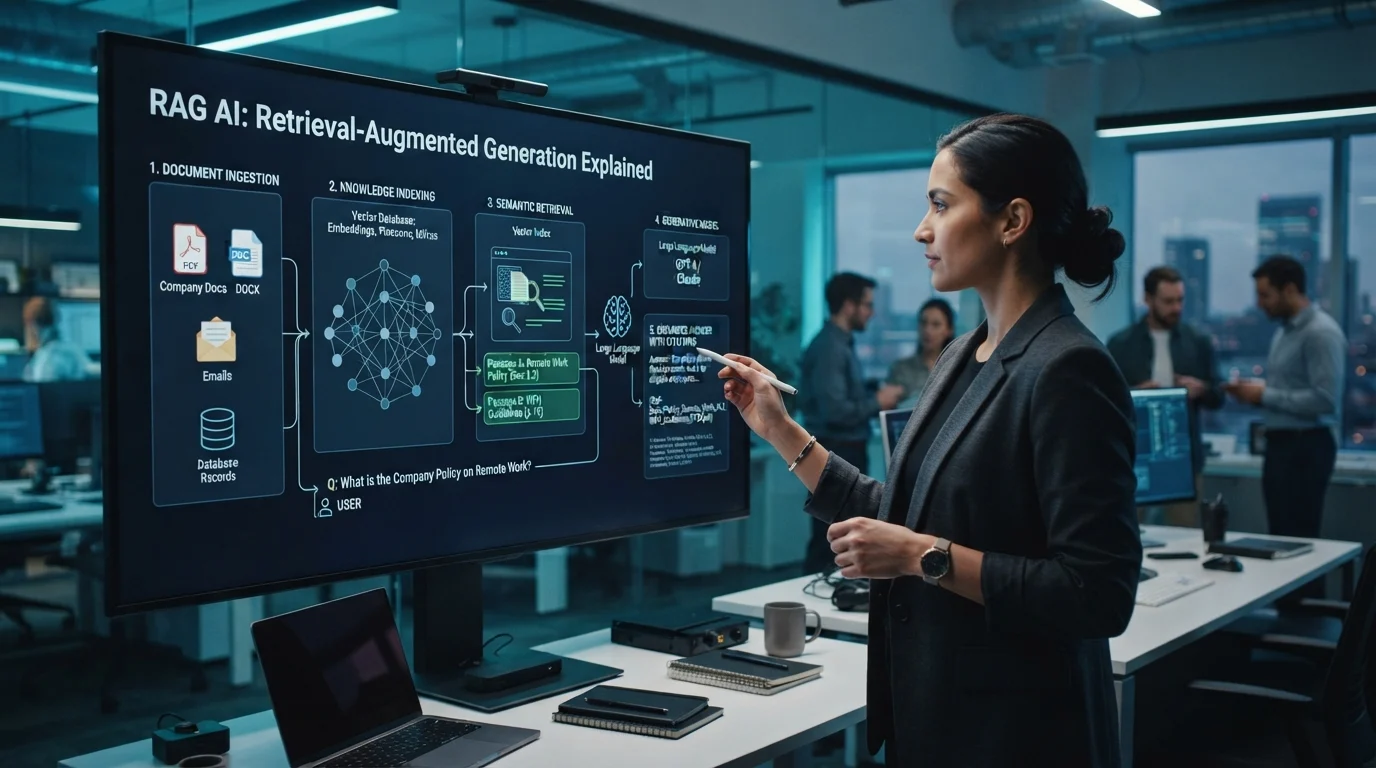
RAG AI, or retrieval-augmented generation, combines a language model with a retrieval system that finds relevant information from external sources before generating an answer. It helps AI applications use current or private knowledge more effectively, but answer quality still depends on retrieval accuracy, source quality, and how the model uses the evidence.
At a Glance
- Meaning: RAG stands for retrieval-augmented generation.
- Purpose: Connect an AI model to relevant documents, databases, and other knowledge sources.
- How it works: Retrieve information, add it to the model’s context, and generate a grounded response.
- Main benefit: Answers can reflect selected information without retraining the model for every content update.
- Common uses: Enterprise search, customer support, document analysis, and internal knowledge assistants.
- Key limitation: RAG cannot guarantee accuracy if the retrieved information is incomplete, outdated, or misinterpreted.
What Is RAG AI?
RAG AI is an architecture that combines information retrieval with generative artificial intelligence. Instead of relying only on knowledge learned during training, a large language model (LLM) receives relevant information retrieved from an external knowledge source when answering a question.
The term retrieval-augmented generation describes the three central ideas:
- Retrieval: Find information relevant to the user’s question.
- Augmentation: Add the retrieved information to the model’s input.
- Generation: Use the model to produce a response informed by that information.
Imagine a company employee asking an AI assistant about its parental leave policy. A standard chatbot might provide a generic explanation based on its training. A RAG-powered assistant can search the company’s current policy documents and use the relevant passage to answer the question.
This makes RAG especially useful when answers depend on company-specific, frequently updated, or specialized information.
RAG is not a single AI model or a standalone chatbot. It is a system design that connects a retrieval mechanism, a knowledge source, and a language model.
How Does RAG AI Work?
A RAG application typically follows a pipeline with two stages: preparing the knowledge base and answering user questions.
The RAG workflow
1. Collect and prepare data
Documents, FAQs, databases, manuals, and approved web content
2. Split, embed, and index
Create searchable text chunks and store retrieval representations
3. Receive a user question
Interpret the request and prepare a search query
4. Retrieve relevant evidence
Search the index and select useful passages
5. Generate a grounded answer
Provide the evidence to the LLM with instructions to answer appropriately
6. Return the response
Present the answer and, where supported, source citations
Actual implementations vary. Some search multiple indexes, rerank results, query databases, or repeat retrieval when the first search does not provide enough evidence.
Step 1: Collect and prepare knowledge
The system connects to the sources it is allowed to search. These might include PDF files, product documentation, help-center articles, internal wikis, database records, or approved websites.
The preparation stage often includes extracting text, removing irrelevant formatting, preserving metadata, and handling duplicate documents. Poor extraction can damage the quality of every answer that follows.
Step 2: Split documents into chunks
Large documents are often divided into smaller sections called chunks. Each chunk becomes a unit that the retrieval system can search and return.
Chunk size affects the results. Very small chunks may lose context, while very large chunks can contain irrelevant information and consume more of the model’s context window.
Some systems use overlapping chunks or structure-aware splitting to preserve relationships between headings, paragraphs, and tables.
Step 3: Create embeddings and an index
An embedding is a numerical representation of text that captures aspects of its meaning. Embeddings allow a system to search for passages that are semantically related to a question, even when the wording differs.
For example, a query about “parental leave” may retrieve a passage titled “Family Care Benefits.” The terms are different, but their meanings are related.
The resulting vectors can be stored in a vector database or another retrieval index. Not every RAG system uses vector search alone. Many combine semantic search with traditional keyword search.
Step 4: Retrieve relevant information
When a user asks a question, the system searches its knowledge base and selects candidate passages.
Retrieval quality depends on the query, the indexing method, document quality, metadata, and ranking strategy. A system may retrieve several passages, then use a reranker to identify the most relevant evidence.
This step is crucial. If the system retrieves the wrong policy or misses an important qualification, the language model may produce a convincing but incorrect answer.
Step 5: Generate the answer
The application adds the retrieved passages to the prompt sent to the LLM. Instructions can tell the model to use those sources, acknowledge uncertainty, and avoid unsupported claims.
The model then generates a natural-language response based on the question and available context.
RAG can make answers better grounded, but it does not eliminate hallucinations. The model may misread evidence, combine conflicting statements, or answer beyond what the sources support.
Step 6: Present citations and evaluate results
A well-designed RAG application may show the documents or passages behind an answer. This helps users verify the response and locate the original information.
However, citations must be linked to the actual evidence used. A citation that merely points to a related document does not prove that the answer accurately represents it.
Developers should test both retrieval quality and final answer quality before deploying a RAG system.
RAG AI Use Cases and Real-World Examples
RAG is most valuable when a system needs to answer questions using information that a general-purpose model may not know or cannot reliably recall.
Enterprise knowledge assistants
Companies store information across policy documents, internal wikis, shared drives, and project systems. Employees often struggle to find the correct document or identify the latest version.
A RAG assistant can search approved internal sources and summarize the relevant passages. With appropriate permission checks, it can provide answers tailored to the user’s authorized access.
Example: An employee asks, “What expenses can I claim for international travel?” The system retrieves the current travel policy, identifies the reimbursement rules, and returns an answer with links to the relevant sections.
Customer support automation
Support teams can use RAG to connect an LLM to product manuals, troubleshooting guides, warranty terms, and approved help-center articles.
This can help an assistant explain a procedure using the company’s own documentation rather than generating a generic response. A well-designed system can also escalate questions when it cannot find adequate evidence.
Example: A customer asks how to reset a router. The assistant retrieves the instructions for the correct model and provides the relevant steps.
Document analysis and research
RAG can help users search collections of reports, research papers, contracts, and technical manuals. It can retrieve passages related to a question and summarize what the documents say.
For research workflows, source attribution is essential. Users should be able to inspect the original passage and distinguish direct evidence from the model’s interpretation.
E-commerce product discovery
A product assistant can retrieve specifications, inventory details, compatibility notes, and return policies. It can then answer questions using the available product information.
For example, a customer might ask which laptop supports a particular docking station. The system should retrieve compatibility information rather than infer compatibility from general product knowledge.
Healthcare and other specialized fields
RAG can support searches across approved clinical references, internal procedures, and technical documentation. However, retrieval alone does not make a system clinically validated or suitable for autonomous medical decisions.
In regulated or high-stakes environments, deployments need domain-specific evaluation, appropriate access controls, human oversight, and clear limits on how generated answers may be used.
Benefits of RAG AI
RAG offers several practical advantages when implemented with appropriate data and evaluation methods.
Access to specialized or updated information
A model’s training does not automatically include a company’s latest documents. RAG can retrieve newly indexed information without requiring the base model to be retrained each time a document changes.
This depends on the ingestion and indexing process. If the source changes but the index does not refresh, the system may still retrieve outdated information.
Better grounding and traceability
Retrieved evidence gives the model relevant material to work from. When the application includes reliable citations, users can inspect the underlying sources.
Grounding improves the opportunity to verify an answer, but it is not a guarantee that every generated statement follows from the evidence.
Reduced need for repeated model training
Organizations can often update the knowledge base independently of the language model. This can be simpler than fine-tuning a model whenever policies, product details, or internal documentation change.
RAG and fine-tuning solve different problems. RAG provides relevant external knowledge at answer time, while fine-tuning changes a model’s behavior through additional training.
Flexible knowledge integration
A RAG architecture can combine information from multiple approved sources. Depending on the implementation, those sources may include document repositories, structured databases, search indexes, or web content.
This flexibility comes with a responsibility to manage data quality, permissions, and source conflicts.
Limitations and Common RAG Failure Points
RAG is not a shortcut to a fully reliable AI system. Its effectiveness depends on the entire pipeline, from document preparation to answer generation.
Poor retrieval quality
The system may return passages that share keywords with the question but do not answer it. It may also miss relevant information because the wording differs from the indexed text.
Hybrid search, query rewriting, metadata filters, and reranking can help, but each method needs testing against realistic questions.
Incorrect or incomplete source documents
A model cannot reliably correct a knowledge base that contains missing, outdated, or contradictory information. If two policies conflict, the application needs a rule for selecting the authoritative source or reporting the conflict.
Document ownership, versioning, and scheduled index refreshes are therefore important parts of RAG engineering.
Hallucinations despite retrieved evidence
An LLM can misinterpret a passage, merge details from unrelated sources, or add unsupported conclusions. More retrieved documents do not automatically produce a better answer.
Applications should instruct the model to acknowledge insufficient evidence and test whether its claims are supported by retrieved passages.
Context-window limitations
A context window determines how much input a model can process in one request. The question, instructions, conversation history, and retrieved passages all compete for that space.
Sending too much material can increase costs, introduce irrelevant details, or push important evidence out of the usable context. Retrieval and reranking should prioritize the most useful passages rather than returning everything.
Increased latency and operational complexity
A basic RAG request may involve query embedding, search, reranking, and a model call. More advanced systems may make several searches or model calls before responding.
These additional steps can improve coverage, but they also add latency, infrastructure costs, and more potential points of failure.
RAG vs. Fine-Tuning vs. Long Context
These approaches are often discussed together, but they address different needs.
| Approach | Primary purpose | Best suited to | Main limitation |
|---|---|---|---|
| RAG | Retrieve external information at query time | Current or specialized knowledge | Depends on retrieval and source quality |
| Fine-tuning | Adapt model behavior through additional training | Consistent task patterns, formats, or domain-specific behavior | Does not automatically provide current external facts |
| Long-context prompting | Provide more material directly in the model input | Tasks involving a large, known set of documents | Input limits, processing costs, and attention to relevant details |
| Traditional search | Find documents or passages | Direct information discovery | May not synthesize an answer into conversational language |
These techniques can also work together. A system might use fine-tuning to improve response formatting, RAG to retrieve current policies, and a longer context window to analyze a collection of selected documents.
The right design depends on the task, data volume, update frequency, and evaluation results. RAG should not be added automatically when a simpler search system or direct model prompt already meets the requirements.
RAG AI Tools and Frameworks
Developers can build RAG applications using managed cloud services, open-source frameworks, search engines, and vector databases. The options below represent different layers of the technology stack, not interchangeable products.
| Platform or framework | Target user | Key strength | Pricing transparency | Core limitation |
|---|---|---|---|---|
| Microsoft Azure AI Search | Enterprise and cloud development teams | Search indexes, hybrid retrieval, and semantic ranking | Consult current regional pricing and service tiers | Requires configuration and appropriate data-access controls |
| Google Cloud RAG offerings | Cloud developers and businesses | Managed cloud infrastructure and integrated AI services | Depends on the services and usage selected | Costs and architecture depend on the chosen components |
| LangChain | Application developers | Components for retrieval and LLM orchestration | Core framework and hosted services have different cost models | Abstraction layers can add complexity and require debugging |
| LlamaIndex | Developers building data-focused AI applications | Data ingestion, indexing, and retrieval workflows | Open-source components and commercial offerings differ | Quality still depends on data preparation and system design |
Official documentation describes RAG as a way to ground generated responses in external or proprietary content. Microsoft’s guidance also highlights hybrid retrieval, token limits, response time, and access control as important design considerations.
Google Cloud
+3
Pricing should be checked against current service documentation before publication or procurement. Cloud search, embedding generation, model inference, storage, and data ingestion may be billed separately.
How to Build a Reliable RAG System
A successful RAG implementation starts with the information need, not the choice of vector database or LLM. Teams should first establish what users need to ask and which sources are authoritative.
1. Define the knowledge boundary
Identify the documents and databases the system should search. Record ownership, update frequency, access permissions, and the source of truth for each type of information.
A narrow, well-maintained knowledge base is often easier to evaluate than a large collection of unrelated documents.
2. Choose the retrieval strategy
Common approaches include:
- Keyword search: Matches words and phrases, useful for exact identifiers and product codes.
- Vector search: Finds semantically similar content, including passages that use different wording.
- Hybrid search: Combines keyword and vector retrieval to improve coverage across different query types.
- Reranking: Reorders candidate results to place more relevant passages first.
Hybrid retrieval is often worth testing when users ask questions in natural language but also need exact matches. It is not automatically superior for every dataset, so compare results against a representative test set.
Microsoft Learn
+1
3. Select the model and orchestration framework
Choose an LLM based on answer quality, supported languages, context capacity, cost, latency, and deployment requirements.
The orchestration layer connects retrieval to the model. Frameworks such as LangChain and LlamaIndex can simplify development, but teams still need to understand the underlying pipeline and debug its behavior.
4. Evaluate retrieval and generation separately
Create a set of representative questions with known relevant sources and expected answers. Measure whether the system retrieves the right evidence before assessing its final responses.
Useful evaluation measures include:
- Recall at k: How often relevant documents appear among the top k retrieved results.
- Precision at k: How many of those retrieved results are relevant.
- Groundedness: Whether generated claims are supported by the available evidence.
- Answer correctness: Whether the response answers the question accurately.
- Citation accuracy: Whether citations point to sources that actually support the claims.
- Latency and cost: How long responses take and how much each request costs.
Automated metrics can help identify problems, but human review remains valuable for ambiguous questions, conflicting sources, and high-impact decisions.
5. Monitor the system after launch
Track failed searches, unanswered questions, user corrections, outdated documents, and changes in response quality. Re-evaluate the system when the knowledge base, retrieval configuration, embedding model, or generation model changes.
A RAG system is an ongoing software service, not a one-time model integration.
RAG AI Security and Privacy
RAG systems can expose sensitive information if retrieval permissions or document processing are poorly designed. Connecting a language model to private data does not automatically make that data secure.
Enforce access controls at retrieval time
The system should retrieve only documents the current user is authorized to access. Filtering results after the model has already received unauthorized content is too late.
Where appropriate, preserve source permissions, use identity-aware access controls, and test that users cannot retrieve information from other departments or accounts. Microsoft’s RAG guidance explicitly identifies permission-aware retrieval as a core enterprise concern.
Microsoft Learn
+1
Treat retrieved documents as untrusted input
Documents can contain malicious or misleading instructions, including text intended to manipulate the model. This is a form of prompt-injection risk.
A RAG application should treat retrieved content as evidence, not as authority to override system instructions. Additional safeguards may include content screening, tool restrictions, and human approval for sensitive actions.
Understand data retention and vendor dependencies
Review the privacy and retention terms of every service handling queries, embeddings, retrieved text, and generated responses. Some architectures send retrieved passages to an external model provider, which may process information under its own contractual terms.
Check whether the provider offers zero data retention, what that setting covers, and which exceptions apply. Do not infer zero retention from a general security statement or a SOC 2 report. These are different claims.
For confidential information, confirm the actual data flow and contractual protections before deploying the system.
RAG AI Costs: What Determines the Price?
There is no universal RAG AI price. Costs depend on the architecture, data volume, query traffic, and services selected.
Typical cost categories include:
- Embedding generation: Converting documents and queries into vectors.
- Search infrastructure: Index storage, query capacity, and any semantic-ranking services.
- LLM inference: Processing the prompt and generating the response.
- Data ingestion: Extracting, cleaning, splitting, and indexing documents.
- Reranking and additional model calls: Improving retrieval or handling complex questions.
- Operations: Monitoring, security, evaluation, backups, and maintenance.
Two overlooked cost drivers are index refreshes and context size. Frequently changing documents can increase ingestion work, while large retrieved passages can increase model token consumption.
To estimate total cost, benchmark realistic queries rather than relying on a provider’s advertised model price alone. Include average retrieval volume, prompt length, response length, traffic peaks, and failed-request retries.
The Future of RAG: Hybrid and Agentic Retrieval
RAG architectures continue to evolve beyond a single search followed by a single model response.
Hybrid retrieval
Hybrid retrieval combines keyword and vector search, often with a ranking stage that merges or reorders results. This helps address the different strengths of exact-term matching and semantic similarity.
Agentic RAG
Agentic retrieval uses an LLM to break a complex question into smaller searches, gather results from multiple sources, and combine the evidence. It can be useful when a question requires several related searches instead of one simple lookup.
Microsoft’s current documentation describes agentic retrieval as a multi-query approach for complex conversational questions, with availability and capabilities depending on the particular service and feature status.
Microsoft Learn
+1
Additional query planning can improve coverage, but it also adds processing steps and potential failure points. A straightforward RAG pipeline may be preferable for simple questions that need fast, predictable answers.
GraphRAG and structured relationships
Graph-based approaches connect entities and relationships in a knowledge graph. They can help when answering a question requires understanding connections across many documents rather than retrieving passages based mainly on textual similarity.
GraphRAG is not required for every application. Its value depends on whether relationships between people, events, products, or concepts are central to the task.
Frequently Asked Questions About RAG AI
1. What does RAG stand for in AI?
RAG stands for retrieval-augmented generation. It is an AI architecture that retrieves relevant information from external sources and provides that information to a language model so it can generate a response grounded in the retrieved evidence.
2. Is RAG AI better than fine-tuning?
Neither approach is universally better. RAG is useful when a model needs access to updated or specialized information, while fine-tuning can adapt model behavior to particular tasks or formats. Some applications benefit from using both.
3. Does RAG eliminate AI hallucinations?
No. RAG can reduce reliance on unsupported model knowledge by providing relevant source material, but errors remain possible. Poor retrieval, outdated documents, conflicting evidence, and incorrect interpretation can all produce inaccurate answers.
4. Which database is best for RAG AI?
The right database depends on your data, search requirements, scale, and infrastructure. Options include vector databases, traditional search indexes, and systems that support both keyword and vector retrieval. Evaluate retrieval quality, filtering, integration, operational costs, and access controls before choosing.
5. Can RAG AI use private company documents?
Yes. RAG systems can retrieve information from private company documents when the application has appropriate access. Organizations must enforce user permissions, review data retention and model-provider terms, and prevent confidential information from reaching unauthorized users.
Conclusion
RAG AI connects large language models to external knowledge sources, allowing applications to generate answers informed by relevant documents and data. It is particularly useful for enterprise search, customer support, document analysis, and knowledge assistants.
Its success depends on more than the language model. Document quality, retrieval relevance, access controls, evaluation, latency, and operating costs all matter. For developers and businesses, the practical next step is to test a small RAG pipeline against real questions before committing to a larger deployment.

Oliver Wilson is an AI researcher and tech writer living at the intersection of human creativity and machine intelligence. At AixOrbit.com, he decodes complex neural networks, generative AI and emerging tech trends into actionable insights making sure humans stay one step ahead of the algorithms.