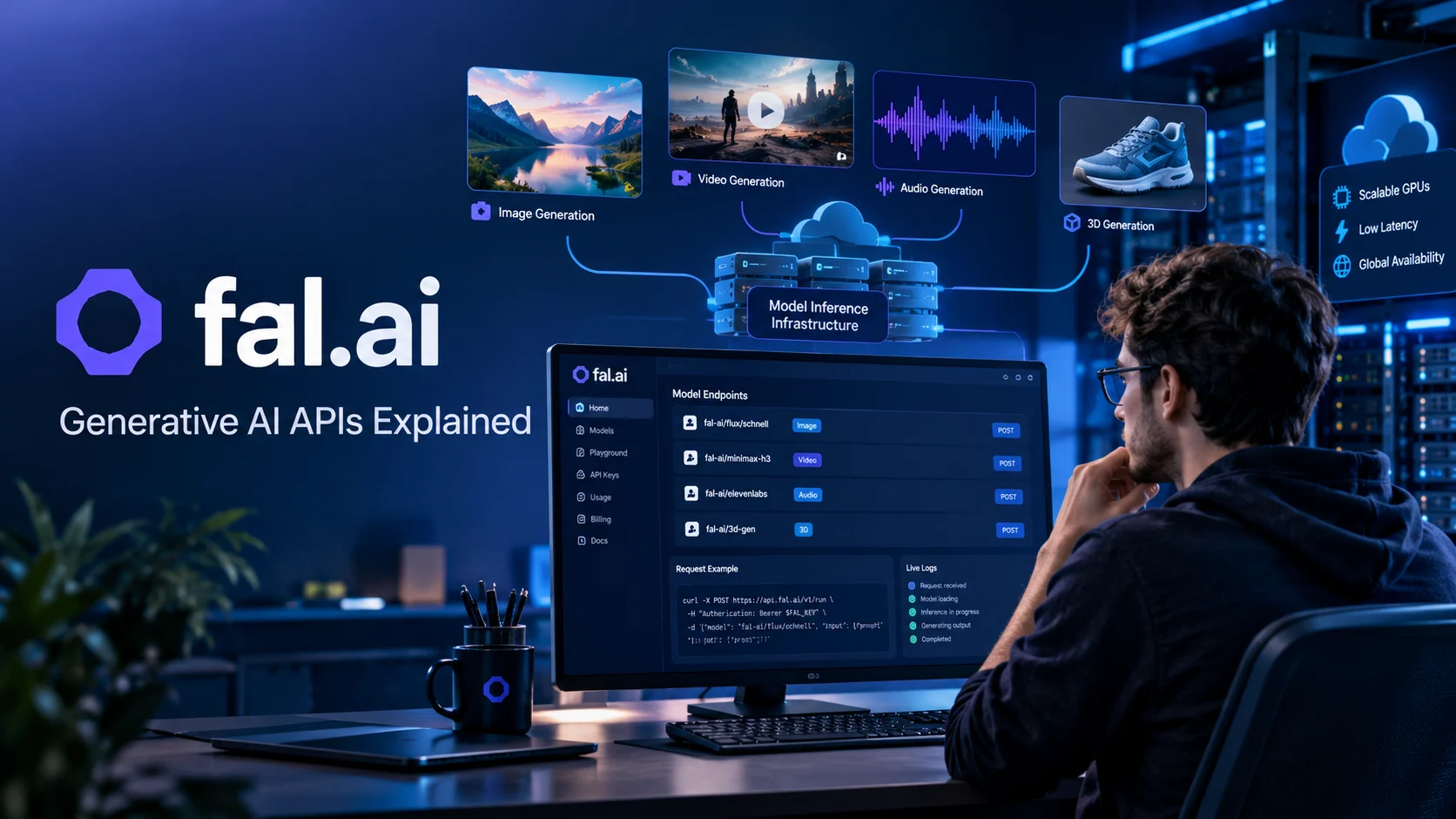
fal.ai is an AI inference platform that gives developers API access to generative image, video, audio, and 3D models, along with serverless GPU infrastructure for running custom models. It helps teams integrate AI generation into applications without managing all the underlying GPU infrastructure, with costs that vary by model, output, and compute usage.
At a Glance
- What it does: Provides APIs and infrastructure for generative AI applications.
- Main workloads: Image generation, video generation, audio, 3D assets, and related media workflows.
- Developer access: API endpoints, SDKs, queued requests, webhooks, and custom model deployment options.
- Pricing: Pay-per-use model APIs and separately priced GPU compute for custom deployments.
- Security: fal publishes enterprise security features, including SOC 2 Type II, access controls, and data-management options.
What Is fal.ai?
fal.ai, commonly styled as fal, is a developer platform for running generative AI models through APIs. It focuses on media generation and inference infrastructure rather than serving only as a consumer-facing chatbot.
The platform provides access to models that generate or transform images, videos, audio, and 3D assets. Developers can integrate these capabilities into websites, mobile applications, creative software, and automated content pipelines.
According to its current website, fal offers more than 1,400 model endpoints through a common inference API. It also provides serverless GPU infrastructure for deploying custom models and pipelines.
That combination is important because building an AI feature involves more than choosing a model. A production application must send inputs, handle processing time, retrieve outputs, manage failures, and control costs.
fal aims to provide much of that infrastructure as a managed service.
Is fal.ai a model, an API, or an AI app?
It is primarily an AI inference platform and model API provider.
These terms describe different parts of the AI ecosystem:
- AI model: The trained system that generates an image, produces speech, or performs another task.
- Inference: The process of running a trained model to produce an output from an input.
- API: The interface an application uses to request that output.
- Inference platform: The infrastructure that runs models and manages requests.
fal brings these components together. It gives developers access to third-party model endpoints and tools for running their own workloads.
This means fal is not simply one proprietary image generator. The capabilities and limitations of an application depend on the particular model, endpoint, settings, and infrastructure selected.
How Does fal.ai Work?
fal acts as the layer between your application and the AI model doing the work. You select an endpoint, provide the required inputs, and receive the generated result.
1. Your application
A website, mobile app, or backend sends a request.
2. fal API
Authenticates the request and routes it to the selected model endpoint.
3. Model inference
The model processes the prompt, image, audio, or other input.
4. Result delivery
Your application retrieves the output directly or through a queued request and webhook.
fal documents both direct requests and asynchronous queue workflows. The queue is particularly useful for longer jobs, such as video generation, because the application does not have to keep one connection open while processing finishes.
What is inference in fal.ai?
Inference is the execution of a trained AI model. For example, when a user asks your application to generate a product image, the selected model converts the prompt and settings into an image.
The platform manages the model execution, while your application handles the user experience and business logic. This separation lets developers add generative capabilities without building every component of the inference infrastructure themselves.
Key Features of fal.ai
fal’s features are designed around model access, generation workflows, and deployment. The following capabilities are especially relevant to teams building AI-powered products.
1. Image generation and editing APIs
Developers can connect applications to image models for text-to-image generation, image editing, and related visual tasks.
Possible applications include:
- Product photography and marketing creatives.
- Custom illustrations and concept art.
- Image editing and background transformations.
- Personalized graphics generated from user prompts.
- Automated visual content production.
The available settings and output formats vary by model. Some endpoints charge by image, while others use megapixels or a different billing unit.
2. AI video generation
fal exposes endpoints for video-generation models that support workflows such as text-to-video and image-to-video.
These APIs can support short advertisements, animated product demonstrations, creative previews, and video tools inside other applications.
Video is a workload where cost estimation matters. Duration, resolution, model choice, and other settings can change the total charge. A five-second clip should not be assumed to cost the same across different endpoints.
3. Audio generation and processing
The platform also lists audio capabilities, including text-to-speech, sound-effect generation, and other audio-related tasks.
Developers can use these features to add narration to videos, generate sound effects, or create voice-based experiences. Voice and audio endpoints may charge by character count, generated second, or another model-specific unit.
4. 3D generation
fal includes endpoints for generating 3D assets from text or images, as well as certain motion-related workflows.
These capabilities may help with prototypes, game assets, product visualization, and creative experimentation. However, generated assets still need evaluation for geometry, texture quality, compatibility, and suitability for the intended production pipeline.
5. Serverless GPU infrastructure
Teams can deploy custom models or pipelines on fal’s managed GPU infrastructure. Its serverless system is designed to scale with incoming work, reducing the need to maintain GPU machines manually.
The platform also lists reserved capacity for teams that need a baseline of available compute. Reservation options, deployment requirements, and pricing depend on the workload and agreement.
6. Queues, webhooks, and model workflows
For long-running requests, developers can submit work to a queue, track its status, and retrieve results later. Webhooks can notify an application when a job finishes.
fal also offers tools for comparing models and connecting multiple generation steps into workflows. This is useful when an application needs a sequence of operations rather than a single model call.
Common Use Cases for fal.ai
The most appropriate use case depends on your product and the model you choose.
| Use case | How fal can help | What to evaluate |
|---|---|---|
| AI image generator | Connect prompts to image-generation endpoints | Image quality, cost per usable result, output rights |
| Video creation app | Generate video from text or reference images | Cost per second, duration, latency |
| E-commerce tools | Produce or edit product visuals | Product accuracy, consistency, editing requirements |
| Creator software | Add image, video, and audio generation | Workflow reliability and usage costs |
| Game development | Generate concept art and 3D assets | Asset quality, format compatibility, licensing |
| Enterprise media pipeline | Automate multiple generation tasks | Access controls, data handling, monitoring |
Example: Building an AI product-image generator
Imagine an online retailer wants customers to create promotional images for their products.
The application collects a product photo and a text description. It sends those inputs to an appropriate image-editing endpoint through fal. Once the model returns an image, the application displays it for review and lets the customer download an approved version.
The retailer can then track the cost of each generation, average processing time, failed requests, and the percentage of outputs customers accept.
That last metric is important. The cheapest image is not necessarily the most economical if it regularly requires several regenerations or manual corrections.
fal.ai Pricing: How Much Does It Cost?
fal uses usage-based pricing rather than one universal subscription price for every model. Its official pricing page lists individual model rates and separate prices for custom GPU deployments.
Here are representative rates shown on the published pricing page reviewed on October 12, 2026.
| Service or model | Published rate | Billing basis |
|---|---|---|
| FLUX.1 [schnell] | $0.003 | Per megapixel |
| Z Image Turbo | $0.005 | Per megapixel |
| Nano Banana 2 | $0.08 | Per image |
| Nano Banana Pro | $0.15 | Per image |
| MiniMax H3 Max video | $0.05 | Per generated second |
| MiniMax H3 Max Turbo video | $0.025 | Per generated second |
| ElevenLabs multilingual text-to-speech | $0.10 | Per 1,000 characters |
| H100 GPU, standard listed rate | $4.50 | Per hour |
Rates are examples from fal’s published pricing page, not a quote for every configuration. Prices, endpoint availability, output settings, and promotional or negotiated rates may change. See the official fal pricing page for current details.
How to estimate your actual cost
Start by identifying the unit charged by the endpoint you plan to use. Then multiply the rate by the expected number of billed units.
For example, if a video endpoint charges $0.05 per second, a five-second generation would cost $0.25 at that rate. One hundred such generations would cost $25, before other applicable charges.
For image models, check whether the rate is per image, per megapixel, or based on another unit. Image dimensions and generation settings can affect the final cost.
Costs developers should not overlook
Repeated generations: Users often regenerate images or videos to get an acceptable result. Budget for attempts, not only successful downloads.
Resolution and duration: Higher-quality or longer outputs can change the bill, depending on the model.
Custom compute: Deploying your own model can use a different billing structure from calling a hosted model endpoint.
Traffic patterns: A low-traffic application may have very different economics from a service generating thousands of assets daily.
Engineering time: A cheaper raw GPU rate does not automatically mean a lower total cost. Deployment work, monitoring, scaling, and maintenance also consume resources.
A sensible evaluation uses the cost per accepted output, not just the advertised cost per generation.
fal.ai API for Developers: Integration and Technical Considerations
fal’s API is useful when you want to add generative AI to an existing application without implementing model serving from scratch.
Its JavaScript client package is @fal-ai/client, and the documentation also covers Python workflows. Individual endpoints specify their required inputs, optional settings, and response structure.
A typical API integration
A basic integration usually involves these steps:
- Create an account and obtain an API key.
- Select the model endpoint that matches your task.
- Install the appropriate SDK or use the documented HTTP interface.
- Send the required inputs and configuration.
- Process the result, handle errors, and monitor usage.
For long-running tasks, use the documented queue workflow and a webhook or status polling. This avoids tying up a user-facing request while a video or other expensive generation job completes.
Keep API keys out of the browser
One of the most important implementation details is credential management.
Do not expose your fal API key in public frontend code. A key embedded in browser JavaScript can be extracted and used by someone else, potentially generating charges against your account.
Instead, route requests through your backend. Authenticate your users, validate their inputs, apply rate limits, and enforce spending limits where available.
Plan for latency and failed requests
The time needed to return a result varies by model, workload, queue conditions, and output settings. Video generation can take longer than a simple image request.
A production application should account for:
- Timeouts and retryable errors.
- Queue status and asynchronous completion.
- Webhook verification and duplicate event handling.
- Rate limits and concurrency restrictions.
- Output URL expiry or retention settings.
- Usage monitoring and budget alerts.
Retry logic deserves special care. If an application resubmits a request after a timeout without checking its status, it may generate the same asset twice and incur extra costs.
Model choice matters more than catalog size
A platform may offer many endpoints, but not every model is appropriate for every application.
Test candidate models with representative prompts and inputs. Measure the factors that matter to your users, such as output quality, consistency, latency, cost per accepted result, and failure rate.
For a production application, this small evaluation can be more valuable than selecting the model with the most impressive demonstration.
fal.ai Privacy, Security, and Data Retention
Privacy requirements depend on what your application sends to the platform. A public product prompt has a different risk profile from a confidential design, customer photograph, or internal business document.
fal publishes a privacy policy, a data processing addendum, and enterprise controls. Its inference platform also advertises SOC 2 Type II, single sign-on, model access controls, and options for managing output retention.
These are useful indicators, but they do not eliminate the need to assess your own obligations.
How long does fal retain generated outputs?
According to fal’s published inference-platform information, generated files are stored on its CDN for at least seven days by default. The platform documents a request-level retention preference and API options for deleting stored request payloads and output files.
This is an important distinction: the retention period for generated files is not necessarily the same as the retention period for account information, logs, billing records, or other data.
Check the applicable documentation and contractual terms for your specific service.
Does fal.ai offer zero data retention?
Do not assume that all fal endpoints provide zero data retention by default. The documented output-storage behavior shows that generated files may remain available for a defined period.
If your application handles sensitive information, confirm the available retention controls and any enterprise-specific terms before deployment. Also check whether the selected model provider has separate requirements or limitations.
Does SOC 2 Type II mean every model is private?
No. SOC 2 Type II is an assessment of controls over a defined period and scope. It does not, by itself, establish zero data retention, guarantee that every model provider follows identical practices, or prove that every configuration satisfies your compliance requirements.
For regulated workloads, review the relevant audit documentation, data processing agreement, subprocessors, and data-location requirements. Obtain written confirmation when a contractual guarantee is essential.
fal.ai vs. Alternatives: Which Platform Fits Your Project?
fal is one option among several services that host or serve AI models. The most relevant alternative depends on whether you need managed media APIs, a broad community model catalog, custom GPU workloads, or language-model inference.
| Platform | Target user | Key strength | Pricing transparency | Main limitation to assess |
|---|---|---|---|---|
| fal.ai | Developers building generative media products | Image, video, audio, and 3D APIs with managed inference | Published endpoint rates and GPU pricing | Costs and capabilities vary by endpoint |
| Replicate | Developers exploring hosted models | Public model catalog and managed model execution | Pricing shown for supported models and compute options | Model-specific APIs and deployment options require evaluation |
| RunPod | Developers and ML teams needing GPU infrastructure | GPU instances and serverless compute options | Public GPU pricing, with options varying by product | More infrastructure decisions may fall to the user |
| Modal | Python developers and ML engineering teams | Code-driven cloud compute and custom workloads | Public usage-based pricing | Custom deployment requires engineering work |
| Together AI | Teams using hosted language models and open-weight models | LLM inference and model services | Published model and compute pricing | Media-specific workflows may not match fal’s catalog |
These platforms have overlapping capabilities, but they are not interchangeable in every use case. Check their current product documentation and pricing before deciding.
When should you choose fal.ai?
fal is worth evaluating when your application relies heavily on image, video, audio, or 3D generation and you want managed access to multiple model endpoints.
Replicate is worth comparing if you depend on a particular community model or want a different model-discovery workflow. RunPod and Modal deserve consideration when custom deployment and infrastructure control matter more than a ready-made media endpoint.
Together AI is a relevant option when your primary requirement is hosted language-model inference rather than generative media.
The right choice comes from testing the same workload across candidate platforms. Compare output quality, total cost, integration effort, data controls, and operational reliability under realistic conditions.
Who Should Use fal.ai?
fal can be a good fit for several types of technical teams, provided the platform’s model catalog and operating terms match their requirements.
- AI app developers: Add image, video, audio, and 3D generation to existing products.
- Startups: Prototype AI features without first building a complete GPU-serving stack.
- Creative software companies: Integrate generative media into editing, design, and content-production workflows.
- E-commerce businesses: Build tools for product-image generation and visual customization.
- ML engineers: Deploy custom models and manage inference pipelines on GPU infrastructure.
- Enterprise teams: Evaluate managed inference alongside documented access controls, retention settings, and contractual security requirements.
fal may be less suitable if you need a single, fixed subscription for unpredictable workloads, a self-hosted environment with complete infrastructure control, or a language-model platform focused primarily on text and reasoning. Those requirements deserve a direct comparison with other providers.
Common Mistakes to Avoid When Using fal.ai
Choosing a model based only on its advertised price
A low-cost generation may require several attempts or extensive manual editing. Evaluate the cost of producing an output that actually meets your quality requirements.
Ignoring the model’s input and output specifications
Endpoints can differ in supported image dimensions, video duration, file formats, and required parameters. Read the model’s documentation before building your integration.
Exposing API credentials
Never put unrestricted API keys in client-side code. Use a backend, control access, and monitor consumption.
Treating every endpoint as identical
A common API layer simplifies integration, but it does not make all models equally capable. Their quality, latency, pricing, licensing, and limitations can differ significantly.
Overlooking data retention
Check how prompts, uploaded files, generated assets, and logs are handled. Make sure the applicable retention settings match your business and legal requirements.
Skipping production testing
A successful demonstration does not establish production readiness. Test failure handling, concurrency, output consistency, and costs at realistic traffic levels before launching.
Frequently Asked Questions About fal.ai
1. What is fal.ai used for?
fal.ai is used to integrate generative AI models into applications through APIs and managed inference infrastructure. Common applications include image and video generation, audio processing, 3D asset creation, and custom model deployment. It is designed primarily for developers and teams building AI-powered products.
2. Is fal.ai free to use?
fal.ai publishes usage-based prices for its model APIs and GPU infrastructure. Do not assume that every endpoint includes free usage or that all services share the same trial allowance. Check the current pricing page and account terms to understand any available credits, minimum charges, or usage restrictions.
3. How much does fal.ai cost?
Costs depend on the selected model and its billing unit. Some image endpoints charge per image or megapixel, while video endpoints may charge per generated second. Custom GPU deployments use compute-based pricing. Check the endpoint’s current rate and calculate the cost of repeated generations before launching.
4. Is fal.ai suitable for production applications?
It can support production applications through its APIs, queued requests, webhooks, and managed inference infrastructure. However, suitability depends on the chosen model, workload, latency requirements, failure handling, costs, and security needs. Test the full application under realistic conditions before relying on it in production.
5. Is fal.ai secure, and does it offer zero data retention?
fal publishes security information, including SOC 2 Type II and enterprise access controls. Its documentation also describes default storage of generated files for at least seven days, with retention and deletion options. SOC 2 Type II does not guarantee zero data retention, so verify the exact terms for your workload.
Conclusion
fal.ai is a generative AI inference platform that helps developers integrate image, video, audio, and 3D models into applications. Its main appeal is managed access to numerous model endpoints and GPU infrastructure without requiring every team to build its own serving system.
It is worth evaluating for AI product developers, creative platforms, and businesses automating media workflows. Before choosing it, compare real output quality, cost per accepted result, latency, integration requirements, and data-retention controls.
The strongest decision comes from testing your actual workload, not relying solely on a model catalog or advertised price.

Oliver Wilson is an AI researcher and tech writer living at the intersection of human creativity and machine intelligence. At AixOrbit.com, he decodes complex neural networks, generative AI and emerging tech trends into actionable insights making sure humans stay one step ahead of the algorithms.