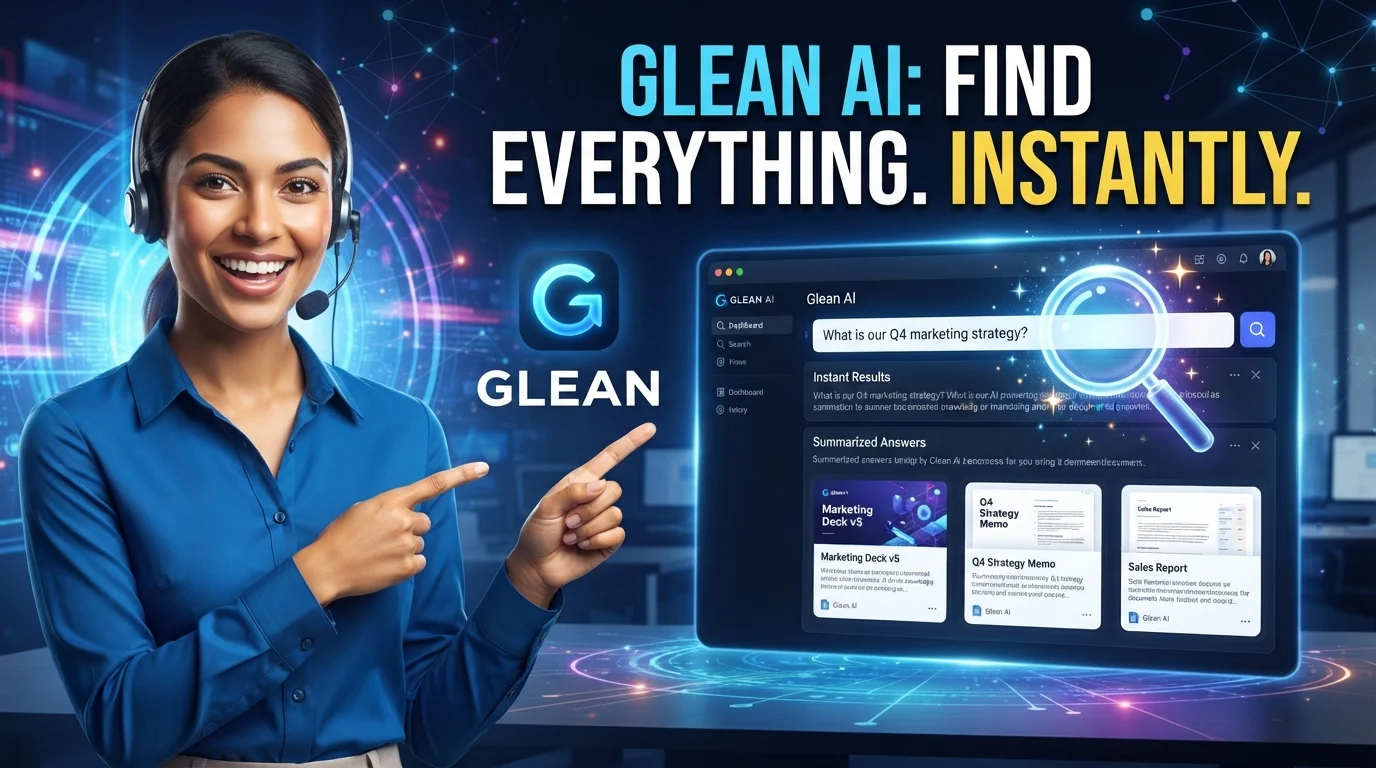
Glean AI is an enterprise AI platform that connects company knowledge, applications, and workflows so employees can search for information, generate answers, and automate work. Its platform combines enterprise search, an AI assistant, AI agents, permission-aware data access, model flexibility, and governance for organizations using many business systems.
At a Glance
- What it is: An enterprise AI platform built around company context, search, assistants, and agents.
- Core products: Glean Search, Glean Assistant, Glean Agents, Enterprise Graph, Glean Protect, and platform APIs.
- How it works: Glean connects business applications, indexes information, maps relationships and permissions, then uses that context to answer questions or perform tasks.
- Who it targets: Primarily medium-sized and large organizations with information spread across many workplace applications.
- Pricing: Glean does not publish a simple public self-service price list for its enterprise platform. Buyers generally need to contact Glean for commercial terms.
- Key consideration: Glean is most relevant when an organization needs a cross-system AI layer rather than an assistant limited to one software ecosystem.
What Is Glean AI?
Glean AI is an enterprise artificial intelligence platform designed to make an organization’s internal knowledge and business systems usable through AI.
Glean originally focused on enterprise search. The platform has since expanded into a broader Work AI system covering search, conversational assistance, AI agents, application integrations, enterprise context, and AI governance.
The distinction matters.
A general-purpose chatbot answers questions using its model and whatever information a user provides. Glean is designed to answer questions using information from an organization’s connected systems while respecting the permissions attached to that information.
For example, an employee might ask:
“What is our current enterprise pricing policy for customers in Europe?”
Instead of searching separately through Google Drive, Slack, Salesforce, internal documentation, and other systems, Glean can retrieve relevant information from connected sources and produce an answer grounded in that enterprise context.
Glean also supports actions and workflows. Its agents can use connected tools to perform tasks rather than simply returning text.
Who created Glean?
Glean was founded in 2019 by Arvind Jain and other former Google engineers. Jain serves as Glean’s CEO.
The company’s original product was enterprise search. Its evolution reflects a broader shift in enterprise software from finding information toward using AI to understand and act on organizational information.
How Does Glean AI Work?
Glean’s architecture can be understood as several connected layers.
1. Connect business applications
Glean connects to workplace systems where company information lives.
Examples include:
- Google Drive
- Gmail
- Microsoft 365
- SharePoint
- OneDrive
- Slack
- Salesforce
- Jira
- GitHub
- ServiceNow
- Confluence
- Workday
- Zendesk
- Notion
The available connector catalog changes over time, and not every connector supports identical capabilities.
Glean’s documentation currently distinguishes between indexed content and live tools. Indexed content can be searched, while tools can retrieve current information or perform actions in connected applications.
2. Build an enterprise knowledge layer
Glean doesn’t simply treat company information as a folder of documents.
Its Enterprise Graph is designed to represent relationships between people, documents, applications, teams, projects, and other enterprise entities.
That context can help determine which information is relevant to a particular employee.
For instance, a product manager searching for a project update may receive different relevant information from an engineer working on the same project.
3. Preserve source permissions
Permissions are central to Glean’s enterprise architecture.
When Glean connects to a source, it can ingest information about content, users, groups, and access permissions. Search results are then filtered according to the user’s existing authorization.
This is particularly important for enterprise AI because a technically correct answer can still be a security problem if it exposes information the user should never see.
4. Retrieve relevant information
Glean uses search and retrieval techniques to identify relevant enterprise information before generating an answer.
This resembles retrieval-augmented generation, or RAG.
In simple terms, RAG means an AI system first retrieves useful information and then gives that information to a language model as context for generating an answer.
The advantage is that the model does not have to rely only on what it learned during training.
5. Generate or execute
Once relevant context has been retrieved, Glean can generate an answer through its assistant or use that context within an agent workflow.
Agents can reason through multi-step tasks and interact with connected tools.
This moves the product beyond enterprise search toward workflow automation.
Key Glean AI Features
Glean Search
Glean Search provides AI-powered search across connected workplace applications.
Instead of remembering where a piece of information was stored, employees can search across multiple sources from one interface.
The value is especially apparent in organizations where knowledge is distributed across documents, messages, tickets, CRM systems, project tools, and internal databases.
Glean Assistant
Glean Assistant provides a conversational interface for asking questions, summarizing information, generating content, and working with enterprise context.
It is designed around a user’s company environment rather than functioning as an isolated consumer chatbot.
Answers can be grounded in organizational sources, with references that help users inspect the underlying information.
Glean Agents
Glean Agents are designed to automate multi-step work.
An agent might be configured to:
- Find relevant company information.
- Analyze the information.
- Use a connected business application.
- Generate an output.
- Complete or trigger a workflow.
The important distinction is that an agent can potentially act, while traditional search primarily retrieves.
Glean also provides agent-building and governance capabilities intended for broader organizational deployment.
Enterprise Graph
The Enterprise Graph is one of the central ideas behind Glean.
It represents relationships among organizational information and people. This context can help AI understand not just what a document says, but how that document relates to a team, project, person, or business process.
Model flexibility
Glean has increasingly emphasized model choice rather than tying its platform to a single large language model.
Its current platform materials describe support for more than 40 open and frontier models.
This can matter because different AI models can have different strengths in reasoning, speed, cost, context handling, and task performance.
A company may prefer one model for a simple search task and another for a complex reasoning workflow.
APIs and developer tools
Glean also provides APIs for organizations that want to incorporate its search, chat, indexing, or other capabilities into custom applications.
Its developer documentation includes REST APIs and SDK support.
This makes Glean more than an employee-facing application. It can also function as an enterprise AI infrastructure layer.
Glean AI Use Cases
Glean’s strongest use cases tend to appear where employees repeatedly search across disconnected systems.
Employee knowledge search
Employees can ask questions about company policies, projects, processes, customers, products, and internal documentation.
This can reduce the need to manually search multiple applications.
Customer support
Support teams can use enterprise search to locate product documentation, previous cases, troubleshooting information, and internal guidance.
An AI assistant can then summarize the relevant information.
Sales enablement
Sales teams can search for product information, customer history, competitive material, pricing guidance, and previous conversations.
The usefulness depends heavily on the quality and permissions of the underlying connected data.
IT and employee support
IT teams can create agents or workflows for common requests.
Examples might include finding troubleshooting documentation, retrieving internal procedures, or initiating actions through connected systems.
Software development
Engineering organizations can search code, documentation, tickets, project discussions, and technical knowledge.
Glean also provides tools for working with developer-focused sources such as GitHub and GitLab.
Research and analysis
Employees can ask questions spanning multiple enterprise sources instead of manually combining information from each system.
This is particularly useful when the answer exists across several departments.
Glean AI Benefits
The primary benefit is context.
A general AI model may be intelligent, but intelligence alone does not give it access to a company’s latest internal information.
Glean attempts to combine AI reasoning with enterprise context.
Other potential benefits include:
- Unified workplace search
- Permission-aware answers
- Cross-application context
- Source references
- AI-generated summaries
- Workflow automation
- Agent development
- Model flexibility
- Administrative controls
- Enterprise APIs
- AI usage visibility
However, these benefits depend on implementation quality.
Poor source data, incomplete connectors, outdated documentation, incorrect permissions, or badly designed workflows can reduce the value of any enterprise AI platform.
Glean AI Limitations
Glean is not automatically the right choice for every organization.
Enterprise complexity
Glean is designed for organizational deployments, not primarily for individual consumers.
That means implementation can involve administrators, identity systems, application connectors, security policies, governance, and change management.
Data quality still matters
AI cannot reliably fix a badly managed knowledge base.
If company documentation is contradictory, outdated, duplicated, or incomplete, the resulting answers may also be incomplete or misleading.
Connector differences matter
Having a connector does not mean every feature works identically across every application.
Some integrations focus on indexing. Others can support live tools or actions. Buyers should test the exact systems and workflows they depend on.
AI agents introduce additional risk
Agents can perform actions, which increases their potential value and their potential risk.
Organizations need to evaluate:
- Permissions
- Approval processes
- Tool access
- Prompt injection defenses
- Auditability
- Human oversight
- Failure handling
- Cost controls
An agent that can send messages or modify records deserves more governance than a read-only search assistant.
Pricing can be difficult to compare
Glean does not provide a simple public pricing page that lets most enterprise buyers calculate a complete deployment cost instantly.
The commercial structure can depend on the customer’s deployment, products, usage, and contract.
Therefore, online claims about a universal Glean per-user price should be treated cautiously unless they come from a current contract or official Glean documentation.
Glean AI Pricing
Glean uses an enterprise sales model rather than a straightforward public self-service pricing page.
For that reason, there is no reliable single Glean AI price that applies to every organization.
Pricing discussions can involve the platform itself and additional AI or usage-related components. Glean’s documentation also describes FlexCredits for certain usage patterns and plans.
Businesses evaluating Glean should request a detailed quote covering:
- Number of users
- Core platform access
- AI features
- Agent usage
- Model usage
- FlexCredits or other consumption components
- Connector requirements
- Support
- Deployment services
- Contract term
- Renewal terms
- Data residency requirements
The important procurement question is not simply “How much does Glean cost per user?”
It is:
What will the total cost of operating Glean across our actual users, data sources, models, and AI workflows be?
Privacy and Security
Security is one of the most important parts of evaluating enterprise AI.
Glean states that its platform is designed to preserve source-system permissions and provide administrative governance.
Its public Trust Center lists certifications and assessments including SOC 2 Type II, ISO 27001, ISO 42001, HIPAA, and GDPR-related controls or commitments.
These credentials are useful evidence of an organization’s security and compliance program, but they should not be interpreted as proof that every deployment is automatically secure.
Customers still need to configure identity, permissions, connectors, retention policies, and governance correctly.
Does Glean use customer data to train AI models?
This question requires attention to the model provider and deployment configuration.
Glean’s contractual materials state that when customers use Glean’s OpenAI or Azure OpenAI key arrangements, customer data is subject to negotiated zero-day retention terms and is not used to train those models.
However, Glean also states that customers using their own model-provider API keys are responsible for the terms negotiated with that provider.
Therefore, SOC 2 certification and zero data retention are separate concepts.
A buyer should verify the exact data-retention, training, subprocessors, and model-provider terms that apply to its deployment.
Glean AI vs Microsoft 365 Copilot
Glean and Microsoft 365 Copilot overlap, but their architectural emphasis differs.
| Platform | Target User | Key Strength | Pricing Transparency | Core Limitation |
|---|---|---|---|---|
| Glean | Large organizations with mixed SaaS environments | Cross-system enterprise context, search, assistants, and agents | Sales-led | Enterprise deployment and commercial evaluation can be complex |
| Microsoft 365 Copilot | Microsoft-centric organizations | Deep integration with Microsoft 365 and Microsoft Graph | Public Microsoft licensing information exists | Cross-platform requirements can vary by workload and integration |
| Google Gemini for Workspace/Enterprise | Google-centric organizations | Native Google ecosystem integration | Varies by edition and contract | Less compelling when critical knowledge is spread across many non-Google systems |
| Coveo | Enterprises needing search and relevance technology | Enterprise search and AI relevance | Sales-led for enterprise offerings | Broader deployment may require more search-specific configuration |
| coach | Teams focused on governed internal knowledge | Knowledge management and verified information | Product and contract dependent | More focused on knowledge workflows than a broad horizontal enterprise AI layer |
The key question is ecosystem fit.
A company heavily invested in Microsoft may already have substantial AI capabilities through Microsoft 365. A company with a more heterogeneous technology environment may place greater value on a platform designed to connect information across many applications.
Who Should Use Glean AI?
Glean is most relevant for organizations with:
- Thousands of employees or complex information environments
- Many SaaS applications
- Large internal knowledge repositories
- Significant Slack, Microsoft 365, Google Workspace, CRM, or ticketing data
- Enterprise AI governance requirements
- Interest in AI agents
- Multiple departments that need a shared AI platform
- A need for permission-aware enterprise search
It may be less suitable for a small team that only needs a general chatbot or an AI assistant already included in its existing productivity suite.
What Should Companies Evaluate Before Buying Glean?
A successful proof of concept should test real company questions rather than artificial demos.
Ask Glean to demonstrate:
- Search accuracy: Can employees find the right information?
- Permission enforcement: Can restricted information remain restricted?
- Freshness: How quickly do important source changes appear?
- Connector coverage: Are the organization’s critical systems supported?
- Agent actions: Can agents safely perform the required tasks?
- Model flexibility: Can the organization choose models appropriate for different workloads?
- Usage economics: What happens to costs as adoption and AI usage increase?
- Auditability: Can security teams investigate AI activity?
- Data retention: What is retained, where, and for how long?
- Exit strategy: How portable are data, workflows, prompts, and integrations?
This evaluation is more useful than comparing feature checklists alone.
Latest Glean AI Developments
Glean’s 2026 product direction shows a clear move from enterprise search toward broader AI infrastructure.
The company introduced an Agent Development Lifecycle framework focused on building, governing, and measuring enterprise agents.
It has also introduced Glean AI Gateway, positioned as a control layer for models and Model Context Protocol, or MCP, access.
The gateway is designed to give organizations visibility into model traffic, tool access, token consumption, latency, and errors.
Glean also continues to expand model choice and enterprise connectors.
The strategic direction is significant: Glean is increasingly presenting itself not merely as an AI search box, but as a context and governance layer beneath multiple enterprise AI experiences.
In May 2026, Glean announced that it had surpassed $300 million in annual recurring revenue. That is a company-reported business metric rather than an independently audited comparison with competitors.
Glean AI Alternatives
The right alternative depends on what an organization is actually trying to replace.
Potential alternatives include:
Microsoft 365 Copilot: Relevant for Microsoft-heavy organizations.
Google Gemini: Relevant for organizations centered on Google Workspace and Google’s AI ecosystem.
Coveo: Relevant for enterprise search and relevance use cases.
coach: Relevant when governed internal knowledge is the primary requirement.
Elastic: Relevant for organizations wanting extensive control over search infrastructure.
Atlassian Rovo: Relevant for organizations deeply invested in Atlassian’s ecosystem.
ServiceNow: Relevant where employee service and workflow automation are central.
Onyx: Relevant for teams exploring open-source enterprise search and AI approaches.
The important comparison is not simply which platform has more AI features.
Compare the platforms against your actual data sources, permissions, workflows, users, security requirements, AI model strategy, and total cost.
Frequently Asked Questions
What is Glean AI used for?
Glean AI is used by organizations to search company information, ask questions about internal knowledge, summarize content, generate responses, and automate workflows with AI agents. It connects information from business applications while using enterprise permissions and governance controls.
Is Glean AI the same as ChatGPT?
No. ChatGPT is a general-purpose AI platform, while Glean is designed specifically around enterprise knowledge, workplace applications, permissions, and business workflows. Glean can also connect with external AI models and provide enterprise context to AI experiences.
How much does Glean AI cost?
Glean does not publish one universal public price for its enterprise platform. Pricing depends on the organization’s requirements, products, users, usage, and contract, so businesses generally need to contact Glean for a quote.
Is Glean AI secure?
Glean provides enterprise security, permission controls, audit capabilities, and published compliance information. Its Trust Center lists certifications including SOC 2 Type II and ISO 27001. Security outcomes still depend on deployment configuration, source permissions, policies, and model-provider arrangements.
Does Glean AI use company data to train AI models?
Glean’s contractual materials state that customer data is not used to train OpenAI or Azure OpenAI models under Glean’s negotiated key arrangements and that zero-day retention applies to those arrangements. Customers using their own model-provider keys must evaluate that provider’s separate retention and training terms.
Conclusion
Glean AI has evolved from an enterprise search product into a broader platform for enterprise context, AI assistance, and agentic work.
Its central proposition is straightforward: connect fragmented company knowledge to AI while preserving permissions, governance, and business context.
That approach can be valuable for organizations with information scattered across dozens of applications. It also creates a more demanding implementation and procurement process than simply buying a consumer chatbot.
Before choosing Glean, companies should test search quality, connector coverage, permission enforcement, agent behavior, model flexibility, retention policies, and total usage costs against real workflows.
For enterprise buyers, those practical details matter more than a long list of AI features.

Oliver Wilson is an AI researcher and tech writer living at the intersection of human creativity and machine intelligence. At AixOrbit.com, he decodes complex neural networks, generative AI and emerging tech trends into actionable insights making sure humans stay one step ahead of the algorithms.