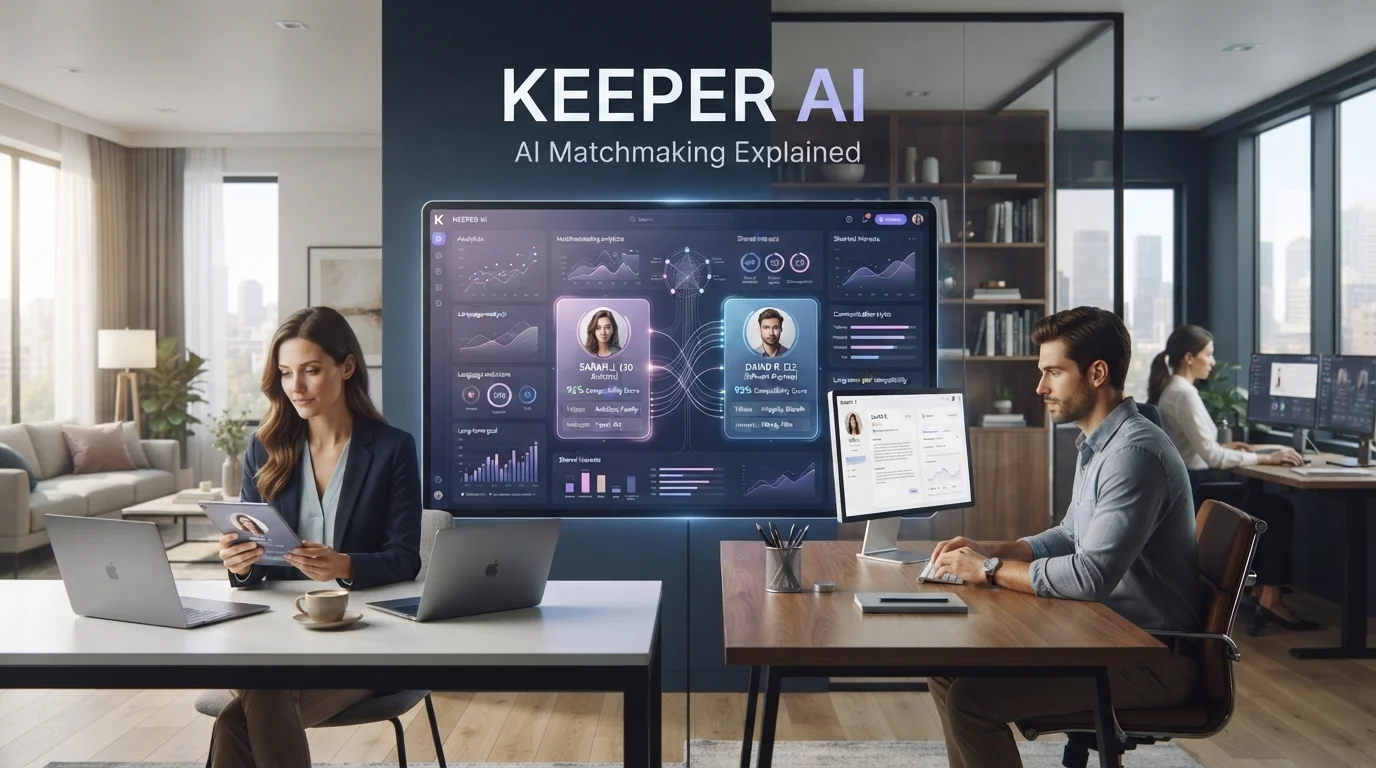
Keeper AI is an AI-assisted matchmaking service designed for adults seeking serious relationships and marriage, using language and vision models to evaluate preferences and potential compatibility. It combines proprietary algorithms, third-party AI models, and human matchmaker reviews to help arrange introductions, with free and outcome-based paid options.
Keeper AI at a Glance
- Main purpose: Matchmaking for people interested in serious relationships and marriage.
- How it works: Analyzes personal preferences, written responses, and photos to help identify potential matches.
- AI technology: Combines proprietary algorithms and custom AI models with selected third-party models, including OpenAI’s GPT API.
- Human involvement: Expert matchmakers review potential introductions.
- Pricing: Offers a free membership and a paid Marriage Bounty option; paid costs vary by individual circumstances.
- Main consideration: Matching outcomes depend on the quality of your information, the available member pool, and compatibility that an algorithm cannot fully measure.
Keeper+1
What Is Keeper AI?
Keeper AI is the technology behind Keeper , a matchmaking platform focused on long-term relationships rather than casual dating or endless profile swiping.
The service asks users to explain their preferences, relationship goals, values, and expectations. Its AI systems help interpret these answers and assess potential matches. Human matchmakers also participate in reviewing introductions.
Unlike a general-purpose chatbot, Keeper’s AI serves a specific purpose: helping people identify potential life partners. The company says its algorithms combine relationship science, custom models, and third-party AI technology.
This distinction matters because Keeper AI is not simply an AI girlfriend, a general relationship chatbot, or a standalone language model. It is part of a matchmaking service that uses AI to support a human-centered process.
The name can also cause confusion. Keeper Security uses the separate name KeeperAI for AI-powered threat detection in privileged-access security. This article focuses on the dating and matchmaking service at keeper.ai, not Keeper Security’s cybersecurity product.
How Does Keeper AI Work?
Keeper AI follows a structured matchmaking process. Instead of relying only on quick swipes or short profile descriptions, it collects more detailed information about what members want in a long-term partner.
1. Complete your profile
You provide personal information, relationship goals, preferences, values, and answers to more detailed questions. The quality and honesty of these responses help shape the matching process.
2. AI analyzes your preferences
Keeper says its language models interpret written answers, while vision models help assess photos against appearance preferences. Its algorithms use these signals to identify potential matches.
3. Matchmakers review introductions
Human matchmakers remain involved in reviewing potential matches. The service combines algorithmic analysis with human judgment before presenting an introduction.
4. Review and decide whether to meet
Members can evaluate an introduction before agreeing to meet. The goal is to facilitate fewer, more intentional introductions rather than maximize daily swiping.
Process based on Keeper’s published product descriptions. Exact steps and eligibility can vary by membership and current service design.
What technology powers Keeper AI?
Keeper says its matchmaking system combines proprietary algorithms, custom AI models, and selected third-party models, including OpenAI’s GPT API. It also describes using AI language and vision models to interpret text responses and evaluate photos.
These components can help process information at a scale that would be difficult to manage through manual review alone. However, the company does not publicly document every model, model version, weighting formula, or validation benchmark used in its matching system.
That distinction is important. Knowing that a service uses AI does not, by itself, establish that its compatibility predictions are scientifically validated or that every recommendation will be accurate.
Key Features of Keeper AI
Keeper’s main features support serious matchmaking rather than general-purpose AI assistance.
1. Detailed preference analysis
The platform asks for more information than a typical short dating profile. Its AI can interpret written preferences and help identify candidates who appear to meet a person’s stated criteria.
This approach may be useful when relationship goals, lifestyle, values, and long-term expectations matter more than a quick first impression.
2. AI-assisted photo evaluation
Keeper says its vision models evaluate photos against appearance preferences. This is a specific use of computer vision, a field of AI that analyzes visual information.
However, appearance analysis should not be confused with a reliable prediction of attraction. Human preferences are subjective, and a photo cannot capture someone’s personality, communication style, or relationship behavior.
3. Human-reviewed introductions
Keeper’s published descriptions emphasize that expert matchmakers review potential introductions. This adds a human review stage to a process that also relies on algorithms.
Human involvement may help identify context that automated systems miss. Still, prospective users should ask how reviews are conducted, how much discretion matchmakers have, and what happens when a recommendation does not fit their expectations.
4. Matching focused on marriage
Keeper positions itself around finding a long-term partner and potentially a spouse. It is not designed primarily for people seeking casual encounters or an endless stream of matches.
This focused approach makes the service more relevant to users who already know they want a committed relationship.
5. Free and outcome-based paid membership
Keeper offers a free option and a paid Marriage Bounty plan. The free option generally limits eligibility to matches with paying members, while the paid option expands the pool to include free members. The company describes the paid model as charging for matches under its stated conditions.
Read the current membership terms carefully to understand what qualifies as a match, when a fee becomes payable, and which conditions apply.
Keeper AI Pricing: Is It Free?
Keeper offers two main membership options, but the cost structure differs from that of a typical monthly dating subscription.
| Pricing option | How it works | Main consideration |
|---|---|---|
| Free membership | Eligible to be matched with paying members | Your potential match pool is more limited |
| Marriage Bounty | Paid, outcome-based matchmaking with access to free and paid members | Fees vary by individual circumstances and match terms |
How much does Keeper AI cost?
There is no single universal price for Keeper’s Marriage Bounty plan in the published FAQ. Keeper says the fee varies based on individual needs and circumstances. Its website also describes a model in which payment is tied to a successful match rather than a conventional recurring subscription.
Before paying, ask the company to explain the complete fee schedule in writing. Specifically, clarify:
- The fee for each qualifying match.
- What the company defines as a successful match.
- Whether charges apply before or after both people approve an introduction.
- What happens if you reject a proposed match.
- Whether any additional services or charges apply.
- Whether you can pause the service and how that affects your membership.
Pricing tip: Do not assume that “pay for results” means you only pay when you get married. Confirm the precise contractual definition of a qualifying result before committing.
Benefits of Using Keeper AI
Keeper may appeal to people who find conventional dating platforms tiring or poorly aligned with their relationship goals.
Less emphasis on endless swiping
Traditional dating apps often encourage users to browse large numbers of profiles. Keeper’s matchmaking approach instead emphasizes detailed information and selected introductions.
This may reduce the effort spent screening incompatible profiles, although the actual time saved depends on the number and quality of matches available.
More detailed compatibility preferences
A short profile rarely explains everything a person wants from a partner. Longer written responses can offer additional context about values, expectations, lifestyle, and future plans.
AI can help process this information consistently. It cannot guarantee that two people will build a healthy relationship.
Human judgment alongside automation
The combination of algorithms and matchmaker review is a meaningful distinction from a fully automated recommendation feed.
Human review can provide context, but its value depends on the reviewers’ methods, experience, and access to relevant information.
A model designed for serious relationships
People who are already looking for marriage may appreciate a service that makes long-term commitment its central goal.
That focus is also a limitation for users who prefer casual dating, broad social discovery, or the freedom to browse many profiles independently.
Keeper AI Limitations and Potential Drawbacks
An AI-assisted matchmaking service can make the search more structured, but it cannot remove the uncertainty inherent in relationships.
1. Compatibility scores are not guarantees
Even if an algorithm identifies two people whose stated preferences align, their real-world chemistry may differ. Communication, trust, emotional maturity, timing, and shared experiences all influence a relationship.
Do not treat a compatibility score or recommendation as an objective verdict on your romantic future.
2. Detailed onboarding takes effort
Keeper asks for substantial personal information. That can improve the amount of context available to the system, but it also makes the onboarding process more demanding.
People who prefer quick registration or minimal disclosure may find this approach inconvenient.
3. The available match pool matters
An algorithm can only recommend people who are available in its effective pool and meet the relevant criteria. Your location, age range, preferences, and willingness to consider long-distance relationships may influence the number of suitable introductions.
Keeper says its service is currently most active in the United States, Canada, and the United Kingdom, while people elsewhere can sign up but may encounter a more limited network.
If you live outside these markets, ask about current activity in your area before investing time in the onboarding process.
4. Results may take time
Keeper’s process emphasizes careful matching rather than a guaranteed daily volume of introductions. Its published FAQ says onboarding and information gathering can take a couple of weeks, although the timeline varies.
If you want immediate matches, a conventional dating app may better suit your expectations.
5. Independent outcome evidence is limited
Keeper promotes a company-reported statistic that approximately one in ten first dates arranged through its service have led to marriage engagements.
This is a company claim, not an independently verified guarantee of an individual user’s success. Before relying on it, look for the underlying methodology, sample size, reporting period, and definition of a first date or engagement.
Keeper AI Privacy and Data Security
Privacy deserves particular attention because matchmaking requires information about personal values, relationships, preferences, and sometimes sensitive aspects of identity.
Keeper’s privacy notice, last updated October 2, 2026, explains that the company uses personal information to provide matchmaking, improve recommendations, support safety, and develop AI models. It also describes potential sharing with selected model-development and research partners under contractual safeguards.
That notice provides a more detailed picture than a simple assurance that the company keeps information confidential.
What data might Keeper collect?
Depending on the information you provide and how you use the service, the privacy notice identifies categories that may include:
- Contact and account details.
- Photos, profile information, and location.
- Relationship preferences and dating goals.
- Personality assessments, values, and questionnaire responses.
- Sensitive information, where permitted by law and with consent when required.
- Communications and service usage information.
Does Keeper use your information to train AI?
Keeper’s current privacy notice says it uses information for internal AI and model development, including improving match rankings, recommendations, and safety-related systems. It also describes possible sharing of certain traits or related information with selected partners for research and model development, subject to applicable safeguards and consent requirements.
This is an important consideration for anyone submitting highly personal answers.
The company says it does not sell personal information to data brokers. However, that statement should not be interpreted as meaning that personal information is never processed or shared with service providers or model-development partners.
How to protect your information
Before joining:
- Read the current Keeper Privacy Notice.
- Check the options for consent, AI training, and partner sharing that apply to your location.
- Avoid submitting unnecessary identifying details in free-text responses.
- Ask how long personal data is retained and how deletion requests are handled.
- Review the terms governing international data transfers.
- Confirm what information prospective matches can see before you approve an introduction.
Keeper’s privacy notice describes certain rights to withdraw consent and object to specific processing, depending on jurisdiction. Check the terms that apply where you live.
Keeper AI vs. Other Dating and Matchmaking Platforms
Keeper belongs to a broader market of dating apps, compatibility-focused services, and professional matchmaking companies. The most useful comparison depends on whether you want AI-assisted introductions, independent profile browsing, or personalized human matchmaking.
| Platform | Target user | Main strength | Pricing transparency | Main limitation |
|---|---|---|---|---|
| Keeper | Adults seeking marriage | AI-assisted analysis and human-reviewed introductions | Free option available; paid fees vary | Match availability may be limited by preferences and location |
| Hinge | People interested in dating and relationships | Profile-based discovery and user-directed matching | Check current in-app plans and regional prices | Users do more of their own screening |
| eHarmony | People seeking relationships | Compatibility-oriented matching | Check current plans and regional offers | Subscription terms and availability vary |
| Tawkify | People seeking a more guided matchmaking experience | Personalized human matchmaking | Request a current quote and full fee terms | Professional matchmaking can require a larger financial commitment |
These descriptions summarize each service’s general positioning, not independently measured performance rankings. Verify current plans, eligibility, and features directly before choosing.
Which alternative should you choose?
- Choose Keeper if you want a serious relationship, detailed preference analysis, and curated introductions.
- Consider Hinge if you prefer browsing profiles and deciding whom to contact yourself.
- Consider eHarmony if you want to explore a compatibility-focused dating platform.
- Consider Tawkify if you prefer a more traditional, personalized matchmaking service.
No platform can guarantee a compatible partner. Compare the experience, total cost, local member pool, privacy practices, and level of personal control instead of relying on marketing claims alone.
Who Should Use Keeper AI?
Keeper AI may be worth exploring if you already know what you want from a relationship and are comfortable sharing detailed personal preferences.
It may suit:
- Marriage-minded singles: People looking for a long-term partner rather than casual encounters.
- Busy professionals: People who would rather review selected introductions than spend hours browsing profiles.
- Users frustrated with conventional dating apps: People who want a more guided process with human involvement.
- People open to detailed self-reflection: Users willing to answer questions about their values, expectations, and lifestyle.
It may be less suitable for people seeking casual dating, immediate matches, or a large searchable directory of profiles.
Location also matters. If you live outside Keeper’s strongest markets, check whether its active membership can support your preferences before completing the full process.
Common Mistakes to Avoid When Using Keeper AI
A few practical steps can help you approach AI matchmaking with realistic expectations.
Treating AI predictions as facts
An algorithm can identify patterns in preferences, but it cannot reliably predict every aspect of human chemistry. Use recommendations as a starting point for conversation, not as a final judgment.
Giving contradictory answers
If your written responses conflict with your selected preferences, the system may receive a confusing picture of what you want. Be consistent, honest, and specific about your priorities.
Setting overly restrictive preferences
Some preferences are essential, while others are flexible. Distinguish between non-negotiable values and optional characteristics so you understand how your criteria affect the potential match pool.
Ignoring privacy terms
Do not assume that personal information is used only to create your profile. Read the privacy notice, especially its sections on AI model development, research partners, consent, and data deletion.
Paying without understanding the conditions
Before choosing a paid plan, obtain clear answers about match fees, approval requirements, cancellation, and any additional costs. A pricing model tied to matchmaking outcomes still requires careful review of the contract.
Frequently Asked Questions About Keeper AI
1. Is Keeper AI a real dating app?
Keeper is a real AI-assisted matchmaking service available through its website. It focuses on serious relationships and marriage, combining algorithmic analysis with human matchmaker reviews. Its experience differs from conventional dating apps that primarily let users browse and swipe through profiles.
2. Does Keeper AI use ChatGPT?
Keeper says its proprietary matching system uses custom AI models and selected third-party models, including OpenAI’s GPT API. It also uses AI language and vision models to analyze written preferences and photos. This does not mean the service is simply ChatGPT with a dating interface.
3. Is Keeper AI free to use?
Keeper offers a free membership for people eligible to match with paying members. Its paid Marriage Bounty plan provides access to a broader pool, with fees varying by individual circumstances. Review the current terms to understand exactly when payment is due.
4. Is Keeper AI safe for personal information?
Keeper publishes a privacy notice describing how it collects, uses, and shares personal information, including for AI development and selected research partnerships. Review its consent options, data-sharing practices, and deletion procedures before submitting sensitive relationship or personality information.
Conclusion: Is Keeper AI Worth Considering?
Keeper AI takes a focused approach to matchmaking by combining AI-assisted preference analysis with human-reviewed introductions. It is designed for people seeking serious relationships, particularly those who want a more guided alternative to conventional dating apps.
Its value depends on your location, the availability of compatible members, the quality of its recommendations, and the cost of its paid service. Its AI capabilities should not be confused with a guarantee of romantic compatibility.
Before signing up, review the current pricing terms, understand how personal information may be used, and check whether the service has enough relevant members in your area. If its approach fits your goals, it may be worth exploring as one option in your search for a long-term partner.

Oliver Wilson is an AI researcher and tech writer living at the intersection of human creativity and machine intelligence. At AixOrbit.com, he decodes complex neural networks, generative AI and emerging tech trends into actionable insights making sure humans stay one step ahead of the algorithms.