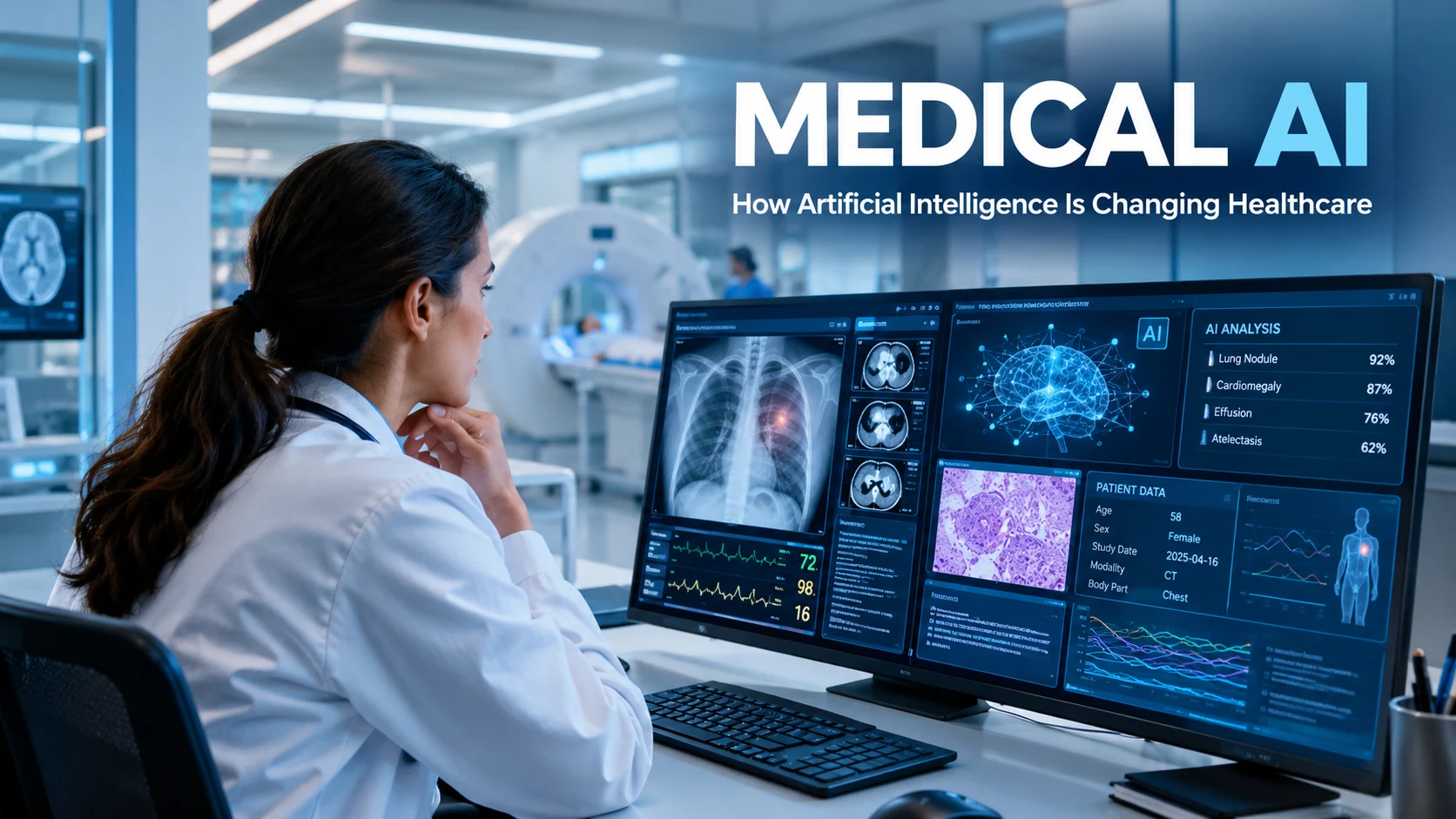
Medical AI uses artificial intelligence and machine learning to analyze health data, support clinical decisions, assist diagnosis, automate healthcare tasks, and accelerate medical research.
Its value depends on the quality of the data, clinical validation, regulatory oversight, privacy protections, and how effectively it works alongside healthcare professionals.
At a Glance
- Medical AI applies AI and machine learning to clinical care, medical research, diagnostics, administration, and health monitoring.
- Common applications include medical imaging, clinical decision support, pathology, patient monitoring, drug discovery, and clinical documentation.
- The FDA says more than 1,600 AI-enabled medical devices had been authorized for marketing in the United States as of September 2026.
- Generative AI and large multimodal models are expanding medical AI beyond traditional prediction and image analysis into text, documentation, and multimodal workflows.
- Major concerns include bias, privacy, hallucinations, limited explainability, cybersecurity, data quality, and performance changes after deployment.
- Medical AI should be evaluated for its specific intended use, evidence, workflow impact, and risks rather than judged by AI branding alone.
What Is Medical AI?
Medical AI is the use of artificial intelligence technologies to perform or support tasks related to healthcare and medicine.
These systems can process medical images, electronic health records, laboratory results, physiological signals, clinical notes, genomic information, and other health data. Depending on the application, an AI system may classify information, identify patterns, estimate risk, generate text, detect abnormalities, or support a healthcare professional’s decision.
Medical AI is not one single technology.
It includes traditional machine learning, deep learning, natural language processing, computer vision, predictive models, generative AI, and increasingly multimodal AI systems.
The FDA describes AI-enabled medical devices as systems that can analyze large and complex datasets, identify patterns, and generate information that supports areas such as disease detection, diagnosis, and treatment.
That distinction matters because a model that summarizes clinical notes is fundamentally different from an AI-enabled device designed to identify abnormalities in a CT scan.
How Does Medical AI Work?
The basic workflow is easier to understand as a pipeline.
1. Data collection
An AI system needs relevant data.
Depending on its purpose, that data might include:
- X-rays, CT scans, MRI scans, or ultrasound images
- Pathology slides
- ECG and other physiological signals
- Electronic health records
- Laboratory results
- Medication information
- Clinical notes
- Genomic data
- Wearable-device measurements
The quality and representativeness of this data can strongly influence the resulting system.
2. Model training
Machine learning models identify patterns within training data.
For example, an imaging model may learn statistical relationships between image features and previously labeled clinical findings.
Modern systems can use neural networks and deep learning to process highly complex information.
3. Validation and testing
A model should not be judged only by its performance on the data used to train it.
Testing on separate datasets can reveal whether the model generalizes to new patients and clinical environments.
This is particularly important because healthcare populations differ by geography, age, equipment, clinical practice, and disease prevalence.
4. Inference
Once deployed, the trained model receives new information and produces an output.
That output could be:
- A classification
- A risk estimate
- An image measurement
- A clinical alert
- A generated summary
- A recommendation for further review
The output is then incorporated into a defined workflow.
5. Human review and monitoring
Medical AI should be evaluated as part of the human-AI system, not simply as an isolated algorithm.
FDA guidance emphasizes the importance of transparency, intended use, workflow integration, performance, limitations, and information needed by users.
Major Applications of Medical AI
Medical AI is already used across multiple areas of healthcare.
Medical Imaging
Medical imaging is one of the most established areas for AI-enabled healthcare technology.
AI can help analyze:
- X-rays
- CT scans
- MRI images
- Mammograms
- Ultrasound
- Retinal images
- Nuclear medicine images
Some systems detect or highlight abnormalities, while others assist with image reconstruction, segmentation, measurements, or workflow prioritization.
The FDA’s current AI-enabled device database contains numerous authorized products in radiology, reflecting the importance of imaging within the medical AI landscape.
AI does not automatically make an imaging diagnosis correct. Performance depends on the intended use, population, imaging protocol, model validation, and clinical workflow.
Clinical Decision Support
Clinical decision-support systems can analyze patient information and provide alerts, predictions, or other information that may assist healthcare professionals.
Examples include systems designed to help identify patients at elevated risk of certain conditions or to prioritize clinical information.
Research reviews have found promising results across several clinical applications, while also identifying challenges involving bias, explainability, prospective validation, and real-world clinical outcomes.
Pathology
Digital pathology allows tissue slides to be converted into high-resolution digital images.
AI can then analyze these images for patterns associated with disease.
Potential applications include tumor detection, tissue classification, quantitative analysis, and biomarker-related research.
The FDA’s authorized-device database includes AI-enabled pathology products, demonstrating that medical AI extends beyond radiology.
Patient Monitoring
AI can process continuous or repeated measurements from devices such as cardiac monitors, wearable sensors, and other medical technologies.
The goal may be to detect patterns that deserve attention or help clinicians manage large amounts of incoming data.
This can be especially useful when manual review of every measurement would be inefficient.
Clinical Documentation
Generative and ambient AI systems are increasingly being used to assist with clinical documentation.
An ambient system may process a clinician-patient conversation and produce a draft clinical note.
This is different from an autonomous diagnostic system. Documentation tools primarily address workflow and administrative burden, although they still create important privacy, accuracy, and governance questions.
The AMA notes that AI is increasingly used in healthcare administration and to reduce physician burden, alongside AI-enabled medical devices.
Drug Discovery and Medical Research
AI can also support biomedical research.
Researchers use machine learning for tasks such as:
- Target identification
- Molecular analysis
- Virtual screening
- Biomarker discovery
- Patient stratification
- Predictive modeling
- Analysis of scientific literature
Recent reviews describe AI as increasingly relevant to drug discovery and development, while emphasizing that AI does not remove the need for laboratory research, preclinical testing, clinical trials, and regulatory evaluation.
Medical AI vs. Generative AI
Medical AI is the broader category.
Generative AI is one part of that category.
Traditional medical AI often performs a defined predictive or classification task. For example, a model may estimate whether an image contains a particular finding.
Generative AI can create new content, such as text, summaries, images, or other outputs.
Large multimodal models can work with more than one type of input, potentially combining information such as text and images. WHO’s guidance on large multimodal models specifically addresses their potential use in healthcare, research, public health, and drug development.
However, a general-purpose generative AI model should not automatically be treated as a clinically validated medical device.
That distinction is critical.
A model can produce fluent medical language without having been validated for a particular clinical decision.
Benefits of Medical AI
The potential benefits of medical AI vary by application.
Faster Data Analysis
AI can process large datasets much faster than manual review in some workflows.
This can help clinicians manage high volumes of images, signals, documents, or other information.
Earlier Detection
Some AI systems are designed to identify patterns that may be difficult or time-consuming to detect manually.
This can support earlier review or prioritization, depending on the use case.
Workflow Efficiency
AI-assisted documentation, image analysis, scheduling, and administrative tools may reduce repetitive work.
The important question is whether the technology reduces total workload rather than simply moving work from one task to another.
Personalized Medicine
AI can analyze combinations of clinical, molecular, imaging, and other data to support more individualized approaches to care.
The quality of personalization depends heavily on the quality and completeness of the underlying patient data.
Research Acceleration
AI can help researchers search, classify, analyze, and model complex biomedical information.
It may also assist drug discovery and biomarker research.
These benefits remain application-specific. A promising laboratory result does not automatically translate into improved patient outcomes.
Limitations and Risks of Medical AI
Medical AI has significant limitations.
Data Bias
A model trained on data that does not adequately represent its intended population may perform differently across groups.
FDA transparency guidance specifically identifies information about bias, data gaps, intended populations, and performance as relevant when evaluating machine-learning-enabled medical devices.
Hallucinations
Generative AI can produce plausible but incorrect information.
This is especially important in medicine because a confident-sounding error can be more dangerous than an obvious error.
Generated information should therefore be checked against appropriate clinical sources and workflows.
Lack of Explainability
Some complex models are difficult to interpret.
Healthcare professionals may need to understand what a system is intended to do, where it can fail, and what its output means.
Transparency does not necessarily require revealing every mathematical detail. It does require providing meaningful information about intended use, performance, limitations, risks, and workflow.
Dataset Shift
A model can encounter conditions after deployment that differ from its development environment.
Changes in patient populations, equipment, clinical protocols, disease patterns, or data quality can affect performance.
This is why monitoring after deployment matters.
Automation Bias
People may place too much trust in an automated recommendation simply because it came from a computer.
A clinically useful system should support informed human judgment rather than encourage blind acceptance.
Privacy and Cybersecurity
Healthcare data is highly sensitive.
Organizations deploying medical AI should understand where data is stored, who can access it, how long it is retained, whether it is used for model improvement, and what security controls apply.
A vendor’s general statement that it uses encryption or has a security certification does not answer every privacy question.
For example, SOC 2 and Zero Data Retention are different concepts. A SOC 2 report concerns controls examined against specified trust-services criteria; it does not automatically establish that a provider retains no customer data.
How Is Medical AI Regulated?
Regulation depends on the technology, intended use, jurisdiction, and risk.
In the United States, the FDA regulates medical devices, including AI-enabled medical devices, using a risk-based approach that considers intended use and technological characteristics.
The FDA maintains a public list of AI-enabled medical devices authorized for marketing in the United States. As of September 2026, the agency reports that more than 1,600 such devices had been authorized.
That number should not be interpreted as 1,600 autonomous AI doctors.
The category includes many types of medical devices and software, with different intended uses and risk profiles.
The FDA also works with international regulators on good machine learning practice, transparency, and approaches for managing changes to AI-enabled devices across their product lifecycles.
What Should Healthcare Organizations Evaluate Before Adopting Medical AI?
A strong procurement process should look beyond a product demonstration.
Intended Use
Ask exactly what the system is designed to do.
A tool designed to prioritize images is different from one intended to provide diagnostic information.
Clinical Evidence
Look for evidence relevant to the intended use and target population.
Important questions include:
- Was the model externally validated?
- Was testing prospective or retrospective?
- What population was studied?
- What were the comparators?
- Were clinically meaningful outcomes measured?
- Has performance been assessed in the organization’s own environment?
Integration
A technically strong model can still fail operationally.
Evaluate compatibility with existing systems, clinical workflows, identity management, data formats, and reporting processes.
Performance Monitoring
Ask how the vendor detects performance degradation.
FDA guidance on AI-enabled devices emphasizes lifecycle management and monitoring because AI systems can create ongoing performance and change-management considerations.
Privacy
Review:
- Data storage location
- Retention periods
- Data-processing agreements
- Access controls
- Encryption
- Secondary use of data
- Model-training policies
- Incident response
- Subprocessors
Do not rely on a single security badge or certification as a complete privacy assessment.
Vendor Dependence
Organizations should also consider whether they can export data, migrate workflows, integrate alternative models, or operate if a vendor changes pricing or product strategy.
Vendor lock-in can become a significant long-term cost even when the initial implementation looks attractive.
Medical AI and Responsible AI
The technical performance of a model is only one part of responsible deployment.
WHO says AI for health should place ethics and human rights at the center of development and use. Its guidance highlights concerns involving accountability, equity, privacy, and appropriate use.
WHO’s 2026 report on AI-related health research also highlights issues such as fairness, power imbalances, data governance, benefit sharing, and oversight.
NIST’s AI Risk Management Framework provides a general framework for organizations designing, deploying, or using AI systems to manage risks and promote trustworthy AI. It is voluntary and not specific to healthcare.
For healthcare organizations, responsible AI therefore means considering the entire system:
data → model → workflow → human decision → patient outcome → monitoring
That is more meaningful than judging an AI product solely by its model architecture.
Common Mistakes When Evaluating Medical AI
Mistake 1: Confusing a Demo With Clinical Evidence
A compelling demonstration does not establish clinical effectiveness.
Mistake 2: Looking Only at Accuracy
Accuracy may hide important differences in sensitivity, specificity, calibration, false positives, and false negatives.
The right metrics depend on the clinical task.
Mistake 3: Ignoring the Intended Population
Performance on one dataset does not guarantee equivalent performance elsewhere.
Mistake 4: Treating Generative AI as a Medical Authority
A language model can generate useful text while still producing incorrect statements.
Its output needs appropriate verification.
Mistake 5: Assuming Regulatory Authorization Means Universal Suitability
Authorization applies to a defined product and intended use.
It does not mean the technology is appropriate for every patient, hospital, workflow, or clinical decision.
Mistake 6: Treating Privacy as a Checkbox
Healthcare organizations should examine actual data flows, retention, access, contractual terms, and secondary uses.
Latest Developments in Medical AI
Medical AI is moving beyond isolated prediction models toward broader clinical workflows.
One major development is the expansion of generative and multimodal AI. These systems can work with different information types and potentially support more complex healthcare workflows, although their clinical safety and effectiveness still require careful evaluation.
Another important development is the growth of AI-enabled medical devices. The FDA’s September 2026 device list shows continued activity across radiology, cardiovascular care, pathology, neurology, ultrasound, oncology-related applications, and other specialties.
Regulatory attention is also shifting toward the full lifecycle of AI systems.
That includes how models are developed, validated, updated, monitored, explained, and changed after deployment. FDA guidance on predetermined change control plans reflects this lifecycle approach.
The broader direction is therefore not simply “more AI.”
It is more clinically integrated, continuously evaluated, and governed AI.
Who Should Use Medical AI?
Medical AI has different roles for different audiences.
| Audience | Potential Use | Key Consideration |
|---|---|---|
| Clinicians | Decision support, imaging, documentation | Clinical validation and workflow fit |
| Hospitals | Diagnostics, monitoring, administration | Integration, governance, and ROI |
| Researchers | Data analysis and drug discovery | Data quality and reproducibility |
| Developers | Medical AI applications and models | Regulation, security, validation |
| Patients | Health information and approved digital tools | Privacy and clinical oversight |
| Health systems | Population and operational analytics | Bias, interoperability, and governance |
Patients should be especially careful with general-purpose AI chatbots.
A conversational system may explain medical terminology or help prepare questions for a clinician, but that does not make it a substitute for professional diagnosis or treatment.
What the Future of Medical AI May Look Like
The future is likely to involve AI embedded into healthcare infrastructure rather than isolated AI applications.
Medical imaging systems may incorporate AI directly into acquisition and interpretation workflows. Clinical software may use AI to summarize information and surface relevant findings. Research platforms may use AI to connect molecular, clinical, and imaging data.
At the same time, regulation and governance will become increasingly important.
The central challenge is not simply whether an AI model can produce an impressive output. It is whether the complete system produces useful, reliable results for the right population, within the right workflow, with appropriate safeguards.
That is the standard that matters most in medicine.
Frequently Asked Questions
What is medical AI?
Medical AI is the use of artificial intelligence and machine learning to support healthcare tasks such as medical imaging, diagnosis, clinical decision support, patient monitoring, documentation, research, and drug discovery. Its role can range from analyzing specific data to generating information for healthcare professionals.
Is medical AI safe?
Medical AI safety depends on the specific system, intended use, validation, population, deployment environment, and human oversight. Regulatory authorization can provide evidence that a device met applicable requirements, but it does not mean every AI system is suitable for every medical situation.
Can medical AI replace doctors?
Medical AI is generally designed for specific tasks rather than replacing the full role of a physician. AI may analyze information, flag potential findings, summarize documentation, or provide decision support, while clinical decisions remain dependent on professional judgment and the broader patient context.
What are the biggest risks of medical AI?
Major risks include biased data, incorrect predictions, generative AI hallucinations, privacy breaches, cybersecurity problems, limited explainability, automation bias, and performance changes when systems encounter populations or workflows different from those used during development.
How should a hospital evaluate a medical AI system?
A hospital should examine intended use, clinical evidence, validation data, target population, regulatory status where applicable, interoperability, workflow impact, privacy, security, monitoring, vendor dependence, and total cost. The evaluation should focus on the complete human-AI workflow rather than model performance alone.
Conclusion
Medical AI is becoming a significant part of modern healthcare, from diagnostic imaging and pathology to clinical documentation, patient monitoring, and biomedical research.
Its strongest applications are not defined simply by having an AI model. They are defined by evidence, appropriate clinical use, reliable data, transparent limitations, privacy protections, and effective integration with healthcare professionals.
For organizations considering medical AI, the most important question is not whether a product uses AI. It is whether the technology has been appropriately validated for the specific problem it is being asked to solve.
As the field develops, responsible adoption will depend on combining technical capability with clinical evidence, human oversight, lifecycle monitoring, and strong governance.

Oliver Wilson is an AI researcher and tech writer living at the intersection of human creativity and machine intelligence. At AixOrbit.com, he decodes complex neural networks, generative AI and emerging tech trends into actionable insights making sure humans stay one step ahead of the algorithms.