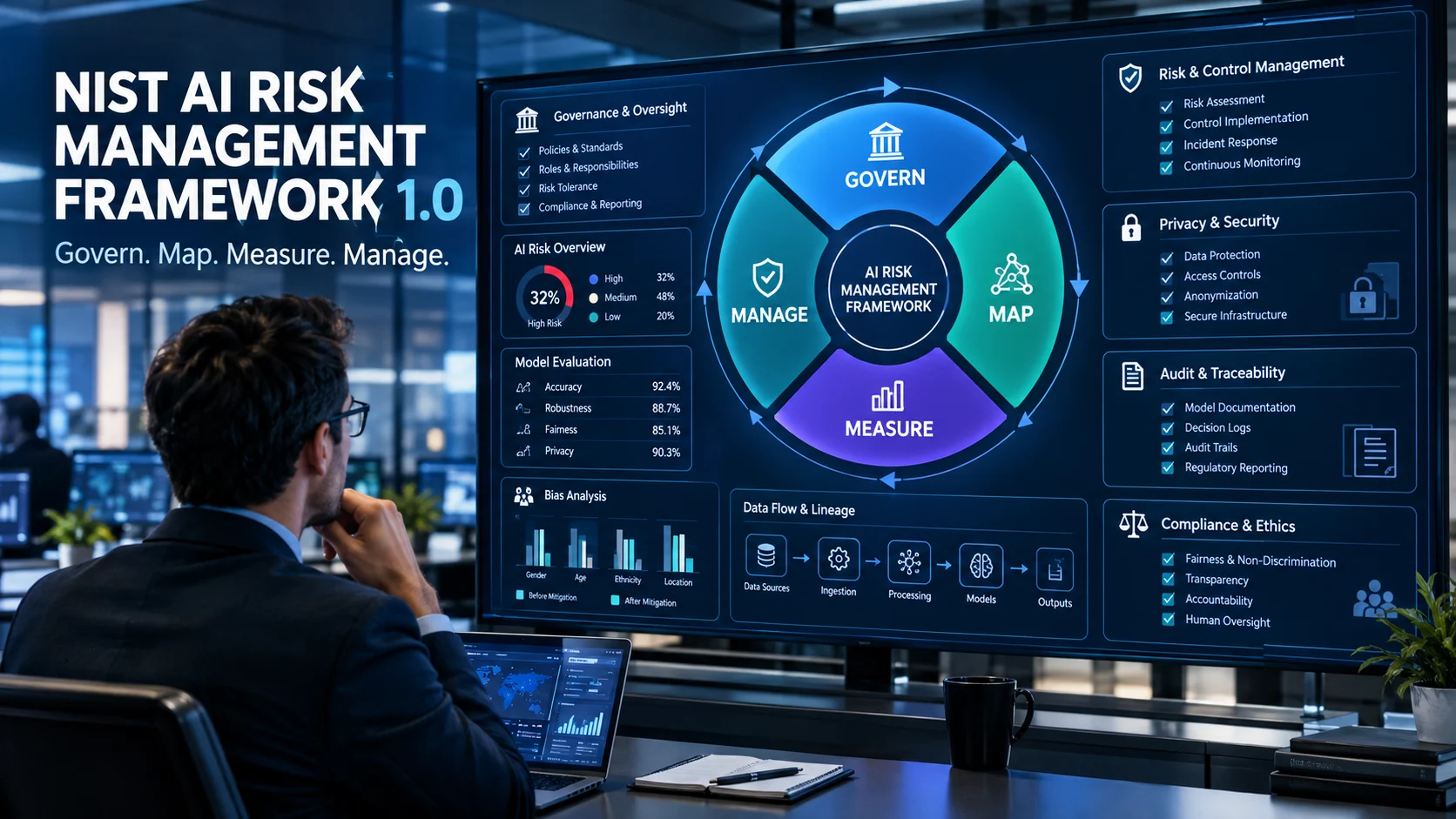
The NIST AI Risk Management Framework 1.0, published in January 2023, is a voluntary framework designed to help organizations manage risks throughout the AI lifecycle. Its four core functions, Govern, Map, Measure, and Manage, provide a structured approach to improving AI trustworthiness, accountability, transparency, and risk-based decision-making.
At a Glance
- Publisher: National Institute of Standards and Technology (NIST), part of the U.S. Department of Commerce.
- Release date: January 2023.
- Version: AI RMF 1.0.
- Purpose: Help organizations develop and use trustworthy, responsible AI systems.
- Core functions: Govern, Map, Measure, and Manage.
- Legal status: Voluntary guidance, not a standalone law or certification.
- Related resource: The NIST AI RMF Generative AI Profile, published in July 2024, extends the framework’s risk-management approach to generative AI.
What Is the NIST AI Risk Management Framework 1.0?
The NIST AI Risk Management Framework, commonly called the NIST AI RMF, is a voluntary guidance document for organizations that build, buy, deploy, or evaluate artificial intelligence systems. NIST published version 1.0 on January 26, 2023, under publication number NIST AI 100-1.
The framework helps organizations consider the potential effects of AI on individuals, businesses, society, and the environment. Instead of focusing exclusively on technical performance, it addresses how an AI system behaves, who it affects, how risks emerge, and what organizations can do about them.
For example, a customer-service chatbot may produce convincing but incorrect answers. A hiring model might disadvantage certain applicants because of biased training data. A fraud-detection system could incorrectly flag legitimate transactions.
The NIST AI RMF gives organizations a common structure for identifying these problems, evaluating their significance, documenting decisions, and responding appropriately.
Why Did NIST Develop the Framework?
AI systems can create risks that traditional software risk assessments may not fully capture. Their behavior can depend on training data, model design, deployment conditions, human decisions, and changes in real-world use.
NIST developed the framework following a congressional directive in the National Artificial Intelligence Initiative Act of 2020. Its development involved public consultation, workshops, and contributions from organizations across industry, academia, government, and civil society.
The framework aims to make AI risk management more practical, adaptable, and consistent across different industries.
Is the NIST AI RMF Mandatory?
No. AI RMF 1.0 is voluntary guidance rather than a standalone legal requirement. Organizations can adapt its recommendations to their size, sector, risk tolerance, and AI applications.
However, voluntary status does not mean every related obligation is optional. Laws, contracts, sector-specific rules, procurement requirements, or internal policies may impose separate requirements.
Organizations should therefore distinguish between adopting the NIST framework and complying with applicable laws.
The Four Core Functions of NIST AI RMF 1.0
The framework organizes AI risk management into four interconnected functions: Govern, Map, Measure, and Manage. Together, they cover organizational accountability, contextual understanding, risk evaluation, and risk response.
1. GOVERN
Establish policies, accountability, oversight, and an organizational culture that supports responsible AI.
2. MAP
Understand the AI system’s purpose, context, stakeholders, potential impacts, and sources of risk.
3. MEASURE
Assess, analyze, and track risks using appropriate testing, metrics, evidence, and evaluation methods.
4. MANAGE
Prioritize risks, select responses, implement safeguards, and monitor remaining risks.
These functions work together throughout the AI lifecycle. Govern is cross-cutting and informs the other three functions.
1. Govern: Establish Accountability and Oversight
Govern creates the organizational foundation for AI risk management. It addresses policies, roles, responsibilities, workforce training, risk tolerance, and oversight mechanisms.
An organization should determine who approves an AI system, who monitors its performance, and who can suspend its use when serious problems arise.
Key activities include:
- Establishing an AI governance policy and clear accountability.
- Defining acceptable levels of risk.
- Assigning responsibilities across technical, legal, security, and business teams.
- Training employees who develop, procure, or operate AI.
- Maintaining documentation and review procedures.
- Incorporating risk management into the organization’s broader culture.
Practical example: A bank deploying an AI-assisted loan assessment tool could establish a review committee, define escalation procedures, and require human review for certain high-impact decisions.
Governance should not exist only in policy documents. It must influence actual decisions, resource allocation, and operational behavior.
2. Map: Understand the System and Its Context
Map helps organizations understand what an AI system does, why it exists, and who may experience its effects.
Risk assessment becomes unreliable when teams evaluate a model without understanding its intended use, limitations, users, or operating environment.
The Map function encourages organizations to document factors such as:
- The AI system’s purpose and intended users.
- Relevant stakeholders and potentially affected communities.
- Data sources, assumptions, and dependencies.
- Deployment conditions and foreseeable misuse.
- Potential benefits, harms, and downstream consequences.
- Applicable legal, operational, and ethical considerations.
Practical example: A hospital considering an AI tool for prioritizing patient appointments should examine the intended clinical workflow, the population represented in its data, the consequences of missed alerts, and the role of clinical staff.
The same model may create different risks in different settings. An inaccurate recommendation in a low-stakes entertainment application has different consequences from an inaccurate recommendation in healthcare.
3. Measure: Evaluate and Track AI Risks
Measure turns identified risks into questions that can be investigated with evidence.
Organizations choose evaluation methods based on the system, its intended purpose, available data, and potential impacts. Testing may involve quantitative metrics, qualitative analysis, expert review, user feedback, and independent assessment.
Common evaluation areas include:
- Accuracy and reliability.
- Safety and security.
- Privacy risks.
- Bias and potential discriminatory outcomes.
- Explainability and interpretability.
- Robustness under changing conditions.
- Transparency and accountability.
- Performance across relevant user groups and operating environments.
Practical example: A company testing an AI hiring assistant could compare error rates across relevant applicant groups, review whether recommendations rely on inappropriate signals, and examine how the system performs on unfamiliar applications.
A single benchmark score cannot establish that an AI system is trustworthy. Results depend on the evaluation dataset, test design, operating conditions, and the risks the organization needs to address.
Measurement also requires ongoing attention. A model that performs well before deployment may deteriorate when user behavior, input data, or business conditions change.
4. Manage: Prioritize and Respond to Risks
Manage uses the information gathered through mapping and measurement to decide what action to take.
Organizations cannot always eliminate every AI risk. They must identify which risks require immediate intervention, which can be reduced through safeguards, and which residual risks are acceptable under their policies and applicable obligations.
Possible responses include:
- Mitigate: Reduce risk through technical controls, human oversight, better data, or workflow changes.
- Avoid: Do not deploy the system, or discontinue a use case when its risks cannot be justified.
- Transfer: Allocate certain risks through appropriate contractual or other arrangements, while recognizing that some responsibilities cannot simply be outsourced.
- Accept: Document a reasoned decision to retain a risk within the organization’s defined tolerance.
Other activities include incident response, monitoring, documenting residual risks, and determining when a system should be modified or decommissioned.
Practical example: If a customer-support chatbot repeatedly invents refund policies, a company might restrict its answers to approved documentation, require escalation for uncertain questions, test the revised system, and monitor subsequent incidents.
Manage closes the loop, but it does not end the process. New evidence can require teams to revisit the system’s context, repeat evaluations, or change governance decisions.
How to Implement the NIST AI Risk Management Framework
NIST AI RMF 1.0 is not a rigid sequence of mandatory steps. Its functions, categories, and subcategories describe desired outcomes and support activities that organizations can adapt to their circumstances. The companion Playbook offers suggested actions rather than a compulsory checklist.
A practical implementation can follow this workflow.
- Inventory AI systems. Identify internally developed models, third-party AI services, embedded AI features, and systems used by employees.
- Assign ownership. Name accountable business owners and identify the technical, legal, privacy, security, and operational teams responsible for oversight.
- Classify use cases by context and impact. Consider the people affected, the consequences of errors, the system’s autonomy, and the sensitivity of its inputs and outputs.
- Document risks and assumptions. Record intended use, known limitations, data dependencies, foreseeable misuse, and applicable requirements.
- Define evaluation criteria. Choose tests and metrics that reflect the risks of the specific application, including appropriate fairness, safety, privacy, and security assessments.
- Set response thresholds. Determine when the organization should approve, restrict, remediate, pause, or reject a system.
- Monitor after deployment. Track incidents, changes in performance, user complaints, model updates, and new risks throughout the system’s lifecycle.
What Documentation Should Organizations Maintain?
A useful AI risk register can connect the framework’s functions to operational evidence.
| Record | What it should capture |
|---|---|
| AI inventory | System owner, purpose, provider, and deployment status |
| Context assessment | Intended users, affected groups, and operating environment |
| Risk register | Identified risks, likelihood where meaningful, impact, and priority |
| Evaluation report | Testing methods, datasets, results, and known limitations |
| Mitigation plan | Controls, responsible owners, deadlines, and verification |
| Approval record | Decision rationale, outstanding risks, and authorization |
| Monitoring log | Incidents, performance changes, reviews, and corrective actions |
These are practical implementation suggestions, not a claim that NIST requires this exact document set. Organizations should tailor their evidence to their risk exposure, regulatory environment, and internal processes.
What Makes an AI System Trustworthy Under NIST AI RMF 1.0?
The framework describes characteristics that contribute to trustworthy AI. They should be considered together because improving one characteristic does not automatically resolve problems in another.
| Trustworthiness characteristic | What it means in practice |
|---|---|
| Valid and reliable | The system performs its intended task consistently and with suitable evidence of validity. |
| Safe | Its operation avoids or reduces unacceptable harm to people, property, and the environment. |
| Secure and resilient | It can withstand relevant attacks, disruptions, and unexpected conditions. |
| Accountable and transparent | Responsibilities are clear, and appropriate information about the system and its decisions is available. |
| Explainable and interpretable | People can understand relevant aspects of its operation and outputs. |
| Privacy-enhanced | The system manages personal information and privacy risks appropriately. |
| Fair, with harmful bias managed | The organization evaluates and addresses relevant harmful biases and inequitable outcomes. |
These characteristics are not interchangeable certifications or guarantees. For example, a highly accurate model may still expose personal data, behave insecurely, or produce unequal outcomes for different populations.
Trustworthiness also depends on context. The evidence needed for a low-impact recommendation system will differ from the evidence needed for an AI tool used in a high-impact decision.
NIST AI RMF 1.0 for Generative AI and Large Language Models
Generative AI introduces risks that deserve particular attention. Large language models (LLMs) can generate fabricated information, expose sensitive data, reproduce harmful biases, and respond unpredictably to some prompts.
Retrieval-augmented generation (RAG), which connects a model to external information sources, can improve access to relevant material. However, RAG does not automatically eliminate hallucinations, data leakage, malicious documents, or incorrect source interpretation.
The NIST AI RMF provides the broader risk-management structure. Organizations can apply its four functions to chatbots, AI assistants, image generators, coding agents, and other generative systems.
The NIST Generative AI Profile
NIST published the Artificial Intelligence Risk Management Framework: Generative Artificial Intelligence Profile, also known as NIST AI 600-1, on July 26, 2024. It is a companion resource to AI RMF 1.0, with guidance focused on generative AI risks.
The profile helps organizations adapt the framework to issues associated with generative models, including:
- Confabulation, commonly called hallucination.
- Risks involving harmful, misleading, or inappropriate content.
- Privacy and intellectual property concerns.
- Information security and the misuse of generated outputs.
- Human-AI interaction and overreliance on model responses.
- Risks arising from third-party models, data, and components.
For example, a business deploying an internal AI assistant could use Govern to establish accountability, Map to identify sensitive data flows, Measure to test fabricated answers and information leakage, and Manage to restrict access and introduce escalation procedures.
The important distinction is that AI RMF 1.0 remains the general framework, while the Generative AI Profile provides additional guidance for generative AI applications. Neither resource guarantees that a model will be accurate or safe in every situation.
Benefits of the NIST AI Risk Management Framework
The framework offers several practical advantages for organizations developing or adopting AI.
A Consistent Risk Management Structure
The four functions give technical teams, business leaders, compliance professionals, and auditors a shared vocabulary. This can make it easier to discuss risks across departments.
Flexible Adoption Across Industries
The framework is designed for different sectors, use cases, and organizational sizes. A small company can begin with a limited inventory and a basic risk register, while a larger enterprise can integrate AI reviews into established governance processes.
Better Documentation and Accountability
Documented assessments make it easier to understand why an AI system was approved, which safeguards were introduced, and who owns unresolved issues.
More Meaningful Testing
The framework encourages organizations to consider context and potential harm rather than relying on accuracy scores alone. This supports more targeted evaluation and better-informed deployment decisions.
Support for Broader Governance Programs
Organizations can map their existing processes to the framework and identify gaps. NIST also provides crosswalks and related resources to help users understand relationships with other standards and guidance.
Limitations and Common Implementation Mistakes
NIST AI RMF 1.0 provides a structure for managing risks, but it does not perform risk assessments for an organization. Teams must still choose suitable methods, collect evidence, and make defensible decisions.
Treating the Framework as a Certification
Using AI RMF 1.0 does not automatically award an organization a NIST certification or prove that every AI system is trustworthy. The framework is voluntary guidance, not a product approval scheme.
Treating the Playbook as a Mandatory Checklist
The NIST AI RMF Playbook provides suggested actions. NIST explicitly states that it is not a one-size-fits-all checklist or a prescribed sequence of steps. Organizations should select actions that fit their context.
Measuring Only Model Accuracy
Accuracy alone cannot establish safety, fairness, privacy protection, or security. Organizations need evaluations that reflect the system’s intended use and potential consequences.
Ignoring Third-Party AI
Buying an AI service does not remove every risk for the organization using it. Teams should examine provider documentation, data handling, model limitations, update practices, contractual terms, and available incident reporting.
Some information may be unavailable because providers treat model details as proprietary. Organizations should document those evidence gaps and consider whether the remaining uncertainty is acceptable.
Failing to Monitor After Deployment
AI risk management should continue after launch. Changes to models, data, user behavior, integrations, or the surrounding environment can create new problems.
Underestimating Implementation Resources
Effective risk management requires people, time, testing capabilities, and ongoing oversight. Smaller organizations may need to prioritize their highest-impact use cases first rather than attempting an enterprise-scale program immediately.
NIST AI RMF 1.0 Compared With Other AI Governance Resources
Organizations often combine the NIST AI RMF with other standards or regulatory frameworks. These resources serve related but distinct purposes.
| Framework or resource | Primary purpose | How it differs from AI RMF 1.0 |
|---|---|---|
| NIST AI RMF 1.0 | Manage AI risks and support trustworthy AI | A voluntary, use-case-agnostic risk management framework |
| NIST AI RMF Playbook | Help organizations operationalize the framework | Offers suggested actions aligned with the four core functions |
| NIST Generative AI Profile | Address generative AI risks | Adds generative AI-specific guidance to the broader framework |
| ISO/IEC 42001 | Establish an AI management system | An international management-system standard with certification pathways |
| EU AI Act | Establish legal requirements for AI within its scope | A regulation with obligations determined by its provisions and applicability |
| NIST Cybersecurity Framework | Manage cybersecurity risks | Focuses on cybersecurity rather than the full range of AI trustworthiness risks |
These resources are not direct substitutes in every situation. Organizations may use them together, depending on their legal obligations, certification goals, security needs, and AI risk management objectives.
In particular, following NIST AI RMF 1.0 does not by itself establish compliance with the EU AI Act or ISO/IEC 42001. Each requires a separate assessment against its applicable requirements.
Latest Developments: Is NIST AI RMF 1.0 Still Current?
As of October 13, 2026, NIST’s official AI Risk Management Framework website states that AI RMF 1.0 is being revised. The original January 2023 publication remains available, but readers should check the official NIST resources for updates and the status of the revision.
Two developments are particularly relevant:
- July 26, 2024: NIST published the Generative AI Profile, NIST AI 600-1, as a companion to AI RMF 1.0.
NIST+1
- April 7, 2026: NIST announced a concept note for an AI RMF Profile on Trustworthy AI in Critical Infrastructure. This indicates work on more targeted guidance for AI-enabled critical infrastructure.
The critical infrastructure announcement concerns a concept note, not proof that a final profile has been issued. Organizations should verify publication status before treating proposed guidance as finalized.
For current implementation material, start with the official NIST AI Risk Management Framework page and its linked resources. The NIST AI RMF Playbook is useful for exploring suggested actions under each function.
Who Should Use NIST AI RMF 1.0?
The framework can help a broad range of organizations, particularly those that need a repeatable way to assess AI risks.
- Business leaders: Establish accountability and understand AI-related operational and reputational risks.
- AI developers and engineers: Build risk evaluation into development, testing, deployment, and maintenance.
- Risk and compliance teams: Document assessments and connect AI governance with existing controls.
- Cybersecurity and privacy teams: Assess relevant threats, sensitive data flows, and potential misuse.
- Procurement teams: Review third-party AI systems and identify information gaps before adoption.
- Auditors and researchers: Examine documented processes, evaluation evidence, and risk decisions.
The framework is also relevant to smaller organizations that rely on third-party AI products. They may not control the underlying models, but they can still assess the way those products are used and the consequences of their outputs.
FEQs
1. What is the NIST AI Risk Management Framework 1.0 January 2023?
The NIST AI Risk Management Framework 1.0 is voluntary guidance published on January 26, 2023. It helps organizations identify, evaluate, prioritize, and manage AI risks through four core functions: Govern, Map, Measure, and Manage.
2. What are the four pillars of the NIST AI RMF?
The four core functions are Govern, Map, Measure, and Manage. Govern establishes organizational accountability, Map identifies context and risks, Measure evaluates those risks, and Manage prioritizes and responds to them. The functions work together throughout the AI lifecycle.
3. Is NIST AI RMF 1.0 mandatory?
No. The framework is voluntary guidance, not a standalone law. However, organizations may have separate legal, contractual, regulatory, or procurement obligations that require specific AI risk management practices. They should assess those obligations independently.
4. Is NIST AI RMF 1.0 a certification?
No. Adopting or aligning with AI RMF 1.0 does not automatically grant NIST certification. Organizations can document how their processes align with the framework, but they should not describe that alignment as a formal NIST certification.
5. How does NIST AI RMF 1.0 apply to generative AI?
Organizations can use the four core functions to assess generative AI risks, including fabricated outputs, privacy issues, harmful content, and security concerns. NIST’s Generative AI Profile, published in July 2024, provides additional guidance for adapting the framework to generative AI systems.
Conclusion
The NIST AI Risk Management Framework 1.0, published in January 2023, provides organizations with a flexible approach to managing AI risks across the system lifecycle. Its four functions, Govern, Map, Measure, and Manage, connect organizational accountability with practical risk identification, evaluation, and response.
The framework is particularly useful for organizations seeking a structured AI governance program without adopting a single rigid implementation process. However, it does not guarantee trustworthy AI, replace applicable laws, or certify compliance.
Before implementation, identify your highest-impact AI use cases, assign clear ownership, define evaluation criteria, and establish ongoing monitoring. Then consult NIST’s official resources to check for revisions and guidance relevant to your industry.

Oliver Wilson is an AI researcher and tech writer living at the intersection of human creativity and machine intelligence. At AixOrbit.com, he decodes complex neural networks, generative AI and emerging tech trends into actionable insights making sure humans stay one step ahead of the algorithms.