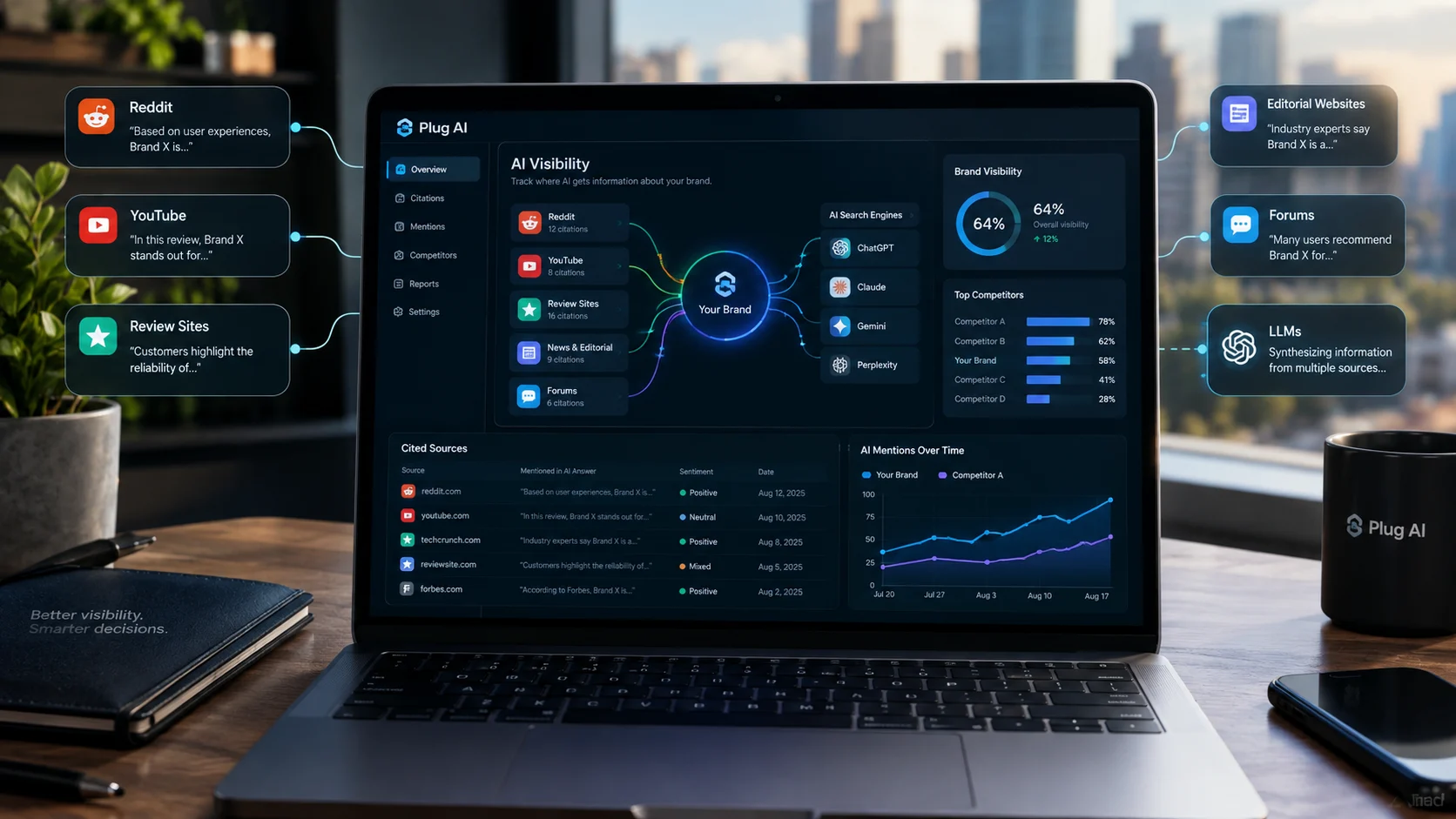
Plug AI is an AI search visibility platform focused on tracking where and how AI systems cite a brand across third-party websites and off-site content. Unlike traditional SEO tools that mainly monitor rankings on your own website, Plug AI focuses on the external pages that AI assistants may use when forming answers about your brand.
At a Glance
- Plug AI is built for AI search visibility, particularly off-site citations and mentions.
- It helps identify which external pages AI systems use when discussing a brand.
- Relevant sources can include Reddit, YouTube, forums, review sites, and other third-party pages.
- Plug AI is aimed primarily at SEO, marketing, brand, and growth teams, rather than general consumers.
- Its main distinction is its focus on off-site citation intelligence, rather than trying to be a complete SEO suite.
- Pricing and availability are still evolving because Plug is a relatively new product and currently operates under an early-access model.
What Is Plug AI?
Plug AI is an AI search visibility tool designed to show businesses how their brands appear in AI-generated search results and, importantly, which external sources contribute to those answers.
That distinction matters because AI search is not simply another version of Google.
When someone asks an AI assistant to recommend software, compare products, or identify companies in a category, the answer may draw from a mixture of company websites, review platforms, forums, social content, videos, editorial articles, and other sources.
A company therefore cannot rely solely on optimizing its own website.
Plug AI focuses on that less visible layer of the search ecosystem: the off-site content that AI systems cite or use when constructing answers about a brand.
Plug’s LinkedIn profile describes the product as an AI search visibility tool for tracking off-site content, with specialties including off-site content tracking and LLM citation ranking.
Plug AI vs. the other “Plug AI” apps
The name creates a genuine search-intent problem.
Several unrelated products use the Plug AI name. For example, Apple’s App Store and Google Play list Plug AI products designed as AI-powered dating or texting assistants.
This article is specifically about Plug AI at getplug.ai, the AI search visibility product.
That distinction is important if you are researching the platform for SEO, GEO, AEO, brand monitoring, or AI search optimization.
How Plug AI Works
The basic concept is straightforward.
Instead of asking only:
“Where does my website rank?”
an AI visibility platform asks:
“When potential customers ask AI about my category, which brands appear, and what sources does the AI cite?”
Plug’s differentiating angle is the second half of that question.
1. AI generates an answer
A user submits a natural-language question to an AI search system.
Examples might include:
- “What are the best project management tools for startups?”
- “Which CRM is best for a small SaaS company?”
- “What alternatives are there to [competitor]?”
- “Which accounting platforms integrate with Shopify?”
The response can contain brand recommendations and supporting citations.
2. AI retrieves or relies on external information
The information influencing an answer does not necessarily come from a company’s own domain.
It can come from third-party sources such as:
- Review websites
- Reddit discussions
- YouTube videos
- Industry publications
- Forums
- Comparison pages
- Product directories
- Other user-generated content
Plug’s public product description specifically highlights this off-site environment, including Reddit threads, YouTube reviews, forum answers, and review listings.
3. Plug identifies the cited sources
The platform’s value is not merely counting brand mentions.
The more useful question is:
Which specific URLs are being used to support the AI’s answer?
That can expose information a conventional SEO report may miss.
For example, a company might spend months improving its product pages while discovering that AI assistants are actually relying on a review-site comparison page, a Reddit discussion, or a YouTube review.
That changes the optimization strategy.
4. Marketers can investigate the source
Once a cited URL is identified, the marketing team can examine what the source says.
It may reveal:
- Outdated product information
- Missing features
- Incorrect pricing
- Weak positioning
- Competitor advantages
- Unfavorable reviews
- Strong third-party endorsements
- Content opportunities
- Unclaimed profiles
This is where citation tracking becomes actionable rather than simply another visibility metric.
Why Off-Site AI Citations Matter
Traditional SEO naturally encourages companies to concentrate on their own websites.
That remains important.
However, AI search introduces another layer of discoverability.
An AI system may understand a brand through a distributed collection of information across the web. The company controls only part of that information.
This creates an owned-versus-earned visibility problem.
Owned content
Owned content includes:
- Your website
- Documentation
- Blog posts
- Product pages
- Case studies
- Knowledge bases
You control these assets directly.
Earned and third-party content
Third-party content includes:
- Reviews
- Community discussions
- Editorial coverage
- Videos
- Industry comparisons
- Forums
- Software directories
You influence these sources, but you do not fully control them.
For AI search, both layers can matter.
That makes off-site citation monitoring particularly useful for brands that already have strong on-site SEO but still struggle to appear in AI-generated recommendations.
Key Features and Capabilities
Public information about Plug AI is still relatively limited compared with established SEO platforms, so it is important not to attribute unsupported features to the product.
The clearest documented capability is off-site AI citation tracking.
Off-site citation monitoring
Plug is designed to identify content outside a company’s own website that is being cited by AI systems.
That can help marketers move beyond the question of whether a brand appears.
They can investigate why it appears and where the supporting information comes from.
Citation and source analysis
The source itself can be as important as the mention.
Suppose an AI assistant recommends five products.
Your company appears in position four, but the answer repeatedly cites a third-party comparison article that ranks a competitor above you.
That source becomes a potential optimization target.
Creator attribution
Plug’s public descriptions indicate that the platform can associate cited off-site content with the creator behind the content.
This is useful when a brand wants to understand not only which URL is influential, but also who produced the information.
Multi-source visibility
The product is positioned around sources beyond traditional company websites.
That makes it particularly relevant to brands whose reputation is shaped by communities, reviews, creators, publishers, and comparison sites.
Who Should Use Plug AI?
Plug AI is most relevant to teams already working on AI search visibility, rather than people looking for a general-purpose chatbot.
Potential users include:
SEO and GEO teams
SEO professionals can use citation information to complement conventional keyword and ranking data.
The key difference is that traditional SEO asks where pages rank, while AI visibility research asks which sources appear inside synthesized answers.
Content marketers
Content teams can identify topics where competitors receive citations but their brand does not.
That can inform new content, digital PR, comparison pages, and reputation work.
SaaS companies
B2B software companies are particularly exposed to comparison-driven discovery.
A potential customer may ask an AI system to compare several products before ever visiting the vendors’ websites.
Understanding the sources behind those recommendations can therefore inform both content strategy and positioning.
Agencies
Agencies managing GEO or AEO programs need repeatable ways to monitor AI visibility for clients.
Off-site citation data can complement traditional reporting around rankings, traffic, backlinks, mentions, and conversions.
Plug AI vs. Traditional SEO Tools
Plug AI should not be viewed as a replacement for a conventional SEO platform.
The tools answer different questions.
| Area | Traditional SEO platform | Plug AI |
|---|---|---|
| Google keyword rankings | Core capability | Not the primary focus |
| Website SEO | Core capability | Not the primary focus |
| Backlinks | Common capability | Not the primary focus |
| AI answer visibility | Limited or specialized | Core focus |
| Off-site AI citations | Usually limited | Central use case |
| Third-party source discovery | Varies | Core positioning |
| AI recommendation analysis | Increasingly common | Central positioning |
The practical approach is therefore complementary.
A mature SEO program can use traditional tools for technical SEO, organic rankings, links, and traffic while using AI visibility software to understand generative search.
Plug AI Competitors and Alternatives
The AI visibility market has become crowded quickly.
However, not every platform solves the same problem.
Peec AI, for example, offers broader AI search analytics with metrics including visibility, position, sentiment, share of voice, competitor analysis, source analytics, AI referrals, and crawlability. Its current pricing page lists Starter, Pro, Advanced, and Enterprise offerings, with tracking based partly on prompts and models.
Other products in the broader AI visibility category include Profound, Otterly.ai, AthenaHQ, Scrunch, Sauce, and Searchable. Plug’s own industry comparison identifies these and other platforms while distinguishing between broad AI visibility suites and tools with a stronger off-site citation focus.
| Platform/Tool | Target User | Key Strength | Pricing Transparency | Core Limitation |
|---|---|---|---|---|
| Plug AI | SEO, GEO and growth teams | Off-site citation tracking | Early-access pricing currently reported | Newer product with a narrower focus |
| Peec AI | Brands and agencies | Broad AI search analytics | Public plans | Broader platform rather than purely off-site |
| Otterly.ai | SEO and marketing teams | AI search monitoring | Public pricing | Less specialized around creator-level off-site attribution |
| Profound | Enterprise teams | Enterprise AI visibility | More sales-led | Can be more than a small team needs |
| Sauce | Brands monitoring citations | Off-site citation use cases | Public entry pricing | Check frequency and engine coverage vary by tier |
This table should be treated as a functional comparison, not a ranking. Product capabilities and pricing can change quickly in this category.
Plug AI Pricing
Pricing deserves particular attention because Plug is still an emerging product.
Plug’s own August 2026 comparison content lists $0 during its early-access period, while explicitly distinguishing that from a permanent free tier.
That distinction matters.
A “free” early-access period does not necessarily tell you what the long-term commercial model will look like.
Before adopting Plug AI for ongoing reporting, buyers should confirm:
- The current subscription price
- Number of tracked prompts
- Number of AI engines
- Check frequency
- Historical-data retention
- Export options
- Team access
- API availability
- Client reporting
- Any future usage limits
For an agency, these details can matter more than the headline monthly price.
Privacy and Data Considerations
AI visibility tools can process commercially sensitive information.
Before connecting a brand or client account, review the vendor’s current privacy documentation and terms.
Pay particular attention to:
- What information is stored
- How long it is retained
- Whether prompts are stored
- Whether customer data is used for model training
- Who can access reports
- Whether data can be exported or deleted
- Whether third-party infrastructure processes the data
Do not assume that an AI product is private simply because it has security controls.
Likewise, SOC 2 certification and Zero Data Retention are different concepts. A SOC 2 report concerns controls evaluated against defined criteria; it does not automatically mean that customer data is never retained.
For enterprise procurement, request the actual security and data-processing documentation rather than relying on marketing terminology.
Important Limitations
Plug AI’s narrow focus is also its main limitation.
It does not replace SEO
Technical SEO, crawlability, information architecture, links, content quality, and search demand still matter.
AI visibility sits on top of a much larger search ecosystem.
AI answers are not perfectly deterministic
Generative systems can produce different answers for similar questions.
Results can vary by:
- Model
- Location
- Language
- User context
- Search history
- Prompt wording
- Time
- Retrieved sources
That means one AI answer should never be treated as a permanent ranking position.
Citation presence does not equal business impact
Being cited is useful evidence of visibility.
It does not automatically prove:
- More website traffic
- More leads
- Higher revenue
- Better conversion rates
- Stronger brand preference
Those outcomes require separate measurement.
Early-stage product risk
Plug is a young platform. Its LinkedIn profile lists the company as founded in 2026, and third-party product information describes the product as not yet having a mature marketplace presence.
That is not inherently negative, but buyers should account for the normal risks associated with early-stage software.
How to Use Plug AI Effectively
The biggest mistake is treating AI visibility as another vanity metric.
Instead, build a repeatable measurement process.
Step 1: Define buyer questions
Do not begin with random prompts.
Create questions based on actual customer intent:
- Category discovery
- Product comparison
- Alternative searches
- Use-case questions
- Problem-based searches
- Competitor comparisons
Step 2: Track the same prompts consistently
Changing prompts every week makes trends difficult to interpret.
Maintain a stable core prompt set.
Add experimental prompts separately.
Step 3: Record citations, not just mentions
A brand mention tells you that the company appeared.
A citation tells you what information supported the answer.
That distinction creates a more actionable workflow.
Step 4: Investigate recurring sources
If the same review site, Reddit thread, article, or video appears repeatedly, investigate it.
Look for:
- Accuracy problems
- Missing information
- Competitive positioning
- Outdated claims
- Opportunities for legitimate engagement
Step 5: Connect visibility to business outcomes
Where possible, compare AI visibility with:
- Referral traffic
- Branded search demand
- Demo requests
- Signups
- Assisted conversions
- Sales conversations
This turns GEO from an abstract visibility exercise into a measurable marketing program.
Common Mistakes When Using AI Visibility Tools
Optimizing only your own website
AI systems may rely heavily on third-party information.
Improving your homepage will not automatically change what Reddit, review sites, publishers, or videos say about you.
Chasing a single AI response
One answer is not a stable ranking.
Track patterns across a defined prompt set.
Treating every citation as equally valuable
A citation from an authoritative industry publication may matter differently from an obscure page.
Source quality and relevance still require human judgment.
Assuming AI visibility guarantees traffic
An AI answer can satisfy a user without generating a website visit.
Measure visibility separately from referral traffic and revenue.
Ignoring incorrect third-party information
If AI repeatedly surfaces outdated information about your product, publishing more content on your own site may not solve the problem.
First identify the external sources feeding the narrative.
Is Plug AI Worth Evaluating?
Plug AI makes the most sense for organizations asking a specific question:
“What external information is influencing how AI systems describe and recommend our brand?”
That is narrower than general SEO software, but it is also the reason the product can be useful.
If your primary requirement is comprehensive AI search analytics across visibility, sentiment, share of voice, competitors, crawlability, referrals, and reporting, broader platforms such as Peec AI may cover more of the workflow.
If your priority is understanding off-site citations and the third-party pages behind AI answers, Plug’s positioning is more directly aligned with that problem.
The decision should therefore depend on the measurement problem you need to solve, not simply the number of features on a pricing page.
FAQs
What is Plug AI?
Plug AI is an AI search visibility platform focused on tracking off-site content and the sources that AI systems cite when generating answers about brands. It is designed for SEO, marketing, GEO, and growth teams rather than as a general-purpose chatbot.
What makes Plug AI different from traditional SEO tools?
Traditional SEO tools primarily measure search rankings, website performance, backlinks, and organic visibility. Plug AI focuses on AI-generated answers and the third-party content that can influence those answers, particularly off-site citations.
Does Plug AI track Reddit and other third-party sources?
Plug’s public product descriptions specifically identify sources such as Reddit threads, YouTube reviews, forum answers, and review listings as part of its off-site citation tracking focus.
Is Plug AI free?
Plug’s current public material describes $0 access as an early-access period, rather than confirming a permanent free plan. Buyers should verify current pricing and usage limits before relying on the service for long-term reporting.
Is Plug AI a replacement for SEO?
No. Plug AI addresses AI search visibility and citation tracking, while traditional SEO covers areas such as technical optimization, organic rankings, backlinks, website content, and search demand. The two approaches can be used together.
Conclusion
Plug AI represents a narrower but increasingly important part of modern search optimization: understanding the external sources that AI systems use when describing a brand.
Its strongest differentiator is the focus on off-site citation intelligence rather than traditional website rankings alone. That makes it potentially useful for SEO teams, GEO specialists, agencies, SaaS companies and brands trying to understand why competitors appear in AI-generated recommendations.
The key consideration is not whether a brand receives a mention once. It is whether the same trusted sources repeatedly influence AI answers about the questions that matter to potential customers.
Before adopting Plug AI, evaluate its current engine coverage, prompt limits, tracking frequency, historical data, exports, privacy terms, and long-term pricing. Because the product is still evolving, those practical details may matter as much as its headline feature set.
In short: Plug AI is best understood as an off-site AI citation intelligence tool, not another generic chatbot or conventional SEO rank tracker.

Oliver Wilson is an AI researcher and tech writer living at the intersection of human creativity and machine intelligence. At AixOrbit.com, he decodes complex neural networks, generative AI and emerging tech trends into actionable insights making sure humans stay one step ahead of the algorithms.