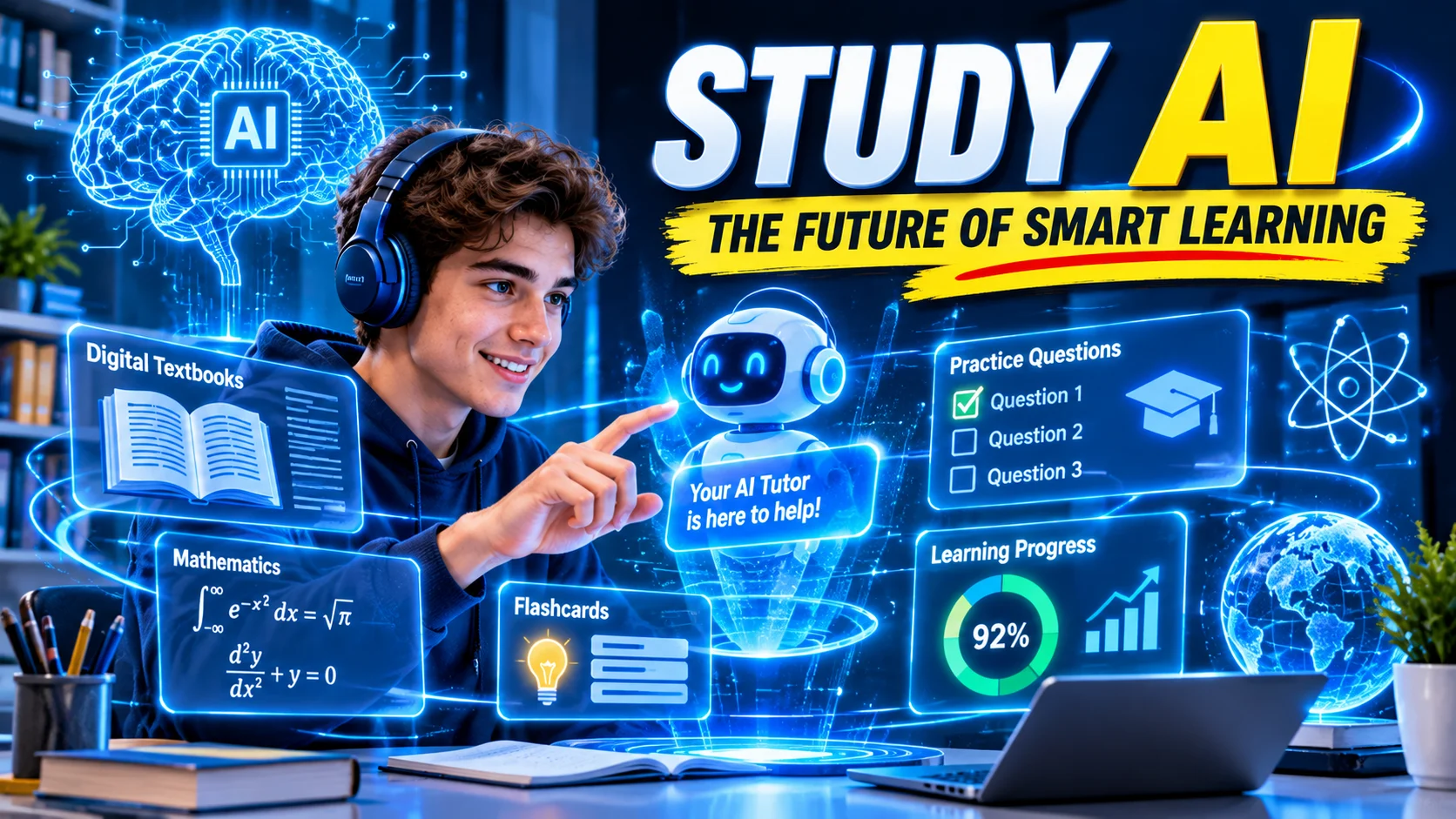
Study AI refers to using artificial intelligence tools to help students understand difficult subjects, organize study materials, practice questions and prepare for exams. These tools can personalize learning, explain complex topics, generate revision materials and provide instant feedback, but students should verify important answers and use AI responsibly.
Study AI at a Glance
- Personalized learning: AI can adapt explanations and practice activities to individual learning needs.
- Homework assistance: Students can receive step-by-step explanations for challenging questions.
- Exam preparation: AI tools can generate quizzes, flashcards, practice questions, and revision plans.
- Time management: Smart study assistants can organize tasks and help students manage deadlines.
- Learning accessibility: Some tools support different languages, learning formats, and accessibility needs.
- Important limitation: AI-generated information can contain mistakes, so independent verification remains essential.
What Is Study AI?
Study AI describes a growing category of artificial intelligence technology designed to make education more interactive, personalized, and accessible.
Instead of relying entirely on traditional textbooks, classroom explanations, and manual revision, students can use AI-powered applications to support different parts of their learning process.
These applications can:
- Explain difficult concepts in simple language.
- Answer questions about academic subjects.
- Summarize lengthy educational materials.
- Generate flashcards and practice examinations.
- Analyze uploaded notes and documents.
- Recommend topics that need additional revision.
- Help students organize assignments and study schedules.
The term also appears in the names of individual applications. For example, StudyAI offers step-by-step homework explanations, while other platforms use similar names for exam preparation and personalized learning.
The important distinction is that Study AI is not one universal software product. It is a broader approach to using artificial intelligence in education.
How Does Study AI Work?
Study AI systems combine several technologies to understand questions, process educational information, and generate useful responses.
The exact technology depends on the application, but most modern AI learning assistants use some combination of machine learning, natural language processing, and generative AI.
1. Understanding Student Questions
Natural language processing (NLP) allows an AI system to interpret written questions and understand their context.
For example, a student might ask:
“Why does the human heart have four chambers?”
The AI system identifies the subject, interprets the question, and generates an explanation appropriate to the requested level.
Students can also use voice input, images, or uploaded documents when their chosen platform supports these features.
2. Generating Personalized Explanations
Generative AI can produce explanations, examples, summaries, and practice questions.
A student struggling with algebra might request a simple explanation before moving toward more advanced calculations.
The system can adjust its response based on the student’s instructions and previous answers. However, personalization quality varies between platforms.
3. Analyzing Study Materials
Some AI study platforms allow students to upload:
- PDF textbooks
- Lecture notes
- Classroom presentations
- Research papers
- Worksheets
- Study guides
Certain tools use retrieval-augmented generation (RAG) to locate relevant information in uploaded materials before generating an answer.
This approach can make responses more closely connected to the student’s actual course content.
However, students should still check citations and compare important answers with the original documents.
4. Evaluating Learning Progress
Some educational platforms offer quizzes, progress tracking, and performance analysis.
These features help identify subjects where students repeatedly make mistakes.
For example, a student preparing for a biology examination might perform well in genetics but struggle with cellular respiration.
An AI-powered learning system can recommend additional practice in weaker areas.
Key Features of AI-Powered Study Tools
Not every platform offers the same features. The following capabilities are particularly useful when choosing an AI study assistant.
AI Homework Assistance
AI homework assistance helps students understand challenging academic questions.
Instead of searching through multiple websites, students can submit a question and request a structured explanation.
Useful capabilities include:
- Step-by-step mathematical solutions.
- Scientific concept explanations.
- Grammar and writing assistance.
- Programming explanations.
- Follow-up questions.
- Image-based question recognition.
The most educational approach is to understand the method rather than simply copy the final answer.
AI Flashcard Generation
Flashcards help students remember important information through repeated practice.
AI-powered applications can convert lecture notes and textbook passages into question-and-answer cards.
For example, uploading biology notes might produce flashcards covering:
- Cell structures
- Photosynthesis
- DNA replication
- Human anatomy
- Genetic inheritance
Students can then review these cards instead of manually creating every question.
Automatic Study Guides
Preparing revision notes can consume considerable time.
AI study tools can extract important ideas, identify key terminology, and organize information into structured study guides.
A useful study guide should contain:
- Main concepts.
- Important definitions.
- Supporting examples.
- Practice questions.
- Revision summaries.
Students should review automatically generated materials before using them for examination preparation.
AI Practice Tests and Quizzes
Practice examinations help students evaluate their understanding before actual tests.
AI systems can generate multiple-choice questions, short-answer exercises, and subject-specific quizzes.
Some platforms also explain incorrect answers, helping learners understand where their reasoning went wrong.
Personalized Study Planning
AI study planners can help students organize their academic responsibilities.
Depending on the application, these systems may support:
- Daily study schedules.
- Assignment reminders.
- Examination preparation timelines.
- Subject-based revision plans.
- Progress monitoring.
A realistic schedule should consider available study time, examination dates, and the difficulty of each subject.
Benefits of Study AI for Students
AI-powered education offers several practical advantages when students use it thoughtfully.
1. Faster Understanding of Difficult Subjects
Some academic concepts require repeated explanations before they become clear.
An AI assistant can explain the same topic using simpler language, different examples, or step-by-step instructions.
For instance, a physics student struggling with Newton’s laws can request everyday examples involving vehicles, sports, and moving objects.
This flexibility makes additional explanations available whenever needed.
2. More Flexible Learning
Traditional classroom instruction follows a fixed timetable.
AI study applications allow students to review topics outside classroom hours, subject to their internet connection and platform availability.
Students can ask questions during independent revision and revisit explanations whenever necessary.
3. Better Examination Preparation
Exam preparation requires more than reading textbooks repeatedly.
Students need to recall information, solve problems, and identify weaknesses.
AI-powered quizzes, practice questions, and flashcards can support these activities.
4. Reduced Time Spent Organizing Notes
Students often spend considerable time converting lecture materials into revision notes.
AI summarization and document-processing features can automate part of this preparation.
However, automatically generated summaries should not replace complete reading when detailed understanding is required.
5. Support for Different Learning Preferences
Some students understand information through written explanations, while others benefit from audio, diagrams, or practical examples.
Depending on the platform, AI tools can provide multiple presentation formats.
This flexibility can make educational materials easier to access and review.
6. More Opportunities for Independent Learning
Students can explore subjects beyond their classroom curriculum.
They can ask follow-up questions, investigate unfamiliar concepts, and practice new skills independently.
This can encourage curiosity and continuous learning.
Best Study AI Tools and Platforms to Consider
Several established platforms provide AI-powered educational features. They serve different purposes, so choosing between them depends on individual study requirements.
Feature comparison based on publicly available platform information reviewed in November 2026. Availability and pricing can change.
| Platform | Target user | Key strength | Pricing transparency | Main limitation |
|---|---|---|---|---|
| ChatGPT Study Mode | School and university students | Guided explanations and interactive learning | ChatGPT plan-dependent | Can make mistakes |
| Google NotebookLM | Students and researchers | Answers grounded in uploaded sources | Free access with usage limits | Depends on source quality |
| Quizlet | Exam candidates | Flashcards and practice tests | Free and paid features | Advanced features may require payment |
| StudyAI | Homework and revision students | Step-by-step question explanations | Free and paid subscriptions | Focused on answering study questions |
| Study AI | Nigerian examination candidates | Mock exams and exam-focused resources | Published student plan | Primarily focused on selected examinations |
ChatGPT Study Mode
ChatGPT Study Mode is designed to help students understand subjects rather than simply receive quick answers.
It can:
- Explain difficult topics step by step.
- Ask guiding questions.
- Generate practice questions.
- Review uploaded study materials.
- Provide feedback on student responses.
Students can access it through the Study option in supported ChatGPT interfaces.
Its main advantage is interactive learning. Students can ask for hints, request simpler explanations, and practice one question at a time.
Google NotebookLMGoogle NotebookLM is useful for students working with large collections of educational materials.
Students can upload supported sources and ask questions about their contents.
Its learning capabilities include:
- Source-based answers with citations.
- Document summaries.
- Flashcards.
- Practice quizzes.
- Study guides.
- Audio Overviews.
- Mind maps.
One important advantage is that answers can reference the original uploaded sources.
Quizlet
Quizlet focuses on memorization, active recall, and examination practice.
Its AI features can transform notes and uploaded materials into study guides, flashcards, and practice tests.
It is particularly useful for vocabulary, definitions, academic terminology, and repeated revision.
Some advanced capabilities require a paid subscription..
StudyAI Homework Assistant
StudyAI is also the name of a specific homework assistance application.
Its official website describes a service where students submit questions and receive step-by-step explanations.
Published features include:
- Question scanning.
- Typed questions.
- Follow-up questions.
- Saved answer history.
- Revision libraries.
- Support for multiple school subjects.
Its published web pricing lists a free plan with four questions per week, alongside paid weekly, monthly, and yearly subscriptions.
| Plan | Published price |
|---|---|
| Free | $0 |
| Weekly | $5.99 |
| Monthly | $11.99 |
| Yearly | $59.99 |
These are listed regular US-dollar prices, not guaranteed local checkout prices. Subscriptions automatically renew unless canceled.
Editorial distinction: These platforms are not interchangeable. ChatGPT emphasizes interactive explanations, NotebookLM emphasizes source-based learning, Quizlet emphasizes revision, and StudyAI emphasizes homework assistance.
Practical Ways to Use Study AI Effectively
The value of AI study tools depends heavily on how students use them.
Simply requesting answers may save time, but it does not necessarily improve understanding. A better approach is to use AI as an interactive learning partner.
Example 1: Learning Mathematics
A student struggling with quadratic equations can ask an AI assistant to:
- Explain quadratic equations using simple language.
- Demonstrate a worked example.
- Explain each calculation.
- Generate five similar practice questions.
- Check the student’s answers.
- Explain any mistakes.
This process combines explanation with independent problem-solving.
Example 2: Preparing for a Biology Examination
A biology student can upload lecture notes and request a structured revision session.
The AI assistant can create:
- Chapter summaries.
- Important biological definitions.
- Flashcards.
- Multiple-choice questions.
- Diagram explanations.
- Practice examination questions.
The student can then test their knowledge without repeatedly reading the same material.
Example 3: Improving English Skills
Language learners can use AI to practice grammar, vocabulary, reading comprehension, and writing.
They can request sentence corrections, explanations of grammatical rules, and conversational exercises.
For better results, students should request explanations for corrections instead of accepting rewritten sentences without understanding them.
Example 4: Understanding Research Papers
University students often struggle with technical research papers.
An AI tool that supports document uploads can help identify:
- Research objectives.
- Important terminology.
- Methodology.
- Main findings.
- Limitations.
- Conclusions.
Source-based tools are particularly useful because students can check generated explanations against the original paper.
How to Choose the Right Study AI Platform
Choosing an AI study application requires more than looking at its advertised features.
Students should consider their academic goals, available resources, privacy requirements, and budget.
Match Features to Your Learning Goals
Start by identifying the problem you want to solve.
| Learning requirement | Useful AI capability |
|---|---|
| Understanding difficult subjects | Interactive AI tutor |
| Memorizing definitions | Flashcard generator |
| Preparing for examinations | AI practice tests |
| Reviewing lecture notes | Document summarization |
| Managing assignments | AI study planner |
| Understanding research | Source-based AI assistant |
| Solving mathematics | Step-by-step problem explanations |
Avoid paying for features you will rarely use.
Check Free and Paid Usage Limits
Some platforms provide free access but restrict certain capabilities.
Before purchasing a subscription, check:
- Daily or weekly question limits.
- Monthly AI credits.
- File upload restrictions.
- Document size limits.
- Premium model availability.
- Subscription renewal terms.
- Cancellation procedures.
For example, StudyAI’s published web pricing includes four free questions per week. Its premium subscriptions remove that weekly question limit.
Other applications use different pricing structures.
Evaluate Answer Quality
An AI application should provide understandable explanations, not merely confident-sounding responses.
Test it with questions from your actual coursework.
Check whether it:
- Explains the reasoning.
- Handles follow-up questions.
- Identifies uncertainty.
- References reliable sources when appropriate.
- Corrects mistakes when challenged.
Do not judge accuracy from one successful answer.
Consider Device Compatibility
Students may need to study across different devices.
Check whether the application supports:
- Desktop browsers.
- Android devices.
- iPhones and iPads.
- PDF uploads.
- Image recognition.
- Offline access, if required.
Also check whether your subscription covers multiple devices.
Privacy and Security Considerations
Privacy deserves particular attention when students upload academic materials to AI applications.
Uploaded files and questions may contain personal information, institutional documents, or unpublished research.
Before using a platform, review its privacy policy and data-handling practices.
Important questions include:
- Does the provider store uploaded documents?
- Can submitted information be used for model training?
- How long is conversation history retained?
- Can users delete their data?
- Is information shared with third-party providers?
- Are institutional or enterprise privacy controls available?
Do not assume that a platform protects information simply because it uses encryption or advertises security features.
UNESCO’s guidance on generative AI in education emphasizes human-centered implementation, age-appropriate use, and the protection of personal data. UNESCO
Students should avoid uploading sensitive personal information or confidential institutional documents without permission.
Limitations of Study AI
Despite its educational potential, AI technology has limitations that students should understand.
1. Incorrect or Misleading Answers
Generative AI systems can produce incorrect information.
Sometimes an answer sounds convincing even when its facts, calculations, or references are wrong.
This is particularly important in mathematics, science, medicine, and technical subjects.
Always verify important information using trusted textbooks, academic sources, and teacher guidance.
2. Overdependence on AI
Using AI for every homework question can weaken independent problem-solving habits.
Students may become familiar with receiving answers without developing the ability to solve similar problems themselves.
The solution is to attempt questions independently before requesting assistance.
3. Limited Understanding of Academic Context
AI systems may misunderstand a teacher’s instructions, examination requirements, or subject-specific terminology.
A general explanation may not match the exact approach expected by a particular course.
Providing relevant course materials can improve context, but it does not guarantee perfect answers.
4. Subscription Costs
Some AI applications restrict useful features to paid plans.
Students may encounter limits on questions, uploads, advanced models, or generated learning materials.
Comparing the free tier with the actual requirements of a course can prevent unnecessary spending.
5. Academic Integrity Concerns
Schools and universities have different policies regarding AI-assisted assignments.
Submitting AI-generated work as entirely original work may violate institutional rules.
Students should use AI for learning, brainstorming, feedback, and practice while following their institution’s academic integrity requirements.
Study AI and the Future of Education
Artificial intelligence is changing how educational resources are created and delivered.
The next generation of educational applications is likely to place greater emphasis on adaptive learning, interactive tutoring, and evidence-based assessment.
Several developments are especially important.
More Personalized Learning Experiences
Future educational systems may use student performance data to identify knowledge gaps and recommend specific learning activities.
Instead of assigning identical revision exercises to every student, adaptive systems can adjust practice according to individual progress.
The effectiveness of these systems will depend on the quality of their educational design and assessment methods.
AI Learning Agents
AI agents are systems designed to complete tasks through multiple steps.
In education, specialized agents could help organize research, create revision schedules, generate exercises, and monitor learning activities.
However, their recommendations still require appropriate human oversight.
Better Integration With Educational Materials
AI applications are increasingly designed to work with textbooks, presentations, lecture recordings, and research documents.
This can make it easier for students to move between reading, questioning, reviewing, and testing their knowledge.
Source citations and document-grounded responses are particularly valuable developments.
Greater Focus on Responsible AI
As AI becomes more common in education, institutions will need clear policies covering privacy, transparency, accessibility, and academic integrity.
UNESCO’s education guidance provides an important framework for considering these issues.
AI should support teachers and learners rather than remove the human judgment essential to education.
Common Mistakes Students Should Avoid
Students can get better results by avoiding a few common mistakes.
- Copying answers: Read explanations and solve similar questions independently.
- Trusting every response: Verify facts, formulas, and important references.
- Uploading unreviewed documents: Check the privacy implications before sharing files.
- Using vague prompts: Mention your subject, academic level, and learning objective.
- Ignoring examination requirements: Follow your teacher’s instructions and syllabus.
- Relying only on summaries: Read original materials when detailed understanding matters.
- Paying without testing: Explore free features before purchasing subscriptions.
Frequently Asked Questions
1. What is Study AI used for?
Study AI is used to support learning through artificial intelligence. Students can use AI tools to understand difficult subjects, summarize educational materials, generate flashcards, solve practice questions, and prepare for examinations.
2. Is Study AI free to use?
Some AI study platforms offer free plans with limited features or usage allowances. Others require subscriptions for unlimited questions, advanced learning features, or additional resources. Pricing depends on the application.
3. Can Study AI help students prepare for exams?
Yes. AI study tools can generate practice tests, quizzes, flashcards, revision summaries, and personalized study schedules. Students should also practice independently and review their official course materials.
4. Is Study AI accurate for homework answers?
Study AI can provide useful explanations, but it is not always accurate. AI systems may misunderstand questions or generate incorrect information. Students should verify important answers using textbooks, teachers, and reliable educational resources.
5. Which Study AI tool is best for students?
The right platform depends on the student’s requirements. ChatGPT Study Mode is useful for guided explanations, NotebookLM for working with personal study materials, Quizlet for flashcards, and dedicated StudyAI applications for homework assistance.
Conclusion
Study AI represents a practical development in modern education. It gives students additional ways to understand difficult subjects, organize learning materials, and prepare for examinations.
However, its value depends on how responsibly students use it.
The most useful platform is not necessarily the one that generates answers fastest. Students should prioritize accurate explanations, helpful practice activities, transparent pricing, and appropriate privacy protections.
Whether you are a school student, university learner or independent researcher, AI can support your learning journey when combined with critical thinking and independent study.
The best approach is simple use AI to understand more, practice regularly and become a more independent learner.

Oliver Wilson is an AI researcher and tech writer living at the intersection of human creativity and machine intelligence. At AixOrbit.com, he decodes complex neural networks, generative AI and emerging tech trends into actionable insights making sure humans stay one step ahead of the algorithms.