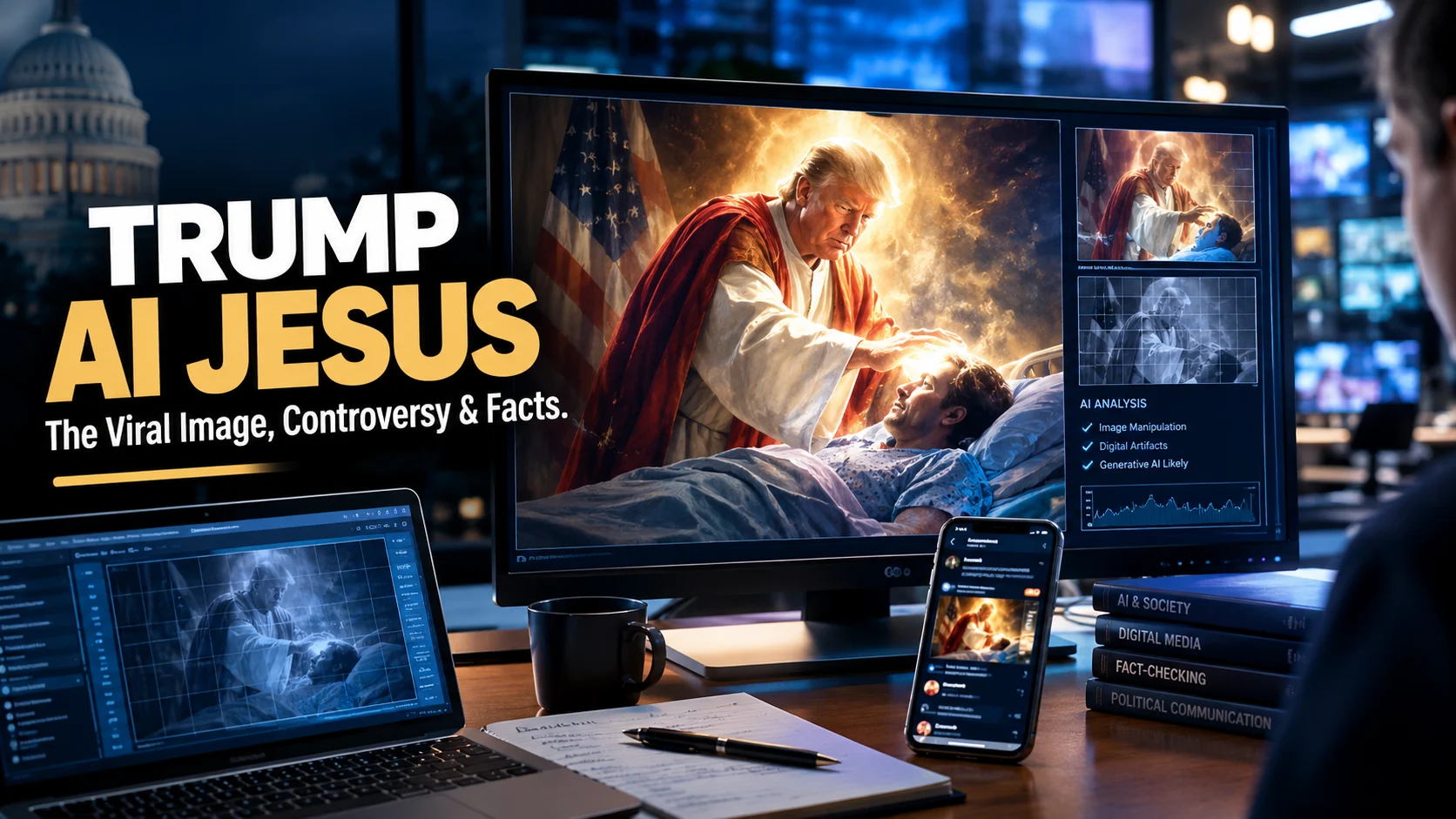
The Trump AI Jesus controversy began on April 12, 2026, when Donald Trump shared an AI-generated image on Truth Social that appeared to portray him as a Jesus-like healing figure. Trump later said he intended to depict himself as a doctor, and he deleted the post after widespread criticism, including from some conservative Christian supporters.
At a Glance
- What happened: Donald Trump shared an AI-generated image that resembled traditional depictions of Jesus Christ.
- Where it appeared: The image was posted on Trump’s Truth Social account.
- When it happened: April 12, 2026, followed by its deletion on April 13.
- Trump’s explanation: He said the image showed him as a doctor helping people, not as Jesus.
- Why it became controversial: Critics considered the religious imagery inappropriate or blasphemous, including some of Trump’s usual supporters.
- Why it matters: The incident highlights how AI-generated imagery can influence political debate, religious sensitivities, and public perceptions.
What Is the Trump AI Jesus Controversy?
The term Trump AI Jesus refers to a viral, AI-generated image of Donald Trump dressed in religious-style clothing and appearing to heal a sick person. The image circulated widely after Trump posted it on Truth Social, prompting debate over its symbolism, intended meaning, and political implications.
Unlike an ordinary photograph, the image was a digitally created visual depicting a scene that had not occurred as a real-world event. Its dramatic lighting, glowing hands, and traditional religious imagery contributed to the impression that Trump was being represented as a Christ-like figure.
The controversy was not simply about the use of artificial intelligence. It also involved the relationship between religion and political leadership, the limits of political satire, and the responsibilities of influential public figures who share synthetic media.
For readers searching for the original Trump Jesus AI image, the key distinction is that the post was real, but the depicted healing scene was not a documentary photograph of an actual event.
What Did the Trump AI Jesus Image Show?
The image showed Trump wearing a white robe with a red garment draped over his shoulders. He appeared to place a glowing hand on a man lying in a hospital bed, with bright light surrounding the figures.
Other elements included patriotic imagery and dramatic, supernatural-looking details. These visual choices made the scene resemble religious paintings that depict Jesus healing the sick.
The image’s composition mattered because people interpret pictures through familiar visual symbols. A white robe, radiant light, a healing gesture, and a suffering person can collectively suggest divine authority even when the creator does not explicitly label the subject as Jesus.
According to contemporary reporting, the version Trump shared was based on an earlier image posted online by conservative commentator Nick Adams. Trump’s version included alterations to the background, including a demonic-looking figure.
It is important to distinguish between the image’s visible content and claims about the creator’s intentions. The imagery explains why many viewers interpreted it as a depiction of Jesus, but the image alone cannot establish exactly what Trump intended when he shared it.
What Happened? A Timeline of the Trump AI Jesus Image
The controversy unfolded over roughly 24 hours. The sequence of events helps explain why the image attracted so much attention.
Feb 4
2026
Conservative commentator Nick Adams shared an image portraying Trump as a healing figure, presenting it as a metaphor for America’s recovery.
Apr 12
2026
Trump posts a modified version to Truth Social amid his public dispute with Pope Leo XIV over the war involving Iran.
Apr 13
2026
Religious conservatives and other commentators criticize the imagery. Trump deletes the post and tells reporters that he thought it depicted him as a doctor.
Why did the timing matter?
The post appeared shortly after Trump criticized Pope Leo XIV, who had spoken against the war and advocated peace. That context made the image more politically sensitive than a standalone AI-generated meme.
It was also Orthodox Easter Sunday. For many Christians, the timing and the image’s apparent use of sacred symbolism made the post especially offensive.
The sequence is documented in news reports, but the exact reasoning behind Trump’s decision to share the image remains a separate question.
Why Did Trump Delete the AI Jesus Image?
Trump confirmed that he posted the image and offered an explanation when reporters questioned him. He said he believed it showed him as a doctor or Red Cross worker helping people.
He also argued that media coverage had misinterpreted the picture. In a subsequent exchange, he said he did not want people to be confused.
The post was deleted after attracting criticism, including from people who ordinarily supported Trump. However, the precise internal decision-making behind its removal has not been established publicly.
Three points are worth separating:
- Confirmed: Trump posted the image and later removed it.
- Trump’s stated explanation: He understood the image as portraying a doctor who makes people better.
- Public interpretation: Many viewers saw the robes, glowing light, and healing gesture as unmistakably Christ-like.
Deleting a post does not automatically establish an admission of wrongdoing. Equally, an explanation offered after a controversy does not erase the imagery that audiences originally saw.
The most accurate account preserves all three facts without assuming motives that cannot be independently verified.
Why Did the Trump Jesus AI Image Spark Religious Backlash?
The backlash reflected a collision between political messaging and religious symbolism.
For Christians, Jesus Christ is central to their faith. An image that appears to place a political leader in the role of Jesus can therefore be interpreted as disrespectful, especially when it uses familiar representations of divine healing.
Some conservative Christian voices condemned the image as blasphemous. Their reactions demonstrated that support for a political leader does not necessarily extend to every image, joke, or symbolic comparison involving that leader.
1. Sacred imagery and political self-presentation
Religious imagery carries meanings that extend beyond its literal content. A figure dressed in biblical-style robes and surrounded by radiant light can evoke holiness, redemption, or supernatural power.
When such imagery is applied to a president, audiences may read it as a comparison between political authority and divine authority, whether or not that comparison was intended.
2. Different audiences interpret images differently
Supporters may see a political meme as exaggerated humor or a metaphor for national recovery. Other viewers may see the same picture as arrogant, offensive, or religiously inappropriate.
Neither reaction can be inferred from the image alone. Audience beliefs, religious commitments, political identity, and the timing of publication all shape interpretation.
3. The dispute involved more than one image
The controversy developed alongside Trump’s public criticism of Pope Leo XIV. That background connected the visual controversy to broader disagreements about religious leadership, political authority, and the moral implications of war.
The result was a debate that extended beyond AI art. It became a discussion about how political figures use religious symbols and how their supporters respond when those symbols cross perceived boundaries.
Is the Trump AI Jesus Image Real or Fake?
The answer depends on what the word real means.
| Question | Evidence-based answer |
|---|---|
| Did Trump share the image? | Yes. Contemporary reporting and fact-checking confirmed the post. |
| Was it an ordinary photograph of a real healing event? | No. It was an AI-generated depiction, not documentary evidence of such an event. |
| Did Trump later remove it? | Yes. The post was deleted on April 13, 2026. |
| Did Trump say he intended to portray Jesus? | No. He said he thought the image showed him as a doctor. |
| Was the original image created for Trump’s post? | Reporting traced a similar image to an earlier post by Nick Adams. |
| Does the image establish what Trump intended? | No. Visual interpretation cannot conclusively establish private intent. |
This distinction is important because political misinformation often mixes a genuine social media post with misleading claims about what the image proves.
In this case, the post itself was authentic as a published social media item. The scene depicted within it was synthetic. Calling the entire incident fake would be inaccurate, just as presenting the generated scene as a real healing event would be misleading.
How can you verify a viral AI image?
Use several checks rather than relying on one visual clue.
- Find the original post. Look for a primary-source account, a credible archive, or contemporaneous reporting that confirms when the image appeared.
- Compare earlier versions. Reverse-image search can reveal whether a picture existed before the latest post or was modified from an earlier design.
- Check reputable fact-checkers. Search for independent reporting that verifies the post and distinguishes confirmed details from speculation.
- Inspect provenance information. Some AI tools support content credentials or watermarks that provide information about an image’s origin.
- Avoid judging solely by appearance. Visual errors can raise questions, but realistic details do not prove authenticity, and imperfect details do not independently prove AI generation.
Tools such as Content Credentials, based on the C2PA standard, can preserve information about a file’s origin and editing history when supported. However, missing metadata does not prove an image is genuine, and provenance information alone does not establish whether its accompanying claims are true.
How AI-Generated Political Images Shape Public Opinion
The Trump AI Jesus controversy illustrates a broader change in political communication: synthetic images can spread political narratives without showing an actual event.
Generative AI systems create images from text prompts, reference images, or combinations of both. Depending on the system, users can generate new scenes, change backgrounds, alter clothing, and modify visual details without traditional photography.
A finished image can then circulate as a meme, a social media post, a news illustration, or a purported record of something that happened. Once it spreads beyond its original context, viewers may not know who created it or how it was edited.
The difference between a political meme and misinformation
AI-generated content is not automatically misinformation. Its purpose and presentation matter.
| Content type | Example | Main concern |
|---|---|---|
| Clearly labeled satire | An exaggerated image of a politician as a superhero | Viewers may misunderstand the joke |
| Political propaganda | An idealized image designed to promote a candidate | Persuasion through emotional symbolism |
| Misleading synthetic media | A generated scene presented as a real event | False impressions about what happened |
| Fabricated evidence | An AI image used to support a false accusation | Damage to reputations and public trust |
| Edited historical imagery | A modified image presented without context | Distortion of the historical record |
The same image can also move between categories depending on how people share it. A clearly satirical image may become misleading when reposted without its original caption.
Why emotional images travel quickly
Images communicate through color, expression, symbolism, and composition. A viewer can understand the broad emotional message of an image before reading its caption.
AI tools make producing such visuals easier. Political creators can experiment with dramatic scenes that would otherwise require complex editing, staged photography, or professional illustration.
This accessibility has legitimate creative uses. It also reduces the effort needed to produce persuasive but misleading imagery.
The practical lesson is simple: an image can be authentic as a social media post without being authentic as a depiction of reality.
What the Trump AI Jesus Controversy Reveals About Political Communication
The incident offers several lessons for journalists, voters, content creators, and anyone who follows political news online.
Visual symbolism can overpower a caption
A creator may intend a picture to communicate strength, recovery, humor, or leadership. Yet visual symbols can carry associations that compete with the caption’s intended message.
In this case, the healing gesture and biblical-style clothing encouraged many viewers to interpret the image as a depiction of Jesus. Trump’s explanation that he intended to show a doctor did not eliminate that interpretation.
Public figures face different standards of interpretation
When a prominent politician publishes an image, audiences often examine it for clues about character, judgment, values, and political strategy.
A private meme shared among friends may attract little attention. A similar image posted by a president can become a major news story because of the officeholder’s influence and the audience’s expectations.
Deletion does not erase digital circulation
Once an image is shared, people can take screenshots, create copies, and distribute them across other platforms. Removing the original post may stop that account from displaying it, but it cannot guarantee that all copies disappear.
This is why fact-checking should examine the original publication, the image’s history, and subsequent edits rather than treating a deleted post as proof that the incident never happened.
Context matters as much as the image itself
An image shared during a religious holiday or a dispute with a religious leader may carry meanings that it would not have in another setting.
For accurate reporting, readers should examine the publication date, surrounding posts, the creator’s stated explanation, and reactions from relevant communities. These details help explain the controversy without requiring unsupported speculation about motives.
What Should Users Learn From the Trump AI Jesus Image?
You do not need advanced technical knowledge to evaluate a controversial AI image. A few consistent habits can reduce the risk of sharing false or misleading content.
- Pause before reposting. Strong emotional reactions can make questionable content feel more convincing.
- Look for the earliest available version. Earlier posts may reveal a creator, an original caption, or later alterations.
- Separate facts from interpretation. Confirm that an image was posted before drawing conclusions about what it represents.
- Read beyond headlines. News summaries may omit the creator’s explanation, the timing, or important qualifications.
- Be careful with screenshots. A screenshot can document a post, but it can also be cropped, edited, or detached from its context.
- Treat automated AI detectors cautiously. Detection tools can make mistakes and should not be treated as definitive proof of authorship.
For publishers, the lesson is equally important. Label synthetic visuals clearly, preserve available provenance information, and avoid presenting generated scenes as documentary photography.
For political commentators, transparent labeling helps audiences distinguish between illustration, satire, advocacy, and factual reporting.
Frequently Asked Questions About Trump AI Jesus
1. Did Donald Trump post an AI image of himself as Jesus?
Yes. Donald Trump posted an AI-generated image on Truth Social on April 12, 2026, that many viewers interpreted as portraying him as Jesus Christ. He deleted it the following day after criticism from religious commentators and others.
2. Why did Trump say the AI Jesus image showed him as a doctor?
Trump told reporters that he thought the image portrayed him as a doctor or Red Cross worker helping people. The image’s robes, glowing light, and healing gesture led many viewers to interpret it as a Christ-like depiction instead.
3. Where did the Trump AI Jesus image come from?
Reporting traced a similar version to a February 4, 2026, post by conservative commentator Nick Adams. Trump’s April version contained apparent changes to the background, although the full creation and editing process has not been conclusively established.
4. Why did Christians criticize the Trump AI Jesus meme?
Some Christians considered the image blasphemous because it appeared to place a political leader in the role of Jesus. The timing, the religious symbolism, and Trump’s public dispute with Pope Leo XIV contributed to the backlash.
5. How can you tell whether a Trump AI image is authentic?
Check whether the original social media post can be verified, compare the image with earlier versions, and consult reputable news reports or fact-checkers. AI detection tools and image metadata can offer clues, but neither should be treated as conclusive evidence on its own.
Conclusion
The Trump AI Jesus controversy was more than a viral political meme. It demonstrated how AI-generated imagery, religious symbolism, and political conflict can combine to create a story that reaches far beyond its original social media post.
The central facts are clear: Trump shared the image, many viewers interpreted it as Christ-like, he explained that he intended to portray a doctor, and he subsequently deleted the post.
For readers, the most useful takeaway is to distinguish verified events from visual interpretation and speculation about intent. As generative AI becomes more accessible, understanding the difference between a real post and a real-world event will become increasingly important.

Oliver Wilson is an AI researcher and tech writer living at the intersection of human creativity and machine intelligence. At AixOrbit.com, he decodes complex neural networks, generative AI and emerging tech trends into actionable insights making sure humans stay one step ahead of the algorithms.