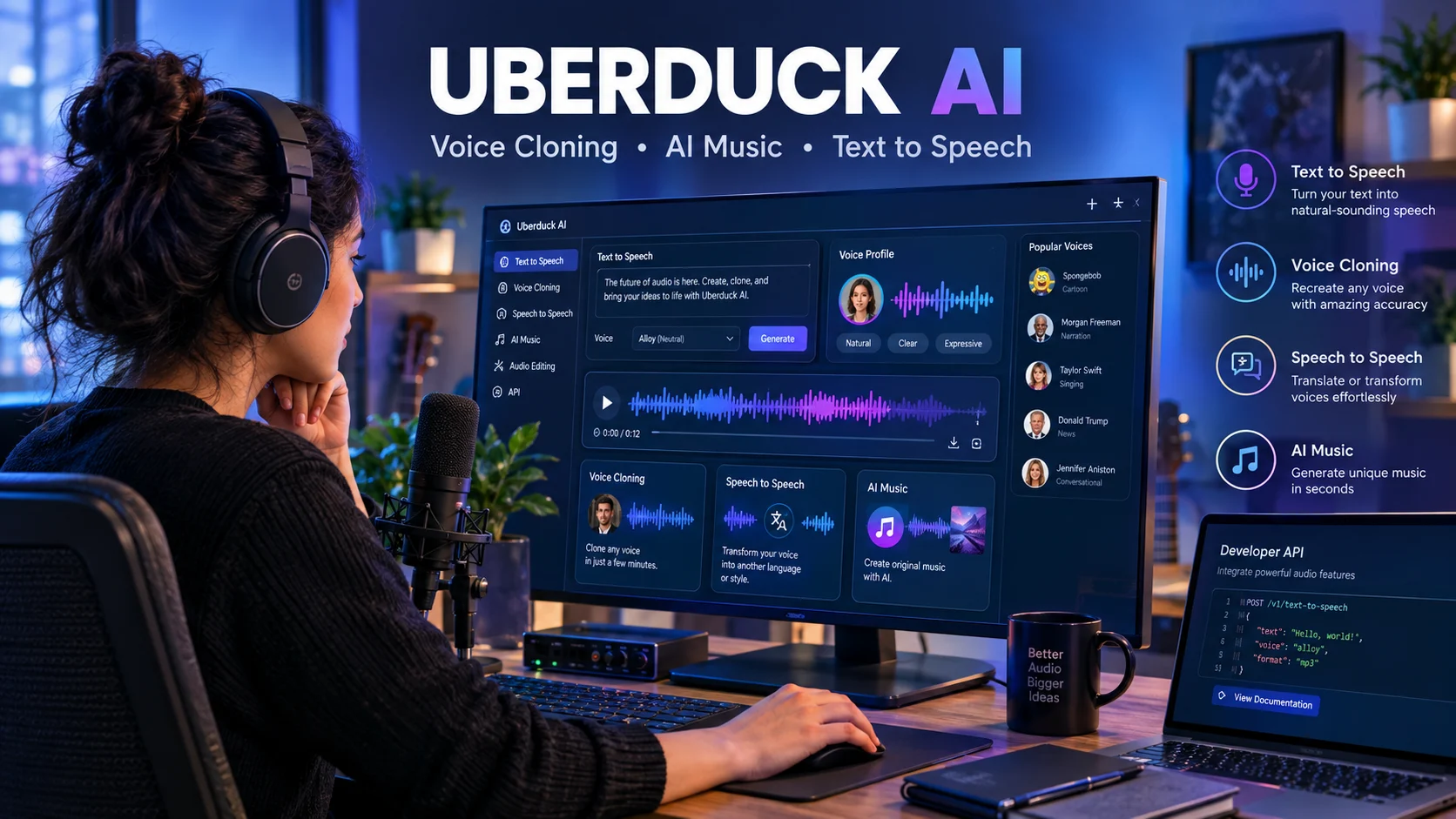
Uberduck AI is a generative media platform for AI voice generation, voice cloning, speech-to-speech conversion, and AI music creation. It also provides an API for developers who want to integrate text-to-speech, voice cloning, and music generation into applications.
At a Glance
- Core focus: AI voices, text-to-speech, voice cloning, speech-to-speech, and AI music.
- Voice capabilities: Generate speech, clone voices, and transform spoken audio into another voice.
- Creative tools: AI-generated songs, raps, voiceovers, jingles, and other audio content.
- Developer access: Uberduck provides an API with text-to-speech, voice-cloning, and music-generation capabilities.
- Current pricing: Paid plans currently start at $2 per month when billed annually.
- Important limitation: Older community-created celebrity and character voices were removed because of ethical and legal concerns.
What Is Uberduck AI?
Uberduck AI is an AI-powered audio and media-generation platform built around synthetic voices and creative audio. Its current product combines text-to-speech, custom voice creation, speech-to-speech conversion, and AI music generation.
That makes Uberduck different from a traditional text-to-speech website. A user can write a script and generate spoken audio, create a custom voice, transform existing speech, or generate music from a text description.
The platform also targets developers. Uberduck’s API provides a unified interface for speech synthesis, voice cloning, and music generation. Its documentation describes a model-and-provider architecture that can expose different speech models and voices through the same API. (Uberduck API)
Uberduck is also worth understanding historically. The platform became widely known for its large collection of user-created character and celebrity-style voices. Uberduck removed those voices in July 2023 because of ethical and legal concerns surrounding voices created without explicit consent. (Uberduck)
The current product is therefore more focused on authorized custom voices, professional voice generation, AI music, and creator workflows.
How Does Uberduck AI Work?
At a basic level, Uberduck converts an input such as text, audio, or a music description into generated media.
Text-to-Speech
With text-to-speech, you provide written content and select an available voice and language. Uberduck then generates an audio file containing synthesized speech.
Its current text-to-speech interface supports numerous languages and a large collection of voices. The English section alone currently lists more than 200 built-in voices. (Uberduck)
The workflow is straightforward:
- Enter or prepare your script.
- Choose a voice.
- Select the appropriate language or model where available.
- Generate the audio.
- Review and export the result.
This can work well for short-form videos, narration, prototypes, podcasts, games, educational content, and other projects where recording a human voice is inconvenient.
Voice Cloning
Voice cloning is one of Uberduck’s more important current capabilities.
The platform allows users to create custom voices from recorded or uploaded audio. Uberduck says its system can reproduce characteristics such as tone, timbre, and accent. (Uberduck)
A typical workflow involves supplying a voice sample, creating a voice model, and then using that model for generated speech or voice conversion.
The critical issue is authorization. Voice cloning is not simply a technical problem. A user must have the legal right to clone and use the voice.
Uberduck’s terms specifically state that it may verify whether a user is legally permitted to create a custom voice clone. (Uberduck)
Speech-to-Speech
Uberduck also supports speech-to-speech conversion.
Instead of starting with text, you provide spoken audio. The system can then transform that performance into another voice while attempting to preserve aspects of the original delivery.
This is useful for creators who want to perform a line themselves but change the resulting voice.
It can also be useful for character production, demos, entertainment, and voice experimentation.
AI Music Generation
Uberduck has expanded into AI music generation.
Its current music tool allows users to describe a song idea using natural language. The platform says it can generate songs for use cases such as social media, YouTube videos, podcasts, game projects, jingles, and other creative work. (Uberduck)
This makes Uberduck broader than a conventional AI voice generator.
The platform now sits somewhere between:
- AI voice generator
- text-to-speech platform
- voice cloning tool
- speech-to-speech system
- AI music generator
- creative media API
That broader positioning is one of the biggest changes in how Uberduck should be evaluated today.
Key Uberduck AI Features
AI Voice Generation
Uberduck provides a library of voices for converting written scripts into speech.
The available selection varies by language and voice category, so users should evaluate actual samples rather than assuming every voice has the same quality.
Voice Cloning
Custom voice creation lets creators generate speech using a voice based on their own recorded samples.
This can reduce the need to record every line manually, especially for recurring content.
Multilingual Text-to-Speech
Uberduck currently advertises support for more than 70 languages across its platform, while its language directory lists a broad range of languages including English, Spanish, French, German, Hindi, Urdu, Arabic, Japanese, Korean, Portuguese, Turkish, and others. (Uberduck)
However, language availability should not be confused with identical voice quality across every language. A professional project should always test the exact language and voice combination before production.
AI-Generated Music
Users can generate music from text descriptions.
Potential applications include background tracks, social content, podcast music, game concepts, jingles, and creative experiments.
AI-Generated Raps
Uberduck’s paid Creator and Pro plans specifically list AI-generated raps as a feature. (Uberduck)
This connects with Uberduck’s earlier identity as a rap and character-voice platform while fitting into its broader current generative-media strategy.
Developer API
Uberduck offers an API for developers.
The current documentation lists capabilities including:
- Text-to-speech
- Voice cloning
- Music generation
- Voice and model discovery
- API authentication
- Audio output formats
The text-to-speech endpoint currently accepts text of up to 10,000 characters and can return formats such as MP3, WAV, and OGG. (Uberduck API)
The API documentation also shows that Uberduck can expose models from different providers. Examples in its documentation include AWS, Google, and Azure speech models. (Uberduck API)
That is an important technical distinction: Uberduck is not necessarily synonymous with one proprietary speech model.
Uberduck AI Use Cases
Uberduck can serve several types of users.
Content Creators
Creators can use AI voices for:
- YouTube narration
- Short-form videos
- Social media clips
- Character content
- Podcast segments
- Advertisements
- Intro and outro audio
Voice cloning can also help creators maintain a consistent voice without recording every piece of content.
Musicians and Songwriters
The AI music and rap features can help with experimentation, demos, jingles, and creative concepts.
It is better viewed as a generation and ideation tool than as a replacement for a complete professional music-production workflow.
Game Developers
Developers can use synthetic voices for prototypes, NPC dialogue, character concepts, and other game-audio workflows.
The API can also be relevant when generated speech needs to become part of an application rather than remaining a manually created audio file.
Marketers
Marketing teams can use generated voices for advertisements, product demonstrations, social campaigns, and branded audio.
Commercial licensing becomes especially important here. The plan you choose matters because Uberduck’s current Starter plan is listed as non-commercial, while Creator and Pro include commercial licenses. (Uberduck)
Developers
Developers may be interested in Uberduck when they need a single API layer across multiple voice and media-generation capabilities.
The model/provider abstraction can also be useful when an application needs access to different speech systems without building every integration independently.
Uberduck AI Pricing
Uberduck’s current public pricing is relatively inexpensive at the entry level.
| Plan | Current price* | Commercial use | API access | Monthly credits |
|---|---|---|---|---|
| Starter | $2/month | No | Not listed | 1,000 |
| Creator | $5/month | Yes | Yes | 3,600 |
| Pro | $30/month | Yes | Yes | 25,000 |
*The listed $2, $5, and $30 prices are the annual-billing prices shown on Uberduck’s current pricing page. (Uberduck)
Starter
The Starter plan is designed for experimentation and smaller tasks.
It includes 1,000 monthly credits and private voice access, but the current pricing page identifies the license as non-commercial. (Uberduck)
Creator
Creator costs $5 per month when billed annually.
It adds commercial licensing, API access, AI image generation, custom AI image clones, AI-generated raps, and 3,600 monthly credits. (Uberduck)
Pro
The Pro plan costs $30 per month when billed annually.
It provides 25,000 monthly credits and includes the Creator-level features, along with a stated 24-hour support response time. (Uberduck)
Because pricing and included credits can change, users should check the live pricing page before purchasing.
Is Uberduck AI Free?
Uberduck offers ways to try several capabilities without immediately committing to a paid subscription, but free access should not be confused with unrestricted commercial use.
The most important distinction is licensing.
Uberduck’s current pricing page identifies Starter as non-commercial and Creator and Pro as commercial. (Uberduck)
If you plan to monetize YouTube videos, advertisements, client work, branded content, or another commercial project, check the applicable license before publishing.
Uberduck AI Privacy and Security
Privacy deserves particular attention when using voice cloning.
Uberduck’s privacy policy says it collects personal information such as email addresses and usage data, and it may transfer personal data to and process it in the United States. The policy also says personal data is retained for as long as necessary for stated purposes and legal obligations. (Uberduck)
The policy does not establish a blanket zero-data-retention promise.
That distinction matters for businesses handling sensitive voice recordings.
Uberduck’s terms provide a more specific statement for custom voice clones: the company says it will not expose the submitted clone data to other users or use it to create voice clones beyond the user’s private voice clone, while also reserving the right to delete clone data. (Uberduck)
For sensitive corporate or regulated workflows, review the current contractual and privacy documentation rather than assuming that a general security statement means Zero Data Retention.
What Happened to Uberduck’s Celebrity Voices?
This is one of the most common questions about Uberduck.
Uberduck became famous for user-created voices resembling well-known characters and public figures. That historical reputation still influences many search results for the platform.
However, Uberduck says it removed its large collection of community-created character voices in July 2023 because of ethical and legal concerns about voices belonging to people or characters without explicit consent. (Uberduck)
This is important for anyone reading older Uberduck tutorials.
A guide from several years ago may describe voices that are no longer available.
The current Uberduck experience should therefore be evaluated based on its present voice library, custom voice tools, licensing, and generation capabilities.
Uberduck AI API and Technical Considerations
The Uberduck API is potentially more important to developers than the consumer interface.
Its documentation describes a unified API architecture in which capabilities are separated from models and providers. This can make the system easier to integrate because developers work with standardized endpoints while selecting supported voices or models. (Uberduck API)
The current API includes a text-to-speech endpoint with a 10,000-character maximum for the text field. It supports MP3, WAV, and OGG output formats. (Uberduck API)
Developers should still evaluate:
- API latency
- Rate limits
- Credit consumption
- Model availability
- Voice availability
- Error handling
- Output consistency
- Commercial licensing
- Data handling
- Vendor dependency
For production applications, a successful demo is not enough. Run representative workloads and measure response times, failure rates, and audio quality.
Uberduck AI Limitations
Uberduck has a broad feature set, but there are several reasons to test it carefully.
Voice Quality Can Vary
Not every voice will sound equally natural.
Voice quality depends on the underlying model, language, voice, input text, and generation settings. A strong result from one voice does not guarantee the same result from another.
Voice Cloning Requires Consent
Voice cloning creates legal and ethical risks when users clone someone without permission.
Uberduck’s own terms recognize this issue and allow the company to verify whether users have the legal right to create a clone. (Uberduck)
Older Tutorials Can Be Misleading
Many older articles focus heavily on celebrity and character voices.
Those guides may no longer describe the current product because Uberduck removed many community-created voices in 2023. (Uberduck)
Commercial Licensing Depends on the Plan
The inexpensive Starter plan is listed as non-commercial.
That makes the $2 entry price attractive for experimentation but less relevant to businesses that need commercial rights. (Uberduck)
AI Music Rights Need Careful Review
AI music licensing is complicated.
Users should review the current Uberduck terms and the terms attached to their plan before using generated music commercially, especially for client work, distribution, advertising, or monetized content.
Uberduck AI vs Alternatives
Uberduck competes across several categories rather than one narrow market.
| Platform/Tool | Target user | Key strength | Pricing transparency | Core limitation |
|---|---|---|---|---|
| Uberduck | Creators, developers, media teams | Voices, cloning, music, API | High | Broad platform means users should test specific models and voices |
| ElevenLabs | Creators, developers, businesses | Advanced voice generation and voice conversion | High | Can become more expensive as usage grows |
| Suno | Musicians and creators | Full AI music creation | High | Primarily music-focused rather than general voice infrastructure |
| Hugging Face | Developers and researchers | Open model ecosystem | Varies by model/service | Requires more technical evaluation and setup |
Uberduck, ElevenLabs, Suno, and Hugging Face occupy different positions in the AI audio ecosystem.
Uberduck vs ElevenLabs
ElevenLabs is a stronger comparison when the primary requirement is high-quality synthetic speech and voice conversion.
ElevenLabs currently offers text-to-speech, voice changer functionality, voice cloning, speech-to-text, and developer APIs. Its published pricing starts at $6 per month for the Starter tier on the current voice pages. (ElevenLabs)
Uberduck is more interesting when the workflow combines voices with AI music and other creative-generation features.
Uberduck vs Suno
Suno is a more direct competitor for AI music.
Suno’s current paid Pro plan starts at $8 per month when billed annually and includes commercial-use rights, while its free plan does not provide commercial rights. (Suno)
If your main goal is complete AI song production, Suno’s specialized music workflow may be more appropriate.
If you want a combination of voice tools, cloning, speech conversion, and music, Uberduck offers a broader mix.
Who Should Use Uberduck AI?
Uberduck is worth considering if you need several of these capabilities in one platform:
- AI text-to-speech
- Custom voice cloning
- Speech-to-speech conversion
- AI-generated music
- AI rap generation
- Multilingual voice generation
- Developer API access
- Creator-oriented audio production
It may be particularly useful for content creators, developers, game teams, marketers, educators, and experimental media projects.
It is less suitable when you need a highly specialized enterprise voice stack and require extensive guarantees around compliance, data residency, contractual data retention, or regulated workloads.
Common Uberduck AI Mistakes
Assuming Every Voice Is Commercially Usable
A generated voice is not automatically cleared for every commercial application.
Check the license attached to your plan and the rights associated with the particular voice or content.
Using Someone Else’s Voice Without Permission
Technical ability does not equal legal permission.
Only clone voices when you have the necessary authorization.
Trusting Old Character-Voice Lists
Older Uberduck content can be outdated.
The removal of community-created character voices means historical lists should not be treated as current inventories. (Uberduck)
Choosing a Plan Only by Price
The $2 Starter price looks attractive, but it is explicitly non-commercial.
For monetized projects, the licensing difference can matter more than the subscription cost. (Uberduck)
FAQs About Uberduck AI
Is Uberduck AI still available?
Yes. Uberduck is currently operating as an AI media-generation platform offering text-to-speech, voice cloning, speech-to-speech, AI music, and developer APIs. Its product has evolved significantly from its earlier community-voice reputation. (Uberduck)
Is Uberduck AI free?
Uberduck provides free access or trials for some capabilities, while its current paid pricing begins at $2 per month when billed annually. The Starter plan is listed as non-commercial, so users should check licensing before monetizing generated content. (Uberduck)
Can Uberduck clone my voice?
Yes. Uberduck currently offers voice cloning from microphone recordings or uploaded audio. Its terms state that it may verify whether users are legally permitted to create the requested clone. (Uberduck)
Can I use Uberduck AI for commercial content?
Commercial use is available on the current Creator and Pro plans, according to Uberduck’s pricing page. The Starter plan is listed as non-commercial, so creators should select the appropriate plan and review the applicable terms. (Uberduck)
What happened to Uberduck’s celebrity voices?
Uberduck removed many community-created character and individual voices in July 2023 because of ethical and legal concerns about consent. Current users should not assume that voices featured in older Uberduck articles remain available. (Uberduck)
Conclusion
Uberduck AI has evolved from its early reputation as a playground for character and celebrity-style voices into a broader generative-audio platform. Its current capabilities cover text-to-speech, voice cloning, speech-to-speech conversion, AI music, rap generation, multilingual audio, and developer APIs.
The biggest factors to evaluate are voice quality, licensing, cloning permissions, credit usage, API requirements, and privacy. For creators who want multiple AI audio capabilities in one service, Uberduck is worth testing; users with highly specialized voice or music requirements should compare actual outputs against platforms such as ElevenLabs and Suno before committing.

Oliver Wilson is an AI researcher and tech writer living at the intersection of human creativity and machine intelligence. At AixOrbit.com, he decodes complex neural networks, generative AI and emerging tech trends into actionable insights making sure humans stay one step ahead of the algorithms.