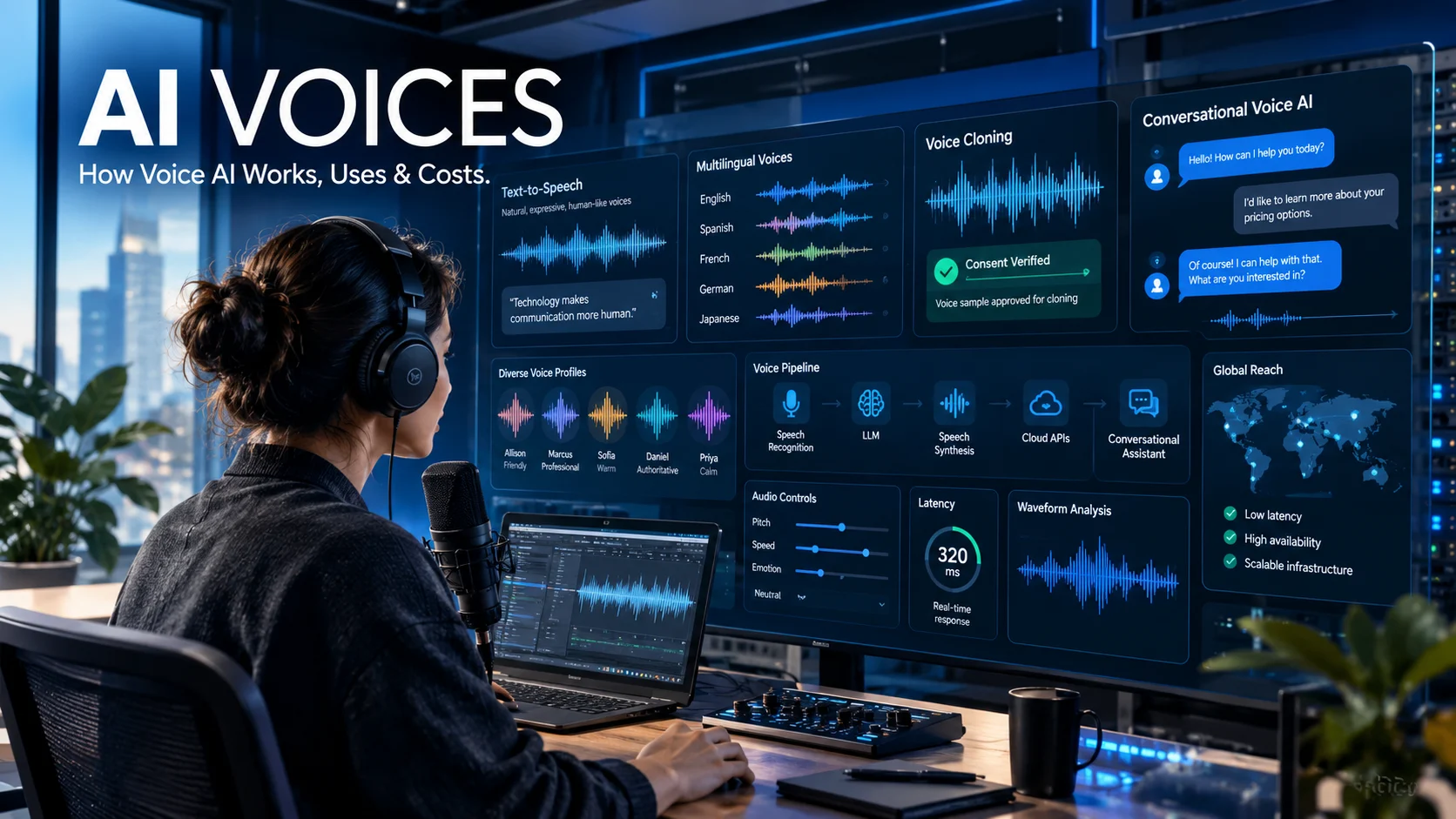
AI voices are computer-generated voices created with speech-synthesis models that turn text, instructions, or other inputs into natural-sounding spoken audio. Today, AI voices range from preset text-to-speech speakers to custom voice clones and real-time voices used in assistants, videos, games, accessibility tools, and business applications.
AI Voices at a Glance
- AI voices use speech-synthesis technology to generate spoken audio from text or other inputs.
- Modern systems can control tone, pacing, pronunciation, accent, emotion, and speaking style.
- Voice cloning can reproduce characteristics of a real speaker from recorded samples, but consent and usage rights matter.
- AI voices power audiobooks, videos, podcasts, customer service, accessibility, education, games, and AI assistants.
- Developers can access voice technology through APIs, SDKs, streaming systems, and cloud AI platforms.
- The right solution depends on quality, latency, language support, customization, licensing, privacy, and total cost, not simply how human the demo sounds.
What Are AI Voices?
AI voices are synthetic voices generated by artificial intelligence. They allow software to speak without requiring a human speaker to record every sentence.
The most common technology behind them is text-to-speech (TTS). A TTS system receives written text and generates an audio waveform that sounds like spoken language.
Older speech systems often sounded robotic because they relied heavily on concatenated recordings or relatively rigid speech rules. Modern systems use neural networks and generative models to produce much more flexible speech.
The term AI voice can describe several different technologies:
- Preset synthetic voices: Ready-made voices supplied by an AI platform.
- Voice design: A system creates a new synthetic voice based on characteristics such as age, accent, tone, or style.
- Voice cloning: AI generates speech that resembles a particular person’s voice.
- Real-time AI voices: Speech is generated dynamically during a live conversation.
- Voice conversion: One spoken voice is transformed toward another vocal identity or style.
- Multilingual voices: One voice can generate speech across multiple languages or locales.
These categories overlap, but they are not interchangeable.
A business creating an AI narrator, for example, may need only a high-quality preset voice. A virtual assistant may require low latency and real-time streaming. A media company using a synthetic version of an actor’s voice faces additional consent, licensing, and rights questions.
How AI Voice Technology Works
At a basic level, an AI voice pipeline turns language into sound.
A simplified workflow looks like this:
Text or instructions → language processing → speech representation → waveform generation → audio output
Modern systems can involve several models rather than one standalone neural network.
1. Text processing
The system first interprets the input text.
This includes handling punctuation, numbers, abbreviations, names, dates, and pronunciation.
For example, the text:
“The meeting starts at 3:30 p.m.”
must be converted into speech with the correct interpretation of “3:30 p.m.” rather than simply reading every character mechanically.
2. Prosody and speaking style
The system determines how the words should sound.
Prosody includes characteristics such as:
- Pitch
- Rhythm
- Stress
- Pauses
- Speaking rate
- Intonation
- Emotional delivery
This is one reason modern AI voices can sound significantly more natural than traditional TTS.
3. Acoustic or speech generation
The model generates a representation of the intended speech and converts it into audio.
Different systems use different architectures and representations. Some modern generative TTS models use transformer-based components, while others combine language models with specialized speech decoders.
Amazon, for example, describes its generative Polly engine as using a transformer followed by a decoder that produces speech codes and waveforms. (AWS Documentation)
4. Audio delivery
The resulting audio can be returned as a file or streamed progressively.
Streaming matters for conversational systems because users do not want to wait for an entire response to be generated before hearing the first word.
That makes latency an important technical measurement for AI voice applications.
AI Voices vs. Traditional Text-to-Speech
AI voices are part of the broader text-to-speech industry, but the terms are not identical.
Traditional TTS can produce highly reliable speech without requiring the newest generative models. Modern AI voice systems tend to focus more heavily on naturalness, contextual pronunciation, expressiveness, customization, and conversational interaction.
The distinction is useful because the most expensive or sophisticated model is not automatically the best choice for every application.
For example, a navigation system may prioritize predictable pronunciation and low cost. A premium audiobook may prioritize expressive delivery and consistency.
A customer-service agent may care more about latency, interruption handling, speech recognition, and integration with business systems.
What Makes an AI Voice Sound Realistic?
A convincing AI voice involves more than reproducing individual words.
Natural prosody
Humans vary pitch, rhythm, emphasis, and pauses constantly. High-quality AI voices attempt to reproduce these patterns.
Context-aware pronunciation
A good system should understand that the same written sequence can have different pronunciations depending on context.
Names, technical terms, abbreviations, and numbers can be particularly difficult.
Emotional expression
Some newer models can produce speech with changes in energy, emphasis, pacing, and emotional character.
However, emotional control is not identical across platforms. A feature advertised as “expressive” may provide different levels of direct control.
Consistency
For long-form content, consistency can matter as much as realism.
A voice that sounds excellent for one sentence but changes noticeably between chapters may create a poor listener experience.
Amazon specifically notes that updates to its generative models can cause slight changes in how voices sound over time, which can matter for long-running content such as podcast series. (AWS Documentation)
Voice Cloning: How It Differs From Standard AI Voices
Voice cloning attempts to reproduce characteristics of a specific speaker.
Instead of selecting a generic synthetic narrator, a user supplies voice recordings that provide information about the target speaker.
The amount and quality of required audio varies considerably by platform and cloning method.
Some systems can create a usable clone from a short sample. More advanced professional cloning workflows can use substantially more training material.
ElevenLabs, for example, distinguishes between Instant Voice Cloning and Professional Voice Cloning. Its documentation says Professional Voice Cloning uses a larger dataset and dedicated training, while Instant Voice Cloning is designed for much faster creation. (ElevenLabs)
The quality of the source recording matters. Background noise, compression, inconsistent microphone placement, and changes in speaking style can affect the resulting voice.
Why voice cloning requires extra caution
A person’s voice can be commercially valuable and personally identifiable. Unauthorized cloning can also enable impersonation and fraud.
The U.S. Federal Trade Commission has specifically identified voice cloning as a technology that can create risks involving fraud, deception, misuse of biometric information, and harm to creative professionals. (Federal Trade Commission)
Responsible platforms therefore increasingly require some form of permission or verification.
For example, Microsoft requires explicit consent from the voice talent for its personal voice workflow, including a recorded consent statement. (Microsoft Learn)
ElevenLabs also requires verification for Professional Voice Clones and states that Professional Voice Clones can only be created from the user’s own voice. (ElevenLabs)
The practical rule is simple: do not clone another person’s voice merely because you have an audio recording of it.
Main Uses of AI Voices
AI voices have moved well beyond novelty applications.
Content creation
Creators use synthetic voices for:
- YouTube narration
- Short-form videos
- Podcasts
- Audiobooks
- Explainer videos
- Training content
- Advertisements
- Social media content
The biggest advantage is production speed. A creator can revise a script without booking another recording session.
Accessibility
AI speech can make written information easier to consume for people who prefer or require audio.
Applications include:
- Screen reading
- Educational materials
- Digital documents
- Navigation
- Assistive communication
- Voice restoration
Voice technology can also be valuable for people who lose the ability to speak naturally. The FTC has identified medical assistance as one potential beneficial application of voice cloning. (Federal Trade Commission)
Customer service
Companies can combine speech synthesis with conversational AI to build voice agents.
The overall architecture may look like:
Caller → speech recognition → AI model → business tools → AI response → voice synthesis
In this setup, the AI voice is only one component.
The system may also require authentication, retrieval from a knowledge base, CRM integration, function calling, call routing, monitoring, and human escalation.
Education
AI voices can read lessons, create language-learning exercises, pronounce difficult words, and deliver interactive educational content.
Multilingual speech can also help organizations localize training material.
Gaming and virtual characters
Game developers can use synthetic speech for characters, interactive stories, prototypes, and dynamic dialogue.
This can reduce the need to pre-record every possible line, although commercial productions still need to consider performance quality, licensing, actor agreements, and consistency.
Translation and dubbing
AI voices can also be used to generate speech in another language.
This becomes more complicated when a production needs to preserve the original speaker’s vocal identity, timing, emotion, and lip synchronization.
AI Voice Platforms and Tools
The market now includes specialized voice companies, cloud providers, open-source models, and broader AI platforms.
| Platform/Tool | Target User | Key Strength | Pricing Transparency | Core Limitation |
|---|---|---|---|---|
| ElevenLabs | Creators, developers, media teams | Expressive TTS, multilingual voices, cloning and voice agents | Public plans and API pricing | Advanced capabilities vary by plan and usage |
| OpenAI TTS | Developers and AI application teams | TTS API with controllable speech characteristics | Usage-based API pricing | Built-in voices are currently optimized for English |
| Google Cloud TTS | Developers and enterprises | Cloud-scale TTS and generative voices | Public usage pricing | Cloud configuration can add complexity |
| Amazon Polly | Developers and AWS customers | Large cloud infrastructure and pay-as-you-go TTS | Public usage pricing | AWS architecture may be more than simple creators need |
| Microsoft Azure Speech | Enterprises and developers | Enterprise speech services and personal/custom voice capabilities | Usage-based pricing | Some custom voice features have eligibility and access restrictions |
| Hugging Face ecosystem | Researchers and developers | Open model ecosystem and experimentation | Varies by model and deployment | Setup, licensing, hardware, and quality vary by model |
ElevenLabs currently offers free and paid TTS plans, with higher tiers increasing credits and access to advanced capabilities. Its published pricing also distinguishes features such as Instant Voice Cloning and Professional Voice Cloning by plan. (ElevenLabs)
OpenAI’s current TTS API uses GPT-4o mini TTS and provides built-in voices plus controls for characteristics such as accent, emotional range, intonation, speaking speed, and tone. OpenAI also requires developers to disclose to end users that the generated voice is AI-generated. (OpenAI Developers)
Google Cloud lists Chirp 3: HD voices among its latest TTS offerings and publishes usage-based pricing. Its current pricing page lists $30 per one million characters for Chirp 3 HD voices after the applicable free usage allowance. (Google Cloud)
Amazon Polly currently prices generative voices at $30 per one million characters outside the applicable free tier. AWS also expanded its generative voice offering during 2026 and added bidirectional streaming support for real-time applications. (Amazon Web Services, Inc.)
Hugging Face provides access to a large and rapidly changing collection of speech models, including TTS and voice-cloning projects. Its Transformers documentation lists models such as Dia, CSM, Bark, MMS, VITS, and SpeechT5, while its model hub contains numerous newer community models. (Hugging Face)
How Much Do AI Voices Cost?
There is no single AI voice price.
Costs can be based on:
- Characters generated
- Text tokens
- Audio tokens
- Minutes of audio
- Monthly credits
- API requests
- Voice-cloning plans
- Concurrent requests
- Enterprise usage
- Infrastructure costs
For example, Amazon Polly uses character-based pricing, while OpenAI’s GPT-4o mini TTS uses token-based pricing. (Amazon Web Services, Inc.)
ElevenLabs combines subscription credits with different capabilities and published API pricing. Its 2026 pricing changes also show why older articles can quickly become inaccurate. (ElevenLabs)
For developers, the visible TTS price is only part of the bill.
A production voice application may also require:
LLM costs + speech recognition + TTS + telephony + hosting + storage + monitoring + integrations
This is particularly important for voice agents.
A cheap TTS model can still become expensive when thousands of users make long calls.
What to Evaluate Before Choosing an AI Voice
Do not choose a platform solely because its demo sounds human.
Voice quality
Listen for:
- Pronunciation
- Pauses
- Breathing artifacts
- Emotional range
- Sentence endings
- Numbers
- Proper names
- Long-form consistency
Language and accent support
Check the exact language and locale you need.
“Supports 30 languages” does not necessarily mean every language receives identical quality or features.
Latency
For prerecorded content, latency may barely matter.
For live conversations, it matters enormously.
Evaluate time to first audio, streaming behavior, interruption handling, and end-to-end response time.
Commercial rights
Check whether your subscription permits commercial use.
This is especially important for advertising, monetized videos, audiobooks, branded characters, and client work.
Voice cloning rules
Review:
- Consent requirements
- Verification
- Voice ownership
- Sharing restrictions
- Commercial licensing
- Removal procedures
- Voice marketplace rules
API and integration
Developers should examine:
- REST APIs
- SDKs
- Streaming
- WebSocket support
- Rate limits
- Authentication
- Error handling
- Webhooks
- Regional availability
Cost at scale
Test your expected workload rather than relying on a free trial.
A voice platform that is affordable for a few videos may have a very different economics profile for millions of generated characters or thousands of live calls.
Privacy and Security Considerations
Privacy is especially important when users upload voice recordings.
A voice dataset can contain personal information and may have implications beyond ordinary text data.
Before uploading sensitive recordings, examine the provider’s documentation for:
- Data retention
- Training use
- Data deletion
- Enterprise controls
- Access controls
- Encryption
- Regional processing
- Contractual commitments
- Audit and compliance documentation
Do not assume that a provider’s security certification automatically guarantees a particular data-retention policy.
SOC 2 and Zero Data Retention are different concepts. SOC 2 concerns controls examined under an assurance framework, while ZDR is a specific data-handling arrangement that must be verified in the provider’s applicable documentation or contract.
Custom voice products can also have additional restrictions. Microsoft, for example, treats personal and custom voice capabilities as controlled services with consent requirements and, in some cases, limited-access eligibility. (Microsoft Learn)
Open-Source AI Voices vs. Commercial APIs
Open-source speech models can provide more control.
Developers can potentially:
- Self-host models
- Customize inference
- Inspect model configurations
- Avoid some vendor dependencies
- Integrate models into private infrastructure
Hugging Face currently hosts a broad selection of TTS and voice-cloning models, demonstrating how quickly the open model ecosystem is developing. (Hugging Face)
But open source does not automatically mean easier, cheaper, or more private.
Self-hosting can introduce costs for:
- GPUs
- Storage
- DevOps
- Model optimization
- Monitoring
- Security
- Scaling
- Maintenance
Licensing also matters. A model being publicly available does not automatically mean its weights, training data, voice samples, or generated output can be used without restrictions.
Common AI Voice Mistakes
Choosing based only on a demo
A polished sample may not represent your actual use case.
Test your own scripts.
Ignoring pronunciation
Technical terminology, names, acronyms, and local words can expose weaknesses quickly.
Using voice cloning without clear permission
An accessible recording is not the same as authorization.
Forgetting commercial licensing
A creator plan and an enterprise production license can have very different terms.
Ignoring latency
A voice can sound excellent while still being unsuitable for real-time interaction.
Assuming all languages perform equally
Voice quality can vary substantially across languages and accents.
Looking only at TTS costs
For voice agents, the TTS bill is only one component of the complete system.
Where AI Voices Are Heading
The market is moving from simple speech generation toward interactive voice systems.
Current platforms increasingly combine:
LLMs + speech recognition + TTS + tools + memory + real-time streaming
That changes the role of the voice.
Instead of simply reading a paragraph, an AI system can listen, reason, retrieve information, call a tool, and respond conversationally.
The 2026 voice-AI market also shows increasing emphasis on real-time agents, customer support, embedded assistants, and developer infrastructure. Product Hunt’s current voice-AI categories reflect this shift toward conversational and real-time applications. (Product Hunt)
Another important direction is voice personalization.
Users increasingly expect systems to adapt speaking style, language, accent, pacing, and conversational behavior rather than simply select one static narrator.
At the same time, the industry faces a difficult trust problem.
As synthetic speech becomes more convincing, distinguishing legitimate AI-generated audio from unauthorized impersonation becomes more important. The FTC has explored prevention, authentication, and content-origin approaches, including watermarking and other technical safeguards. (Federal Trade Commission)
Who Should Use AI Voices?
AI voices can make sense for:
- Content creators who need scalable narration
- Businesses producing training or marketing material
- Developers building voice-enabled applications
- Accessibility teams creating speech interfaces
- Game studios prototyping interactive characters
- Media companies exploring dubbing and localization
- Customer-service teams building voice agents
- Researchers experimenting with speech models
They may be less suitable when a project depends heavily on the unique performance of a professional human voice actor, particularly when emotion, improvisation, legal rights, or artistic direction are central to the production.
In many professional workflows, the practical future is not necessarily human voices versus AI voices. It is a combination of human performance, synthetic speech, editing, and clear consent.
Frequently Asked Questions
What are AI voices?
AI voices are computer-generated voices created using speech-synthesis and generative AI technology. They can convert written text into spoken audio and, in some systems, reproduce or transform characteristics of a particular speaker.
Can AI voices sound like real people?
Yes. Modern systems can produce highly realistic speech, and some can create synthetic versions of a person’s voice. However, realism varies by model, language, recording quality, and use case.
Is AI voice cloning legal?
The answer depends on the jurisdiction, the speaker’s rights, the intended use, contracts, and other circumstances. Users should obtain appropriate permission and review applicable laws and platform terms before cloning or commercially using another person’s voice.
What is the difference between AI voice and text-to-speech?
Text-to-speech is the technology that converts text into spoken audio. “AI voice” is a broader term that can include TTS, voice cloning, voice design, voice conversion, and real-time conversational speech.
Which factors matter most when choosing an AI voice platform?
Start with voice quality, language support, latency, licensing, cloning permissions, privacy, API capabilities, usage limits, and total cost. For business applications, also evaluate reliability, support, integration requirements, and contractual terms.
Conclusion
AI voices have evolved from basic robotic narration into sophisticated speech-generation systems capable of expressive, multilingual, and real-time interaction.
The technology is now useful across content creation, accessibility, education, gaming, customer service, localization, and AI assistants. But choosing an AI voice platform requires more than listening to a convincing demo.
Evaluate voice quality, language coverage, latency, pricing, commercial rights, privacy, consent requirements, API limits, and long-term consistency against the actual application.
For voice cloning in particular, permission should be treated as a core requirement rather than an optional feature. As synthetic speech becomes more capable, responsible deployment will matter just as much as audio quality.

Oliver Wilson is an AI researcher and tech writer living at the intersection of human creativity and machine intelligence. At AixOrbit.com, he decodes complex neural networks, generative AI and emerging tech trends into actionable insights making sure humans stay one step ahead of the algorithms.