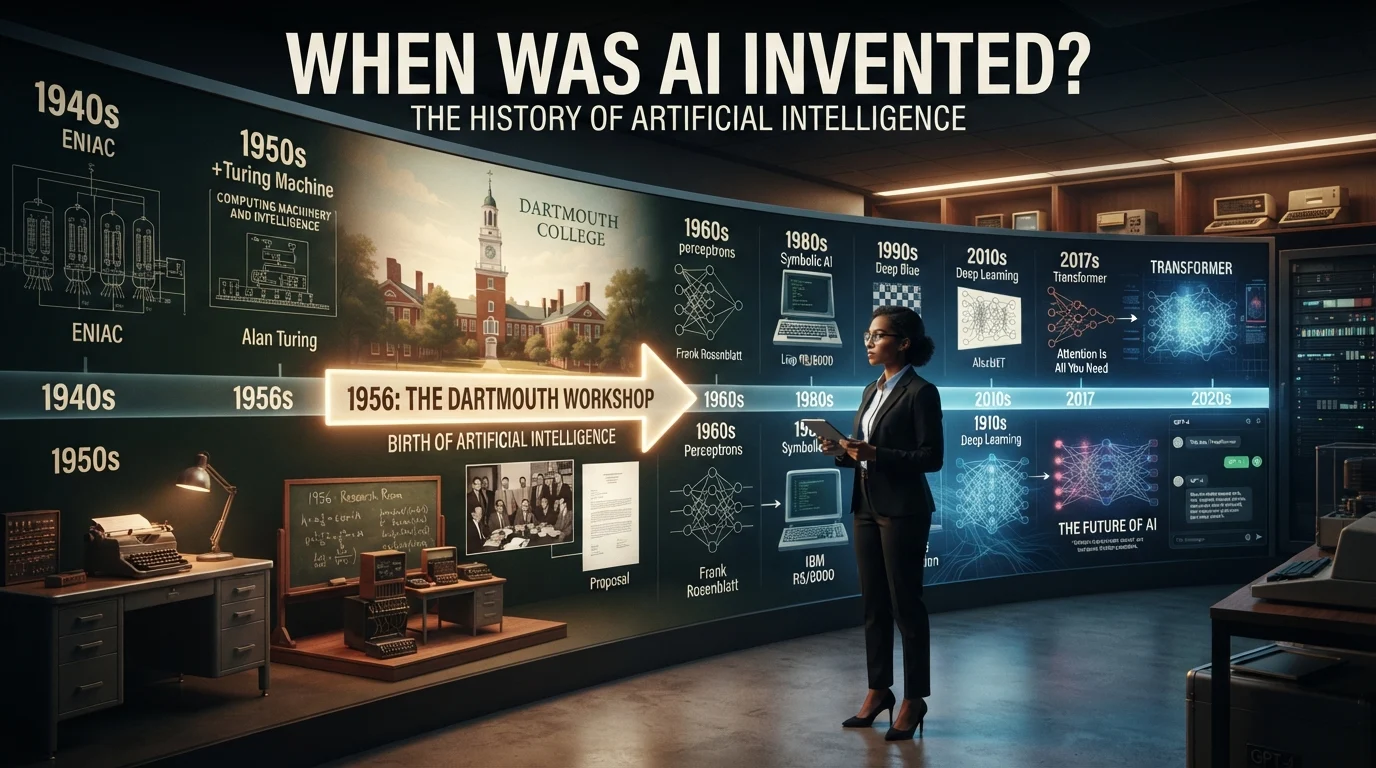
Artificial intelligence was formally established as a research field in 1956 at the Dartmouth Summer Research Project on Artificial Intelligence, although important ideas and working systems existed years earlier. The term “artificial intelligence” was coined in a 1955 proposal led by John McCarthy, while Alan Turing and other researchers had already laid important foundations for machine intelligence. (AI at Dartmouth)
At a Glance
- 1956 is generally considered the birth of AI as a formal research field.
- John McCarthy coined the term “artificial intelligence” in a 1955 Dartmouth workshop proposal.
- Alan Turing’s 1950 work helped establish the intellectual foundation for thinking about machine intelligence.
- Neural-network research had already begun by the 1940s and 1950s.
- Early AI focused heavily on logic, problem solving, symbolic reasoning, and rule-based systems.
- Modern AI grew through machine learning, deep learning, large datasets, powerful hardware, and increasingly capable neural networks.
When Was AI Invented?
The simplest answer is 1956.
That year, researchers gathered at Dartmouth College in Hanover, New Hampshire, for the Dartmouth Summer Research Project on Artificial Intelligence. The workshop is widely regarded as the point when artificial intelligence became a distinct academic research field. (Dartmouth)
However, saying “AI was invented in 1956” needs some qualification.
Researchers had already been exploring machine intelligence before Dartmouth. In 1950, British mathematician Alan Turing published Computing Machinery and Intelligence, which examined whether machines could demonstrate intelligent behavior. Earlier work on artificial neurons and computational models of the brain also appeared during the 1940s. (IBM)
So there are really three dates worth remembering:
| Year | What happened | Why it matters |
|---|---|---|
| 1943 | McCulloch and Pitts published an influential mathematical model of artificial neurons | Helped establish foundations for neural-network research |
| 1950 | Alan Turing published Computing Machinery and Intelligence | Advanced the question of machine intelligence |
| 1955 | “Artificial intelligence” appeared in the Dartmouth project proposal | Gave the emerging field its name |
| 1956 | Dartmouth workshop took place | AI became established as a formal research field |
| 2012 | AlexNet produced a major ImageNet breakthrough | Helped accelerate modern deep learning |
| 2017 | Transformer architecture was introduced | Became a foundation for modern large language models |
The most accurate short answer, therefore, is 1956 for the formal birth of AI, with important foundations going back much further. (AI100)
Who Invented Artificial Intelligence?
There is no single inventor of AI.
Artificial intelligence developed through the combined work of mathematicians, computer scientists, neuroscientists, engineers, philosophers, and researchers working across several decades.
John McCarthy is particularly important because he coined the term “artificial intelligence” in the proposal for the Dartmouth research project. The proposal was co-authored with Marvin Minsky, Nathaniel Rochester, and Claude Shannon. (Dartmouth Admissions)
The Dartmouth project was not the beginning of every idea associated with AI. Instead, it brought several existing lines of research under a new research agenda.
This distinction matters because modern AI did not suddenly appear in 1956. It evolved from earlier work in computing, mathematics, statistics, neuroscience, logic, information theory, and cognitive science.
What Happened at Dartmouth in 1956?
The Dartmouth Summer Research Project on Artificial Intelligence was organized around a bold idea: aspects of human intelligence might be described precisely enough for machines to simulate them.
John McCarthy organized the project, while Marvin Minsky, Nathaniel Rochester, and Claude Shannon were also central to the proposal. Researchers gathered during the summer of 1956 to explore machine problem solving, language, learning, abstraction, and other aspects of intelligence. (Dartmouth Admissions)
Dartmouth now describes the workshop as the birthplace of the field. Stanford’s history of AI similarly identifies the 1956 workshop as the point when AI was formally born and named. (AI at Dartmouth)
The importance of Dartmouth was therefore organizational and intellectual as much as technological.
It established artificial intelligence as a recognizable field of research.
AI Before 1956: The Forgotten Foundations
The story of AI starts before the phrase “artificial intelligence” existed.
1943: Artificial Neurons
In 1943, Warren McCulloch and Walter Pitts published a mathematical model describing how simplified artificial neurons could process information.
Their work did not create today’s neural networks. However, it provided an important theoretical foundation for later research into computational models inspired by the brain. (Stanford University)
This is one reason it can be misleading to identify 1956 as the beginning of every AI idea.
The intellectual roots of AI are older than the field itself.
1950: Alan Turing and Machine Intelligence
Alan Turing made another major contribution in 1950 with his paper Computing Machinery and Intelligence.
Rather than trying to settle the philosophical question “Can machines think?”, Turing proposed a more practical way to discuss machine intelligence. His work introduced what became known as the Turing Test, involving whether a machine could produce responses that a human evaluator could distinguish from those of another person. (IBM)
The Turing Test is not a universal definition of intelligence, and modern AI evaluation uses many other measurements. Still, Turing’s work remains a landmark in the history of artificial intelligence.
1951: Early Artificial Neural Networks
In 1951, Marvin Minsky and Dean Edmunds developed SNARC, or the Stochastic Neural Analog Reinforcement Calculator.
The machine attempted to model learning processes inspired by the brain. IBM describes it as an early artificial neural network that used vacuum tubes and neuron-like units to simulate a rat navigating a maze. (IBM)
This shows how several different approaches to AI were developing at roughly the same time.
The First AI Programs
The years immediately surrounding the Dartmouth workshop produced several influential experiments.
Allen Newell, Herbert Simon, and J.C. Shaw developed the Logic Theorist, a program designed to prove mathematical theorems. It became one of the earliest programs to demonstrate computer-based problem solving. (IBM)
Early researchers often approached intelligence through symbolic AI.
Instead of training a neural network on enormous datasets, symbolic systems represented knowledge through rules, symbols, logical statements, and explicit procedures.
For example, an early system might be designed around rules such as:
- If condition A is true, perform action B.
- If statement X implies Y, derive Y.
- Search possible solutions until a valid solution is found.
This approach produced important results but also faced serious limitations when problems became less structured.
How AI Evolved After 1956
AI history is not a straight line of constant progress. The field has gone through periods of excitement, disappointment, reduced funding, and renewed breakthroughs.
1960s and 1970s: Symbolic AI and Expert Systems
Researchers continued developing programs that could reason within limited environments.
One famous example was SHRDLU, developed by Terry Winograd around 1970. It allowed users to communicate with a computer using natural language while manipulating objects inside a controlled virtual world. (IBM)
Another influential system was MYCIN, developed at Stanford in the 1970s. It used rules to assist with medical diagnosis and antibiotic recommendations. Its historical significance comes from demonstrating how expert knowledge could be represented computationally. (IBM)
These systems were impressive within their designed environments.
However, they did not possess broad human-like understanding.
AI Winters
AI researchers also encountered periods when expectations exceeded what available technology could deliver.
These periods are commonly known as AI winters.
Funding and interest declined when systems failed to meet ambitious expectations, especially when computers lacked the processing power, data, algorithms, or flexibility required for broader applications. IBM’s historical account identifies the 1970s and 1980s as important periods in this cycle of enthusiasm and retrenchment. (IBM)
The lesson was important: impressive demonstrations in narrow environments did not automatically translate into general intelligence.
The Rise of Machine Learning
A major shift occurred as researchers increasingly focused on machine learning.
Traditional software generally requires programmers to specify rules and procedures. Machine learning instead allows systems to identify patterns from data using algorithms and statistical methods.
This changed the development process.
Rather than explicitly programming every rule, researchers could provide large amounts of data and design methods that allowed a model to learn useful patterns.
Machine learning became especially powerful when three factors began reinforcing each other:
- More data
- More computing power
- Improved algorithms
These ingredients helped move AI from primarily rule-based systems toward increasingly data-driven approaches.
Why 2012 Was a Major Turning Point
The year 2012 is another important milestone in modern AI history.
A neural network known as AlexNet, developed by researchers associated with the University of Toronto and Geoffrey Hinton, achieved a major breakthrough in the ImageNet image-recognition competition. Its error rate was substantially lower than the previous year’s leading result. (IBM)
The result demonstrated the practical power of deep neural networks when combined with large datasets and modern computing hardware.
This helped accelerate investment and research in deep learning.
Deep learning subsequently became central to advances in:
- Computer vision
- Speech recognition
- Natural language processing
- Recommendation systems
- Generative AI
- Robotics
- Autonomous systems
How Modern Generative AI Emerged
Today’s generative AI systems are built on several decades of research.
A particularly important development was the Transformer architecture, introduced in 2017 in the research paper Attention Is All You Need. Transformer-based architectures became foundational to many modern language models.
Large language models, or LLMs, learn statistical relationships within enormous collections of text and other data. During inference, they use the learned parameters to generate responses based on the input context.
Modern generative AI can produce:
- Text
- Images
- Audio
- Video
- Software code
- Structured data
This is a major difference from many early AI systems.
Early programs were often designed for a narrow task. Modern foundation models can support many tasks through a single underlying model, although their capabilities and reliability vary considerably.
AI in 2026: How Far Has It Come?
In 2026, AI is no longer confined to research laboratories.
It is used across software development, search, customer service, healthcare research, education, robotics, finance, media, scientific research, and many other fields.
The technology has also expanded beyond traditional chatbots.
AI agents are increasingly designed to perform multi-step tasks rather than simply respond to individual prompts. Dartmouth researchers describe current agentic AI systems as moving toward proactive systems capable of tasks such as writing and testing code, planning activities, and managing workflows. (Dartmouth Engineering)
At the same time, modern AI still has important limitations.
Models can produce inaccurate information, struggle with unfamiliar situations, inherit problems from training data, and require substantial computing resources.
That is why today’s AI should not be confused with a finished version of human intelligence.
Why AI Took So Long to Become Mainstream
If researchers were experimenting with AI in the 1950s, why did AI applications take so long to become widespread?
Several constraints mattered.
Limited Computing Power
Early computers were extremely expensive and had tiny amounts of memory compared with modern systems.
Large neural networks require substantial computational resources for training and deployment.
Limited Data
Many modern AI techniques depend on enormous datasets.
The internet, digital media, smartphones, cloud computing, and large-scale enterprise databases dramatically increased the amount of machine-readable information available.
Better Algorithms
Hardware alone was not enough.
Researchers developed improved optimization methods, neural-network architectures, training techniques, and ways of using large datasets.
Specialized AI Hardware
Graphics processing units and other accelerators made large-scale parallel computation much more practical.
Together, these developments created the conditions for today’s AI boom.
Was AI Invented Before Computers?
The idea of artificial intelligence is much older than electronic computers.
People have imagined artificial beings, mechanical reasoning, and intelligent machines for centuries. Mechanical calculating devices also existed long before modern computers.
But those historical inventions were not artificial intelligence in the modern scientific sense.
The important distinction is between the idea of artificial intelligence and AI as a computational research field.
The modern field required programmable computing machines capable of executing algorithms and manipulating information at useful speeds.
That is why the history of AI overlaps heavily with the history of computing.
Who Is Considered the Father of AI?
John McCarthy is frequently described as one of the founding figures of artificial intelligence because he coined the term and organized the Dartmouth project.
However, calling one person the sole “inventor” or “father” of AI oversimplifies the history.
Other foundational figures include:
- Alan Turing, for foundational work on computation and machine intelligence.
- Marvin Minsky, for early neural-network research and AI theory.
- Claude Shannon, for information theory and early machine intelligence research.
- Nathaniel Rochester, for his work in computing and the Dartmouth proposal.
- Allen Newell and Herbert Simon, for early symbolic AI and problem-solving programs.
- Arthur Samuel, for influential machine-learning research.
- Frank Rosenblatt, for the perceptron and early neural-network learning.
The field emerged from contributions by many researchers rather than from a single invention.
AI History Timeline
Here is a simplified timeline of the most important milestones:
| Year | Milestone |
|---|---|
| 1943 | McCulloch and Pitts publish a mathematical model of artificial neurons. |
| 1950 | Alan Turing publishes Computing Machinery and Intelligence. |
| 1951 | Minsky and Edmunds develop SNARC. |
| 1952 | Newell and Simon begin work associated with early AI problem-solving programs. |
| 1955 | The term “artificial intelligence” appears in the Dartmouth project proposal. |
| 1956 | Dartmouth workshop formally establishes AI as a research field. |
| 1957 | Rosenblatt develops the perceptron. |
| 1960s–70s | Symbolic AI, natural-language systems, and expert systems expand. |
| 1970s–80s | AI winters reduce enthusiasm and funding. |
| 1997 | IBM Deep Blue defeats world chess champion Garry Kasparov in a match. |
| 2012 | AlexNet demonstrates a major deep-learning breakthrough in image recognition. |
| 2017 | Transformer architecture is introduced. |
| 2020s | Generative AI and foundation models become mainstream technologies. |
| 2026 | AI research increasingly includes multimodal models, agents, robotics, and advanced foundation models. |
IBM documents Deep Blue’s 1997 victory as the first time a computer defeated a reigning world chess champion in a match under standard tournament controls. (IBM)
Why 1956 Matters More Than Any Single Earlier Date
The question “When was AI invented?” sounds like it should have one exact answer.
History is more complicated.
If you mean when researchers first considered machine intelligence, the answer reaches back before 1950.
If you mean when important computational foundations appeared, the 1940s are significant.
If you mean when the term artificial intelligence was coined, the answer is 1955.
If you mean when AI became an established academic research field, the answer is 1956.
That final distinction is why 1956 is the standard answer.
Dartmouth itself describes the 1956 project as the birth of AI as a research field, while Stanford’s AI history similarly identifies the Dartmouth workshop as the field’s formal beginning. (Dartmouth)
What Is the Difference Between Early AI and Modern AI?
Early AI and modern AI share the same broad ambition: creating systems capable of tasks associated with intelligence.
Their methods are often very different.
| Early AI | Modern AI |
|---|---|
| Hand-coded rules | Learned representations |
| Symbolic reasoning | Neural networks and statistical learning |
| Small datasets | Very large datasets |
| Narrow environments | Broader multimodal applications |
| Limited computing | Large-scale accelerator infrastructure |
| Expert systems | Foundation models and AI agents |
| Explicit knowledge | Learned patterns from training data |
This does not mean modern AI has replaced symbolic methods completely.
Researchers still use rules, search, optimization, statistics, knowledge bases, retrieval systems, and other techniques. Many production AI systems combine several approaches.
Frequently Asked Questions
When was AI officially invented?
AI is generally considered to have been established as a formal research field in 1956, when researchers gathered for the Dartmouth Summer Research Project on Artificial Intelligence. The term itself appeared in the group’s proposal in 1955. (Office of the Provost)
Who invented artificial intelligence?
No single person invented AI. John McCarthy coined the term and organized the Dartmouth project, while researchers including Alan Turing, Marvin Minsky, Claude Shannon, Allen Newell, Herbert Simon, and others made foundational contributions.
Was AI invented in 1956?
1956 is the standard date for the formal birth of AI as a research field, not the beginning of every idea or technology associated with artificial intelligence. Important work on machine intelligence, computation, and artificial neural networks existed before the Dartmouth workshop.
What did Alan Turing contribute to AI?
Alan Turing helped establish the intellectual foundation for machine intelligence. His 1950 paper Computing Machinery and Intelligence explored whether machines could exhibit intelligent behavior and introduced the idea that became known as the Turing Test. (IBM)
How did AI become modern generative AI?
Modern generative AI developed through decades of progress in machine learning, neural networks, deep learning, large-scale datasets, computing hardware, and model architectures. The 2012 AlexNet breakthrough and the 2017 Transformer architecture were important milestones on the path toward today’s foundation models. (IBM)
Conclusion
So, when was AI invented?
The most useful answer is 1956, when the Dartmouth Summer Research Project established artificial intelligence as a distinct research field. But AI’s roots extend further back, particularly through Alan Turing’s 1950 work and earlier research into artificial neurons and computation.
Understanding this timeline also explains why modern AI did not appear overnight. Today’s generative AI, large language models, multimodal systems, and AI agents are the result of decades of research, setbacks, new algorithms, expanding datasets, and rapidly increasing computing power.
The key distinction is simple: 1956 marks the formal birth of AI as a field, not the moment humans first imagined or experimented with intelligent machines.

Oliver Wilson is an AI researcher and tech writer living at the intersection of human creativity and machine intelligence. At AixOrbit.com, he decodes complex neural networks, generative AI and emerging tech trends into actionable insights making sure humans stay one step ahead of the algorithms.