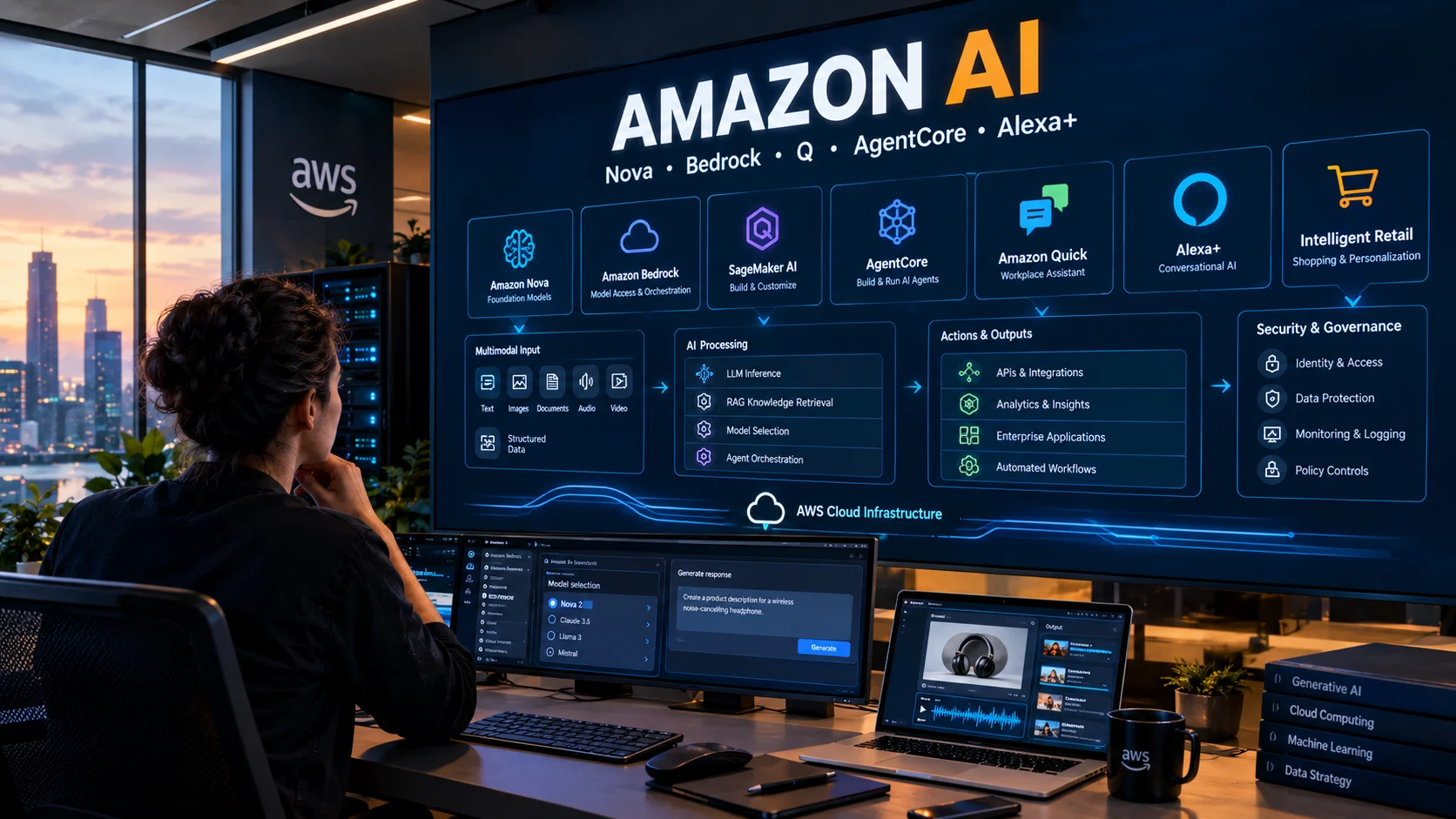
Amazon AI is a broad ecosystem of generative AI models, cloud services, assistants, and AI-powered consumer experiences developed or offered by Amazon. Its core technologies include Amazon Nova, Amazon Bedrock, Amazon Q Developer, SageMaker AI, Bedrock AgentCore, and consumer products such as Alexa+ and Alexa for Shopping.
Amazon AI at a Glance
| Key point | Current reality |
|---|---|
| What is Amazon AI? | An ecosystem rather than one standalone AI product |
| Core model family | Amazon Nova 2 |
| Main developer platform | Amazon Bedrock |
| AI agent platform | Amazon Bedrock AgentCore |
| Developer assistant | Amazon Q Developer |
| Work assistant | Amazon Quick |
| Consumer AI | Alexa+, Alexa for Shopping, AI-powered shopping features |
| Model choice | Bedrock supports 100+ foundation models, including Amazon and third-party models |
| Customization | SageMaker AI supports fine-tuning and other model-customization methods |
| Pricing model | Varies by product, model, tokens, users, infrastructure, and usage |
What Is Amazon AI?
“Amazon AI” is best understood as an umbrella term for Amazon’s artificial intelligence technologies.
Amazon has used machine learning for decades in areas such as product recommendations, search, logistics, fraud detection, advertising, and Alexa. Its newer generative AI strategy expands that foundation into large language models, multimodal models, AI agents, developer tools, enterprise assistants, and consumer experiences.
The biggest distinction is between Amazon’s own AI models and the platforms that let customers use many different models.
Amazon Nova represents the first category. Amazon Bedrock represents the second.
Amazon Bedrock currently supports more than 100 foundation models from providers including Amazon, Anthropic, DeepSeek, Moonshot AI, MiniMax, OpenAI, and xAI. (AWS Documentation)
That makes Amazon AI particularly relevant to organizations already invested in AWS infrastructure.
Amazon AI Ecosystem Explained
Amazon’s AI portfolio can look confusing because several products overlap.
The easiest way to understand it is to separate the ecosystem into five layers.
1. Amazon Nova
Amazon Nova is Amazon’s family of foundation models.
Current Nova 2 documentation describes multimodal capabilities covering text, images, video, documents, and speech. Nova 2 models can support context windows of up to 1 million tokens, depending on the model and workflow. (AWS Documentation)
Current Nova 2 offerings include:
- Nova 2 Lite for cost-conscious, high-volume workloads
- Nova 2 Sonic for real-time speech-to-speech applications
- Nova Multimodal Embeddings for semantic search and multimodal retrieval
Nova 2 Lite includes reasoning controls and built-in tools such as web grounding and code interpretation. Nova 2 Sonic focuses on conversational voice applications. (Amazon Web Services)
2. Amazon Bedrock
Amazon Bedrock is the main platform for building generative AI applications with foundation models.
Instead of training a large model from scratch, a developer can select a model through Bedrock, send requests through APIs, connect company data, add guardrails, and integrate the result into an application.
This is important because Bedrock is not limited to Amazon models.
Developers can choose among models from multiple providers and can change models without rebuilding an entire application architecture. AWS explicitly positions model flexibility as one of Bedrock’s central advantages. (Amazon Web Services)
3. Amazon SageMaker AI
SageMaker AI targets teams that need deeper control over model customization, training, evaluation, and deployment.
It supports techniques including:
- Supervised fine-tuning
- Direct Preference Optimization
- Reinforcement learning
- Reinforcement learning from AI feedback
- Reinforcement learning with verifiable rewards
- Multi-turn reinforcement learning for agents
SageMaker AI can deploy customized models to Bedrock for serverless inference or to managed SageMaker endpoints. (Amazon Web Services)
4. Amazon Q and Amazon Quick
Amazon Q has historically covered workplace and developer assistance.
However, the product landscape has changed in 2026.
Amazon Q Developer remains focused on software development, AWS operations, security, testing, modernization, and related technical tasks. Its Pro tier is currently listed at $19 per user per month, while a free tier is also available with lower limits. (Amazon Web Services)
For broader workplace assistance, Amazon is moving customers from Amazon Q Business toward Amazon Quick, which AWS describes as the next evolution of Q Business.
Amazon Q Business is no longer available to new customers according to current AWS documentation. Existing customers can continue using the service or move toward Quick’s newer agentic capabilities. (Amazon Web Services)
5. Consumer AI
Amazon’s consumer AI strategy includes Alexa+ and AI-powered shopping.
The shopping assistant formerly known as Rufus was renamed Alexa for Shopping in May 2026. Amazon says the experience uses generative and agentic AI and is built on Amazon Bedrock, with models including Amazon Nova and Anthropic Claude. (Amazon News)
Alexa+ is a separate next-generation assistant powered by generative AI.
As of September 2026, Amazon says Alexa+ is available in the United States for $19.99 per month, while Prime members receive it at no additional cost. A free tier is also available to non-Prime users for the Alexa+ chat experience. (Amazon News)
How Amazon AI Works
A typical Amazon AI application combines several components rather than relying on one model.
A simplified architecture looks like this:
User → Application → Amazon Bedrock → Foundation Model → Data/Tools → Response
For example, a customer-service application could use:
- A foundation model such as Nova.
- Amazon Bedrock for model access.
- Retrieval-augmented generation, or RAG, to retrieve company information.
- A knowledge base containing approved documents.
- Guardrails for safety and sensitive information.
- AgentCore or another orchestration layer for multi-step actions.
- CloudWatch and other AWS tools for monitoring.
RAG is particularly important because it lets an AI application retrieve relevant information from a company’s data instead of relying only on what the model learned during training. AWS describes Bedrock Knowledge Bases as a way to augment model responses with information from connected data sources. (AWS Documentation)
Key Amazon AI Features
Multimodal AI
Amazon Nova 2 can work across multiple data types.
Depending on the model, these include:
- Text
- Images
- Video
- Documents
- Speech
This allows applications to analyze mixed business information instead of treating every input as plain text. (AWS Documentation)
Long Context
Nova 2 documentation lists context support of up to 1 million tokens.
A large context window lets an application process much more information in a single interaction. This can be useful for long documents, complex research, codebases, or multi-step agent workflows. (AWS Documentation)
A larger context window does not automatically make an application accurate. Developers still need good retrieval, evaluation, prompting, and data-quality practices.
Model Choice
One of Bedrock’s major advantages is model diversity.
A company can potentially use Amazon Nova for one workload, Anthropic Claude for another, and another supported model for a specialized task.
Bedrock’s current model ecosystem includes proprietary and open-weight options from multiple providers. (AWS Documentation)
AI Agents
Amazon is increasingly moving beyond chatbots toward agents that can perform tasks.
Bedrock AgentCore provides infrastructure for building, deploying, and operating AI agents. Its capabilities include runtime, memory, identity, gateways, observability, evaluations, and policy controls. (AWS Documentation)
AgentCore’s managed harness can handle orchestration, tool execution, context management, state, and failure recovery. AWS says the harness can also switch between models without requiring the underlying agent logic to be rebuilt. (Amazon Web Services)
Automated Reasoning
Bedrock Guardrails now includes Automated Reasoning checks.
These use formal logic to validate certain model outputs against policies defined by the customer. The approach is different from simply asking another model whether an answer looks correct. (Amazon Web Services)
This can be valuable for applications where specific rules must be followed.
It does not mean every response from a generative AI system becomes mathematically guaranteed to be correct. The quality of the verification depends on the policy and the problem being checked.
Amazon AI Use Cases
Software Development
Amazon Q Developer can assist with coding, testing, troubleshooting, security scanning, application modernization, AWS resource optimization, and other software-development tasks. (Amazon Web Services)
Developers can also access multiple foundation models through Bedrock when building custom applications.
Enterprise Knowledge
Companies can connect business information to AI applications using services such as Bedrock Knowledge Bases.
This can support:
- Internal search
- Document question answering
- Employee assistance
- Customer support
- Research
- Policy lookup
- Knowledge retrieval
Permission controls remain important. An AI system should not expose documents simply because the underlying model can technically process them.
Customer Service
Nova 2 Sonic is designed for real-time conversational AI.
Its speech-to-speech architecture can support voice applications such as customer service, interactive learning, and voice assistants. AWS says the model currently supports seven languages. (Amazon Web Services)
E-Commerce
Amazon uses AI directly inside its retail ecosystem.
Alexa for Shopping can answer shopping questions, compare products, provide recommendations, track prices, and perform actions such as automatic purchasing under defined conditions. (Amazon News)
Business Automation
Agentic AI can move beyond generating text.
An agent can potentially:
- Retrieve information
- Call APIs
- Search business systems
- Analyze documents
- Trigger workflows
- Update records
- Coordinate multiple steps
The important difference is that the model becomes one component of a larger software system.
Amazon AI Pricing
There is no single Amazon AI price.
Costs depend heavily on which product you use.
Amazon Bedrock
Bedrock generally uses usage-based pricing that varies by model, token volume, service tier, and other configuration choices.
AWS’s current pricing documentation also distinguishes input, output, cache-read, and cache-write token categories for cost accounting. (AWS Documentation)
This means comparing models only by headline token prices can be misleading.
A cheaper model may require more tokens, produce more retries, or deliver lower task accuracy.
Amazon Q Developer
Amazon Q Developer currently has:
- Free tier: $0
- Pro tier: $19 per user per month
The Pro tier adds higher limits and administrative capabilities, among other features. (Amazon Web Services)
Amazon Quick
Amazon Quick now provides several plans.
Current individual and team pricing includes:
| Plan | Current listed price |
|---|---|
| Free | $0/user/month |
| Plus | $20/user/month annually or $25 monthly |
| Max | $100/user/month annually or $125 monthly |
Enterprise-oriented Professional and Enterprise plans are listed at $20 and $40 per user per month, respectively, with a $250 monthly infrastructure fee per account. (Amazon Web Services)
Quick also meters agent usage, and enterprise plans can incur additional charges for certain usage and storage. (Amazon Web Services)
Alexa+
Alexa+ is currently listed at $19.99 per month in the United States for customers without Prime. Amazon says it is included with Prime at no additional cost. (Amazon News)
Availability and pricing vary by country.
Privacy and Security
Privacy is one of the areas where Amazon AI requires careful terminology.
Amazon says Bedrock does not share customer inputs and outputs with model providers or use them to train foundation models. AWS also provides encryption, IAM controls, PrivateLink connectivity, CloudTrail, Guardrails, and other security features. (Amazon Web Services)
However, security controls, data handling, and zero data retention are not the same thing.
AWS documents separate data-protection and retention considerations, and organizations remain responsible for configuring their AWS environment appropriately. (AWS Documentation)
For Amazon’s own foundation models, AWS states that customer prompts and outputs are not used to train the underlying Amazon foundation models unless the customer consents. (Amazon Web Services)
Organizations should therefore review the exact service, model provider, region, logging configuration, retention settings, and contractual terms before processing sensitive information.
Amazon AI vs Competitors
Amazon is competing across several layers, so there is no single competitor.
| Platform/Tool | Target User | Key Strength | Pricing Transparency | Core Limitation |
|---|---|---|---|---|
| Amazon Bedrock | Enterprises and developers | Multi-model AWS platform | High, but model-dependent | AWS architecture can be complex |
| Google Vertex AI | Developers and ML teams | Google models plus broad Model Garden | High, usage-based | Broad platform creates learning complexity |
| Microsoft Foundry | Enterprise AI teams | Large model catalog and Azure integration | High, but agreement-dependent | Azure ecosystem can be complex |
| OpenAI on AWS | Enterprises wanting OpenAI models in AWS | OpenAI models within AWS workflows | Model-dependent | Availability and model terms vary |
| Hugging Face ecosystem | Developers and researchers | Open models and customization flexibility | Varies by model and deployment | More responsibility for model and infrastructure choices |
Google Vertex AI supports a broad Model Garden that includes Google and third-party models, while Microsoft Foundry advertises more than 11,000 models across its ecosystem. (Google Cloud Documentation)
OpenAI models are also now available on AWS, giving AWS customers another route to frontier models without necessarily leaving their existing cloud environment. (OpenAI)
The practical difference is therefore less about choosing a single “Amazon model” and more about choosing the model, infrastructure, governance, and application architecture that fit a particular workload.
Amazon AI Limitations
Amazon AI has several important limitations.
Ecosystem Complexity
Amazon has many overlapping AI services.
A newcomer may need to understand the difference between:
- Bedrock
- Nova
- SageMaker AI
- Q Developer
- Quick
- AgentCore
- Knowledge Bases
- Guardrails
- AWS AI infrastructure
That flexibility benefits experienced AWS teams but can increase the learning curve.
Pricing Complexity
Usage-based cloud AI can become difficult to forecast.
Costs may involve:
- Input tokens
- Output tokens
- Cached tokens
- Model selection
- Agent runtime
- Storage
- Data retrieval
- Search
- Training
- Dedicated infrastructure
- Enterprise subscriptions
AWS itself provides cost-reconciliation guidance because different token categories can affect billing. (AWS Documentation)
Model Switching Is Not Completely Frictionless
Bedrock makes model switching easier, but it does not make models identical.
Different models can vary in:
- Prompt behavior
- Tool calling
- Context handling
- Output formatting
- Safety behavior
- Latency
- Cost
- Multimodal support
A production application should therefore test alternative models rather than assuming API compatibility equals behavioral compatibility.
Agent Risk
Agents introduce a different risk profile from chatbots.
An inaccurate chatbot might produce a bad answer.
An agent can potentially take an incorrect action.
That makes permissions, identity, tool restrictions, monitoring, evaluations, and human approval especially important.
AWS has been expanding AgentCore governance features, including policy controls, evaluations, observability, and security integrations. (Amazon Web Services)
Who Should Use Amazon AI?
Amazon AI is particularly relevant to:
- AWS developers building production AI applications
- Enterprises with existing AWS infrastructure
- ML teams customizing foundation models
- Developers who want multiple model providers through one cloud platform
- Businesses building AI agents
- Software teams using AI-assisted development
- Retail businesses interested in conversational shopping
- Organizations that need cloud governance and access controls
It may be less attractive for someone who simply wants a standalone chatbot and does not need AWS infrastructure or enterprise integrations.
Latest Amazon AI Developments in 2026
The most significant change is Amazon’s movement toward agentic AI.
AWS is increasingly treating models as components inside larger systems that can retrieve information, call tools, execute workflows, maintain context, and operate with governance controls.
AgentCore has received several major additions during 2026, including a managed agent harness, automated evaluations, policy controls, and payment capabilities for agents interacting with paid APIs and services. (Amazon Web Services)
Amazon has also expanded Nova 2.
Nova 2 Lite focuses on cost-efficient reasoning, Nova 2 Sonic targets conversational voice applications, and Nova Multimodal Embeddings supports cross-modal retrieval across text, images, documents, video, and audio. (Amazon Web Services)
On the consumer side, Alexa+ has expanded internationally and across devices, while Alexa for Shopping brings more agentic shopping capabilities into Amazon’s retail ecosystem. (Amazon News)
Another important development is the emergence of Amazon Quick as the successor to Q Business for broader workplace AI. (Amazon Web Services)
Common Amazon AI Mistakes to Avoid
Assuming Amazon AI Means One Model
It does not.
Amazon AI refers to a broad collection of models, services, assistants, infrastructure, and applications.
Comparing Only Model Quality
A model benchmark does not tell you whether an AI application will succeed in production.
You should also measure:
- Task accuracy
- Latency
- Cost
- Tool reliability
- Security
- Data quality
- Failure recovery
- Human review requirements
Ignoring AWS Architecture
Bedrock may simplify model access, but production applications still require thoughtful architecture.
IAM, networking, logging, data sources, permissions, monitoring, and cost controls remain important.
Treating AI Agents Like Ordinary Chatbots
Agents can perform actions.
That means organizations should establish explicit boundaries around what an agent can read, modify, purchase, send, or execute.
Frequently Asked Questions
What is Amazon AI?
Amazon AI is a broad ecosystem of artificial intelligence technologies from Amazon, including Amazon Nova foundation models, Amazon Bedrock, SageMaker AI, Amazon Q Developer, Bedrock AgentCore, Alexa+, and AI-powered shopping experiences.
Is Amazon AI the same as Amazon Bedrock?
No. Amazon Bedrock is an AWS platform for building generative AI applications with foundation models, while Amazon AI refers more broadly to Amazon’s models, services, assistants, infrastructure, and AI-powered products.
How much does Amazon AI cost?
There is no single Amazon AI price. Costs depend on the product, model, token usage, subscriptions, infrastructure, storage, and other services involved; for example, Amazon Q Developer Pro is currently $19 per user per month, while Amazon Quick has several subscription tiers.
What is Amazon Nova?
Amazon Nova is Amazon’s family of foundation models. The current Nova 2 family includes models for reasoning, speech, and multimodal embeddings, with applications ranging from chatbots and document processing to voice assistants and semantic search.
Is Amazon AI suitable for businesses?
Amazon AI can be suitable for businesses that need generative AI, model choice, enterprise integrations, AI agents, model customization, or AWS-based deployment. The appropriate service depends on the workload, data requirements, governance needs, budget, and technical environment.
Conclusion
Amazon AI is no longer a single feature or model. It is a large ecosystem covering foundation models, cloud AI infrastructure, enterprise assistants, developer tools, AI agents, and consumer experiences.
For developers, Amazon Nova and Bedrock form the core of the generative AI stack. SageMaker AI adds deeper customization, while AgentCore addresses the operational challenges of production AI agents. Amazon Q Developer remains focused on software development, and Amazon Quick is becoming the broader workplace AI experience.
The most important evaluation criteria are not simply model intelligence or feature count. Organizations should examine cost, latency, data handling, model choice, integration requirements, governance, agent permissions, and measurable task performance before committing to an Amazon AI architecture.

Oliver Wilson is an AI researcher and tech writer living at the intersection of human creativity and machine intelligence. At AixOrbit.com, he decodes complex neural networks, generative AI and emerging tech trends into actionable insights making sure humans stay one step ahead of the algorithms.