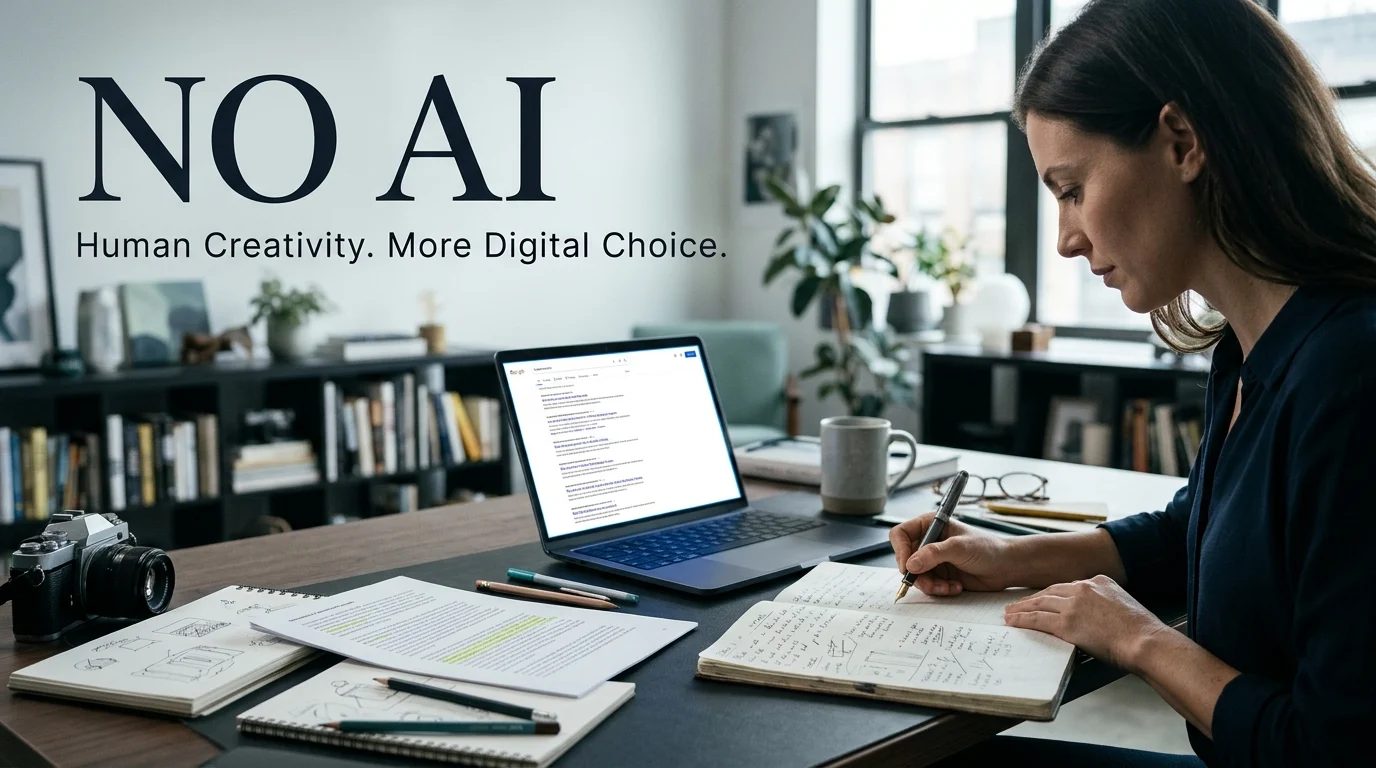
No AI refers to choosing to avoid artificial intelligence in a particular activity, product, or online experience, rather than relying on AI-generated content or automated decisions. Depending on the context, it can mean disabling AI features, using an AI-free search option, finding human-created work, or following a commitment to keep certain tasks entirely human-led.
No AI at a Glance
Meaning
A preference for avoiding AI in a specific tool, workflow, or type of content.
AI-free search
DuckDuckGo offers a dedicated search experience that turns off its AI features and filters AI-generated images by default.
Human-made content
Creators can choose to produce writing, art, photography, and other work without generative AI.
AI controls
Some products let users disable optional AI features instead of avoiding the entire product.
Privacy consideration
Turning off AI does not automatically disable tracking, cloud storage, or other data processing.
Who it suits
People who value human creativity, direct human service, fewer AI-generated search results, or greater control over technology.
What Does No AI Mean?
The term No AI has several meanings, depending on where you encounter it. It can describe a personal preference, a software setting, a search service, or a broader movement promoting human-made work.
For example, someone searching for “no ai” might want to remove AI-generated summaries from search results. Another person might be looking for an AI-free writing tool, a way to identify human-created artwork, or a company that promises human customer support.
These are related goals, but they are not identical. A website that disables AI summaries does not necessarily block AI-generated content, and a product that avoids generative AI may still use traditional machine-learning systems.
Four common meanings of No AI
- AI-free browsing: Using search or browsing options that disable selected AI features.
- AI-free content: Seeking work created without generative AI.
- AI-free software: Choosing products that omit AI functionality or allow optional AI features to be switched off.
- Human-first services: Preferring people to handle tasks such as customer support, creative work, teaching, or professional advice.
The first step is to identify which meaning matters to you. That makes it easier to find the right tool or policy without assuming every “No AI” label means the same thing.
How to Browse the Internet Without AI
You do not need to abandon search engines or modern websites to reduce your exposure to AI features. Several practical options let you choose a more traditional search experience.
1. Use DuckDuckGo’s AI-free search
DuckDuckGo provides a dedicated AI-free search experience at noai.duckduckgo.com.
According to DuckDuckGo’s documentation, this version turns off Search Assist and Duck.ai, and filters AI-generated images from results by default. It otherwise works like DuckDuckGo’s regular search experience.
This option is useful if you want to search the web without DuckDuckGo’s built-in AI answers. However, it does not guarantee that every webpage in the results was written by a human.
2. Turn off optional AI features
Some search engines, browsers, office applications, and productivity tools offer settings that control their AI features.
Look for options related to AI assistance, generated summaries, chat assistants, or AI recommendations. The exact controls vary by product and may change after software updates.
If a feature cannot be disabled, consider using a different service for that task.
3. Prefer original sources
Traditional search results can help you reach primary sources, including research papers, official documentation, government websites, and original reporting.
Opening these sources gives you more context than relying on a generated summary alone. It also helps you distinguish the source’s actual findings from an automated interpretation.
4. Reduce AI-generated images in search
AI-generated pictures can make it harder to find original photography or artwork. DuckDuckGo’s dedicated AI-free search filters AI-generated images by default, although no filter can guarantee perfect classification.
For important research, check the original image page, photographer credits, publication details, and available provenance information.
No AI Tools and Platforms Worth Knowing
There is no single universal No AI application that removes artificial intelligence from the entire internet. Instead, different tools address different needs.
Provides a dedicated search address with selected AI features disabled and AI-generated images filtered by default. It cannot guarantee that every result is human-created.
Offers a free No AI Declaration and a paid No AI Certification with a verification process. Its stated mission is to make commitments to AI-free work more visible. These are the initiative’s own programs, not universal industry standards.
The AI-Free initiative publishes a code of conduct defining AI-free work in relation to generative AI. Its rules explain which uses are prohibited and what its label represents. Read the policy before relying on the label.
How do you choose the right No AI tool?
| Your goal | Practical starting point | Main limitation |
|---|---|---|
| Avoid built-in AI search answers | DuckDuckGo AI-free search | Does not eliminate AI-generated content across the web |
| Find human-created artwork or writing | Look for clear authorship and process disclosures | Labels and claims may be difficult to verify |
| Choose software without generative AI | Review the product’s feature and privacy documentation | Traditional machine learning may still be present |
| Support human customer service | Check the provider’s published support policy | Human availability may vary by channel and time |
| Support AI-free creative work | Review the creator’s process or relevant code of conduct | A label is only as reliable as its verification process |
The best choice depends on what you want to avoid. A search filter, an AI-free creative label, and software with no AI features solve different problems.
Why Are People Choosing No AI?
People choose AI-free options for different reasons. Some want more control over technology, while others want to protect creative work, preserve human interaction, or avoid automated answers.
1. Protecting human creativity
Writers, illustrators, photographers, musicians, and designers may prefer work created through their own skills and experience.
Human-made work can reflect personal history, cultural knowledge, physical craftsmanship, and creative decisions that matter to its audience. Choosing AI-free work can also help consumers support creators whose process they value.
However, human-made does not automatically mean original, accurate, or high quality. The creator’s skills and the quality of the finished work still matter.
2. Preserving jobs and professional skills
Some workers worry that excessive automation could reduce demand for certain roles or weaken opportunities to develop professional skills.
Choosing human-led services can support employment and preserve direct professional involvement. The effect depends on the industry, business model, and type of work being automated.
A practical approach is to identify tasks where human judgment, accountability, or personal interaction provides meaningful value.
3. Improving transparency
People should be able to understand whether they are interacting with a person or an automated system when that distinction matters.
Clear disclosures can help customers make informed choices about creative services, customer support, and professional advice. Organizations can publish straightforward policies explaining where they use AI and where they rely entirely on human work.
4. Reducing dependence on automated answers
AI-generated summaries can be convenient, but they may omit context or misrepresent a source.
People who prefer traditional research may want to read original reporting, examine research papers, and compare multiple independent sources. This approach takes more time but gives readers greater control over how they interpret evidence.
5. Having more control over data
Some people avoid AI features because they do not want their prompts, documents, or conversations processed by AI systems.
This is a reasonable preference, but No AI does not automatically mean private or anonymous. A service without generative AI might still collect analytics, store account information, synchronize files, or share data with service providers.
Review the privacy policy and settings separately from the AI policy.
Is No AI Software More Private or Secure?
Not necessarily. AI use and data privacy are separate issues, and a product’s marketing language may not explain the difference.
A conventional application can process personal information without using generative AI. Similarly, an AI-enabled application may offer privacy controls that suit certain users or organizations.
Before choosing an AI-free service, check these details:
- Data collection: What information does the service collect?
- Cloud processing: Does it upload files, searches, or usage data to remote servers?
- Analytics and tracking: Does it use cookies, telemetry, or third-party analytics?
- Retention: How long does it keep records, and can you delete them?
- Third-party sharing: Does it disclose information to advertising or service partners?
- Local processing: Does the application work offline, or does it require an internet connection?
Do not assume that a tool is secure simply because it does not use a large language model. Security also depends on software maintenance, permissions, encryption, authentication, and how the service handles vulnerabilities.
How to Identify Human-Made Content
One of the biggest challenges associated with the No AI movement is verifying how a piece of content was created.
An article may look natural but have been generated by AI. An image may resemble a photograph while containing synthetic elements. Conversely, human-created work can look polished, repetitive, or technically imperfect.
No single visual or textual clue proves authorship.
Look for evidence of the creative process
When the distinction matters, look for several kinds of evidence:
- Creator information: Is the author or artist identifiable, with a credible history of work?
- Process documentation: Does the creator explain how the work was produced?
- Original materials: Are there sketches, drafts, source files, notes, or photographs that support the claim?
- Consistent disclosures: Does the creator explain whether AI was used for brainstorming, editing, generation, or final production?
- Independent verification: Is there a credible review process or documented standard behind the label?
These signals can increase confidence, but they do not always establish certainty.
Can AI detectors prove that content was generated by AI?
No. AI-content detectors estimate whether text or other material resembles patterns associated with generated content. They can produce false positives and false negatives.
A detector’s score is not proof of authorship. It should not be the sole basis for accusing someone of using AI, rejecting academic work, or denying payment to a creator.
When verification matters, use documented workflows, source files, drafts, and clear disclosure policies rather than relying on a single detection result.
No AI vs. AI-Powered Tools
The choice between AI-free and AI-powered tools is not always an all-or-nothing decision. Many people prefer to use AI for selected tasks while keeping creative, sensitive, or consequential work human-led.
| Consideration | No AI approach | AI-powered approach |
|---|---|---|
| Creative process | Relies on human creation within the declared scope | May generate or transform content using AI |
| Research | Manual search and source evaluation | May include generated summaries or AI-assisted research |
| Productivity | Depends on traditional tools and human effort | Can automate some repetitive tasks |
| Privacy | Depends on the specific service and its data practices | Depends on the specific AI system and its data practices |
| Accountability | Human responsibility remains central | Human oversight is still important, especially for consequential decisions |
| Cost | May involve more time or specialized human labor | May reduce some manual work but introduce subscription or usage costs |
Neither approach guarantees quality or responsible behavior. The important questions are what the technology does, how it handles information, and whether its use aligns with your needs.
A balanced approach: selective AI use
You can reduce AI use without giving up every modern convenience.
For example, a writer might research through original sources and write the article independently, while using ordinary spell-checking software. A business might automate routine scheduling but keep hiring decisions and sensitive customer conversations under human control.
The boundary should be explicit. If your goal is strictly AI-free work, even AI-assisted rewriting or generation may violate your chosen standard. If your goal is simply to avoid generative AI, some conventional automated functions may remain acceptable.
What Does the No AI Movement Mean?
The No AI Movement is an initiative that promotes transparency around AI-free work and human-centered services.
Its website describes two main programs:
- No AI Declaration: A free declaration that lets individuals or organizations state that a specified area of their work is AI-free.
- No AI Certification: A paid certificate that involves a verification or audit process under the initiative’s own framework.
Human to Human, AI-free certification+2
The initiative covers areas including creative work, media, education, customer communication, professional opinions, and software.
Its stated position is not that all AI must be rejected. Instead, it aims to make human involvement and the use or non-use of AI more transparent.
What should you know before trusting an AI-free certification?
A certification should be evaluated against its published criteria, not just its name or visual badge.
Check who issues it, what activities it covers, how the verification process works, whether AI-assisted editing is allowed, and how complaints or violations are handled.
A private certification can provide useful information about a declared process, but it is not automatically a government approval or a universal guarantee. Its value depends on the scope and credibility of its verification.
Common Mistakes When Choosing No AI
Avoid these misunderstandings when evaluating AI-free tools and services.
- Assuming no AI means no data collection: Review privacy and tracking policies separately.
- Treating every AI feature as generative AI: Traditional machine learning, recommendation systems, and image recognition may also use AI.
- Trusting a label without checking its scope: Find out whether it covers the entire product or only a specific activity.
- Relying entirely on AI detectors: Detection scores cannot reliably prove authorship.
- Confusing AI-free with human-made: A product can avoid generative AI without being entirely handcrafted or human-produced.
- Expecting search filters to remove every AI-generated result: Filters can miss content, and some pages combine human and AI work.
- Assuming certification guarantees quality: AI-free production does not automatically establish accuracy, originality, or professional competence.
The most reliable approach is to define what you want to avoid and verify the relevant product or creator’s claims.
Frequently Asked Questions About No AI
1. What does No AI mean?
No AI means choosing to avoid artificial intelligence in a particular activity, product, or workflow. It can refer to AI-free search, human-created content, software without AI features, or services that prioritize direct human involvement.
2. How can I search the internet without AI?
You can use DuckDuckGo’s dedicated AI-free search at https://noai.duckduckgo.com/. It disables selected DuckDuckGo AI features and filters AI-generated images by default, but it cannot guarantee that every webpage in the results was created by a human.
3. Is AI-free software more secure?
Not automatically. Security depends on factors such as encryption, authentication, software maintenance, permissions, and data handling. A product without generative AI may still collect usage information or store personal data online.
4. Can AI detectors reliably identify AI-generated content?
No detector can prove authorship with complete reliability. Detection tools can make mistakes, so their scores should not be treated as conclusive evidence. When authorship matters, review drafts, source materials, process documentation, and creator disclosures.
5. What is the No AI Movement?
The No AI Movement is an initiative that promotes transparency about AI-free work and human-centered services. It offers a free No AI Declaration and a paid No AI Certification with a verification process under its own framework.
Conclusion
No AI is a broad term for choosing less artificial intelligence in search, software, creative work, or professional services. The right approach depends on whether you want to avoid generated answers, support human-made content, reduce automation, or gain more control over your data.
Start by identifying the AI features you want to avoid. Then review product settings, privacy policies, authorship disclosures, and certification criteria before making a decision. The goal is not simply to reject technology, but to make informed choices about where human judgment and creativity matter most.

Oliver Wilson is an AI researcher and tech writer living at the intersection of human creativity and machine intelligence. At AixOrbit.com, he decodes complex neural networks, generative AI and emerging tech trends into actionable insights making sure humans stay one step ahead of the algorithms.